Chapter 5
Financial Bomb
Chen Mo waited until the fourth day in the warehouse before the call he’d been expecting finally came.
At three-thirty in the afternoon, his phone buzzed. The caller ID read Old Zhou. He walked to the corner of the warehouse, making sure Uncle Liu wasn’t nearby, before answering.
“Supai Human Resources has been holding wages for two weeks,” Old Zhou said, his voice flat as a weather report over the line. “Last month’s temp worker salaries still haven’t been paid.”
Chen Mo leaned against a shelf, the corner of his mouth lifting slightly. “You sure?”
“Positive.” Old Zhou said. “I know an accountant at Supai. We grabbed late-night snacks yesterday and she was complaining about it. The company’s cash flow is jammed up. The boss, Qian Dafu, has been scrambling to borrow money all week.”
“How big is the shortfall?”
“Word is it’s tied to a big order that went bad on receivables,” Old Zhou said. “The client defaulted. Qian Dafu’s stuck holding the bag.”
Chen Mo didn’t speak right away. He ran the timeline in his head—temp worker wages were usually paid on the fifth of each month. Today was the nineteenth. That was two full weeks late. According to Article 22 of the Labor Standards Act, if a staffing agency owes wages and doesn’t pay even after the labor bureau fines them or gives them a deadline to fix it, the hiring company becomes jointly liable.
Which meant Mingyang Technology would have to front the money for Supai.
“Should I have the temp workers file complaints?” Old Zhou asked.
“Not yet,” Chen Mo said. “If they go straight to the labor bureau, Li Zonghan will know someone’s gunning for him. He’ll bury it.”
“Then what’s your plan?”
Chen Mo looked out the window. Two pigeons were perched on the roof of the employee cafeteria, pecking at breadcrumbs someone had scattered. He spoke, his voice steady: “First, have the temp workers push for payment internally with Supai. Once they can’t get anywhere, they’ll go to the labor bureau on their own. By then, no one can sweep it under the rug.”
“You want them to self-detonate?”
“Exactly,” Chen Mo said. “Bringing in Supai was Li Zonghan’s idea. The wage arrears are his mess. If the temp workers file complaints themselves, it becomes a company-level issue—the GM will investigate, HR will dig in, and Li Zonghan won’t be able to hide it.”
“You’ve thought this through,” Old Zhou said, a note of appreciation in his voice. “I’ll have my accountant friend ‘accidentally’ leak Supai’s financial situation into the temp workers’ group chat.”
“Good,” Chen Mo said. “Sooner the better.”
After hanging up, Chen Mo walked back to the pile of documents and continued sorting expired invoices. His movements didn’t speed up. His expression didn’t change. But his mind was racing. The wage arrears at Supai were a natural bomb. All he had to do was light the fuse, and the chain reaction would take care of itself.
The trick was making sure no one saw him holding the match.
At six in the evening, Chen Mo left the warehouse and headed back to the office. Almost everyone in the support group had already gone home, except Xiao Lin, whose desk light was still on. She was packing up her things and looked up when Chen Mo walked in, startled. “You’re back early today.”
“The lock on the warehouse door broke. Uncle Liu said it won’t be fixed until tomorrow.” Chen Mo made up the excuse on the spot, walked to his desk, and opened the drawer. The toolbox was still there, along with the envelope containing the forged document copies, tucked at the very bottom.
He didn’t take them out. He just checked their position and locked the drawer again.
“Sister Lin,” he said, turning to her, “do you know any of the temp workers in the support group?”
Xiao Lin nodded. “A few. Why?”
“Did they get paid this month?”
Her expression flickered. “How did you know they didn’t?”
“Just a guess,” Chen Mo said. “I heard Supai Human Resources is having cash-flow problems. Figured they might be holding back wages.”
Xiao Lin lowered her voice. “You guessed right. Yesterday at lunch, I overheard some temp workers at the next table complaining. Said last month’s pay still hasn’t come through. They’ve asked several times, but Supai keeps saying ‘we’ll handle it next week.’ Next week comes, and nothing.”
Chen Mo’s face stayed neutral, but inside he was satisfied. The ember was already spreading among the temp workers. One more nudge and the whole powder keg would go up.
“Do you think they’ll file complaints?” Chen Mo asked.
“I don’t know,” Xiao Lin said. “Some people say they’ll go to the labor bureau, but others are scared of retaliation.”
“If they need help, let them know that path is open,” Chen Mo said, his tone calm. “You don’t have to say I told you.”
Xiao Lin looked at him, a hint of confusion in her eyes. “Why are you helping them?”
Chen Mo smiled. “Because people should get the money they’re owed.”
Xiao Lin didn’t press further. She looked down and continued packing. Chen Mo turned and walked out of the office. As he passed Li Zonghan’s office, he caught a glimpse through the blinds: Li Zonghan was sitting at his desk, staring blankly at his computer screen. The monitor’s glow lit his face, and he looked tired.
Chen Mo didn’t stop.
That night, Chen Mo went home and opened his laptop. Old Zhou had moved fast—he’d already posted an anonymous message in the temp workers’ Line group: “Supai Human Resources is in financial trouble. Word is they haven’t paid wages for two months. Everyone should file a complaint ASAP, or the longer you wait, the harder it’ll be to get your money.”
There were already over fifty replies below the message, mostly panicked and angry emoji.
Chen Mo closed Line and opened the electronic version of the Labor Standards Act. He found Article 22-1 and double-checked the procedure:
- Temp workers file a wage-arrears complaint with the labor bureau.
- The labor bureau investigates, confirms the violation, and either fines the company or orders them to fix it.
- If the staffing agency doesn’t pay by the deadline, the hiring company becomes jointly liable.
- After the hiring company fronts the money, they can seek reimbursement from the staffing agency.
The whole process would take about one to two weeks. Which meant if the temp workers filed complaints within that window, Mingyang Technology would get dragged in.
And Li Zonghan would be the one held accountable.
The next morning, when Chen Mo arrived at the office, he could tell something was off in the support group. A few temp workers were huddled together, talking in low voices, their faces grim. Xiao Lin stood nearby and gave him a subtle nod when she saw him.
He walked over. She whispered, “Someone went to the labor bureau this morning.”
“Who?”
“The temp worker under Section Chief Zhang Wenxiang—Little Liu,” Xiao Lin said. “He said he couldn’t take it anymore. He took the morning off and filed a complaint directly.”
Chen Mo’s heart didn’t race, but a thought flashed through his mind: Too fast. He’d expected the temp workers to push internally for a few more days before going to the labor bureau. But this was fine—earlier meant quicker action, which only tightened his timeline.
“What about the others?” Chen Mo asked.
“They’re still waiting to see what happens,” Xiao Lin said. “But now that Little Liu’s gone, the rest will probably follow.”
Chen Mo nodded without a word. He walked to his desk and opened his computer. A new email sat in his inbox. The sender was HR. The subject line read: “Notification: Temp Worker Wage Arrears Complaint.” He clicked it open. The message was short: HR had received a notice from the labor bureau. An emergency meeting would be held this afternoon. All relevant managers were required to attend.
The recipients included: Li Zonghan, the production department manager, the HR manager, and the finance manager.
Chen Mo closed the email and leaned back in his chair. The fuse had been lit.
At two in the afternoon, the emergency meeting was held in the second-floor conference room. Chen Mo, of course, wasn’t on the invite list. But Xiao Lin had a friend in HR who got her the meeting summary. Half an hour after the meeting ended, she sent Chen Mo a message: “Assistant Manager Li got chewed out by the GM.”
Chen Mo replied with a question mark.
“The GM said bringing in Supai was his decision. Now Supai’s defaulting on wages, and the company has to cover it. That money comes out of the production department’s budget. And the GM gave him three days to come up with a solution, or he’ll be held accountable for his decision-making.”
Chen Mo stared at his phone screen, a faint smile tugging at his lips. This was exactly what he wanted. The top brass was furious. Li Zonghan was pinned on the front line, forced to solve the problem in a hurry. The only way to fix it was to pay the temp workers’ wages out of his own pocket—but that was impossible. His personal finances couldn’t cover two months of wages for a dozen temp workers.
Or he could pressure Qian Dafu—but Qian Dafu was drowning himself.
Li Zonghan had only one option left: hand over his budget-approval authority and let the company handle the temp wage issue directly.
But giving up that authority would be an admission that bringing in Supai was a mistake—a serious one.
Chen Mo put his phone away, stood up, and walked to the window. Outside, the two pigeons were still on the cafeteria roof. He watched them, his mind already on the next step.
Now it was time to go for the safe.
At five-thirty in the evening, Chen Mo waited until almost everyone in the office had left, then walked toward Li Zonghan’s office. He’d checked earlier—Li Zonghan had left the company at four, saying he had a meeting with Qian Dafu. The door was locked. But during his time in the warehouse, Chen Mo had noticed that Uncle Liu had a master key set—standard equipment for a warehouse manager, used to open all kinds of old file cabinets and locks.
He hadn’t stolen the keys. Instead, at lunchtime, he’d borrowed them from Uncle Liu, saying he needed to open a locked file cabinet. Uncle Liu hadn’t asked questions and handed them over. Before returning the keys, Chen Mo made an impression in clay.
After work, he went to a locksmith near his place and had a duplicate made.
Now that duplicate was in his pocket.
Chen Mo stood in front of Li Zonghan’s office. He glanced left and right. The hallway was empty, and he’d already adjusted the angle of the surveillance camera. He pulled out the key, inserted it into the lock, and turned it gently.
A soft click. The door opened.
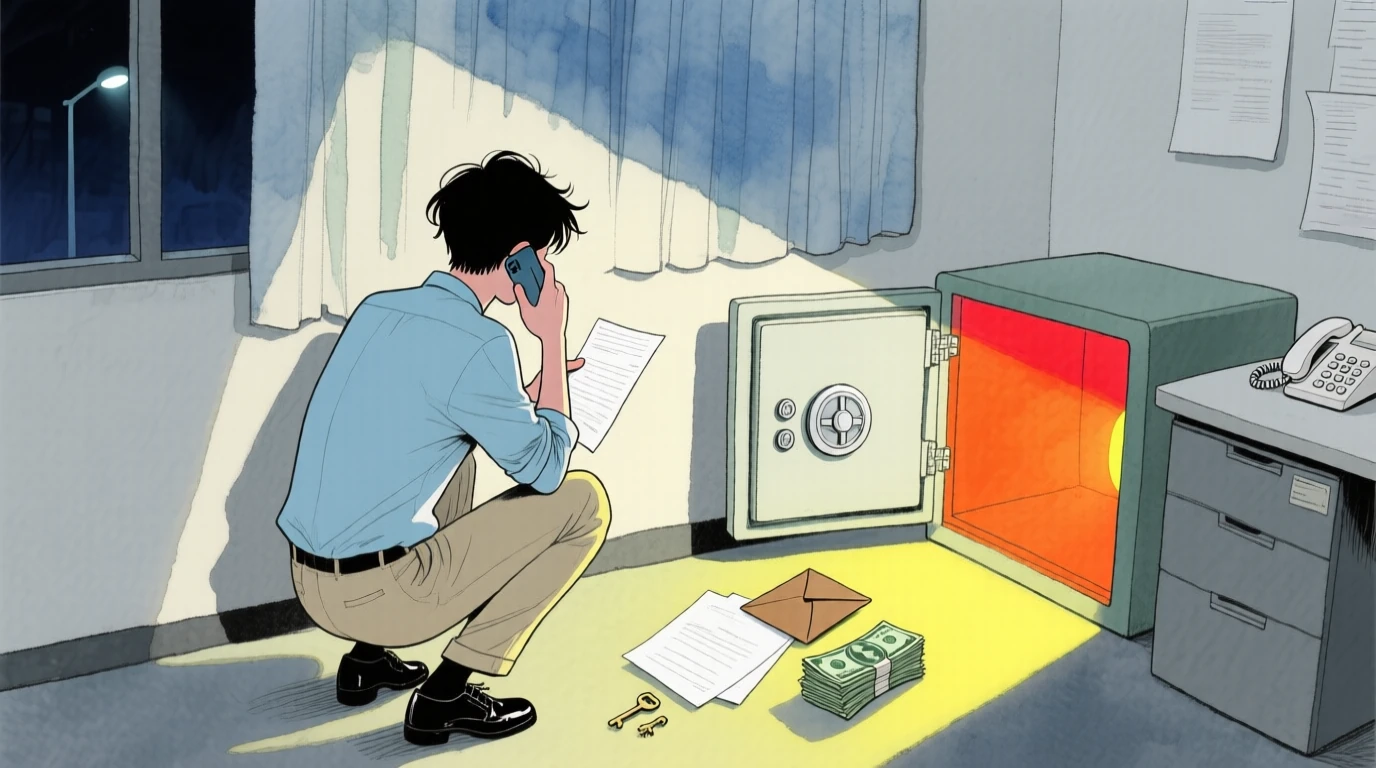
He pushed the door open, stepped inside, and closed it behind him without turning on the light. The office blinds were half-drawn, letting in a long streak of light from the streetlamp outside. He walked to the safe, crouched down, and entered the combination: 0415.
The dial turned smoothly. The safe door swung open.
Chen Mo’s breathing stayed even. He pulled out his phone, turned on the flashlight, and shone it inside. The safe held several stacks of documents, a manila envelope, a spare tie, and a bundle of cash. He quickly flipped through the files and found what he was looking for: a brown paper envelope labeled “Purchase Order Backups.”
He opened it. Inside was a stack of photocopies—the forged purchase orders Li Zonghan had made three years ago. Each one bore Li Zonghan’s signature, with the supplier listed as “Hongyun Machinery Co., Ltd.” The amounts ranged from two hundred thousand to five hundred thousand, totaling over two million yuan.
Chen Mo’s phone buzzed. He ignored it and kept checking. At the bottom of the envelope was a handwritten note with an account number and a line: “Hongyun Machinery dedicated account—transfer on the 15th of each month.”
He photographed both the note and the purchase-order copies, then put the envelope back, closed the safe, and made sure the lock was reset.
The whole operation took less than three minutes.
He stepped out of the office, locked the door, and walked back to his desk as if nothing had happened. His phone buzzed again—a message from Xiao Lin: “Assistant Manager Li came back early. He’s in the parking lot.”
For a split second, Chen Mo’s heartbeat quickened. He picked up his pace, slipped into the stairwell, and left through the first-floor side exit, circling toward the employee cafeteria. He stood in the shadow of the cafeteria and watched Li Zonghan’s car pull into the lot. The engine cut off. Li Zonghan got out—his face ashen, his tie crooked, looking like he’d just had a screaming match with someone.
Chen Mo watched him walk into the office building, then turned and headed toward the MRT station.
When he got home, he opened his laptop, organized the photos he’d taken, encrypted the folder, and sent it to Old Zhou’s email. Then he shut the computer, lay down on his bed, and stared at the ceiling.
Li Zonghan, you brought in Supai to skim kickbacks. Now Supai’s defaulting on wages, the company’s covering the shortfall, your budget authority is gone, and I’ve got the evidence of your forged documents.
What do you have left?
The next morning, when Chen Mo arrived at the office, the mood in the support group was even heavier than the day before. Xiao Lin told him that after the meeting, the GM had called Li Zonghan into his office for nearly an hour. When he came out, his face looked worse than a toilet.
“Word is, the GM ordered him to temporarily hand over production department budget approval to the finance department,” Xiao Lin whispered. “Until the Supai problem is resolved.”
“Did he agree?” Chen Mo asked.
“He had no choice,” Xiao Lin said. “The GM said if he didn’t, he’d be held accountable for his decision.”
Chen Mo nodded without a word. This was exactly the outcome he wanted: Li Zonghan’s power was being cut, the evidence of his forgery was in Chen Mo’s hands, and the Supai financial bomb was about to explode. Everything was going according to plan.
But Chen Mo knew Li Zonghan wouldn’t just roll over. He would fight back.
Sure enough, at two in the afternoon, Chen Mo’s phone rang. The caller ID read Li Zonghan.
He picked up, his tone calm: “Assistant Manager Li, what can I do for you?”
“Chen Mo,” Li Zonghan’s voice sounded tired, but there was a forced calmness underneath, “come to my office.”
“Sure.”
Chen Mo hung up, stood, and walked toward Li Zonghan’s office. As he passed Xiao Lin, she whispered, “What’s going on?”
“Nothing,” Chen Mo said. “The assistant manager wants to have a chat.”
Xiao Lin’s eyes showed concern, but she didn’t ask further.
Chen Mo entered Li Zonghan’s office. Li Zonghan sat behind his desk, dressed in a crisp suit, but the dark circles under his eyes were obvious. He looked at Chen Mo with a standard smile—but that smile was starting to crack.
“Have a seat.” Li Zonghan gestured to the chair across from him.
Chen Mo sat down and said nothing.
Li Zonghan studied him for a few seconds, then spoke: “Chen Mo, do you know about the wage arrears at Supai Human Resources?”
“I’ve heard about it,” Chen Mo said.
“Did you know that someone told me there’s someone behind all this, stirring the pot?” Li Zonghan stared into Chen Mo’s eyes. “What do you think?”
Chen Mo’s expression didn’t change. “Assistant Manager, I’m just a temp worker. How would I know something like that?”
“Is that so?” Li Zonghan leaned forward slightly, his gaze sharpening. “But did you know, I checked your file. Your temp worker record says you used to work at Shengda Electronics. But their manager told me they’ve never hired anyone named Chen Mo.”
Chen Mo’s heart didn’t race. He’d known Li Zonghan would check his background—Old Zhou had prepared fake credentials for him. Shengda Electronics did have a file for a “Chen Mo,” but that was an employee who had left years ago, with no connection to him.
“Assistant Manager, you might have looked at the wrong records,” Chen Mo said, his voice calm. “Shengda has several plants. Maybe you found info from a different site.”
Li Zonghan stared at him, suspicion flickering in his eyes. He paused for a few seconds, then said, “Chen Mo, I don’t want to beat around the bush. I know you’re not an ordinary temp worker. Who sent you?”
“Assistant Manager, I don’t know what you’re talking about.”
“Yes, you do.” Li Zonghan’s tone grew impatient. “You adjusted the camera angle. You found the safe combination. You guided the temp workers to file complaints. You did all of this, didn’t you?”
Chen Mo didn’t answer. He simply looked at Li Zonghan, his eyes as calm as a still lake.
Li Zonghan’s breathing became ragged. He stood up, walked around the desk, and came up to Chen Mo, lowering his voice: “You think you can bring me down? You’re wrong. I’ve been with this company for fifteen years. The GM and I went to school together. What can a temp worker like you do?”
“Assistant Manager,” Chen Mo said, his tone still flat, “I really have no idea what you’re talking about.”
Li Zonghan’s face flushed. His fists clenched. He stared at Chen Mo for a few seconds, then stepped back and sank into his chair. He took a deep breath, forcing his voice back to calm. “Fine. You won’t talk. That’s okay. But I’m telling you—I will find out. And when I do, you’re done.”
“I’ll be waiting,” Chen Mo said. He stood up. “Assistant Manager, is there anything else?”
“No,” Li Zonghan said, his voice icy. “You can go.”
Chen Mo turned and walked out of the office. As he passed Xiao Lin, he didn’t stop, but he saw the tension in her eyes.
He returned to his desk and opened his computer. A new email from finance was in his inbox: the company had initiated the advance payment process for Supai’s wage arrears. The temp workers’ salaries would be paid by next Friday.
Chen Mo closed the email. Li Zonghan’s budget approval authority had officially been taken away.
And his safe was no longer a secret.
At six in the evening, Chen Mo walked out of the company gate. The autumn wind blew, carrying the scent of fallen leaves. He stood under a streetlamp and looked at his phone. Old Zhou had sent a message: “Is the evidence from the safe enough?”
He replied with a single word: “Enough.”
Then he switched off his phone and headed toward the MRT station. He knew the next few days would be the hardest for Li Zonghan.
And all he had to do was watch.