Chapter 1
Ground Down
Just a Tap
Chapter 1: Ground Down
It wasn’t the alarm that woke Xu Gengyong.
The alarm had been broken for three days — it had devolved into a kind of electronic twitch, like a mosquito that flew into a speaker and couldn’t find its way out. He hadn’t replaced it. The upstairs neighbor dragged a chair across the terrazzo floor at exactly six-twenty every morning; that sound punched through the ceiling with more professional reliability than any alarm he’d ever owned.
He lay on his back staring at the ceiling for a few seconds. The fluorescent tube — he’d never turned it off — flickered once, then again, as if weighing whether to give up.
Six square meters. The window faced another building’s wall, three meters away, the kind of wall that blocked direct sunlight year-round, leaving only a flat, gray-bright light — the color of dishwater that’s been used once. The window screen had a hole in it. He’d covered it with clear tape; the tape edges had curled up and collected a layer of black grime. The room smelled of old concrete and the damp that never quite left in summer, the kind of smell that hit the back of your throat like pressing your face into your grandmother’s wardrobe.
Xu Gengyong sat up and grabbed his phone from the nightstand. Six twenty-two. Thanks, upstairs.
The water heater was being difficult again. He turned on the tap, waited ten seconds, pressed his hand under it — cold. Waited twenty seconds, pressed again — still cold. He knew the fix: press the ignition button on the side of the heater, hold it for three seconds while turning the knob, the landlord had shown him twice. He’d reported it three months ago. The landlord said he’d send someone. Xu Gengyong said okay. The someone never came. He never followed up.
He washed his face with cold water.
He remembered how. He just couldn’t be bothered. That was enough.
From the wall next door came the sound of a Taiwanese soap opera — someone crying hard, really committing to it, backed by one of those soundtracks that keeps climbing and never arrives anywhere. Out the aluminum-framed window, the alley’s first wave of scooters had started up, exhaust notes ricocheting off the narrow walls. He brushed his teeth watching himself in the mirror — plain T-shirt, yesterday’s, the one he’d slept in. The shadows under his eyes came from sleeping but not quite sleeping.
He changed into a clean T-shirt, pulled on work trousers, stepped into his sneakers.
Out the door.
Left out of the alley, one intersection, and there was Ah-Feng’s breakfast stand.
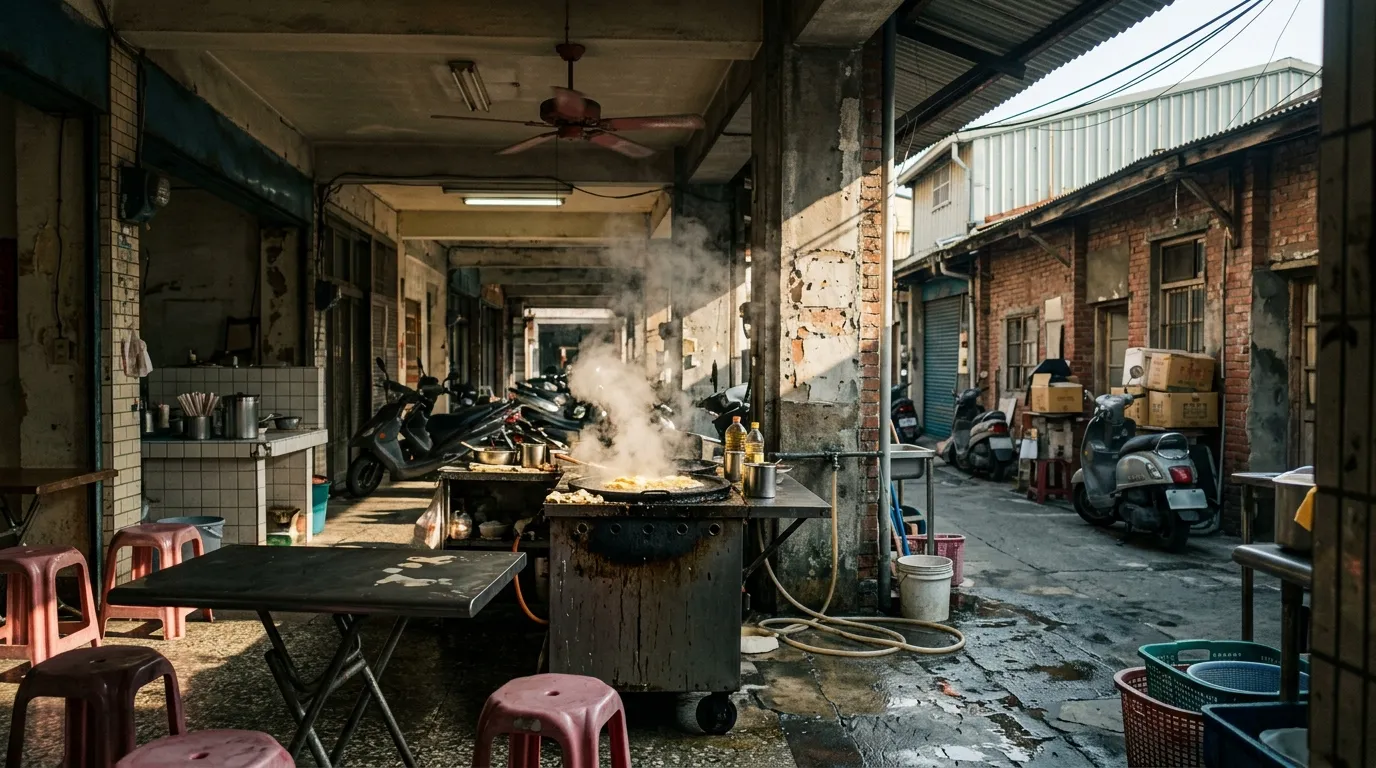
The stall under the arcade was already smoking — three eggs on the griddle at once, the sizzle cracking the morning air open. The iron plate gleamed with oil, catching the slant of light coming in from the alley mouth, cutting the arcade into bright and shadow. He stood in the shadow half.
A ceiling fan rotated overhead with a low, continuous hum — the particular hum of twenty years of uninterrupted rotation. The menu was handwritten on a piece of corrugated cardboard, the characters slightly blurred from cooking smoke, but everyone who was local knew the third line said: egg crepe, NT$25.
There was one person in front of him.
Middle-aged man, quick-dry shirt and shorts, the look of someone who’d just finished a run. Standing at the order spot, tilting his head back to study the cardboard menu with total absorption, as though it contained not breakfast options but the answers to certain fundamental questions about his life.
One minute passed.
Xu Gengyong stood behind him. His expression was blank.
Two minutes. The man turned to ask the owner: “Can you add cheese to the egg crepe?” She said yes. He said: “Okay… let me think about it.”
Inside Xu Gengyong’s head, a play had already reached Act Three.
Act One: He steps forward and says, in a perfectly polite voice, Sorry, I’m in a bit of a rush, would you mind if I ordered first? The man cheerfully steps aside. They exchange a brief smile. The human warmth of Tainan shimmers in the morning light. Everyone leaves satisfied.
Act Two: He cuts in and places his order without explanation. The man turns to look at him. He responds with a small nod — you’ve been thinking long enough, my friend. The man scratches his head sheepishly. The transaction completes itself.
Act Three: He turns around, walks away, buys a sandwich from the American-style place around the corner — inferior, fast, joyless — as a form of principled withdrawal. He carries the three wasted minutes home and files them quietly in the ledger he keeps. The ledger no one else can see.
Three minutes.
The man finally said: “Okay then… egg crepe with cheese, and a large iced milk tea.”
Xu Gengyong’s right hand hung at his side. His fingernail had pressed into his palm at some point. He hadn’t noticed.
“One egg crepe. Medium iced red tea.” His voice was flat, the voice of a man reading from a grocery list.
The owner’s hands moved fast — the spatula flipping the crepe was someone who had turned this into something close to a martial art. He stepped to the side to wait, pulled out his phone, scrolled. Nothing to look at; just scrolling. Thumb pushing upward, eyes not quite focusing. Instagram: someone he sort of knew eating ramen in Japan. Someone he didn’t know at all taking a mirror selfie at the gym. A news headline he registered but didn’t absorb.
The crepe was ready. He took the plastic bag, said thank you. A volume calibrated just loud enough for the owner to hear — not so loud the people nearby would think he was performing generosity.
He’d spent years getting that volume right.
The Yamaha kicked to life with a shudder. The dark-gray body wasn’t old exactly, but the left mirror had a crack running from corner to center, and everything reflected in it came back broken. Three months. The repair shop was a five-minute walk from his building; he thought about it every time he passed, and every time he kept walking.
The breakfast bag hung from the handlebar hook. He steered one-handed through the first corner, pressing the bag against his leg with his other hand. Seven-oh-five, the sun already at work. Inside the helmet it was starting to trap heat, the back of his neck going sticky, the morning air already carrying weight, pressing against his skin without yielding.
Minsheng Road into Fuqian Road, right turn.
He knew the stretch ahead was under construction again. Always under construction. He had a private theory that this particular road segment was a kind of social experiment — if you kept a road perpetually unfinished, would commuters eventually evolve new routes on their own, organically, like roots finding water?
Traffic cones arranged in a row, arranged with real personality — uneven, slightly listing, like a line of drunk little orange men holding hands in a folk dance. A signboard stood in the middle of the road: CONSTRUCTION AHEAD — PLEASE DIVERT. Divert to where? Unspecified. Just: divert. Figure it out. A yellow excavator sat parked on the half-dug roadway, cab empty, the signs of last work looking about three days old.
He went around. He always went around. Four extra minutes, through two side alleys, back out onto Minzu Road.
The traffic thickened. At red lights, scooters fanned out into a semicircle, everyone edging as far forward as possible. He was sandwiched between two bikes, the one on his left with an aftermarket exhaust that was vibrating his helmet. Sixty seconds on the countdown.
He took the crepe out of the bag and ate half of it at the red light. The skin had gone slightly cool, but the inside was still warm, the egg and oil smell intact. He ate fast. Any later and it would be completely cold. He pulled a sip of iced red tea through the straw. Sweet. His stomach made a small complaint — an old habit, the acid thing.
Green. Go.
Seven thirty-five. Ground floor of the office building.
He rode into the car park. Third row of scooter bays, the spot he always used —
Taken again.
That white Yamaha Many. Every time. It was always that one.
He had composed, in his head, many different notes. Version one: This spot is in regular use. Please park elsewhere. Thank you. Too polite. Version two: Please use your own spot. Basic courtesy. Too preachy. Version three: Do it again and I’ll move your bike to the roof. Deeply satisfying. Completely impossible. Version four — he’d even written version four in his head, had its every word ready — but none of them had ever left his skull. He parked in an empty spot nearby, and what he thought wasn’t someone took my spot but I moved aside again. As he always did. Fine. He knew he’d moved. The other person didn’t know. The entry went in the ledger. The ledger stayed closed.
He cut the engine. Pulled the key. Sat on the bike without moving.
Inside the helmet it was stifling. He took it off; his hair was flat, pasted to his forehead with sweat. The iced tea had a third left; he finished it in one go, crushed the cup, stuffed it back in the bag.
Somewhere nearby, a car’s exhaust made a dull thump.
A flash of something — less than a second. A memory: his father at the dinner table, the sound of a fist on wood. A bowl jumping. His mother’s chopsticks stopping mid-air. He and his younger brother both looking down at their own bowls at the same time.
The house stayed quiet for a whole week after that.
He shook his head once and threw the image off.
Third floor. Office. He pushed through the door and the air conditioning hit him — that smell of filtered air and toner and someone’s coffee. He walked to his desk, dropped the breakfast bag, moved his mouse, woke his screen.
The email at the top of the inbox. Yesterday’s project. The client had replied. The subject line was a tower of reply-chain headers: Re: Re: Re: Revised Proposal v3 — Several items still require adjustment.
He read the subject line.
Breathed in.
It was going to be a long day. He didn’t yet know how long.