Chapter 2
Taut
Just a Tap
Chapter 2: Taut
Lu Lingqin opened his eyes at six on the dot.
No alarm needed. His body had been calibrated over thirty-eight years of use to a precision that bordered on unsettling — every morning at five fifty-nine, his consciousness would surface first, lying awake in the dark to wait out that final minute, like an early arrival at a job interview sitting in the lobby pretending to check his phone. Six o’clock, eyes open. Done.
The blackout curtains sealed the bedroom into a camera obscura. His wife’s breathing was even, her back to him, the comforter piled into a small hill. He rolled to the side, put bare feet on the tile floor, and felt the cold shoot up from the soles — same temperature every morning, his toes curling every morning, but he’d never once thought to wear socks. It was part of the procedure: foot meets floor, floor is cold, person is awake.
He put on his slippers, walked out, went downstairs.
At six in the morning the three-story townhouse was like a museum before opening, everything in its place, everything quiet and waiting. As he passed the stairwell landing he glanced down at the ground floor — the remote control was centered on the coffee table, nothing on the sofa. Good.
Kitchen.
He switched on just the small yellow light above the island counter. The whole second floor lit up in that one small patch, like an island floating on a dark sea. He went around behind the counter, opened the cabinet, took out the coffee bean canister.
Empty.
He held the canister, tilted it, gave it a shake. A few fragments tumbled around inside — the last few audience members who couldn’t bring themselves to leave. He set the canister back in the cabinet, closed the door, stood there for two seconds.
His wife had used the last of them last night. She hadn’t said.
He opened the refrigerator. Milk, his son’s Yakult, leftover miso soup from yesterday — no coffee beans. On the refrigerator door hung one of Lu Cheng’s drawings: a family of three standing inside a boxy car, a sun on the roof bigger than the car itself, all three of them smiling, faces perfectly round, fingers radiating outward like five-pointed stars.
He closed the refrigerator.
Six ten. No coffee. The slot in his morning schedule labeled “06:10 — brew coffee” had become a blank space, like a puzzle piece someone had pulled out. The rest of the pieces were still there, but your eyes kept getting pulled toward the gap.
He switched on the television, turned it to the financial channel. Volume pressed low, only numbers and intonations drifting through the air. He stood behind the island counter for a moment, his fingers unconsciously tracing the spot where the coffee canister had been — the counter was clean. Then he noticed his wife’s keys on the dining table, where they didn’t belong. The hook by the entryway was empty.
He walked over, picked up the keys, walked to the entryway, hung them on the hook. The gesture was perfectly natural, like picking up a fallen leaf in passing.
Back on the second floor, he noticed his wife’s jacket draped over the sofa armrest instead of hung in the wardrobe. He picked it up, folded it twice, set it on the sofa cushion. Better. Not tidying — repositioning. Things had their proper places.
Six forty-five.
He went up to the third floor and pushed open the door covered in cartoon stickers.
“Cheng, time to get up.”
A head emerged from the comforter. Lu Cheng’s hair looked like it had been through a mild electrical event, eyes squinted shut, the whole child resembling a mole that had been excavated from its burrow and had opinions about the situation.
“What time is it?”
“Six forty-five.”
“Still early.”
“You need to be at school by seven forty.”
Lu Cheng rolled once inside the comforter, sat up with the effort of someone expending their entire physical reserves for the day, and then said something that moved Lu Lingqin’s eyebrow a fraction of a millimeter:
“Dad, I need to bring art materials today.”
“What art materials?”
“Teacher said. A empty box, glue, and a dream.”
Lu Lingqin looked at his son. ”…A dream?”
“Yeah, teacher said everyone brings a dream.”
“What does the teacher mean by dream?”
Lu Cheng tilted his head and thought. “Just a dream. Do you have a dream?”
“Go brush your teeth first,” Lu Lingqin said.
He walked out into the hallway and stood there for three seconds. An empty box, glue. Nobody had told him any of this last night. He started down toward the kitchen, his mind already running the calculation: empty box at home — yes, a shoebox. Glue — uncertain, possibly in the study. Dream — he skipped that one.
His wife appeared from the master bedroom at that moment, hair down, not yet fully awake. She shuffled toward the bathroom in her pajamas. Passing Lu Lingqin, she said a blurred “morning.”
“Morning.” And then: “We’re out of coffee beans.”
His wife stopped for a moment. “Oh. I used the last of them yesterday. Forgot to say.”
“Mm.”
That was all. Conversation concluded. She walked into the bathroom; the door closed.
This particular “Mm” was Lu Lingqin’s way of not raising his voice. Its duration, pitch, and airflow had been precisely calibrated — short enough to signal that he’d heard, flat enough to give her nothing to argue with, but missing exactly that one trailing note that would have put someone at ease. A “Mm” could mean it’s fine, or it could mean I’ve noted that. What his wife had learned over seven years of marriage was one thing: there was never a second sentence after his “Mm.” What made it uncomfortable was his silence: he simply had no intention of saying anything more.
At breakfast, Lu Cheng ate his cereal and asked whether fish fins and airplane wings were the same thing. Lu Lingqin said no. Lu Cheng asked why. He said “different structure.” Lu Cheng found this answer unsatisfying but accepted it, because his attention had already been taken hostage by a cereal piece shaped like a dinosaur.
His wife sat across from him, quietly drinking milk. The air between the two adults was the kind of stable where you know there’s a closed door and you have no plans to open it.
Seven ten. Out the door.
The white Toyota Corolla Cross sat in the ground-floor garage, its body pale in the half-light coming under the rolling shutter. The wheels aligned precisely with a line on the floor — a line he had painted himself. Inside the car: no hanging ornaments, no air freshener, nothing unrelated to driving. On the hook behind the driver’s seat hung a white dress shirt, ironed, still in its plastic sleeve. In the passenger side compartment: tissues, a charging cable, a power bank. The back seat held the child’s car seat, buckle straps folded away neatly.
He buckled Lu Cheng in. Lu Cheng’s feet couldn’t quite reach the back of the front seat; both small legs hung in the air, swinging.
“Dad, where’s the empty box?”
“Next to your backpack.” He’d found a shoebox at seven oh-five, wiped it clean with a damp cloth.
“Where’s the glue?”
“Found one in the study. It’s inside the box.”
“Where’s the dream?”
“You bring that yourself.”
He started the engine. Before releasing the parking brake he glanced at the gear lever — P. He knew it was in P, because he always put it in P when he parked, but he checked anyway. Then he adjusted the rearview mirror. The angle was the same as always.
When the rolling shutter started to rise, he tilted his head to look at the dashcam mounted above the front windshield. The red indicator light was on. Recording. Good.
He reversed out of the garage and pulled into the road.
He stopped at FamilyMart on the way and bought an Americano — medium size, black. Set the paper cup in the center armrest cupholder. The missing puzzle piece was back. A different shape, but the gap was filled.
Lu Cheng sang something in the back seat, a song of unknown origin whose lyrics appeared to consist entirely of three syllables on a loop — “bong, bong, bong.”
“Cheng.”
“What?”
“If there’s anything else you need to bring to school today, tell Mom when you get picked up.”
“Okay.”
“Don’t leave it until morning.”
“But I forgot yesterday.”
“So don’t forget from now on.”
His tone neither rose nor fell, like a ruler that had already been leveled. Lu Cheng went quiet in the back seat for three seconds, then resumed singing, but at a slightly lower volume. A five-year-old doesn’t know what low-level coercion is, but his body did — Dad looked calm. Something had tightened.
Lu Lingqin’s right hand rested at the three-o’clock position on the steering wheel, left hand at nine. His knuckles were faintly white.
The roundabout.
Tainan’s roundabout is the universe’s most faithful physical demonstration of chaos theory. A circle forty meters in diameter, four entry and exit points — theoretically outer lane for cars and inner lane for scooters, practically the lane you use depends entirely on your mood that day and your karma from a past life. At the center stands a monument; the bronze plaque on its base has been smoked by scooter exhaust to the point where the characters are entirely illegible.
Lu Lingqin entered the roundabout from the north. The sun was on his right, every windshield in sight flaring with reflected light. He needed to exit on the east side, which meant cutting across half the circle — across all those scooters flowing in from angles you would have thought geometrically impossible.
He hated this place. Danger at least has cause and effect; what he hated was the unpredictability. Nobody signaled, nobody checked their mirrors; one scooter was riding the wrong way straight into the outer lane with the facial expression of someone who had done nothing wrong whatsoever; a garbage truck was making its unhurried way around the circle, entirely indifferent to the fact that this was the morning rush, like a grown adult who has found his inner peace on a merry-go-round and refuses to be dislodged from it.
His car crept toward the east exit. His fingers tapped a regular beat on the steering wheel, a measured count, one beat per judgment: is that truck on the left pulling out? Is the scooter ahead of me slowing down or hesitating? To the right —
A scooter cut directly from the inner lane across his path.
He braked.
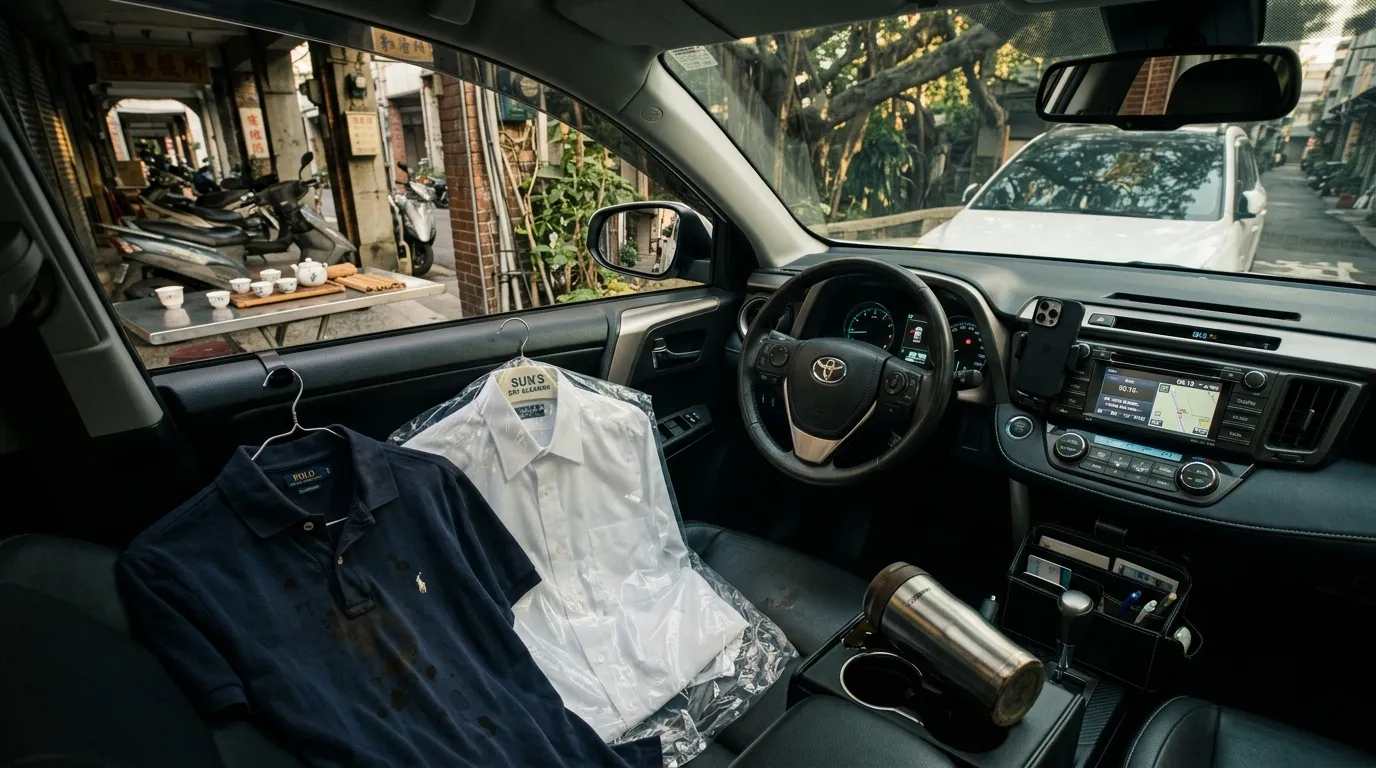
The coffee in the paper cup lurched forward by inertia, the lid popped off, and black liquid splashed out — half across the center armrest, half across his polo shirt. Warm, spreading from his chest to his stomach, the way it feels when someone douses you with water that’s not quite hot enough to scald.
The scooter had already merged into traffic and was gone.
“Dad!” Lu Cheng’s voice from the back seat. “Your shirt!”
“It’s fine.” He said.
No expression on his face. There had been no time for one to form. His response sequence was: brake → confirm no collision → confirm child in back seat is unhurt → and only then, emotions. Emotions were fourth in line, and the first three items had already consumed his available bandwidth.
He drove out of the roundabout and pulled over at the curb. Took tissues and wiped down the center armrest. The shirt didn’t need wiping — he’d be changing anyway.
He turned his head and looked at the dashcam.
Red light on. It had recorded.
This confirmation was more settling than glad I didn’t crash. Not crashing was luck; having it on record was management.
He kept driving.
Seven thirty. Mingcheng Elementary. Parents were already dropping children off at the school gate, the flow chaotic but somehow self-ordering — a kind of half-anarchic equilibrium based on unspoken rules that only Tainan school gates seem to evolve.
Lu Cheng jumped out of the car with his backpack, the clean shoebox tucked under one arm.
“Bye!”
“Be careful,” Lu Lingqin said. Then he added: “Don’t forget your dream.”
Lu Cheng turned, flashing a gap-toothed grin. “I brought it already. It’s in here.” He tapped his chest.
He watched his son’s back disappear through the school gate. The coffee stain on the polo shirt had started to cool, clinging to his skin, like a reminder that refused to leave.
Seven fifty.
Lu Lingqin parked in an alley near the office. Engine off; he sat in the driver’s seat without moving.
The alley was quiet. Residual heat from the engine drifted up slowly from below the steering wheel.
His phone rang. He looked — Xiao Wu, his business assistant.
“Mr. Lu, Manager Zhang says he’s arrived early. He’s asking if the ten o’clock meeting can be moved to nine-thirty.”
He checked the time. Seven fifty-two. Nine-thirty meant the window he’d set aside to organize materials had just been compressed by forty minutes.
“That’s fine. Tell him no problem.”
He hung up. Set the phone on the passenger seat. Sat for a few seconds.
Coffee stain across the front of the polo shirt. He couldn’t meet a client looking like this.
He reached back to the hook behind the driver’s seat and took down the spare white shirt. Unwrapped the plastic sleeve, shook it out, inspected — no creases. He changed in the car with quick, practiced efficiency: released the seatbelt first, pushed the seat back one notch, caught his elbow on the car ceiling pulling off the polo shirt — same spot as always. Shirt on, buttons fastened bottom to top, leaving the top one undone. Folded the coffee-stained polo neatly, placed it in the plastic bag on the passenger footwell.
Under two minutes, start to finish.
He had contingency plans for every kind of setback. Coffee spills — hence the spare shirt. Phone runs out of charge — hence the power bank. Son forgets to bring something — hence the shoebox and the glue always kept at home. Well, the glue was already there by coincidence. But the principle stood: everything manageable. An unexpected event is not a problem; having no contingency plan is a problem.
He opened the glove box for the breath spray. His fingers brushed something deeper inside — a pack of Seven Stars, soft case. Somewhat flattened, but the seal was still intact. Three years. His fingers rested on it for less than a second, then closed around the breath spray and shut the glove box.
One spray. A deep breath.
Outside the car window, an old banyan tree in the alley cast its shadow over half the car body. Further down the lane, someone was brewing tea under an arcade roof — not yet eight o’clock and they were already at it. That’s Tainan mornings for you — some people rushing, some people brewing tea, some people doing a slow waltz with garbage trucks through roundabouts. Everyone at a different tempo, and the city doesn’t care.
He adjusted the rearview mirror. The angle was unchanged.
“It’s fine. Everything’s under control.”
He said it quietly, to himself. Low enough that he might almost have been worried the dashcam would pick it up. Then he opened the car door and got out.
The white shirt was smooth. The belt in its usual notch. His shoes on the asphalt, steady.
He didn’t know that this afternoon he would press a stranger against the hood of his car.
He didn’t know that these hands — these hands that had buttoned his shirt with such precision — would connect with a stranger’s face.
He didn’t know any of it. All he knew was that there was a meeting at nine-thirty, the spare shirt was on, and everything was under control.