Chapter 3
Cracking
Just a Tap
Chapter 3: Cracking
Nine ten. The conference room.
Five people inside the glass partition: two from the client side, the boss, Xinpei, and Xu Gengyong. On the projector screen was the version he’d stayed up until eleven-thirty reworking two nights ago — v3. He remembered the exact hour because when he was done he went to brush his teeth and found he’d bitten through the inside of his lip again; the mouthwash hit and his whole mouth was on fire.
The client-side woman — the account contact, probably, with chestnut-dyed hair and very neat nails — stopped at page seven.
“The storage layout here still seems to have a gap from what we specified last time.”
Her tone was even, almost apologetic — just raising a concern, nothing combative. Xu Gengyong knew she wasn’t pressing him. But when the word “gap” came out of her mouth, the three versions he’d revised over the past three days seemed to stack up on the projector screen and collapse into a pile of waste paper.
“Right, right.” Zheng Xinpei nodded beside him, his pen rotating between his fingers with the speed of something being used not to think with but as a metronome. “I understand that part.”
He glanced at Xu Gengyong. Under half a second.
Then, back to the client: “I’ll have another talk with him before the next presentation to make sure.”
The air conditioning in the conference room suddenly got very loud.
Maybe because no one was talking. Maybe because the air conditioning had always been that loud and the voices had just been covering it. Xu Gengyong didn’t know. What he knew was that the phrase — have another talk with him — had landed in the space directly above the open page of his notebook. Under the table, his left hand was pressing his fingernail into his palm; he hadn’t noticed. His pen drew a hard horizontal line across the paper. As it crossed, the paper fibers lifted slightly — a microscopic wound.
Him. He was the him who needed to be talked to.
The meeting continued. Xinpei handled the timeline discussion at the front, voice steady, punctuating each exchange with a “right, right, right” like stamping a seal at the end of every paragraph. The clients nodded. The boss leaned back in his chair, scrolling his phone. Xu Gengyong sat in the chair closest to the door, furthest from the screen. His notebook showed four lines of writing; if you walked over and looked, you’d find that everything after the third line was just more horizontal strokes.
Ten oh-five. Meeting over. The clients left first. Xinpei and the boss exchanged a few words — Xu Gengyong didn’t catch what. He stood and packed up his laptop, his own face reflected in the screen: blank expression, very dry eyes.
Walking out of the conference room, Xinpei patted him on the shoulder.
“Rough one. This client group is just high-maintenance, you know how they are.”
“Mm.” Xu Gengyong said.
The “Mm” had been dredged up from somewhere below his stomach. It passed through his throat, passed through his teeth, passed through his lips — every gate had wanted to hold it back and swap it for something else. But out it came, and it came out sounding exactly right — not too little, not too warm, not too cold.
Xinpei was already gone. Walking with his shoulders slightly higher than they needed to be, like he was always faintly bracing for something.
Xu Gengyong went back to his seat and sat down. Moved the mouse; the screen came on. Two more emails in the inbox. He didn’t open them. He turned his notebook to the next page — blank, clean, no horizontal lines. Then he started working on v4.
Noon.
FamilyMart. The air conditioning was turned up too high.
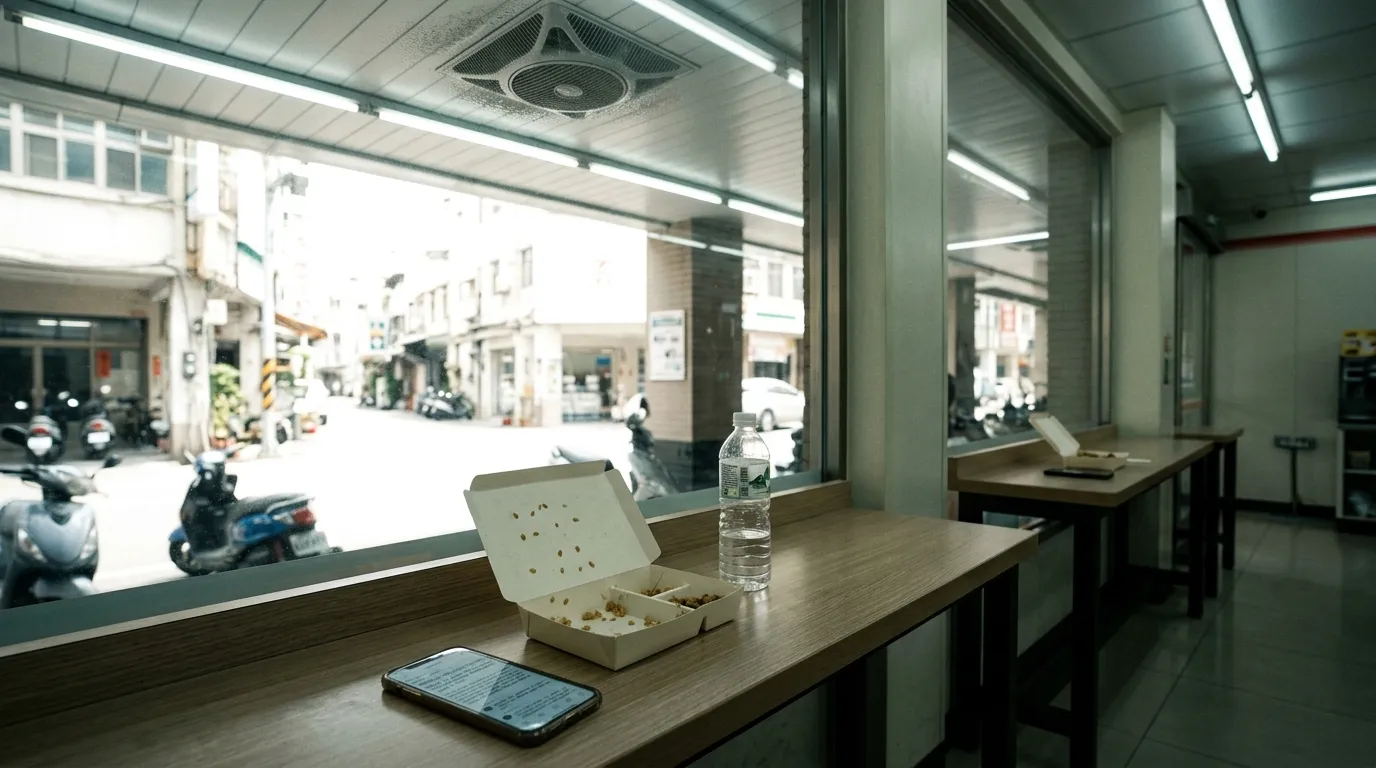
He grabbed a chicken thigh rice box and a bottle of mineral water and sat down in the window-side seats. The sun outside was white like a broken fluorescent tube; almost no one was out walking — everyone inside and hiding. Across the street, the shadow of a banyan tree under an arcade had contracted in the heat, as if even the shadow didn’t want to go out.
He opened the rice box. The sauce from the chicken thigh mixed with the FamilyMart smell — that specific blend of cold air and oden broth that exists nowhere else on earth. He took a bite of rice. Scalding. He ate fast anyway, alternating rice and side dishes, chopsticks barely pausing.
There was someone else at the diagonal table. Male, white button-up shirt, tie loosened, working through a rice ball with the focused deliberateness of a precision operation. Their eyes collided briefly across the air — under a second — then both looked down simultaneously.
A particular unspoken agreement between people eating alone. I see you, you see me, but we pretend we haven’t, because acknowledging each other’s existence means acknowledging that we’re both people who eat lunch by themselves, and that gets too close to something that doesn’t need to be said.
The chicken thigh was done. He pressed the lid back on the box and pushed it into the bin. Half a bottle of mineral water left. Still twenty minutes.
He pulled out his phone.
Instagram: a university classmate photographing a sunset in Bali, five lines of hashtags. Scrolled past. A design account with a very clean entryway storage shot; he looked at it for two seconds, thought it was well done, then thought about his v3 getting sent back this morning and closed Instagram.
Opened the news app.
Scrolled through a few items. Some celebrity got married. Some county or other was building a new transit hub. Weather forecast said Tainan’s high today would be thirty-six degrees, feels like forty-one — he thought this number could stand in as a difficulty rating for the day.
Then he saw that headline.
Sensational, the way all headlines you actually click are. The gist: at some intersection, a scooter rider got honked at, got off his bike to argue with the car driver, and mid-argument things turned physical. The dashcam had caught all of it — clearly, like a film storyboard.
He tapped through to the video. The guy in it pulled off his helmet fast, like he’d been ready for a while. Someone nearby was recording on their phone.
He scrolled down to the comments.
“This guy shouldn’t be allowed on the road.” “Zero EQ.” “Lock him up, waste of public resources.” “They say the most beautiful thing about Taiwan is its—forget it.” “Someone check his priors.” Each comment delivered its verdict like a courtroom pronouncement, every profile picture a self-righteous judge dispatching justice by thumb.
Xu Gengyong read a few. The corner of his mouth moved slightly.
What’s wrong with people like that? Seriously. One honk and they lose it.
He closed the news app, locked his screen. Picked up the mineral water and took a sip. The FamilyMart door slid open and a wave of hot air pushed in from outside before the air conditioning shoved it back. He checked the time. Twelve forty. Time to go.
He stood up, tucked the mineral water bottle into the side pocket of his bag, and pushed through the glass door. The sun hit him full in the face.
Far off, a few low rumbles of thunder. Like someone pounding a table in a very distant room.
Two-thirty in the afternoon. The kitchenette.
He went to get water. The hot water button on the dispenser had been broken for a week; only cold and warm left. He pressed warm. The water running out made a clear sound in the quiet hallway.
His phone buzzed. He looked at the screen. Mom.
He answered, keeping his voice low. “Hello.”
“Ah-Yong, you’re at work, right?” His mother’s voice came through a thin layer of something — the reception was fine; it was the habit she’d always had of speaking as if she’d already turned the volume down.
“Yeah, just came back from lunch.” Lunch was twelve to one. It was now two-thirty. He wasn’t sure why he’d said it that way — just the old habit of making everything sound like nothing when he talked to her.
“Are you free this Saturday? Your dad hasn’t been feeling great lately, I was thinking you could come back for a bit—”
“What’s wrong with him?”
“Just his blood pressure. Last week when he went in, the doctor said…”
His mother talked. He listened. But his attention split like a stream dividing into two channels — half following the blood pressure numbers, half already somewhere else. Going home. Shanhua. That living room. TV on. Dad on the sofa watching, not talking, but his whole body filling up the frequency of the air. Mom in the kitchen, the sound of the tap. Him at the dining table pretending to scroll his phone, actually just not wanting the silence to become a void he’d be expected to fill.
“Okay, I’ll come back Saturday,” he said.
“Are you going to—”
“Mom, I’m at work. Tell me later.”
“Okay, okay, you’re busy.”
He hung up.
He stood in the kitchenette. The warm water in his mug was giving off the faintest steam. Down the hall, someone was photocopying something; the smell of toner drifted over.
His right hand was trembling.
Not much. The kind you can see yourself but no one else would catch. The water surface in the mug trembled faintly, the way it does when someone’s pounding foundations a long way off.
He gripped his right wrist with his left hand. Squeezed. The trembling didn’t stop, but it was hidden.
He didn’t know what he was trembling about. His father’s blood pressure had been high for years; nothing had ever actually come of it. And he’d go home — he always went.
It was the atmosphere. Going home meant a whole day inside that atmosphere. Dad using volume to handle pressure, Mom using silence to handle pressure. And himself — what did he use?
He thought about it for a second. Then stopped thinking.
He carried his mug back to his desk.
Three twelve in the afternoon.
A message notification from the work chat. Xinpei.
Gengyong, a client just said they need the materials list confirmed today. Can you help cross-check the quantities and unit prices. Can this be done today? Thanks
No question mark. A thanks at the end.
Xu Gengyong read it. Three seconds. Then he moved his cursor to the input field and typed his answer:
Sure.
His fingers rested on the keyboard. Two extra seconds. He deleted the period.
Added it back.
Sure.
Sent.
That “Sure.” contained a great deal. He wasn’t going to take it apart and look. But he logged this one. Along with this morning’s phrase, that horizontal line, his name being called twice before he heard — all of it, together.
He opened the materials list. A hundred and thirty-seven items. Cross-reference against the quote sheet. Before end of day.
It was already three-twenty. That left him two hours and ten minutes.
He started.
His fingers moved between keyboard, screen, and the cells of the spreadsheet. Mechanical. Like he’d switched himself to some kind of low-power mode — any action that didn’t require judgment, he didn’t judge; any part that didn’t require feeling, he didn’t feel. Cell, number, cell, number. Occasional switches back to scroll through the quote sheet PDF: down, down, down.
Around four o’clock, he got stuck on item eighty-something — the quote sheet said “tax inclusive,” the materials list said “tax exclusive.” He stared at the two figures, and stared, and the gridlines began going soft in front of him.
A colleague passed his desk.
“Gengyong.”
He didn’t hear.
“Gengyong?”
He looked up. “Hm?”
“You all right? I called you twice.”
“Oh. Yeah. Just thinking.”
He wasn’t thinking about anything. Those few seconds he’d been staring at the numbers on the screen, but the numbers hadn’t made it into his brain. His eyes were looking. The person behind them had briefly logged off.
Back. Keep going. Cell, number, cell, number.
Five thirty. Done.
He looked it over once. There were a few items he wasn’t sure about — but he didn’t go back to check. He knew he should check. The old version of him would have checked. But today’s version just saved the file, dragged it into the chat window, and typed a line:
Xinpei, materials list is confirmed, see attachment.
Sent.
He leaned back in his chair and stared at the ceiling. The fluorescent tubes were bright white; stare long enough and a dark shape would start to float in front of your eyes. A few people were still at their desks working late, keyboard sounds scattered and thin.
He packed up. Laptop closed. His mug still had water in it; he looked at it, didn’t pour it out, left it there.
He stood. Walked out.
The parking lot.
When he clicked his helmet buckle, the metal clasp touched his jaw — cold. He got on the scooter, key in, engine turned — a shudder, then it settled.
The air outside was hot. Five-thirty sun and it was still full-strength, coming in straight off the west face of the building; the heat rising off the asphalt made the outlines of distant things go soft. He rode out of the parking lot, turned left, merged into traffic.
Inside the helmet it was close and warm. Sweat ran down his temple, into the edge of his ear, itchy. He wanted to go home and shower. He only wanted to go home and shower. He didn’t want to think about anything. He shoved everything in his head to the corners, the way you cram things into a wardrobe and shut the door hard.
He turned into the alley he used every day.
Wrong.
It was blocked ahead. Traffic cones in a row, slightly askew — the same little orange figures. A sign in the middle of the road: CONSTRUCTION AHEAD — PLEASE DIVERT. Construction again. But this wasn’t the morning stretch; this was the way home.
He braked. Sat for two seconds, looking.
Cars behind him were already honking — not at him specifically, the whole road was blocked, everyone waiting and figuring it out.
He turned his handlebars and took a side street to get around. He didn’t know this road. In Tainan, the alleys wound around but they all connected back to the main roads eventually. He gave it some throttle and pushed into the lane.
The wind came through the vents in his helmet, hot.
He didn’t know where this road would take him. He was just moving.