Chapter 4
Beep
Just a Tap
Chapter 4: Beep
Lu Lingqin closed his laptop at five twenty-eight.
His face reflected in the darkening screen — white dress shirt buttoned neat, but the collar felt wrong against his neck. Stiffer than the one he usually wore. He pushed it with his thumb. It didn’t give. He gave up.
The phone call at three this afternoon was still stuck in his ear. Manager Zhang’s tone had been light, almost apologetic: Since you think it’s workable, Lu, shall we move the material prep forward two weeks? No problem getting it out by next Friday? He’d heard his own voice answer, No problem. He didn’t know why. The supplier needed at least ten business days. He’d just agreed to ten calendar days. He did the math three times in his head. It didn’t add up any of the three times. But his mouth had already sent no problem out into the world.
That was the sixth thing today that had slipped out of his grip. Who was keeping count, anyway. He was keeping count.
The office was empty. Xiao Wu had left at five; the ice in the cup on his desk still hadn’t fully melted. Lu Lingqin moved the cup onto its coaster — there was already a ring on the desk surface. A small thing. But he’d seen it.
He picked up his keys. Turned off the lights. Locked the door.
The car was hot.
The five-thirty sun drove straight in through the upper left corner of the windshield; the visor pulled down could only block half of it. He started the engine and the air conditioning vents exhaled a lungful of trapped heat — the smell of plastic and dust that had been baking all day. He waited twenty seconds. Cool air finally came.
The radio had turned itself on. Finance channel. Wrong — Lu Cheng had been in the car last time, had switched stations. He pressed a button; a song jumped out. A cheerful song. Something about going on a trip together, sunshine and beaches, the male singer’s voice bright as a convenience store at three in the morning. He didn’t change the station. He put his hand back on the wheel.
Out of the lane, left turn, joining the main road.
Rush-hour traffic was thick. Ahead of him, a white freight truck with rebar ends showing over the tailgate, rust-orange. He followed, keeping a car-and-a-half’s distance. The radio’s song changed to an insurance ad — Give your family the security they deserve. He turned the volume down.
Three hundred meters ahead, orange construction fencing began to appear.
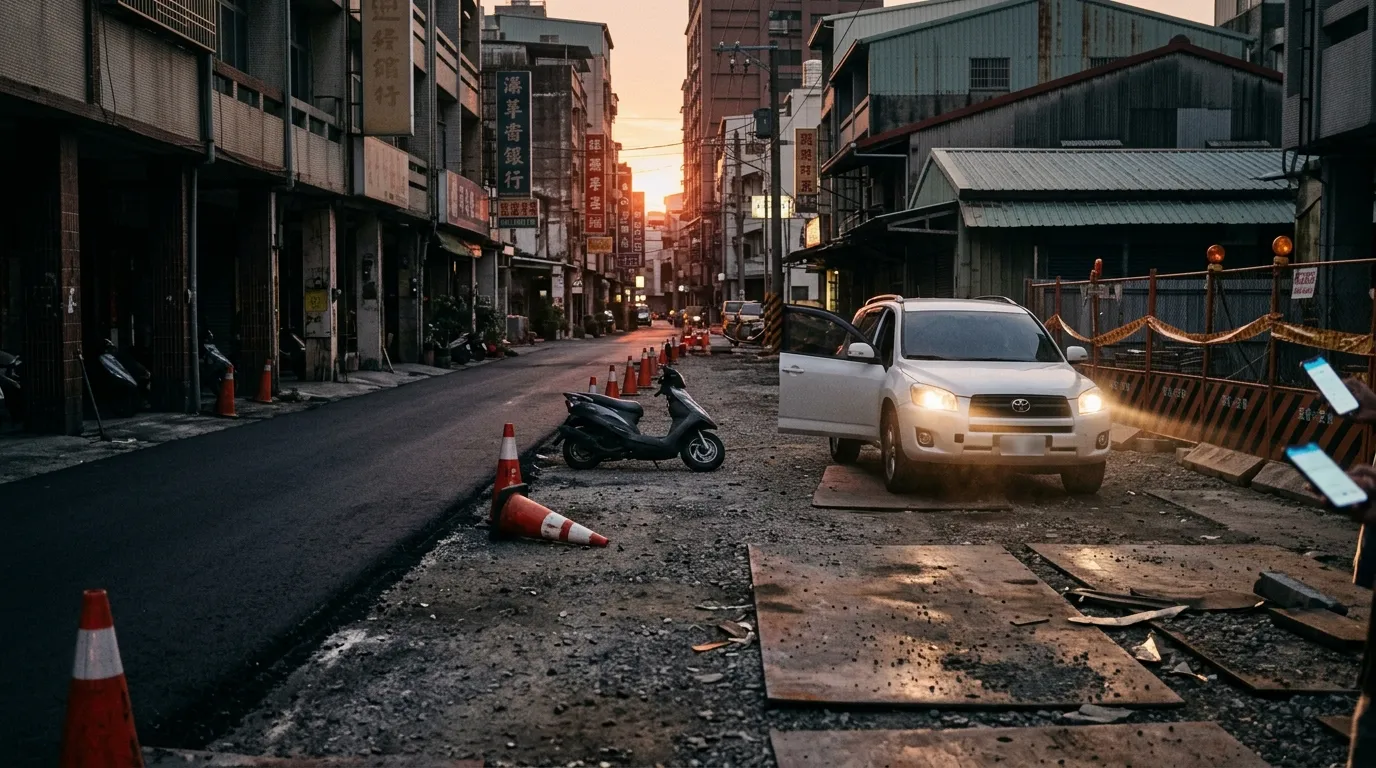
He knew this stretch. Work had started last week — water mains replacement, half the road boxed off with black-and-yellow metal barriers, solar warning lights blinking. He’d detoured around it last week, knew the route. But today was different: the fencing had expanded since then, the right lane fully blocked. A sign stood in the middle of the road: CONSTRUCTION AHEAD — KEEP LEFT. The white truck ahead of him cut left; he followed.
Speed dropped to twenty.
Steel plates started appearing on the road surface. His tires rolling over them produced a hollow metallic knock, like rapping a pot’s bottom. On his left, construction fencing; on his right, a temporary lane — loose stone and steel plates alternating, narrow, just wide enough for one scooter. Several scooters were making their way through it; at a spot where a plate edge had curled up, one of them hit it and bounced, the rider’s shoulders jolting.
He glanced at the clock. Five thirty-four. Home by five-fifty, probably. Still fine. His brain started automatically scheduling the rest of the evening.
Up ahead, a merge point. The temporary lane rejoined the main road here. No traffic light. No clear yield sign. Just a SLOW sign so faded it was nearly illegible. The sun came from his left front, gilding everything in a glare that made it hard to see.
Then a scooter cut out from the temporary lane on his right.
Dark gray, the rider in a plain T-shirt, helmet covering most of his face. He came out of the temporary lane hesitantly, then committed. But the position he cut to was less than three meters in front of Lu Lingqin’s hood.
Lu Lingqin hit the brakes.
The deceleration drove the seatbelt into his collarbone. The child safety seat in the back made a small plastic click.
His right hand left the steering wheel and pressed the horn.
Brief, the way you’d cough. The way you might knock over a pen in a library and make a small involuntary sound. In the noise of Tainan’s evening rush, that horn was somewhere around forty-seventh loudest. It was, in fact, just a tap of the horn.
The scooter rider looked back.
Through the visor, Lu Lingqin saw two eyes. These were eyes that turned to face him burning — nothing in them of oh, sorry, I cut you off. As if he hadn’t pressed a horn but had pressed a switch somewhere inside this person.
His shoulders pulled up.
Traffic continued forward. The scooter ahead, neither fast nor slow. The merge point was behind them now, the road opening back to two lanes. A traffic light ahead, eighty meters. Red.
He stopped. The scooter stopped just ahead to his left, almost side by side.
His gaze moved across. The left rearview mirror was cracked — a fracture running from center outward, branching like a spider web.
Engine idling. Radio still playing: another ad, credit card rewards. His heartbeat had gotten heavier. Heavier rather than faster. Like someone was slowly knocking a fist against the inside of his chest.
He rolled down the window.
He didn’t know why he rolled down the window. He just did. Evening air flooded in — the scorched smell of asphalt releasing its heat, diesel exhaust, the faint sweetness of fresh paving. Thirty-two degrees, though it felt higher than that.
“You weren’t watching the road?”
His voice came out. Quiet. Precisely articulated, each word processed cleanly through his vocal cords. The sentence was structured as a question but its function was not inquiry. It was an accusation. He didn’t know he was accusing. He thought he was communicating.
The rider turned to face him. Helmet still on.
“What?! What are you yelling about!”
Twice the volume of Lu Lingqin’s. The voice came out muffled through the helmet, carrying a kind of raw brokenness — like something that had been locked shut and was suddenly shoved open.
Lu Lingqin’s jaw tightened. The sun came from his left; he was in shadow, and the rider was lit directly by the evening light — the sweat stain at the shirt collar, the helmet strap sitting crooked, both hands on the handlebars.
Red light. Forty-seven seconds.
His mouth opened. He was trying to say something. The sentence broke on his tongue.
“You — you almost hit me —”
Incomplete. He heard something in his own voice he didn’t recognize. Like a tape catching.
“You —”
Still incomplete.
Green.
Cars ahead began moving. The scooter went first, opening the throttle, moving into the left lane. He shifted his foot from brake to accelerator. The car moved. He didn’t know when he’d made the decision, but he’d accelerated — the Corolla Cross’s engine was quiet, almost soundless when it sped up — and the car moved closer to the scooter from the right side, closer, closer still.
Just to make a point.
The scooter moved left. The rear wheel slipped. The rider’s body pitched forward, his left foot dropping to the ground to catch himself, the footpeg scraping asphalt — that sound cut clean through the evening air. The scooter slowed, fell behind him.
His car kept moving forward.
In the rearview mirror, the scooter accelerated again. Caught up. Came from the left, shot past him, hit the brakes hard directly in front of him.
He braked. The car stopped.
His hands were shaking. He hadn’t noticed.
He opened the car door.
Why had he opened the car door? He didn’t know. His legs were moving, but the signals inside his legs didn’t seem to be coming from his brain. His knees were slightly soft, but his thighs were rigid as stone. He got out. White dress shirt. Belt buckled to the same notch as always. Leather shoes on asphalt — the road surface was hotter than he’d expected.
The car sat at an angle at the roadside, right wheel up on the curb. Engine still running.
The rider had already gotten off. He’d parked the scooter about three meters in front of Lu Lingqin’s car and was removing his helmet.
The second the helmet came off, Lu Lingqin saw a face. Young, lean, dark-skinned, dark circles under the eyes. Hair flattened and disheveled from the helmet. Dry lips.
Just a face. A person’s face. He didn’t know this face.
“What the HELL are you doing?!”
Taiwanese. Loud. The young man gripped his helmet, knuckles pale. The words came out in Taiwanese — his mother’s language, the one that broke through every layer of learned restraint when nothing else was left. Lu Lingqin noticed the other hand — palm facing inward, fist closed, as if gripping something invisible.
To his right, a hardware store with its shutter pulled only halfway down, dark inside, a few buckets stacked near the entrance. To his left, the road, cars passing. Slowing. Looking. Not stopping.
The red brick sidewalk had a step — a drop of maybe fifteen centimeters. Evening sun angled through the gap between buildings, stretching both their shadows long. Lu Lingqin had his back to the light. The young man faced it.
Lu Lingqin’s mouth moved.
No sound came out.
He stepped forward.
The young man didn’t step back.
“Move aside.” Lu Lingqin said it. He didn’t know why he said that. Move aside where? Move aside how? His language system had disconnected from its logic center and was running on its own. The voice was low, rough.
“You trying to get me killed?! I almost went down, you KNOW that?!”
The young man’s voice was climbing. The Taiwanese poured out whole, like two frequencies fighting over the same speaker until Taiwanese won. His body was shaking with something that wasn’t fear. There were veins at his throat.
Lu Lingqin shoved him.
Both hands out, palms flat against the young man’s chest. A push. The force wasn’t enormous, but it came suddenly. The young man stumbled back a step, caught the fifteen-centimeter drop, nearly sat down hard on the sidewalk.
The young man shoved back.
Less force than Lu Lingqin’s. Reflex, not attack. His hands hit Lu Lingqin’s shoulder; the fabric of the white dress shirt twisted once.
Then silence.
The world’s volume knob turned all the way down. Traffic sounds, gone. Radio, gone. The construction zone’s warning lights, gone. Even the sun seemed to pause. Lu Lingqin heard his own breathing. Heard the other man’s breathing. Two people standing there, less than a meter apart, both mouths open, neither making a sound.
Three seconds.
Lu Lingqin’s right fist connected with the young man’s left cheek.
He didn’t remember deciding to make a fist.
What the punch felt like against skin wasn’t what he’d expected from films. There was no sharp crack. It was dull, dense — the quality of bone meeting bone. His middle knuckle caught something — a cheekbone, or maybe another bone — a jolt of pain ran up his wrist and into his forearm, but his body filtered that signal out. He couldn’t feel the pain right now.
The young man was sitting on the ground.
He hadn’t fallen — his legs had given way, and he’d gone down with the force of it. His helmet rolled out of his hand and bounced once off the red brick. His lip was cut, bleeding. Not much. Still going.
Someone was shouting.
“He hit someone! He — HIT — SOMEONE —”
The voice came from across the street: an old voice, thin but insistent. Lu Lingqin didn’t turn. His vision had narrowed — he could only see the person sitting on the ground directly in front of him, and the blood on that person’s face. Phones were being raised nearby. More than one. One filming horizontal, one filming vertical. A person in shorts stood at the roadside asking someone nearby, “What’s going on?” — the other person shook their head but didn’t put their phone down.
Lu Lingqin stood at the roadside.
His breathing was shallow. His whole body was shaking with adrenaline. When adrenaline floods the bloodstream it doesn’t ask if you’re ready, it just pours. Now it was receding. The receding felt worse than the flooding — the temperature inside him couldn’t drop, like an engine cut off with the radiator still spinning.
He felt hot.
The air was thirty-two degrees, but something under his skin was burning. Sweat ran from his temple down his jaw line, dripping onto his white dress shirt’s collar.
A siren, somewhere far off. He couldn’t tell if it was coming here.
The young man was still sitting on the ground. One hand braced on the red brick, the other touching his lip, looking at the blood, then setting his hand down. His eyes were fixed on some point ahead — past Lu Lingqin, at something Lu Lingqin couldn’t see.
Lu Lingqin looked down at his right hand.
The knuckles were red. Between the middle and ring finger, a small patch of skin had been scraped away, seeping blood. But he couldn’t feel it. He didn’t remember making a fist. He remembered every second — rolling down the window, speaking, the shove, being shoved back, the silence — he remembered all of it, but he couldn’t explain how the person in any of those moments had been him.
The radio was still playing. The car door still open. Credit card rewards, up to three percent.
His hands were still shaking.