Chapter 5
Shattered
Just a Tap
Chapter 5: Shattered
Red brick.
Xu Gengyong was looking at red brick. Every piece had different markings — some deep, some shallow, a few with chips at the corners that exposed the gray-white body underneath. He didn’t know when he’d started looking at the brick. Could have been a while. Could have been seconds.
Someone was talking — a voice a few meters away, saying I got it, I got it, I got the whole thing from the beginning. Excited.
There was a metallic taste in his mouth.
“Sir, are you all right?”
He looked up. Police. Two of them. One was crouching to look at him; the other stood a little way off talking to a man — the man who’d hit him. White dress shirt. He was standing now, back turned, arms crossed at his chest.
“Are you all right?” the officer asked again.
Xu Gengyong responded with something. He wasn’t sure what he’d said. Probably fine. When he opened his mouth his left cheek pulled at something and hurt.
“Can you stand up?”
He could.
He stood. His knees were soft, but they held. He looked at his hands. Knuckles white. He didn’t remember how long he’d been making a fist — the kind where your fingernails press into your palm until you can’t feel it anymore.
The police had them stand on opposite sides of the patrol car. He stood on the left; the man stood on the right. A white-and-green car between them. He could see the man’s shadow on the ground, but he didn’t look at his face. He didn’t want to.
His scooter was still parked up ahead. Dark gray, handlebars tilted slightly off-center. Beside it, the man’s white Corolla Cross, door open, engine still running, radio still going — he couldn’t hear what it was playing from here.
One of the officers came over and said they’d need to go to the station and give statements.
“Okay.”
That was it.
Zhongzheng Police Station. A three-story old building, exterior walls in yellow-beige washed stone, two round columns at the entrance. He’d ridden in the patrol car. The man had driven his own car, following behind.
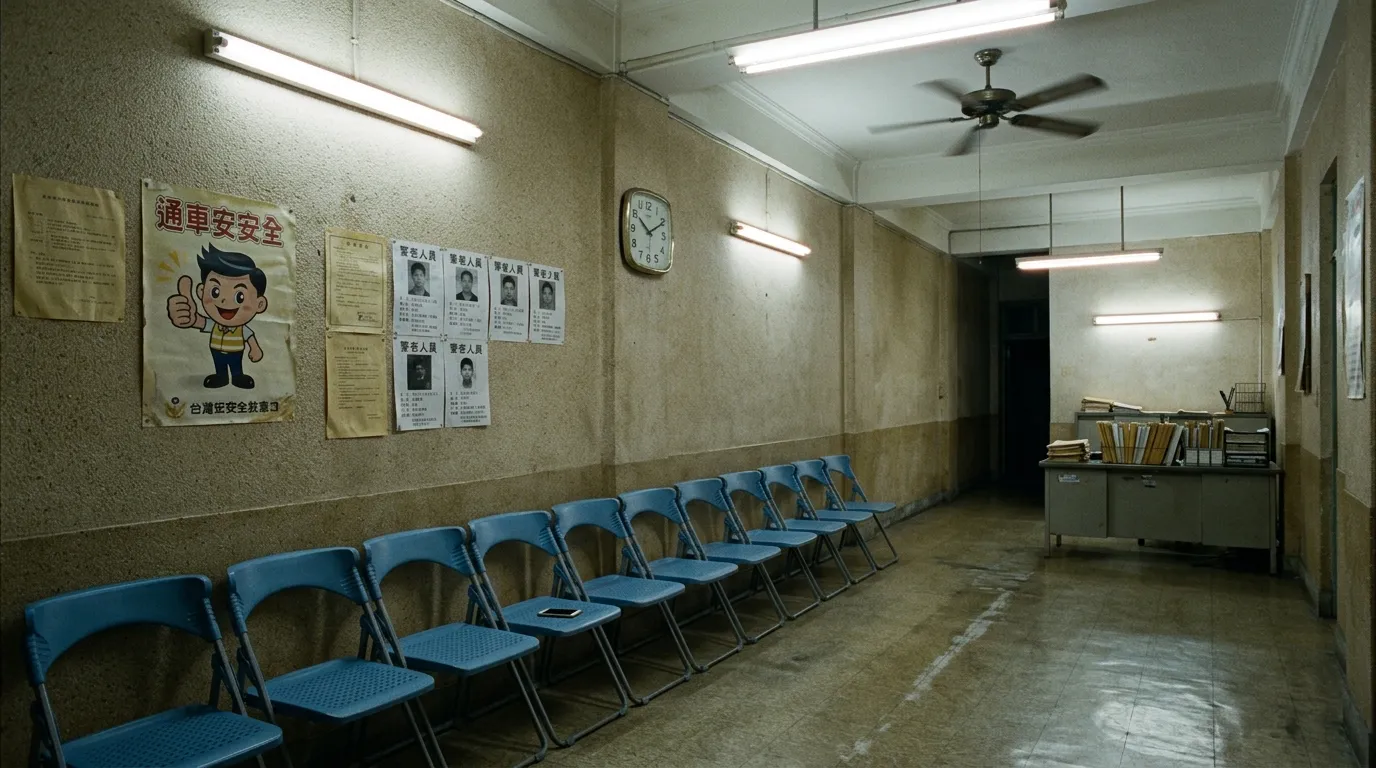
First floor duty room. A high counter, behind it an officer who looked tired writing something. Next to the counter, a row of blue plastic chairs against the wall, one of the chair’s leg screws loose — if you sat in it you’d list to the right. The walls had wanted posters, anti-scam advisories, and a faded traffic safety slogan with print too small for anyone to read.
The ceiling had a ceiling fan. It was turning. Turning slowly enough that you’d find yourself counting the rotations.
Someone brought him a cup of water. Paper cup, the kind that’s more gray than white. Slightly cool. He set it on the chair next to him without drinking it.
The man was sitting across the room. Four chairs between them. They didn’t make eye contact.
The fluorescent lights were very bright. Much brighter than outside — outside had started to dim, March in Tainan, the sky going gray by six-thirty. But in here everything was clean white light, no shadows, nothing to hide behind. He looked down at his hands and could see every line, every fine hair, a small scar on the side of his middle finger he’d never noticed before. Too clear. He didn’t want to see things this clearly.
The wanted posters on the opposite wall. Four photos, three men and one woman. The second man had a scar from his brow to his cheekbone. Xu Gengyong touched his own left cheek. Swollen. Pressing it felt like pressing a not-quite-ripe guava — springy, but it hurt.
He didn’t know what time it was.
The ceiling fan turned. Again. Again.
He went to the bathroom once. The bathroom was at the end of the hallway, the door didn’t shut properly, and it smelled of bleach. He stood at the sink and looked in the mirror. His left cheek had swollen, over the cheekbone — red-purple, going bluish at the edges. His lip had split, the blood already dried, forming a dark brown crust.
He looked at the face in the mirror and felt it wasn’t his.
Not as a figure of speech. He genuinely felt it. The person with the swollen face and dried blood at the corner of his mouth had nothing to do with him. He knew his own face — he looked at it every morning while brushing his teeth, sometimes in selfies — that face had no injuries. This one did. So this one wasn’t his.
He turned the tap to its lowest setting and dabbed water carefully at the corner of his mouth with one finger. The crust softened a little; fresh blood seeped out. He turned the tap off.
The statement room. Three tatami-sized. A table, two chairs, a computer, a video camera propped in the corner with its red light on. Fluorescent lights even brighter than outside.
The officer taking his statement was named Cai, thirties, buzzcut. Xu Gengyong didn’t know why he was noticing these things — he noticed that Officer Cai’s left ring finger had a tan line but no ring. He typed with two fingers. Index and middle, alternating, looking at the keyboard after each key and then back at the screen. The clock on the wall ticked with every second hand movement: tap, tap, tap.
“What’s your relationship with the other party?”
“Don’t know him.”
“No relationship at all? Never met before?”
“No.”
Tap. Tap. Tap. Two fingers.
“Can you describe what happened?”
Xu Gengyong described it. He tried to be thorough. He said he was riding, on that road, there was construction ahead, the lane had narrowed, he merged back onto the main road from the temporary lane on the side, and someone behind him pressed the horn —
“After the horn?”
He’d looked back. Then the other person rolled down his window and started yelling at him. He’d said something back.
“Said what?”
He didn’t remember. Probably something like what are you yelling for. Then the other person started driving close to him, very close, very close — he’d braked and let the other person go past, and then he’d caught up —
He stopped.
“Then what?” Officer Cai’s fingers were suspended over the keyboard.
“I passed him, and I braked hard in front of him.”
He said it himself. Heard his own voice turn this into a sentence. I passed him, and I braked hard in front of him. The subject of that sentence was I.
Officer Cai finished typing. Tap tap tap tap.
“And then both parties got out of their vehicles?”
“Right.”
“Who threw the first punch?”
Xu Gengyong’s stomach contracted. The question was procedural. Who threw the first punch. A question that had right and wrong. A question with an answer. Nothing about injury, nothing about seeing a doctor. One party was going to be written into a particular field.
“He shoved me first. I shoved back. Then he hit me.”
He watched Officer Cai type on the screen. He saw his own name appear in a field. He almost didn’t catch what that field’s heading said — no, he’d caught it. Criminal suspect. Under Criminal suspect, the entry was Xu Gengyong.
“That… why am I under suspect?”
“Both parties are processed this way.” Officer Cai didn’t look up. “The other party is also under suspect. Standard procedure.”
Standard procedure. Okay.
Tap. Tap. Tap.
“We’ll pull the dashcam footage from the scene,” Officer Cai said, fingers still going. “The other party’s vehicle had one installed; we’ll review it.”
Dashcam.
Xu Gengyong thought for three seconds. The white Corolla Cross’s windshield. He hadn’t noticed whether there was a dashcam mounted. But if there was — it had recorded everything. The whole thing. It had recorded the other person pressing his horn, yelling at him, driving close. It had also recorded Xu Gengyong catching up, passing, braking hard, getting out of his vehicle.
Every action, in there.
“Do you want to file a complaint?” Officer Cai asked.
“Sorry?”
“Assault charge. You can file.”
“Oh.” He thought for a moment. “Sure, file it.”
“Okay.” Officer Cai typed a few characters. Then: “The other party is also looking at filing.”
”…He’s filing against me?”
“Right. He says you cut him off first. We’re looking at obstruction and coercion. For the assault charge, his hand has injuries too, but that depends on how it’s determined.”
Xu Gengyong didn’t say anything.
“Would you two like to settle? If both parties agree we can —”
“No.”
Officer Cai gave a small nod and kept typing.
Tap. Tap. Tap.
The second hand went around who knows how many times. Officer Cai typed through one page and turned to the next. Xu Gengyong sat in the chair — the seat was hard plastic, uncomfortable to sit on for long. He looked at the video camera. The red light stayed on. It was recording him.
Then a thought surfaced: Isn’t there an option that says I had a terrible day and on the road I ran into someone who also had a terrible day and we both lost control? File a complaint, don’t file, settle. Three options. Not one of them meant that.
The statement was finished. Officer Cai had him sign. He signed. The handwriting came out uglier than usual, the strokes tilted.
Officer Cai gathered the signed pages into a folder and looked up at him. “You have injuries on your face. Go to the hospital and get them documented — you’ll need a medical certificate.”
”…A certificate?”
“Right. You need documentation to support the assault charge. National Cheng Kung University Hospital emergency, or the municipal hospital — tell them at the registration desk you need an injury certificate.” Officer Cai slid a sheet of paper across the table. It had instructions printed in small type, the photocopy slightly skewed. “Try to go today. The fresher the injury the more accurate the documentation.”
He folded the paper twice and put it in his pocket.
He walked back to the waiting area and sat down. The man was already gone — he’d finished first, left already. The blue plastic chairs held only Xu Gengyong. The ceiling fan was still turning.
He took out his phone.
His notification bar was long. LINE’s red number had climbed to 27. The first thing he saw was from Cai Chenhan — his roommate — three messages. The first was a link. The second was holy shit is this you. The third was ?????
He tapped the link.
A video. Shot on a phone, unsteady. The title was: Tainan road rage man assaults motorcyclist in the street.
He pressed play.
The frame showed a person standing at the roadside — that was him. Then another person walking toward him. The video started there. Whoever was filming hadn’t caught what came before — no horn, no close driving, no hard brake. The video only showed: two people standing face to face, shoving each other, then a punch.
He watched it twice. The second time he noticed the video had been edited. There was a jump cut in the middle, repositioning his shove of the other man to the very front, making it look like he’d made the first move.
He scrolled down to the comments.
This is what he deserves, riding without eyes, good lesson
No actually look at his attitude, he had it coming
Both of them had problems honestly but the motorcycle guy was more aggressive
Hitting someone is wrong regardless of what led to it
Classic Tainan
Anyone know where this is I think I recognize the guy who threw the punch
The motorcycle dude started it right, pretty obvious from the video
Over two hundred. He scrolled three times and stopped. His thumb was still on the screen but not moving.
He flipped his phone face down on his thigh.
He called Chen Luhan.
Three rings. Picked up.
“Hey.” He said it.
“What’s wrong?” Her voice sounded like she might be eating, or doing something. There was a TV in the background.
“I’m at the police station.”
The TV sound disappeared.
“What?”
“Got in an argument on the road. Someone hit me. I’ve finished giving my statement.”
Silence.
He waited for her to say something. She could yell at him, she could ask him how bad it was, she could say how did you let this happen again — anything. Anything at all.
Silence. Five seconds. Maybe eight.
“Is it serious?”
“I’m okay. My face is swollen.”
”…”
“It’s fine,” he said. “Just wanted to let you know.”
“Okay.”
“Okay.”
He hung up.
He didn’t know what he’d been hoping to hear. Anything other than this. Anything other than okay. Though he’d said okay too — he always said okay, it was the easiest word there was, short and blank, no explaining required. But when he heard it from her, that word was hollow, like a bag with nothing in it. If he’d been the one who got this phone call, he would have — he didn’t know what he would have done. Something more than just okay.
Later, a message came through. He looked at it.
Are you okay? I don’t know what to say. We can talk tomorrow.
He walked out of the police station. Outside was completely dark now.
The paper with the injury certificate instructions had been folded twice in his pocket, its corners gone soft. National Cheng Kung University Hospital emergency was to the east, fifteen minutes by scooter. He stood at the entrance and thought for a few seconds. Register, wait, get seen, get the form. Tell a doctor he’d never met, someone hit me. Then that doctor would look at his face and write things down. On paper. Black ink. Facial contusion.
Tomorrow. He put the paper back in his pocket. Same as the broken water heater. Same as the cracked rearview mirror. He knew he should deal with it, he’d remember it was there, but not now.
To the right of the entrance was a convenience store, to the left a self-service laundry. The convenience store’s light was white, the laundry’s light was yellowish, the two beams overlapping on the sidewalk into an uneven patch of color. One of the washing machines was running; through the glass door you could see clothes tumbling in the drum.
His scooter was still at the scene.
He called a ride on his phone. Waited six minutes. A silver Yaris pulled up. He got in the back and gave a location — a nearby intersection, close to the scene but not on it. The driver didn’t ask about his face. Maybe he’d seen it, maybe not; the back seat was dark.
He got out. The scooter was where he’d left it. Handlebars still slightly off-center. The left rearview mirror had always been cracked, and it wasn’t any more cracked now. The white car was gone.
The hardware store down the road had closed. The shutter was down, NO PARKING spray-painted on it. The red brick sidewalk held nothing. No bloodstains — maybe there hadn’t been that much blood, maybe someone had walked over it, maybe it had dried away in the wind. Nothing there.
He straightened the handlebars. Started the engine. Opened the throttle once. The scooter shuddered, settled.
He rode out onto the road.
The route home went past the intersection where it had happened. He could have taken another way around. He didn’t. He didn’t know why. Maybe because taking a different route requires a reason, and he couldn’t produce one. Going straight needs no reason.
The intersection. Construction barriers still up. Orange and white stripes, reflective strips catching in his headlight. One of the traffic cones had fallen over, lying on its side in the road, no one had righted it. The lane was still narrow.
No trace of anything.
Two hours ago, two people had stood here face to face, and one had punched the other. Someone had filmed it. Someone had called the police. Someone had written over two hundred comments online. But the road surface held nothing. Asphalt doesn’t remember anything. Tomorrow morning the construction crew would come back, keep digging their water mains, the fallen cone would get stood back up, the barriers would be pushed forward another two meters.
He rode through.
The wind hit the swollen side of his face. It hurt. Not terribly. The kind of hurt where you know it’s there, but you can choose not to feel it.
He chose not to feel it.