Chapter 6
Performing
Just a Tap
Chapter 6: Performing
Turn signal.
Left turn.
He’d put it on three seconds earlier than usual. The indicator blinked on the dash — tick, tick, tick — like a very patient person reminding him of something.
Lu Lingqin’s right hand rested at the nine o’clock position on the wheel. The skin between his middle and ring fingers had broken open, and the leather caught it with every rotation. He didn’t switch hands. The pain was a kind of confirmation — confirming he was still driving, still heading home, still doing something normal.
The scooter ahead cut in without signaling.
He didn’t press the horn.
His right foot moved to the brake, pressed lightly, eased the car back. The mirrors were clear. On the passenger seat, his polo shirt lay folded in a precise rectangle — he’d changed in the police station bathroom, and the spare white dress shirt had its collar starch intact, still bearing the fold lines from the packaging. When he’d stuffed the polo shirt into his bag he’d checked it over: no blood — none of it his.
府前路 into 健康路, 健康路 into 東寧路. Every road he’d driven thousands of times, but tonight every intersection felt like the first time. At red lights he stopped perfectly square, his tires a clean thirty centimeters behind the stop line. When lights turned green he counted one full second before moving. No one honked at him from behind.
No one honked.
He switched off the stereo. The car held only the sounds of the engine and the air conditioning. His phone was in his bag, silenced — he hadn’t looked at it since leaving the station. He didn’t want to. Now was not the time.
Home.
The garage shutter groaned up into the quiet of the back lane. He pulled in. The dashboard clock: 7:18. Engine off. He sat in the driver’s seat and didn’t move. The only sound left was the chain rattling as the shutter came back down.
He looked at his right hand. A thin film of scab had formed across the break between his middle and ring fingers. Barely visible. Easy to miss if you weren’t looking for it.
He reached to the back seat for his bag. Paused. Opened the glove compartment, tucked the soft pack of Seven Stars into the bag’s side pocket. Three years unopened — the plastic wrap had a fine layer of dust on it. He took the lighter too: an orange BIC. He wasn’t sure it still had any gas.
Upstairs.
The motion-sensor light in the stairwell clicked on. At the landing he stopped for two seconds and arranged his face. Neutral. The face of a husband and father who’d been kept late at the office and was finally home.
Second floor. The television was on, the news anchor’s voice ticking at its unchanging tempo.
“You’re back? Why so late?”
Fang Yun’an leaned out from the kitchen doorway. Her apron had a grease smear on it, hair clipped up, cheeks flushed — she’d just finished the stir-fry.
“Overtime.”
Full stop. He heard his own voice — steady.
“Ah, couldn’t send a message? Dinner’s ready, come eat.”
“Yeah. Let me put this down.”
He set the bag on the entryway cabinet. Turning back, Lu Cheng came charging out of the living room and collided with his legs, arms locking around his knees.
“Baba—”
He crouched. The motion of gathering the boy was muscle memory — nothing to perform. But in the moment of crouching, his eyes passed over his right hand — that redness between the middle and ring fingers, sitting a few centimeters from his son’s face. He shifted his right hand behind the boy’s back. Used his left to pat his head.
“Did you eat?”
“Not yet. Waiting for Baba.”
Fang Yun’an from behind: “He insisted on waiting. Wouldn’t listen.”
“Good boy.” He stood, and Lu Cheng clung to his leg and refused to let go, so he walked to the dining room dragging one leg like ballast.
The pendant light was on, warm yellow. Three dishes and a soup: braised pork belly, stir-fried water spinach, fried eggs, egg-drop soup. Bowls and chopsticks already set. His seat was the one facing the stairs, back to the window.
He sat. Picked up his chopsticks. Lifted a piece of braised pork into his bowl. Chewed. Swallowed. Another piece.
Every motion was correct. The angle of the chopsticks, the rhythm of chewing, the pace of swallowing — all correct. He’d been eating for thirty-eight years; this was not something he could get wrong. But tonight each mouthful landed in his stomach the moment he swallowed and simply sank, like swallowing stones.
“You alright? You don’t look well.”
“It’s fine. Long meeting today.”
Fang Yun’an made a sound and went back to feeding the boy. Lu Cheng was refusing his vegetables, nudging the water spinach to the rim of his bowl with his spoon. She shifted into the particular frequency she kept in reserve for five-year-olds — patient, looping, tireless. He listened and felt it coming from somewhere behind glass, slightly too far away to fully reach him.
The television news drifted in from the living room. He couldn’t make out the words, just the cadence of the anchor’s voice floating through the air.
Then Fang Yun’an looked up: “Oh, did you hear — there was another road rage thing in Tainan today, someone caught it on video. I think it was somewhere on 東豐路 or somewhere around there.”
His chopsticks stopped.
Half a second.
He placed the piece of pork in his mouth, chewed twice, swallowed.
“Mm.”
“Really insane, over someone pressing a horn or whatever, and then the guy actually got out and hit him.” She was talking while wiping rice from Lu Cheng’s chin with a tissue. “What is wrong with people these days?”
What is wrong with people these days. He turned the sentence over in his mind, slowly.
“Let’s eat,” he said.
She glanced at him. The look lasted less than a second, then she turned back to the boy. She hadn’t noticed his chopsticks stopping. Or she’d noticed, and filed it under “tired from overtime.”
He kept eating. Braised pork, water spinach, fried egg, soup. Every mouthful went down.
9:15. Lu Cheng was asleep. Fang Yun’an was in the bedroom scrolling her phone. He said he needed to deal with a few things in the study. She made a sound without looking up.
Fourth floor. Study. Door closed.
He turned on the desk lamp, its circle of light covering just the surface of the desk. He sat down, pulled out his phone. His stomach clenched as the screen lit up.
LINE: seventeen unread messages. Six from different group chats — all the same video link.
He didn’t open LINE first. He opened Google, typed: “Tainan road rage assault.”
Results in 0.3 seconds.
The video was on three platforms. The highest count — seventy-two thousand views. He stared at the number, finger going still against the screen. Seventy-two thousand. Six hours ago he’d been at that intersection, and now seventy-two thousand people had watched him throw that punch.
He opened the video. A dashcam angle, slightly tilted, not great resolution but clear enough. He watched himself — white Corolla Cross stopped in the middle of the road. Door opening. Walking forward. The swing.
He paused it on the frame where his fist made contact. Motion blur, but recognizable. Recognizable as him.
He couldn’t read all the comments. Scrolled through a few. “People like this should be locked up.” “Anyone recognize this car?” “Plate zoomed in” —
The plate had been screenshotted and enlarged. Perfectly legible.
He kept scrolling. Someone had started a thread: “This white CC parks regularly on 東寧路 XX Lane, anyone in the area know the owner?”
He placed the phone face-down on the desk.
Sat there. The desk lamp humming.
Then he picked the phone back up, scrolled through his contacts. Zhou Yanting. College classmate, practicing attorney — criminal law mainly. They’d drunk together at a year-end dinner three years ago, added each other on LINE, barely spoken since.
He pressed call. Four rings.
“Hello?” Zhou Yanting’s voice carried a note of surprise. A friend who almost never calls, at this hour — you’d be surprised.
“Yanting. It’s Lingqin. Good time to talk?”
“Lingqin? Long time. Sure, what’s up?”
“I want to ask about… a hypothetical situation.”
Silence on the line. One second.
“Go ahead.”
“Say a person — on the road — gets into an altercation with another driver over a traffic incident. A physical altercation. He hit the other person. There’s dashcam footage. Both parties have filed complaints.”
He heard his own voice reciting a report. Subject: a person. Verbs: passive. Sentences: complete.
Zhou Yanting didn’t respond. The silence held for about three seconds.
Then there was a very subtle shift on the other end — not in tone, not in volume, but in something like… density. The air tightened. Zhou Yanting drew a breath, and when he let it out, the friend was gone.
“The person you’re describing — does he have a prior record?”
That was it. The person you’re describing. He could have said “your friend,” or “this hypothetical person.” Instead: the person you’re describing. A phrasing of exact precision — carrying no judgment whatsoever, and for that reason, all judgment already passed.
“No.”
“Other party’s injuries?”
“Facial contusion.”
“How many strikes?”
“One.”
He paused. His right hand had closed involuntarily. The scab across his knuckles pulled.
“Two.”
Zhou Yanting asked a few more questions. He answered each one. Short. Like a second round of the police statement.
“Is your hand injured?”
He looked at the scab between his middle and ring fingers. “Yes. Abrasion.”
“Go to a hospital tomorrow, get examined, obtain a medical report. He struck someone, but he also sustained injuries in the confrontation — the pushing and shoving. That needs to be documented.”
“Okay.”
Zhou Yanting paused. The sound of a chair adjusting came through the line — he’d shifted his position.
“On the assault charge — it’s complaint-based, the other party filed, but if the injuries aren’t severe there’s room for settlement.” His speech slowed, each word distinct. “There’s one thing he needs to be prepared for — you said he forced the other vehicle over?”
”…Yes.”
“If that’s classified as criminal coercion, it’s a public prosecution. Even if the other party agrees to settle and withdraws, the prosecutor can still proceed. If the dashcam captured it —”
He didn’t finish. No need.
Lu Lingqin’s throat tightened. He thought of the other car’s dashcam. The red light, blinking. Recording. That red light was still blinking in his head, brighter than any traffic signal he’d ever driven through.
“Don’t discuss this with anyone. You’ve seen the video?”
“Just now.”
“Right.” That same dense silence. “Come to the office tomorrow. Bring your statement copy. Get the medical report done first and bring that too.”
“Okay. Thank you.”
“Lingqin.”
“Yes?”
“Get some sleep tonight.”
He ended the call. Get some sleep. He turned the phrase over in his mouth. Get some sleep.
The balcony door grated open — the rust on its hinges catching.
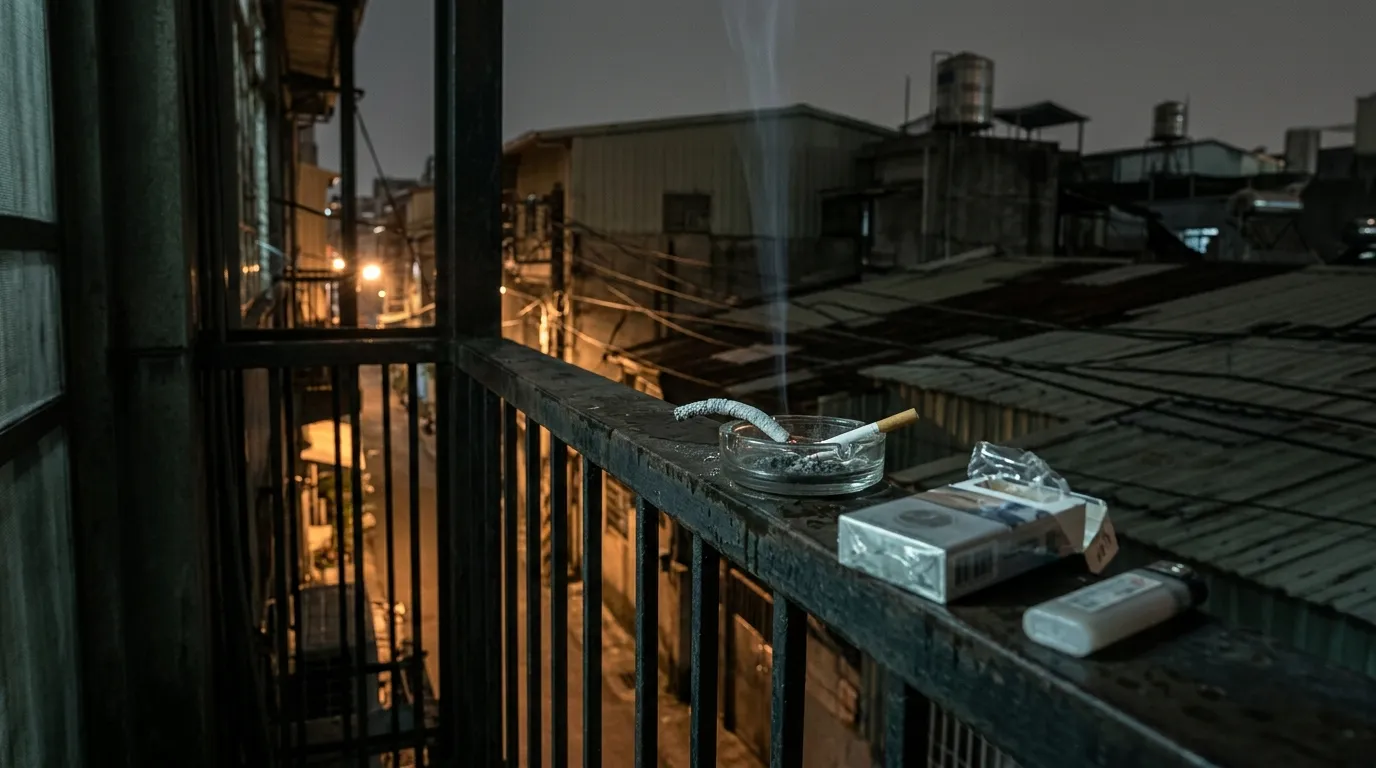
A meter and a half of space. Iron railings, a corrugated iron awning, and a rusted bucket on the floor full of charcoal ash from last Mid-Autumn’s barbecue. He stood at the railing and looked out at the roofline of the back lane. The street lamps below cast orange light that didn’t reach up here. Somewhere in the distance, insects droned — continuous, unbroken, like white noise.
He pulled the Seven Stars from the bag’s side pocket. The dust on the plastic wrap crumbled at his fingertips. His fingers remembered how to tear the seal even after three years away from it — muscle memory holds longer than you think. He slipped one out, put it between his lips.
The BIC clicked twice without catching. Third try: the flame rose, orange, burning quietly in the still night air.
First drag.
Smoke into the lungs. That burning — familiar, and yet not entirely. His lungs three years ago weren’t the same lungs as now. Three years ago he’d stood on this balcony smoking his last cigarette, told Fang Yun’an he was quitting, and she’d said okay. Lu Cheng at that point had just learned to climb stairs by himself, one hand flat against the wall, one step at a time.
He exhaled. White smoke, disappearing quickly in the darkness beyond the street lamps’ reach.
His hand was trembling.
Only at the fingertips. A low-frequency vibration between the fingers holding the cigarette, like a phone on silent skittering across a tabletop. He looked at his own hand. The injury between his middle and ring fingers was invisible in the dark, but he knew it was there.
He thought of the moment his fist made contact with the other man’s face.
That sensation came back.
Muffled. Blunt. Bone against bone. Nothing like the clean sound you hear in films — no sound at all, or maybe there was one and he hadn’t heard it. What he remembered was the feedback: starting at the knuckles, traveling up through the wrist, the forearm, all the way to the shoulder. His whole arm remembered it.
He had hit a person.
A stranger.
Over one press of a horn.
Heat rose behind his eyes. He didn’t know if this was wanting to cry. He couldn’t remember the last time he’d cried. The heat was coming from inside the socket, pushing outward, like the pressure behind the eyes when you’re running a fever. He took a long drag and forced it down.
The ash had grown out. White-gray, curving off the end of the cigarette in a precarious arc, about to fall. He didn’t tap it. The ash dropped, landing on the back of his right hand. A brief burn.
He didn’t move away from it.
The sensation held for about a second, then turned to warmth, then nothing. A small gray circle on the back of his hand.
He stood on the balcony and smoked to the end. Tainan’s night was quiet. Somewhere out there the occasional sound of a car, a scooter passing through the lane entrance. The insects never stopped.
He pressed the stub out against the iron railing. Tucked the pack and lighter back into the bag’s side pocket. Eased the balcony door shut behind him.
Back to the study. Desk lamp off. Downstairs.
The bedroom door was open, Fang Yun’an’s breathing steady and even. The bedside nightlight glowed warm orange. He moved to his side of the bed without making a sound, lay down, pulled the covers to his chest.
Headlights swept across the ceiling. Coming through the gap in the curtains, slow arcs of light moving left to right, then gone. The next car: another arc.
He thought of this morning. Standing at the mirror in the changing room. Looking at the man in the polo shirt looking back.
Everything’s under control.
He turned onto his side, facing away from her.
Closed his eyes. The headlights kept moving across the backs of his eyelids. One arc, then another.
He opened his eyes.