Chapter 7
Empty
Just a Tap
Chapter 7: Empty
He didn’t turn on the light.
Key into the lock, two turns, door open, step through, door shut. Just that. No light. Shoes kicked off, back against the door, sliding down to sit on the floor.
Six square meters of room, and in the dark it was bigger than it really was. The alley streetlamp outside pressed a block of orange-yellow light against the opposite wall, crooked, like a piece of paper someone had crumpled and couldn’t get to lie flat.
His phone buzzed in his pocket. Then again. Then again.
He pulled it out. The screen lit up and the whole room flashed white for an instant. The notification bar wouldn’t stop scrolling. His roommate Cai Chenhan, three university friends, two former coworkers, a number with no name saved next to it. He didn’t unlock the phone. Flipped it over, screen down, set it on the floor beside him. Each buzz sent it sliding a fraction across the tile with a low hum. Like an insect that had flipped onto its back and couldn’t right itself.
He sat for a long time. Long enough for the residual warmth in the wall to seep through to his back. The corrugated iron roof of the top-floor addition had spent the day absorbing heat, and it was still pressing down now, the whole room stuffy like being sealed under a pot lid. He could smell: concrete, damp, a layer of cigarette residue that no amount of washing reached, instant noodles drifting in from next door.
His face was swollen.
Left cheekbone, the sensation had shifted from pain to pressure, swelled enough that he could feel his own pulse beating there. He got up, went to the bathroom, didn’t turn the light on, felt his way to the faucet, turned it on cold, soaked the towel. The water amplified in the small space. He wrung the towel out, pressed it against the left side of his face. The cold hit him and he drew a sharp breath.
Then he saw the mirror.
No light in the bathroom, but the streetlamp outside bent enough light through the window to catch the mirror surface. A crack ran through the lower right corner, splitting his face in two: right side normal, left side swollen. The scab at the corner of his mouth had broken and dried again, a dark red-black crooked line.
He stared at his face in the mirror for a few seconds. He was checking that the face was his.
He couldn’t confirm it. He recognized every piece — eyes, nose, the bruise — but couldn’t assemble them back into a person.
He took the towel down, soaked it again, wrung it out, pressed it back. Moving slowly, like doing something that had nothing to do with him.
Back in the room, he sat on the edge of the bed. Still no light.
And then he started thinking.
His mind started rewinding on its own — he hadn’t chosen to.
Morning. Cold water on his face. He could still feel the faucet handle in his fingers. Three minutes queuing at the breakfast stand — the man in front of him staring at the menu like it held the answers to fundamental questions, asking about cheese, saying let me think. He’d stood there. Said nothing. He never said anything.
The construction road. The detour. His scooter bay taken. He’d circled around and parked farther away. Said nothing.
Work. The v3 proposal rejected by the client. Zheng Xinpei, in front of the client: “I’ll have another talk with him.” Him. He’d said, “Sure.” Period.
His mother’s call. His father’s blood pressure up again; come back to Shanhua on Saturday. He’d said sure. He said sure to everything.
The afternoon rush job. Zheng Xinpei dropped a message: “Can you get this done today? Thanks.” One hundred and thirty-seven items for cross-reference. He replied: “Sure.”
And then one press of a horn.
He couldn’t work it out. Each thing on its own was nothing. Cold water on his face: nothing. Three minutes in a queue: nothing. Scooter bay taken: nothing. Proposal rejected: nothing. I’ll have another talk with him: nothing. His mother’s call: nothing. A hundred and thirty-seven items: nothing. All of it: nothing. Every single one of it: nothing.
But there was a bruise on his face. Left cheekbone, purple-red, shifting toward black by now. How had this bruise gotten here? Which one of these nothings had built it? Or had all of them together added up to exactly the weight of one fist?
He didn’t know. He genuinely didn’t know.
His phone buzzed again. He glanced down. The screen lit up, and at the top of the notifications:
Luhan: Are you okay? I don’t know what to say. We can talk tomorrow.
He read every word. Are you okay. I don’t know what to say. We can talk tomorrow.
We can talk tomorrow.
Okay.
He didn’t reply. He set the phone back on the floor. Screen going dark.
He should call her. Or call his mother. Or call someone. He had a phone in his pocket and over a hundred names in it. He could not find a single one to dial.
There were people he could have called. But what would he say after dialing? “I hit someone today”? And then what were they supposed to say back? “How could you”? “Are you okay”? “Were you under too much stress”? He’d pre-played every version. There wasn’t one he could catch.
He didn’t know how to accept care. Had never known.
So he didn’t call. He dressed it as his own choice, turned being alone into something he’d chosen. But somewhere inside him a counter was running, very quietly, recording the entry: she said we can talk tomorrow. She didn’t come.
He went out.
Convenience store at the end of the lane, one minute on foot. Tainan in March was technically not cold at night, but the air felt heavy against the skin. He wore slippers, shorts, the same T-shirt from this morning. His face uncovered. His phone was in his shorts pocket because his hand had found it on the way out the door.
The automatic doors chimed open. White light fell down. The air conditioning rushed in, and as it hit him, every pore contracted, and the swelling on his left cheek sharpened in the cold — pain dialing up suddenly, as if someone had turned the volume.
He went to the refrigerator section. Pulled out two cans of Taiwan Beer. The aluminum was cold enough to ache in his fingers. He grabbed a soft ice pack too, heavy.
The clerk — early twenties, scanning by reflex. Beep. Beep. He glanced up at Xu Gengyong’s face once. Just once. Then back down to the scanner.
The television mounted in the corner was running news. Two people grappling on the side of a road, someone in the background filming on a phone. The ticker at the bottom scrolled some dispute, some assault. Someone else’s news. Different person. Different road. Different night.
He stared at the screen for ten seconds.
“Do you want your points?”
He looked back. “Yes.”
The clerk scanned his loyalty card, bagged the beer and ice pack. Xu Gengyong paid. Plastic bag in hand, out through the automatic doors. Chime.
Do you want your points. At this hour, with a face like this, standing at a convenience store counter saying yes to loyalty points. What are they even for. Redeem for store credit. Buy what. Buy more beer.
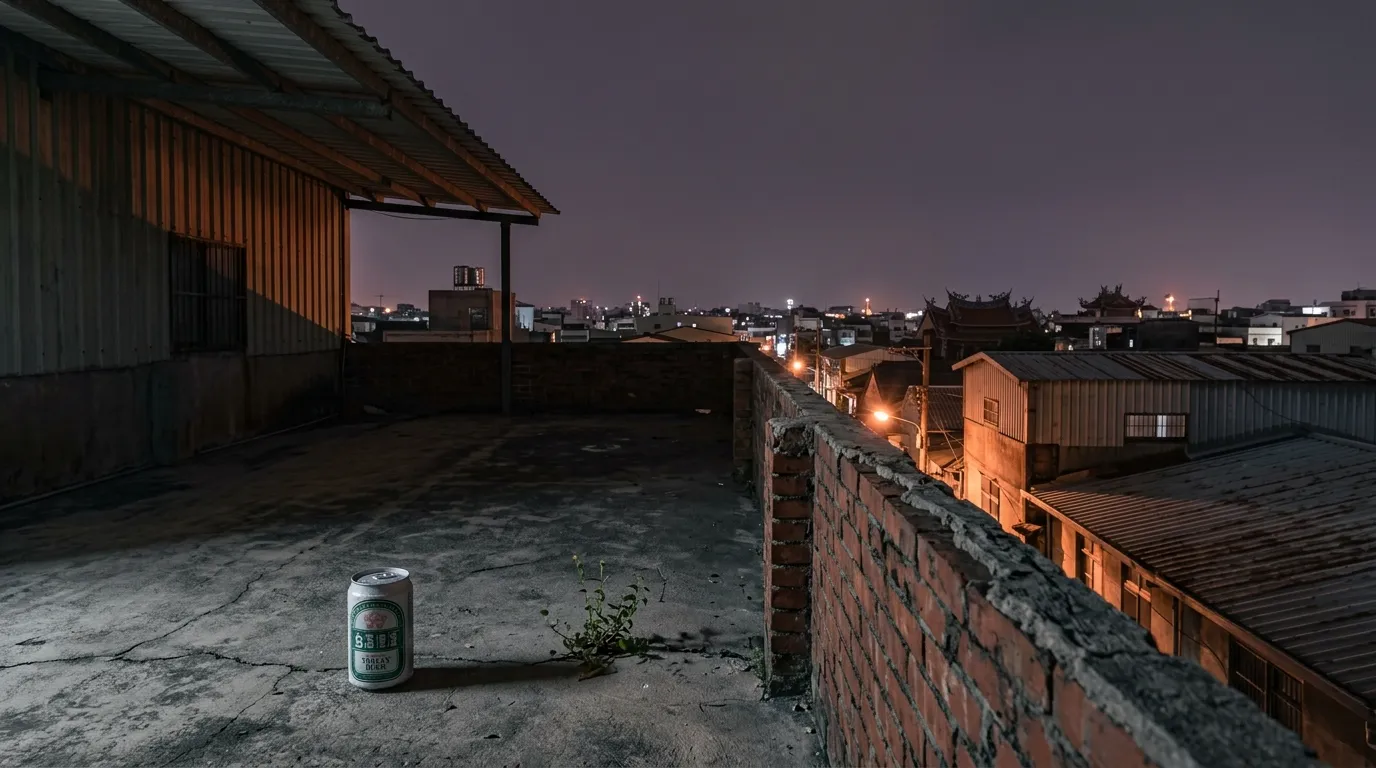
Back to the fourth floor. He tore open the ice pack and pressed it against his left cheek, the cold seeping through the plastic. He threw his phone onto the bed, took the beer, and walked up toward the stairwell.
The iron door to the roof was rusted. Pushing it open made a sound like a fingernail dragged across a chalkboard — one long, scraping note. The stairwell smelled of iron that had been baked all day, mixed with mosquito coil smoke from somewhere.
He sat down. Back against the iron sheeting, facing the city. The sheeting was still warm — the day’s heat not yet gone. His beer was ice cold. Two temperatures meeting his body at once: warmth behind him, cold in his hand. Like two seasons pressing against each other.
Beyond the parapet wall, Tainan’s sky was a deep gray-purple. Light pollution had stained the cloud cover that color; no stars visible. Distant buildings were lit in scattered points — some of them apartments, some of them signs someone forgot to switch off. Underneath it all, the base noise of traffic. Occasionally a dog barked. Three times, then stopped — as if the dog itself decided it wasn’t worth the effort.
He opened the beer. The tab pulled back, a hiss of gas. First sip.
He choked.
The beer came up through his nose, and he coughed twice, eyes squeezing out a little involuntary water. He wiped it with the back of his hand. And then he laughed.
Not the kind of laugh that means something is funny. The kind of laugh you’re left with when things have become so absurd they’ve crossed some threshold, and that’s the only expression your face knows how to make. This morning he’d queued for a dan bing. Tonight he was on a rooftop alone with a beer, a bruise on his face made by someone’s fist. What had happened between those two points? How had he gotten from A to B? What route?
He laughed. Quiet. A breathed-out sound, more exhale than voice, his shoulders barely moving.
Then he stopped.
Because he remembered something.
Lunchtime. The convenience store. His phone.
A road rage story. Someone pressed their horn, and the other driver got out and hit him. He’d been chewing through a chicken leg bento at the time, and a thought had drifted up through him —
What’s wrong with people like that? Seriously.
He was that person.
He was the person with something wrong with him. Someone pressed a horn, and he was exactly like that. That exact kind of not-okay. He was it.
The laugh jammed in his throat. Turned into a swallowing motion. His throat moved up and down once, hard, like forcing something back down.
He set the beer on the ground beside him. The weeds growing from the cracks in the concrete brushed against the base of the can as it settled, a faint scrape. He brought both hands to the back of his head, fingers pushing into his hair, and bowed down.
No tears came.
He just couldn’t lift his head.
He stayed with his head down. Knees pressing against his forehead. Breathing shallow. The iron sheeting behind him radiating its leftover warmth. The beer can beside him sweating condensation onto the ground. Somewhere out there a scooter revved high through the lane and the sound came and went.
He was that kind of person.
At lunchtime he’d been laughing at that kind of person.
He held that position for a long time. Long enough to not know how many minutes. Long enough that the iron sheeting against his back seemed to have cooled a little.
Finally he let his hands go. Didn’t raise his head. Just lowered his hands and let them hang on either side of his knees. Picked up the beer. One sip. No choking this time.
One more sip.
His phone buzzed once in the room downstairs. He didn’t hear it. Or he heard it. Didn’t matter.
Tainan’s night was hot. The iron roof above still held the day’s warmth. In the distance, the sound of an ambulance — wavering and drawn out — threading through several streets, getting smaller.
He didn’t know if someone had gotten into an accident on the road somewhere.
The wind came. Carrying a trace of incense smoke. Someone’s house, burning an offering. He didn’t know whose.