Chapter 8
The Road
Just a Tap
Chapter 8: The Road
He opened his eyes.
No — he hadn’t. Because he’d never closed them. The moving car lights on the ceiling had stopped at some point. What came through the curtain gap now was daylight. Gray, not quite bright yet — the particular, undecided light of five-thirty in the morning.
His wife’s breathing beside him was steady. The night-light still glowed warm orange.
He turned onto his side and set his bare feet on the tile floor. Cold. The same cold as every morning. But this morning his toes didn’t curl. He stood beside the bed and spent three seconds figuring out what to do next — go downstairs. Get water. Then what. Then follow the routine.
He put on his slippers. The movement came a beat slower than usual, like pressing a button on a phone with bad signal and watching the screen hang before it responds.
Downstairs.
The kitchen on the second floor. He turned on the yellow lamp above the island counter. A circle of light fell, one small bright patch, everything else dark. Same as every morning. He opened the cabinet for a glass. The glasses were on the right side of the second shelf, third one in. When his fingers touched the rim, they paused — the scab between his middle and ring finger pulled. A small pain, not sharp. He took the glass out, set it on the counter, opened the filter pitcher and poured.
The sound of water filling the glass was clear in the quiet kitchen.
He drank a sip. Swallowed. Drank another.
Then he saw the refrigerator.
More precisely, he saw the drawing on the refrigerator door. Lu Cheng’s — from who knows when. A family of three inside a square car, a sun on the roof bigger than the car itself, all three people smiling. Just smiling.
He had seen this drawing many times before. Every morning when he made coffee. But he had never really looked at it — it was just one of the things on the refrigerator, the same as the magnets and the delivery menus.
Today he looked.
The car in the drawing had no license plate. The three people had nothing on their faces beyond the smiles — just smiles. Round smiles. Five-year-old smiles, the kind that don’t need a reason. No dashcam in the car. No spare shirt. No briefcase. Just three people and a sun.
He finished the water, set the glass in the sink. Turning away, he looked at the drawing once more.
Then he started making breakfast.
Oatmeal. Milk. Lu Cheng’s bowl. A spoon. A placemat. A cereal bar set beside the placemat, backup — Lu Cheng never finished his oatmeal but would always say he was hungry once they left. Every item he took from where it belonged and placed where it was supposed to go. The sequence was right. The order was right. But between each movement there was an extra pause — pick up the bowl, stop, set the bowl down. Pick up the milk, stop, pour the milk. Like a video playing at 0.9 speed. You wouldn’t notice unless you were looking for it, but something was off.
Six-fifteen. He glanced at the wall clock. Six-fifteen. Still early to wake the boy. He knew. But he was already standing, his feet already moving toward the stairs. The routine was running ahead of him, and he couldn’t keep up with it, couldn’t pull it back.
He went upstairs to wake Lu Cheng.
He pushed open the door. Cartoon stickers. A head poking out from under the blanket.
“Cheng, time to get up.”
His voice was steady. He heard his own voice and confirmed it — steady.
“Mmm…” Lu Cheng rolled inside the blanket. “What time is it?”
“Six-fifteen. Come on.”
“Okay.”
He stood in the doorway for two extra seconds. Lu Cheng sitting up looked the same as every morning — hair messy, eyes squinting, whole body soft. The same. Everything the same.
He went back downstairs.
Six twenty-five. Fang Yun’an appeared at the top of the stairs.
She was in her pajamas, hair loose, phone in hand. Her face still had sleep in it, but not the blurred kind of someone who’d just woken up — the slightly sharp kind, the kind that comes when something wakes you before you’re ready.
She looked at him.
He was standing behind the counter, holding the milk carton. He saw her standing at the top of the stairs, looking at him. Phone in her right hand, screen facing down.
That look.
Not anger. Not worry. Not fear. Not disappointment. Not any of the things he had ever seen on that face. It was —
Strangeness.
The way you look at someone you don’t know. First day in a new building, the elevator opens and a stranger is standing there. You glance at each other. Neither of you is anything to the other. Just two people who happen to occupy the same space.
The look lasted no more than two seconds. Then she put her phone in her pajama pocket, walked into the kitchen, stepped around him, opened the refrigerator, and took out a small bottle of yogurt drink. Closed the refrigerator.
“Is Cheng up?” she asked.
“He’s up.”
“Okay.”
She took the yogurt drink upstairs. Her slippers on the tile: tap, tap, tap.
He stood behind the counter. The milk carton still held at the same angle as before. He didn’t know if that look had lasted two seconds or two years. But he knew his wife had seen something. Her phone held the footage, or the news screenshot, or the enlarged photo of his license plate.
She knew.
She hadn’t asked.
He hadn’t said anything either.
He picked up his phone. Mute had been on all night. Notifications had spread across the screen like watermarks.
LINE unread messages: forty-three. He didn’t open any of them. But the preview list was enough — the company group, Xiao Wu at 6:08 a.m.: Boss, the manager just LINE’d me asking if something happened with you yesterday. I didn’t say anything, but it seems like he saw the news too…
He locked the screen.
Back on again. Three missed calls. Two from numbers he didn’t know — one Tainan landline, one mobile. The third from the company’s main line. Time stamp: 11:12 p.m. last night. The boss wouldn’t call from the company line at eleven unless he was in the office. Unless he was handling something.
He flipped the phone over, screen down, on the counter.
Six-fifty. Time to leave.
He took a white dress shirt from the closet. The same style as the one he’d worn yesterday. He owned three, hung in the same row in the closet, evenly spaced. One missing, a gap where it had been — like a row of teeth with one pulled.
Garage. The roller shutter rose. He fastened the buckle on Lu Cheng’s car seat. Lu Cheng’s legs dangled in the air, a half-eaten cereal bar in hand. He took a bite; crumbs fell onto the seat.
He got into the driver’s seat. Buckled in. Adjusted the rearview mirror — the angle hadn’t changed. Hand on the gearshift, confirmed P. Turned his head and checked the dashcam. The red light. Recording.
His gaze rested on that red light for a moment.
He opened his mouth. No sound came out.
Then he started the engine and reversed out of the garage.
Fang Yun’an was standing at the garage door. She didn’t usually stand there. Usually she called down from the second-floor window — be careful on the road — and that was it. Today she was at the door, watching the car back out.
Lu Cheng rolled down the window: “Bye-bye, Mama—”
She waved once. Her expression was normal. A small smile. Smiling at Lu Cheng.
She didn’t look at Lu Lingqin.
He pulled the car out of the alley. The old man who sat under the building arcade every morning having tea — Lu Lingqin didn’t know his name, but they nodded to each other every day passing through — wasn’t having tea today. He was sitting there, phone in hand, looking at something. As the car drove past, the old man lifted his head and looked at the car — past him, at the car itself. The white Corolla Cross. About a second, then he looked back down and kept scrolling.
Lu Lingqin’s fingers tightened on the steering wheel by one notch.
He pulled onto the road.
The streets of Tainan at seven in the morning were already moving. Steam from breakfast stands, scooter engines, an old man walking under the arcade. The streetlights were still on, mixed with the daylight, every object casting two shadows.
He turned left on Dongning Road. Then he saw that intersection.
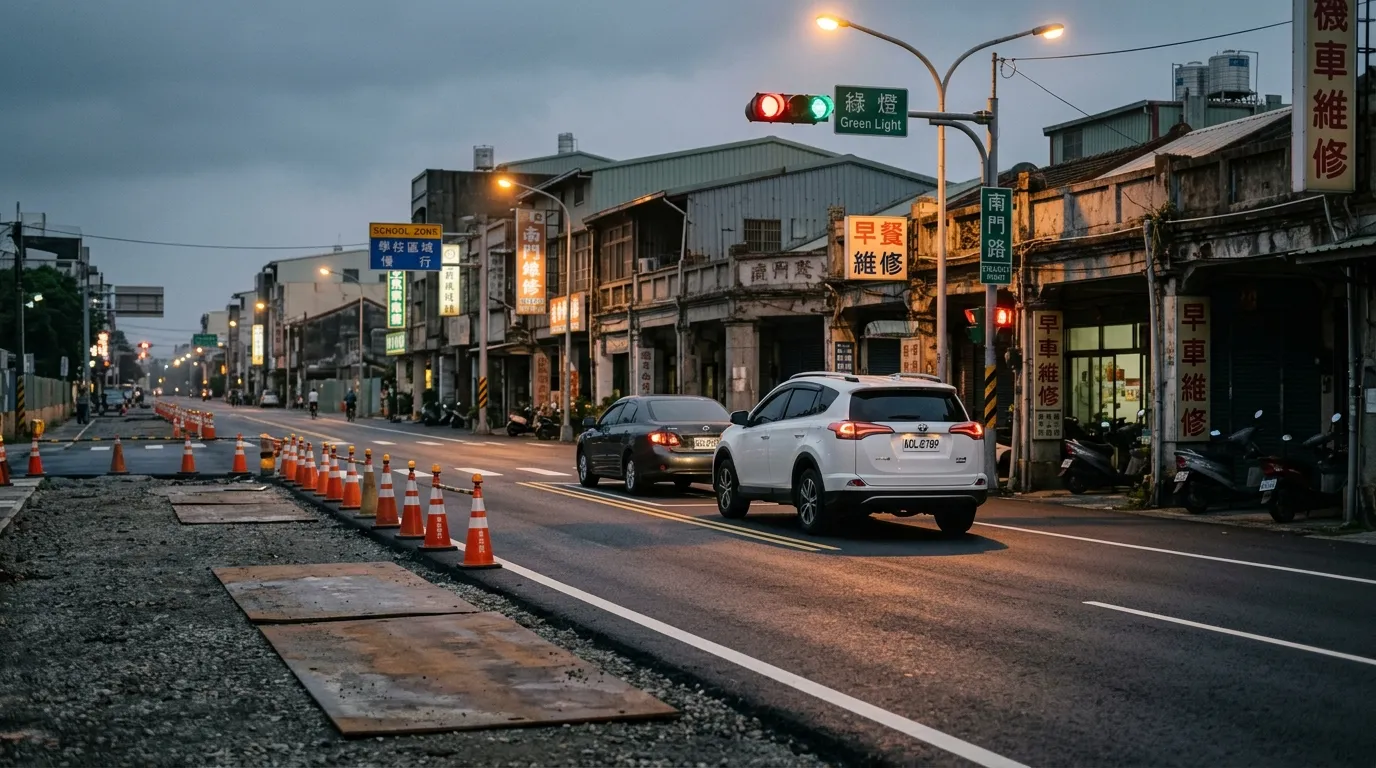
The construction barriers were still there. Traffic cones in a line, alternating orange and white. Half the road surface had been paved — new asphalt, black and smooth, catching the morning light. The other half was still gravel and dirt, covered with iron plates. The water pipe replacement notice still stood at the side, date running to next month.
In a few more days this road would be finished. New asphalt would cover all the gravel and potholes. The surface would look like any other road. There would be no trace — no marker saying something had happened here.
He drove through that stretch. Speed unchanged. Steering wheel straight. Eyes looking directly forward.
Lu Cheng in the back seat was working through his cereal bar.
“Dad.”
“Mm.”
“I drew a new picture yesterday.”
“What kind of picture?”
“Like the one on the refrigerator. But I drew an extra person.”
“Who?”
“Just… someone standing outside the car. But I don’t know who he is.”
Lu Lingqin’s fingers tightened on the steering wheel. All ten fingers pressing, knuckles gone white. The scab between his middle and ring finger was pressed against the leather, cracking slightly. A small sting.
“You draw what you draw.” He said it.
His voice was steady.
He turned the car into the alley in front of Mingcheng Elementary. Parents were already there at the gate, the flow as chaotic as always. He pulled over, got out, unclipped Lu Cheng’s harness. Lu Cheng jumped down, swung his backpack on, looked up at him.
“Bye-bye!”
“Be careful.”
Lu Cheng ran. His backpack bounced with each step.
He stood beside the car for three seconds. Then he looked down at his right hand. The scab on his knuckle. On the back of his hand, a small gray circle — a burn mark from a cigarette ash.
He walked back around to the driver’s seat. Sat down. Closed the door.
The car was quiet. Engine still running, the sound of the air conditioning. He turned and looked at the spot behind the driver’s seat. The spare shirt was gone — he’d worn it yesterday. The hook was there, empty, hanging with nothing on it.
He used to always make sure there was a spare shirt in the car. Coffee might spill, a child might get sick, clothes might get dirty — he had a contingency for every possibility. But his contingency list didn’t have this item. No if you punch a stranger on the road. No spare life hanging in the back seat.
He pulled the car out of the alley and merged into traffic.
There was a red light ahead. He stopped.
Second car in the line. A silver small truck in front. Cars filling in behind.
He sat in the driver’s seat. Both hands at ten and two on the steering wheel. The idle vibration of the engine came up through the seat.
Red light.
He wasn’t thinking about anything. Everything in his head had sunk to the bottom, too heavy to stir. The silence had settled on him; he hadn’t chosen it. He stared at the rear of the truck in front. On the back, a faded sticker: KEEP YOUR DISTANCE. ARRIVE SAFE.
The light turned green.
The truck in front started moving.
He didn’t.
His foot was on the brake. His right foot needed to move to the accelerator. That movement required a signal, and the signal was in transit. Delayed.
A car behind him tapped the horn.
Light. Just a tap. Short. Polite. The kind that means hey, green light.
His fingers moved on the steering wheel. His right foot shifted to the accelerator. He pressed down. The car started moving. Slowly, forward.
He drove away.
Lin Zhiyu was running late.
Only five minutes late. But her supervisor was the kind of person who treated five minutes as a character flaw, so she had her foot down, pinning her hair up with her right hand while watching the road.
Red light.
She stopped, behind a white SUV. Waited twenty-something seconds. The light turned green. The car in front didn’t move.
She waited a second. Two seconds.
She tapped the horn. Light. Just a tap.
The car ahead moved, slowly drove on.
She pressed the accelerator and rejoined the flow.
That was all.
She flicked on her right turn signal, moved into the outer lane, passed the white car. She glanced at it — male driver, mid-thirties, white dress shirt, expression unclear.
Then she was gone. Being late filled her entire head. Progress report at this morning’s meeting, coffee not bought yet, yesterday’s email still unanswered.
She didn’t know that the man in the car she’d just passed had gotten out at a construction intersection the day before and hit a stranger in the face.
She also didn’t know what the sound of her horn had sounded like inside that man’s ears just now.
She didn’t know anything.
No one knew.
That’s how roads are. Everyone in their own car, watching their own little stretch of road ahead. Red means stop, green means go. Some go a little faster, some a little slower. Every now and then you tap the horn, every now and then you get tapped. Then everyone drives away, to wherever they’re going.
Everyone thinks they’re not that person.