Chapter 1
Chapter One: Anomaly
Chén Jiànhóng was staring at a pull request on his screen. The reviewer had left twelve comments, three of them flagged with red exclamation marks. He was about to argue them one by one when the front door clicked—keys turning in the lock.
“I’m home.” Pèiqí dropped her bag on the shoe cabinet, kicked off her flats, her footsteps carrying their usual brisk efficiency. “Kids asleep?”
“In their room. Not sure if they’re up.” He didn’t look away from the screen. Comment number nine questioned his error-handling logic. The reviewer wrote, “Could this have a race condition?”—Race condition my ass, he muttered internally. I specifically added a mutex, did you not see it?
His fingers tapped the desk twice. Forget it, deal with it later. He picked up his mug and took a sip of cold coffee, glancing at the clock in the corner. 2:17 p.m.
The TV in the living room was off, but his phone buzzed. Not a message—a news app push notification.
[BREAKING] Large-scale violent incident near Nangang Exhibition Center. Police have sealed off the area. Public urged to avoid the vicinity.
He swiped it open and skimmed. Nangang. That was roughly… twelve kilometers from home. He did a quick mental calculation. Far away. He tapped through, but there were no details—just a blurry aerial photo. People seemed to be lying on the road. The image was too grainy to make out anything.
Closed it. Back to the comments.
About ten minutes later, his phone buzzed again. The company group chat this time.
Kevin: Is that Nangang thing serious? Anyone watching the news?
Elaine: My friend works in Nangang Software Park. She said the whole building went into lockdown.
Rex: Look at this
Rex dropped a link. Jiànhóng tapped in. A phone-recorded video. The footage was shaky—the person filming seemed to be running. The camera swept across a wide road: several people on the ground, someone screaming. Then a figure appeared in the frame—no, one person chasing another. The one doing the chasing moved wrong. Legs pumping too fast, upper body barely shifting, like a marionette with strings attached only to the legs.
He scrubbed the video back. Watched it again.
Not possible.
He watched it a third time. His fingers drummed the desk faster, unconsciously.
Jiànhóng: Is this video real? Has anyone verified the source?
The group went quiet for a few seconds.
Rex: …Jiànhóng, how would you even verify that? It’s all over PTT.
Kevin: Shit, have you guys turned on the TV? Every channel is running this.
Jiànhóng got up, walked to the living room, and pressed the remote. A news channel filled the screen: an aerial shot looking down on an intersection, dozens of dark figures moving across the pavement. The reporter’s voice trembled in a way she clearly couldn’t suppress: “…authorities have currently classified the attackers’ motives as unknown. Citizens are urged not to—”
The feed cut to the studio. The anchor adjusted her expression, and her eyes flickered—just for a moment. That flicker made Jiànhóng’s stomach clench. Even the anchor was rattled.
“What’s going on?” Pèiqí leaned out from the kitchen.
“Something in Nangang… a violent incident. Looks serious.” He paused. “A lot of people.”
Pèiqí walked to the TV and watched for about thirty seconds. She didn’t ask any questions. Then she turned and went back to the kitchen.
Jiànhóng kept staring at the TV. Channel two, channel three, channel four. Every single one was running the story. One station had patched into a convenience store security camera—a figure rushed in, slammed into the shelving, and lunged at the clerk behind the counter. The feed was cut right there.
The company group chat had blown up. Forty-something messages. He skimmed—someone said their family in Nangang couldn’t get home, someone said all transit was paralyzed, someone was asking if the company would declare remote work.
His brain started building a model on its own. Attackers. Multiple. Abnormal motor patterns. Rapid spread. The lunging motion in the surveillance footage—that wasn’t robbery. Robbers don’t bite—
Wait.
He opened the video one more time. The one chasing people ran like a process still executing after a segfault—core dumped, but the peripheral processes didn’t get the memo, still chugging along. Body running, control system already shot.
He typed that thought into the chat.
Jiànhóng: Does anyone else think those people move like a process still running after a segfault?
The group went quiet for a few seconds.
Rex: …Jiànhóng, are you serious right now?
Kevin: Bro, I think you need to step away from the computer.
He put the phone down. Not enough data. Too many variables. He couldn’t even confirm the basic behavioral pattern of these attackers—
From the kitchen came the sound of the fridge opening and closing. Not the grabbing-a-snack kind of opening. The open-it-all-the-way, pause, rummage, take-things-out-one-by-one kind.
He walked over. Pèiqí was crouched in front of the fridge, sorting vegetables and meat onto the counter by category. Three plastic bags and an insulated cooler bag were already lined up on the floor. A kettle was heating on the stove.
“What are you doing?”
“Getting things ready.”
“Getting what ready?”
She didn’t look up. “Everything in the fridge goes bad if the power cuts. Cook what we can first. Fill up on water first.” She stood, opened the cabinet overhead, pulled out the first aid kit and started rifling through it, muttering under her breath: “Band-Aids, iáu-ū… gauze, got it… iodine—iodine’s expired. Bē-yōng-tit. Fever meds, painkillers—”
“Pèiqí.”
“Mm?”
“Why are you prepping all this?”
She finally turned to face him. Her expression wasn’t panic—it was the one he’d seen when she handled emergencies with the kids. All emotions shelved. Hands moving first.
“Whatever’s happening out there, being ready won’t hurt.”
Jiànhóng opened his mouth to say something, but nothing came out. She was already in motion while he was still watching videos, analyzing data, trying to build a model. He glanced at his work screen—the pull request was still open, twelve comments glowing with red dots.
Those comments suddenly felt very, very far away.
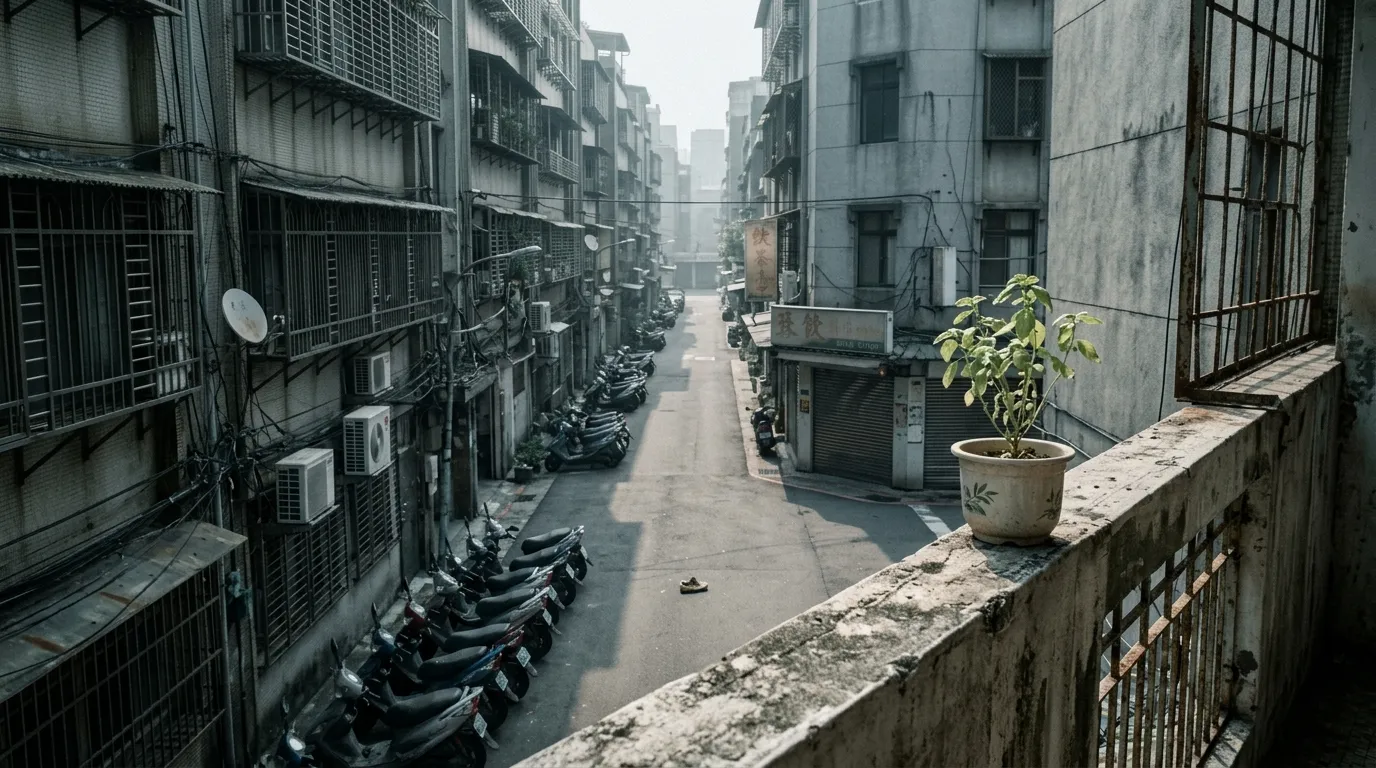
He walked to the balcony. Outside looked perfectly normal—the AC units on the building across the street, the scooter parking below, the drink shop on the corner. An ordinary Wednesday afternoon.
But the sound was wrong.
He closed his eyes and listened. In the distance, ambulance sirens—not one, but several layered on top of each other, like they’d never stop. Farther out, a helicopter. Occasionally, a sound punched through that he couldn’t identify—maybe shouting, compressed by distance into a single blurred tone.
Then the thing that unsettled him most.
The ambulance sirens cut out. One by one, they vanished. The distant sounds were receding like a tide pulling back.
3:40 p.m. Taipei. It should not be this quiet.
He stepped back into the living room and heard a metallic crash from downstairs—the security gate. Not the clean clang of someone shutting a door. The dull thud of a body slamming into it. Then again. And again.
He went back to the balcony and looked down.
From six floors up, he could see the alley. A man in a gray jacket was chasing a woman. The woman was running hard—one sandal had flown off, and she was running on one bare foot. The man’s gait—same as in the video. Head jerking in irregular arcs, like a broken universal joint. Legs running, but the upper body couldn’t match the rhythm.
The woman rounded the corner at the end of the alley and disappeared. The man followed her around.
The alley was empty again.
Jiànhóng realized his hands were clamped on the balcony railing, knuckles white. He looked down at the basil plant. Its leaves swayed gently in the breeze.
He stepped back inside, shut the balcony door, and locked it.
Pèiqí was standing in the kitchen doorway. She looked at his face and didn’t ask a single thing. Then she walked to the front door—closed the wooden door first, then the security gate. The double bolt clicking into place sounded impossibly loud in the silent apartment.
She went back to the kitchen and kept working. On the way, she ducked into the bathroom and turned the bathtub faucet on—a thin stream, left running. The kettle began its shrill whistle. She killed the flame, poured the hot water into three thermoses. Every movement steady, like something she’d done a thousand times.
Jiànhóng stood in the middle of the living room. The TV was still on. The anchor had been replaced; the new one looked worse. The news ticker at the bottom read: “Similar incidents now reported in Banqiao, New Taipei City. Epidemic command center convening emergency press conference—”
Banqiao. That was only five kilometers away.
His fingers started tapping against his thigh. Fast. Rapid-fire.
Down the hallway, a door opened. Quietly—the kids’ room.
Yòutíng came out first, standing at the mouth of the hallway. He looked at the TV in the living room, looked at his mother in the kitchen, then looked at his father standing in the middle of the living room. Then he asked:
“What’s going on outside?”
Yòu’ān trailed behind, rubbing his eyes, dragging a corner of his blanket. He yawned.
“So loud. Were those ambulances? Why were there so many?” He tilted his head. “Hey wait, it stopped now.”
Jiànhóng looked at Pèiqí. Pèiqí looked at Jiànhóng.
The look lasted less than a second, but it held everything they couldn’t say yet.
Pèiqí set down the thermos in her hand. She walked to the hallway, one hand on Yòutíng’s shoulder, the other ruffling Yòu’ān’s hair.
“Come eat something first.” Her voice sounded exactly the same as always. “Mom made instant noodles.”
“Yes!” Yòu’ān perked up immediately. “I want an egg in mine.”
Yòutíng didn’t move. He was still reading his father’s face—not waiting for an answer. Checking if his dad was faking it.
Jiànhóng managed to arrange his face into some kind of expression. Probably a smile.