Chapter 2
Chapter Two: Trapped
The power died while Pèiqí was steaming the last pot of rice.
The gas flame held, but the fluorescent light above the kitchen popped off, and the fridge’s hum cut out. The whole apartment went quiet like someone had yanked the plug—unnaturally quiet.
She didn’t stop. Once the rice was done she could shape it into balls. Rice balls traveled well. No utensils needed, small enough for a kid to hold in one hand. Her brain was already sequencing: finish the rice, wrap the cooked greens in plastic, check all the water bottles.
In the living room, Jiànhóng’s laptop screen still glowed—battery mode. The TV was dead. Yòu’ān called out, “Hey, it went off!” Yòutíng said nothing.
“Bián-kiaⁿ, just a blackout.” She kept her hands moving. “Give me your phone. Turn on the flashlight.”
Jiànhóng brought his phone and lit up the kitchen. The beam hit her face. She squinted. “The pot. Not me.”
He redirected. She noticed his fingers tapping the back of the phone case. Fast.
“What time is it?” she asked.
“Eight forty.”
She pulled the rice pot off the flame. The world outside had been falling apart for six hours now. The last thing on TV before signal dropped was the anchor being pulled away from the desk by a crew member, then the screen jumping to color bars. That was roughly an hour ago.
The sounds outside were far fewer than in the afternoon. Not the kind of fewer that meant things were going back to normal—the kind that meant fewer people were left to scream.
She didn’t think about why.
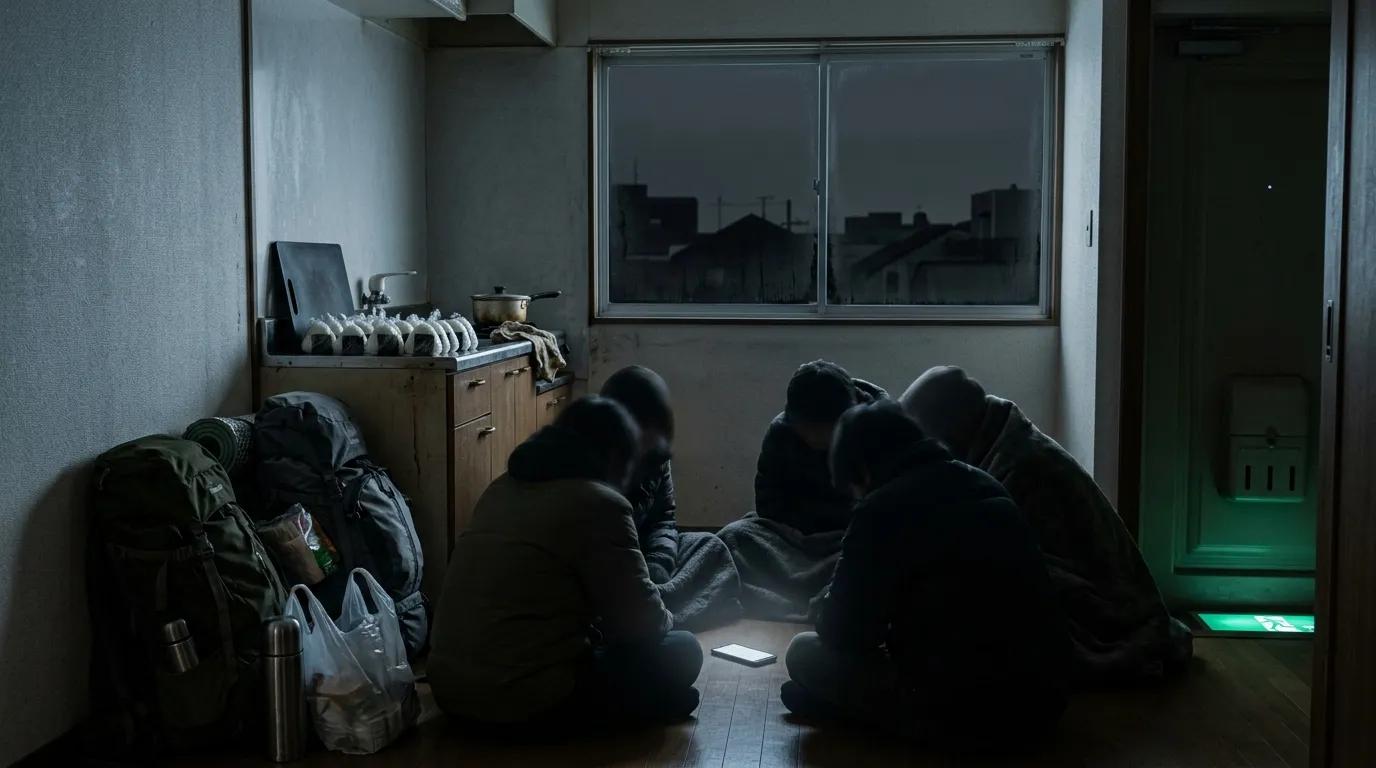
The rice was done. Twelve triangular rice balls lined up on the cutting board, each wrapped in plastic film. She’d mixed salt and the last of the baby greens into four of them. The rest were plain white rice with a pinch of bonito flakes.
Yòu’ān was on the living room floor playing with a phone. Pèiqí walked over and turned the brightness to minimum. “Save the battery.” She handed two rice balls to the boys. Took one for herself, stood at the edge of the kitchen eating and thinking. Jiànhóng shook his head—not hungry.
“Mom, when’s the power coming back?” Yòu’ān asked between bites.
“Don’t know.”
“Tomorrow?”
“Eat.”
Yòutíng took his rice ball without questions. He sat on the arm of the sofa, eyes fixed on the dead TV screen as if something were still playing.
Pèiqí walked to the front door.
The security gate was shut, both bolts locked tight. She stood by the door and tilted her head to listen.
The stairwell was quiet. Only two units on the sixth floor—theirs and the one across the hall. The neighbors were a young couple. She couldn’t remember their surname. Bumped into them sometimes when taking out the trash—a nod, nothing more.
She peered through the metal mesh of the security gate. The corridor was pitch black. The only light was the green emergency exit sign in the stairwell, casting a small rectangle on the floor.
Nothing.
She was turning to go when footsteps echoed in the stairwell.
One step light, one step heavy—irregular rhythm, like someone dragging something upstairs. Threaded between the steps, ragged breathing, deep and coarse, forced out from the bottom of the throat.
Pèiqí’s hand pressed flat against the doorframe. She didn’t move. Didn’t make a sound.
The footsteps reached the sixth floor. Stopped.
Then knocking—not on her door. Across the hall.
“Open up.” A man’s voice, gasping. “It’s me, babe. Open the door. It’s me.”
Pèiqí recognized the voice. The husband from across the hall. Her hand pressed harder against the mesh.
The door across the hall cracked open. The young wife’s voice: “Where have you been—oh my god, your hand—”
“Got… got knocked down. I’m fine, let me in.”
The door shut. The lock turned.
Pèiqí let out a slow breath. She turned to leave.
Then she stopped.
A thud from across the hall. Not loud—like something dropping to the floor. Then the wife’s voice, pitched half a degree higher: “Are you okay? You’re burning up—”
Then a sound Pèiqí couldn’t classify. Like a groan, but wrong. Not the kind of groan that meant pain. The kind that meant something inside the throat was changing.
The back of her neck went cold.
She walked to the living room. Her pace didn’t quicken. Her face showed nothing.
Yòu’ān and Yòutíng sat on the floor, their faces lit by the dim glow of a phone screen. Yòu’ān was still chewing his rice ball.
“Come on. Kín-lâi.” She crouched, one hand on Yòutíng’s shoulder, the other gripping Yòu’ān’s wrist. “Into the back room.”
“Why?” Yòu’ān asked.
“Warmer in there. Come on.”
She brought them into the master bedroom and shut the door. Thicker walls. Thicker door.
“Sit on the bed. Mom’s going to get some things.”
She stepped out and pulled the door closed.
The sounds across the hall had changed.
The man’s voice was no longer speech. It was a low, stuttering snarl—like vocal cords refusing to cooperate while the body forced them to keep producing sound. The wife was crying, shouting something Pèiqí couldn’t make out, then the crash of something shattering, then impact. Not furniture. The door.
Hitting the door from the inside.
Pèiqí stood in the hallway. Jiànhóng emerged from the study, phone light on his face, an expression she chose not to read.
“Across the hall,” she said, voice pressed so low only the two of them could hear.
Jiànhóng nodded. He’d heard.
The door across the hall took one hit, two, three. Each heavier than the last. The lock was holding, but the door shook.
Then the wife’s voice came through—not from inside the apartment. From outside. She’d gotten out. She ran to their door, and through the mesh of the security gate, Pèiqí could see her silhouette.
“Please—please open the door—something’s wrong with him—he’s—”
Pèiqí could see her shaking. Through the mesh. Less than forty centimeters away.
She felt her own hand moving. Reaching for the lock. Something deep inside her body said open the door, someone’s in trouble, you open the door.
Her hand stopped in midair.
Under the master bedroom door, a sliver of phone light leaked through. Two children in there.
“I’m sorry.” Her voice was barely a whisper. “Bē-sái.”
The young wife froze for one second. Then the door across the hall gave way with a tremendous crash—the lock had broken.
The wife screamed and ran for the stairwell. Her rapid footsteps mixed with another set—irregular, lurching—growing fainter and fainter and fainter.
Silence.
Pèiqí stood behind the security gate. Her hand was still in the air, three centimeters from the bolt.
She lowered it.
Before his phone lost signal entirely, Jiànhóng had pulled three critical pieces of information from an engineering community chat.
First: bites transmit it. A healthcare worker had confirmed in the thread—behavioral anomalies after a bite wound, onset ranging from under an hour to six hours. Wide variance.
Second: they’re sensitive to sound. Someone had field-tested it. Anything above normal speaking volume drew every infected within a twenty-meter radius.
Third: the government was ordering evacuation south. A screenshot of a Ministry of National Defense bulletin—several southern counties had established collection points.
Three messages. Then the signal died. The 4G icon on screen flickered a few times and vanished.
Jiànhóng set his phone on the coffee table. The laptop had auto-shutdown ten minutes ago—battery drained. His fingers drummed a rapid cycle against his thigh, then stopped abruptly.
“Family meeting,” he said.
Pèiqí brought the two boys out of the bedroom. The four of them sat in a circle on the floor. One phone in the center serving as a lantern, brightness at minimum, white light hitting four faces. Like camping.
But it wasn’t camping.
“Food.” Jiànhóng picked up the phone and opened the notes app, typed a few characters. “We can’t count the fridge stuff anymore—it’ll spoil without power. What we have is—”
“Nine rice balls,” Pèiqí said before he could finish. “Four packs of instant noodles, one pack of soda crackers, two packs of dry noodle snacks. Not counting seasoning packets.”
Jiànhóng’s fingers hovered over the screen. He’d been about to open a spreadsheet.
”…Right. Water?”
“Three thermoses, full. Two kettles, full. Two bottles of water, six hundred milliliters each. The bathtub—can’t take that with us.”
“I was going to build a table to—”
“Build it in your head.” Pèiqí glanced at him. “Save the battery.”
Jiànhóng closed the notes app.
“Two days,” he said. “That’s how long the food lasts if we ration. Water maybe three, but if we’re walking—”
“Not enough.”
“Not enough.”
Pèiqí looked at the two boys. Yòu’ān was leaning against her, eyes half-closed. She didn’t move—let him lean, her fingers pressing lightly on his shoulder, like confirming he was there. Yòutíng sat upright, watching his father.
“So we can’t stay here,” Jiànhóng said.
No one answered. Wind outside the windows, punctuated by distant unidentified impacts from somewhere in the city. The apartment was cold—a November night, no heating. Yòu’ān’s nose was turning red.
“South,” Jiànhóng continued. “Before signal died I saw the government bulletin. Collection points in the south. I’ll figure out the route.”
“How far?” Pèiqí asked.
“About fifteen kilometers, depending on which way we go.” He was already running it in his head. “Avoid the main roads, stick to alleys and the river embankment. With the kids—bikes would be better than walking. Any bike shops nearby?”
Pèiqí thought for a moment. “There’s one around the corner from our alley. Don’t know if it’s still there.”
“We leave at first light,” Jiànhóng said. “No movement after dark. At dawn, we move. They’re sensitive to sound—at least in daylight we can see the road.”
He looked at Yòutíng. Yòutíng looked back. One nod.
Pèiqí was already on her feet.
She sorted things in the dark. Didn’t need to see to know where everything was.
Her lips moved slightly, as if about to hum something, but no sound came out.
Two hiking backpacks pulled down from the top of the closet, dust slapped off. The last time she’d used them was over a year ago—a field trip with Yòu’ān’s class to Yangmingshan. Twenty-three kids, and she was the only parent who’d brought a first aid kit. Used it three times.
The big pack: food, water, first aid kit, flashlight, lighter, garbage bags. Garbage bags were waterproof—something she’d learned from years of taking kids on outings.
Two small packs for the boys: one bottle of water each, one pack of crackers, one jacket. Weight couldn’t exceed—she hefted one—three kilograms, roughly. Any heavier and a kid couldn’t run.
She muttered as she packed: “Rice balls on top for easy access… water on the bottom for a low center of gravity… flashlight in the side pocket, needs to be grab-and-go… towels, two towels… rope, do we have rope? Yes, the clothesline…”
Jiànhóng was in the living room, offline map cache pulled up on his phone, finger tracing the route segment by segment. His brow was furrowed into a shape she knew well—the debugging face. Too many variables, but he wouldn’t give up.
She walked over and looked. The route on screen was meticulously marked—primary and backup in different colors, every intersection annotated.
“Here,” she pointed at a spot. “That alley’s too narrow for a bike.”
He looked. Adjusted the route.
She went back to packing.
Yòu’ān peeked out from the bedroom doorway. He was clutching his blanket, staring at the backpacks scattered across the floor and the food stuffed into plastic bags.
“Mom, where are we going?”
“We’re going out tomorrow.” Her tone was the same as if she were saying they were going to the park. “Really early.”
“Where?”
“Somewhere safe. It’s a long walk.”
Yòu’ān thought about this for a moment. Then he looked up.
“Can… can I bring a toy?”
Pèiqí looked at him. Nine years old. The world in front of him was crumbling, the neighbor across the hall had been human just hours ago, and he didn’t know. The biggest question in his world was whether he could bring a toy.
She wanted him to never know.
“One,” she said.
Yòu’ān ran back into the room. Rummaging sounds, things falling to the floor. Yòutíng’s voice: “Keep it down.”
Yòu’ān came back clutching a plastic dinosaur. About ten centimeters long, the dark green paint chipped away over most of its body, exposing the grayish-white plastic underneath. A small chip missing from the tail—impossible to tell if it had been dropped or chewed.
“Xiǎo Bào.” He held the dinosaur up for her to see.
Pèiqí knew it. Yòu’ān’s fifth birthday—Jiànhóng had taken them to a night market, spent fifty NT at a toy pile next to a goldfish-scooping booth. Yòu’ān had carried it for four years. Every night, tucked next to his pillow.
Fifty dollars.
“Okay.” She said. “Put it in your pack. You’re in charge of it.”
Yòu’ān tucked Xiǎo Bào into the front pocket of his small backpack, zipped it shut, and gave it a pat.
Pèiqí turned away and kept packing.
Her hand paused for one second. Just one. Then it kept moving.
Wind outside. Cold wind. Tomorrow they would walk through that security gate and into a world that was no longer the one they knew.
She stuffed the last towel into the backpack, pressed it flat, and pulled the zipper shut.