Chapter 3
Chapter Three: Out the Door
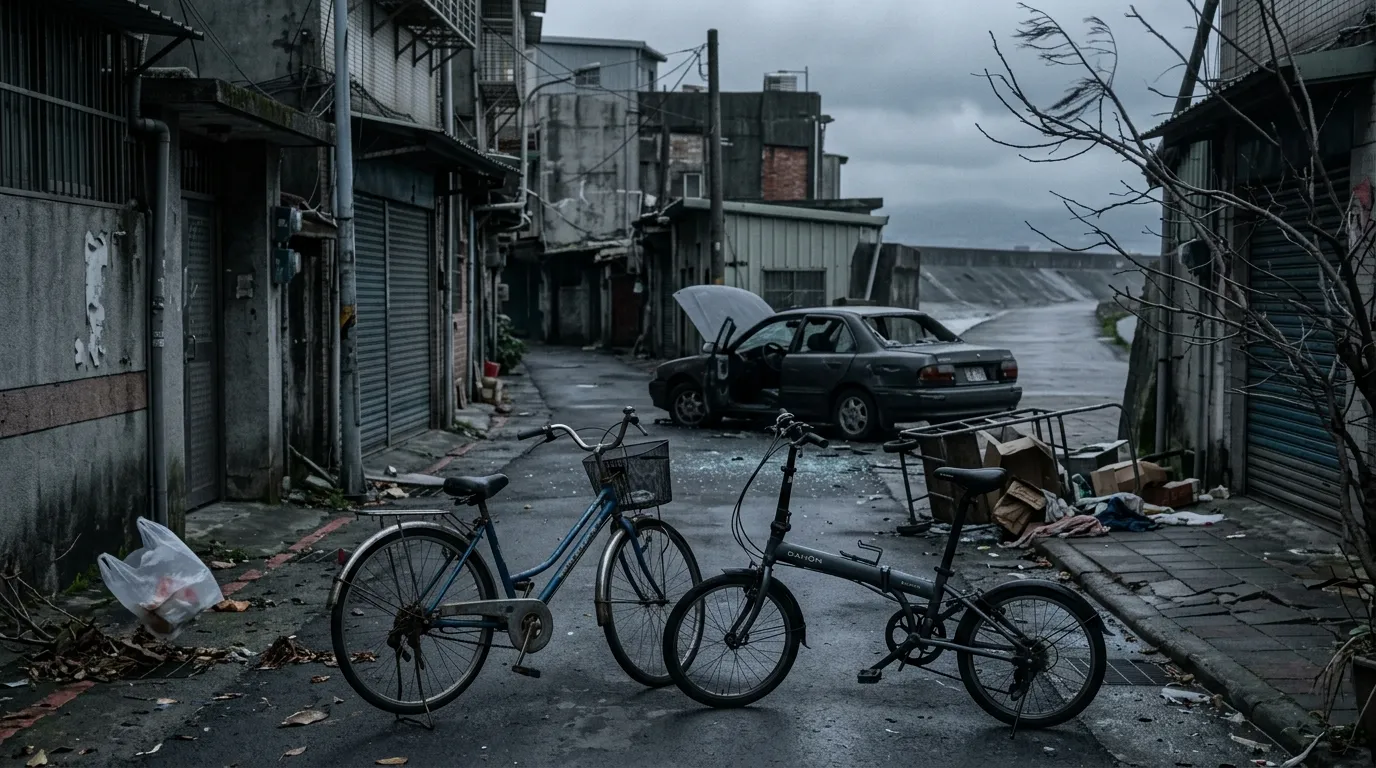
The sky was barely light. The color of ash.
Jiànhóng had his phone spread out on the living room floor, offline map zoomed to maximum. He’d studied the route no fewer than twenty times. Each time, he verified it again—not because he didn’t trust his own memory, but because the act of verifying made him feel better.
Primary route: south through the alleys, onto the river embankment bike path, straight to the end, right turn. Avoid Guāngfù Road and Zhōngzhèng Road—both arterials. Cut through the back lanes behind the market, then into the neighborhood connector road. Fifteen kilometers. Normal cycling time, forty minutes. Now—he didn’t know.
Fallback route A: if the embankment was blocked, take the road parallel to Zhōngshān Road. But the building density was high, too many blind spots. Low priority.
Fallback route B: if bikes weren’t available, proceed on foot. Estimated three hours—but the kids’ stamina was a variable.
He ran the system in his head. The primary route held only if the bike shop wasn’t locked down and the embankment had no large-scale clusters. Two conditions he couldn’t pre-validate. Fault tolerance, he estimated, somewhere in the low sixties.
Still more reliable than most APIs he’d put into production.
“Daddy.”
Yòu’ān was crouching next to him, poking a spot on the map with one finger. “What’s this?”
“The market.”
“Does the market sell things?”
“No.”
“Then why are we going to the market?”
Jiànhóng glanced at him. Yòu’ān’s nose was red, his face still a bit puffy—like a steamed bun fresh out of the fridge. His little backpack was already on, but the front pocket’s zipper wasn’t closed all the way. Xiǎo Bào’s tail poked out through the gap.
“We’re not going to the market. We’re passing by it.”
“Oh.” Yòu’ān nodded. “Is there anything for sale next to the market?”
Jiànhóng closed his eyes, took a deep breath, and opened them.
“No.”
Pèiqí walked in from the hallway, a hair tie in her hand, pulling her hair up as she moved. She glanced at Yòu’ān’s backpack, crouched down without a word, tucked Xiǎo Bào’s tail back inside, and zipped it shut.
“Alright,” she said. “Freeze. One round.”
Yòu’ān went rigid instantly. Feet together, hands pressed flat against his thighs, breathing gone shallow. Yòutíng was already in position beside him—posture sharper than his brother’s, eyes locked on the floor, perfectly still.
“How long?” Pèiqí asked Jiànhóng.
Jiànhóng checked his phone. “Thirty-eight seconds.”
“Again. One minute this time.”
They ran it again. This time Yòu’ān made it to fifty-two seconds before choking on his own saliva. A small cough—he slapped his hand over his mouth immediately and looked at his mother with his eyes.
Pèiqí didn’t scold him. She just said: “Remember that feeling. Once we’re outside, anytime I say freeze—that’s what you do.”
Yòu’ān nodded. Nodded so hard his whole head wobbled.
Jiànhóng confirmed the last item in his pack—backup glasses cloth, offline map screenshots, flashlight battery level—and stood up.
“Kids’ packs. Weight check.”
Pèiqí grabbed Yòu’ān’s little backpack and hefted it, then handed it to Jiànhóng. He hooked it on the cheap digital scale strapped to his wrist. Held it for a few seconds.
“Two point eight.”
“Yòutíng?”
Yòutíng handed his pack over without a word. Two point nine.
Within spec.
Jiànhóng set the scale back on the kitchen counter, walked to the entryway, and put on his shoes. While he crouched to tie the laces, he noticed his fingers were shaking. Not from the cold. He pulled the laces tight and tied a double knot.
“Let’s go.”
The security gate was louder than he’d expected.
Not loud, exactly—but in this stairwell, in this silence, every sound had weight. Jiànhóng pushed the gate open just wide enough for someone to slip through sideways, held it there. Let Pèiqí take the two kids out first, then turned back and pulled the gate shut. Didn’t lock it—if they had to come back, he didn’t want to waste a single second at the door.
The stairwell was dark. Flashlight on, beam sweeping down.
On the second-floor landing, a dark stain on the concrete. Dried. Edges cracked. Jiànhóng held the flashlight on it for one second, then moved the beam away. He took a half-step wider as he passed, hugging the wall. Yòutíng followed close behind, glanced down at the spot once, kept walking. Didn’t ask.
Yòu’ān asked.
“What’s that—”
“Walk.” Pèiqí’s voice was soft, but it carried a texture that left no room for discussion.
Yòu’ān walked.
The ground-floor roll-up shutter was half-open—raised to about head height and stuck there. Whoever had cranked it up partway was gone. Light from outside poured through the gap, white and cold.
Jiànhóng stopped at the edge for three seconds. Looked. Listened.
A car sat in the middle of the street, hood up, driver’s door hanging open. No one in the seat. On the sidewalk nearby, an overturned cart, its contents spilled across the pavement—Jiànhóng didn’t look closely. Broken glass on the road. Somewhere in the distance, a bird was calling. An ordinary bird call. Sparrow, maybe a bulbul.
He signaled. Move out.
The person—the it, Jiànhóng’s mind auto-corrected—was leaning against the outer wall of a convenience store at the mouth of the alley. Roughly twenty meters away.
Convenience store uniform. Dark blue. Still had a name tag pinned to the chest, but the tag was crooked and Jiànhóng couldn’t read it from here. Its head was doing something he didn’t know how to describe—not shaking, not nodding. More like a current short-circuiting inside the neck, causing the head to shift in continuous micro-movements at angles that defied human ergonomics.
Jiànhóng put the kids behind him and signed to Pèiqí: go around.
Pèiqí was already going around.
The four of them pressed against the wall of the building across the street and moved forward slowly. Jiànhóng kept his breathing as shallow as it would go. The crunch of glass under his shoe made his heart clench, but he didn’t stop. Kept walking, steps light and slow, testing each one before committing his weight.
It didn’t turn its head.
When Jiànhóng was about fifteen meters past it, it shifted direction—not the head, but the entire upper body, rotating slowly to the left by roughly forty-five degrees. Facing a completely different direction. Then it stopped. Then it began drifting that way, toward an intersection where no one stood, and walked into it, and was gone.
Jiànhóng kept walking. Didn’t stop.
Only after they’d rounded the next corner and entered another alley did he let himself exhale.
He logged a mental note: sound-sensitivity trigger range—still manageable below twenty meters. Movement speed slower than expected, at least in isolated conditions. Two variables, preliminary validation complete. Fault tolerance revised upward, slightly.
Yòu’ān, beside him, said in a voice barely above nothing: “Why did it go over there?”
“Don’t know.”
“Did it see us?”
Jiànhóng thought for a second. “No.”
Yòu’ān nodded, then said: “Its shoelace was untied.”
Jiànhóng didn’t answer.
He looked at Yòutíng. Yòutíng said nothing. He kept looking back toward the convenience store, even though they’d already walked far past it. Every now and then he’d glance over his shoulder, look, then turn and keep walking. Jiànhóng didn’t know what he was looking at. Didn’t ask.
The bike shop’s glass door was unlocked.
This discovery left Jiànhóng standing at the entrance for a full two seconds. He’d already rehearsed in his head how to pry the door open with a tool. Instead, one pull and it swung wide. End of the world, and someone had left the door unlocked. He wasn’t sure if that counted as lucky or ominous.
He scanned the bikes one by one. Flat tires didn’t count. Loose chains cost too much time. He needed something rideable right now.
He spotted the one on the right first—an orange mountain bike, widened rear rack, solid tires, the right size for carrying kids. He squeezed the tire. Full pressure. But when he checked the handlebars, there was a problem: a chain lock dangled beneath the stem, its end looped through the front fork and fastened to a display rack. Not a real bike lock—the kind shops used to keep display models from walking off. Small padlock, compact and dense. He had no tool to crack it.
He let go. Looked left.
That’s when a sound came from outside—irregular footsteps, passing along the covered walkway in front of the shop. He froze. Held his breath. Pèiqí beside him had stopped too, one arm barring both kids.
The footsteps slowed in front of the glass door.
Jiànhóng stared at the blurred outline—it had stopped just outside the glass, head doing that not-shaking not-nodding micro-shift, direction random. The shop interior was darker than the street. He told himself that. If it was going to see them, it would have to look inside.
Ten seconds. Fifteen.
The outline drifted on. Footsteps fading, then gone.
Jiànhóng let out a slow breath. He kept looking left.
Third one on the left—a blue city bike, cargo rack on the back, tires firm, brakes tested with a squeeze, functional. Not ideal, but usable. He wheeled it out.
Near the back wall, one more—a folding bike, dark gray. The folding latch was stiff, but he pressed it a few times, reseated the clasp. Rolled fine.
“This one.” He pushed the blue bike to Pèiqí. “You take Yòutíng.”
“Yòu’ān’s heavier.”
“By half a kilogram. You’re stronger than me.”
Pèiqí looked at him for a beat, then took the bike.
He lifted Yòu’ān onto the rear rack. Yòu’ān’s legs splayed out to either side, Xiǎo Bào’s backpack clutched to his chest, nose redder than before. “Daddy, whose bike is this?”
“Ours now.”
“Do we have to give it back?”
“Later.”
“After what?”
Jiànhóng set his foot on the pedal and didn’t answer.
They rode out of the alley and turned onto the small road toward the embankment. Wind hit them head-on, carrying the smell of the river and winter.
Jiànhóng rode in front, the map still running in his head. Primary route holding. First node cleared. Fallback routes on standby, not yet needed.
That’s when he heard it.
A woman’s voice, coming from the mouth of an alley to the left. Not loud, but clear.
“Wait. Please, wait. Take me with you.”
Jiànhóng hit the brakes.
Behind him, Pèiqí stopped too.
The woman stood at the alley’s edge. Mid-twenties. Ponytail. A drink shop polo under a jacket, canvas shoes on her feet. She took two steps toward them, slightly unsteady, then stopped. Her right hand gripped a cloth bag. Most of the nail polish on her fingers had chipped away—pale pink. She didn’t appear to be hurt.
She looked at Jiànhóng.
“Take me with you, please. I’m alone.”
Jiànhóng didn’t move.
The wind kept blowing.