Chapter 4
Chapter Four: Take Her or Leave Her
Pèiqí was the first to look at her feet.
Not on purpose—her gaze just swept downward on its own. Canvas shoes. The way the left foot met the ground was off, weight shifted to the outer edge, like it was dodging something. The pant leg covered the ankle. Nothing visible.
“You’re hurt?” Pèiqí was already off the bike.
The girl shook her head, then nodded. “Twisted it. Last night, when I was running out. It’s not that bad, I can still walk.”
Jiànhóng was still straddling the folding bike, not dismounting—feet braced on the ground, hands locked on the handlebars, pure standby mode, ready to pedal at any second. Pèiqí could tell the gears in his head were turning.
“You’re alone?” Jiànhóng asked. Voice low.
“Yeah.”
“Where’d you come from?”
“The alley back there, the building on the corner—” She pointed with her chin. “That’s where I live.”
“What’s the situation in your building?”
“Can’t go back.”
Jiànhóng’s fingers tapped the handlebar twice. Pèiqí knew that rhythm. He was calculating. One more person, one more share of water, one more share of food, one more variable. Load capacity on the bikes. Travel speed. Noise risk. He’d probably already opened a new spreadsheet in his head, column headers filled in and everything.
Pèiqí crouched down and pushed the girl’s pant leg up slightly.
“Does it hurt?”
“It’s fine, really.”
Pèiqí stood up and looked at Jiànhóng.
Jiànhóng’s mouth opened, then closed. He wanted to say something—probably “our supplies only last four people” or “her injury will slow us down” or “too many variables,” the kind of edge case analysis that lived in his code.
“Get on.” Pèiqí said.
She wasn’t talking to Jiànhóng.
The girl froze for a second.
“Yòutíng, go ride with Daddy.” Pèiqí lifted Yòutíng off the rear rack and patted his back. Yòutíng glanced at the girl once, didn’t ask why, and walked to Jiànhóng’s folding bike. Jiànhóng scooted Yòu’ān forward first, wedging him onto the frame with his feet dangling, then took Yòutíng and settled him on the rear rack.
“What’s your name?” Pèiqí asked.
“Xiǎolì.” Her voice was a touch steadier than before. “Zhāng Xiǎolì.”
“Xiǎolì. Hop on, hold tight.”
Xiǎolì slung the cloth bag over her shoulder and sat sidesaddle on the rear rack. Once she was settled, Pèiqí noticed she’d planted her right foot first. The left one came down last, slow and careful.
Yòu’ān poked his head out from Jiànhóng’s bike: “Who’s she?”
“Shh.” Jiànhóng said.
Yòu’ān lowered his voice, but not the volume: “Who’s she?”
“She’s jiějie.” Pèiqí said. “Let’s go.”
Xiǎolì said there was a market up ahead.
“The traditional kind, with the big metal shutters.” She kept her voice barely above a whisper, mouth close to Pèiqí’s ear. “I used to pass it on delivery runs. The owner always went in and out through the side door. That main roll-up shutter is super thick, you know? Should still hold.”
Pèiqí didn’t turn around, but her voice carried backward: “Food inside?”
“The dry goods section should have stuff—canned food, instant noodles, that kind of thing. The refrigerated part though… don’t go there. Power’s been out too long.”
Jiànhóng was riding alongside. He’d heard. Voice low: “How far?”
“Close. Like two alleys over. Take the side streets, I know the way.”
Jiànhóng tapped the handlebar once. Three seconds of thinking. Pèiqí didn’t wait for him to finish.
“Lead the way,” she said.
Xiǎolì pointed the direction.
The streets were quieter than Pèiqí had expected.
Not the good kind of quiet—the kind where everyone is behind walls. Scattered things on the road here and there: a single flip-flop, an overturned stroller, a plastic bag snagged on the base of a streetlight, rustling in the wind.
No baby in the stroller. She told herself not to think about it.
The traffic lights at the intersection were all dead. Housings still there, but the light inside was gone. Pèiqí’s gaze slid over these things without stopping.
Something was moving in the alley to the right. Not a person kind of moving. Pèiqí didn’t turn her head, but the muscles in her arm tensed. She said, barely a sound: “Stay left.”
Jiànhóng was already staying left.
“Don’t go that way,” Xiǎolì breathed from behind. “There’s a clinic at the end of that alley. People were rushing toward it yesterday.”
Pèiqí gave a single nod. Acknowledged. Xiǎolì’s delivery route knowledge had been useful so far. Pèiqí didn’t like evaluating people in terms of useful—but right now, the difference between useful and not useful was the difference between one less block or one more block, and every block had a price.
Yòu’ān tried to turn and look at the alley. Jiànhóng’s hand came down on the back of his head and held it forward. Yòutíng had been facing front the entire time, but his fingers were clenched tight around the hem of Jiànhóng’s jacket.
As they passed an apartment building, a curtain on the second floor twitched. Pèiqí saw it. She didn’t stop. Didn’t wave. The curtain went still again.
Yòu’ān suddenly whispered toward the back: “Jiějie, do you like dinosaurs?”
Pèiqí nearly missed the pedal.
Xiǎolì paused for a beat, then whispered back even quieter than Yòu’ān: “Yeah, I do.”
Yòu’ān pulled Xiǎo Bào out of his jacket and held it up over Jiànhóng’s shoulder so Xiǎolì could see. Pèiqí couldn’t catch any of it from her mirror angle, but she heard Xiǎolì say: “Oh my god, so cute. What’s its name?”
“Xiǎo Bào.”
“Hey there, Xiǎo Bào.”
Pèiqí wanted to tell them to be quiet. She didn’t.
Xiǎolì was quiet on the rack. Pèiqí could feel her fingers gripping the edge of the carrier, knuckles tight. Every time they hit a pothole, the rear shifted slightly, and Xiǎolì would draw in a breath—faint, but Pèiqí heard it.
“You okay?” Pèiqí asked.
“I’m good.”
The left foot, Pèiqí thought. The sprain is on the left.
Xiǎolì didn’t complain again. She pointed directions with her chin, saving her hands: “That intersection up there, turn right. There’s a covered walkway along that stretch—harder to be spotted.”
Pèiqí turned.
The market’s front shutter was down all the way. Locked.
A few bikes leaned against the walkway pillars, scattered, unlocked. Jiànhóng swept his gaze over them—two with air in the tires: a red women’s bike, and an older single-speed with a slightly crooked seat, but the frame was fine. He wheeled both over. One to Yòutíng, one to Xiǎolì.
Yòutíng blinked. “I ride by myself?”
“Can your feet reach the pedals?”
Yòutíng swung a leg over and tested. Toes touched. “Yeah.”
Xiǎolì had already shifted the cloth bag to her other shoulder, ready to mount up. Jiànhóng didn’t ask about her foot. She didn’t mention it.
Pèiqí took Yòu’ān off Jiànhóng’s front rack and set him on her own rear carrier. “Hold on.” Yòu’ān stuffed Xiǎo Bào inside his jacket and grabbed fistfuls of Pèiqí’s shirt.
Xiǎolì pointed to the narrow lane beside them: “Side door’s over there.”
The side door was a metal gate, chain wrapped around the handle, but the padlock wasn’t clasped—the chain was just looped through, its end dangling on the ground. Jiànhóng unwound the chain, and he and Xiǎolì each took a handle.
“This is going to be loud,” Jiànhóng said.
Pèiqí pulled the two kids to the wall across the lane and crouched low. One hand on each child. “Freeze.”
Yòu’ān and Yòutíng locked in place at the same instant.
Jiànhóng and Xiǎolì pulled. The gate let out a sharp metallic screech that rang down the length of the alley. Pèiqí’s teeth ached. She counted three seconds—nothing moving at the alley entrance. Three more—nothing.
“In,” she said.
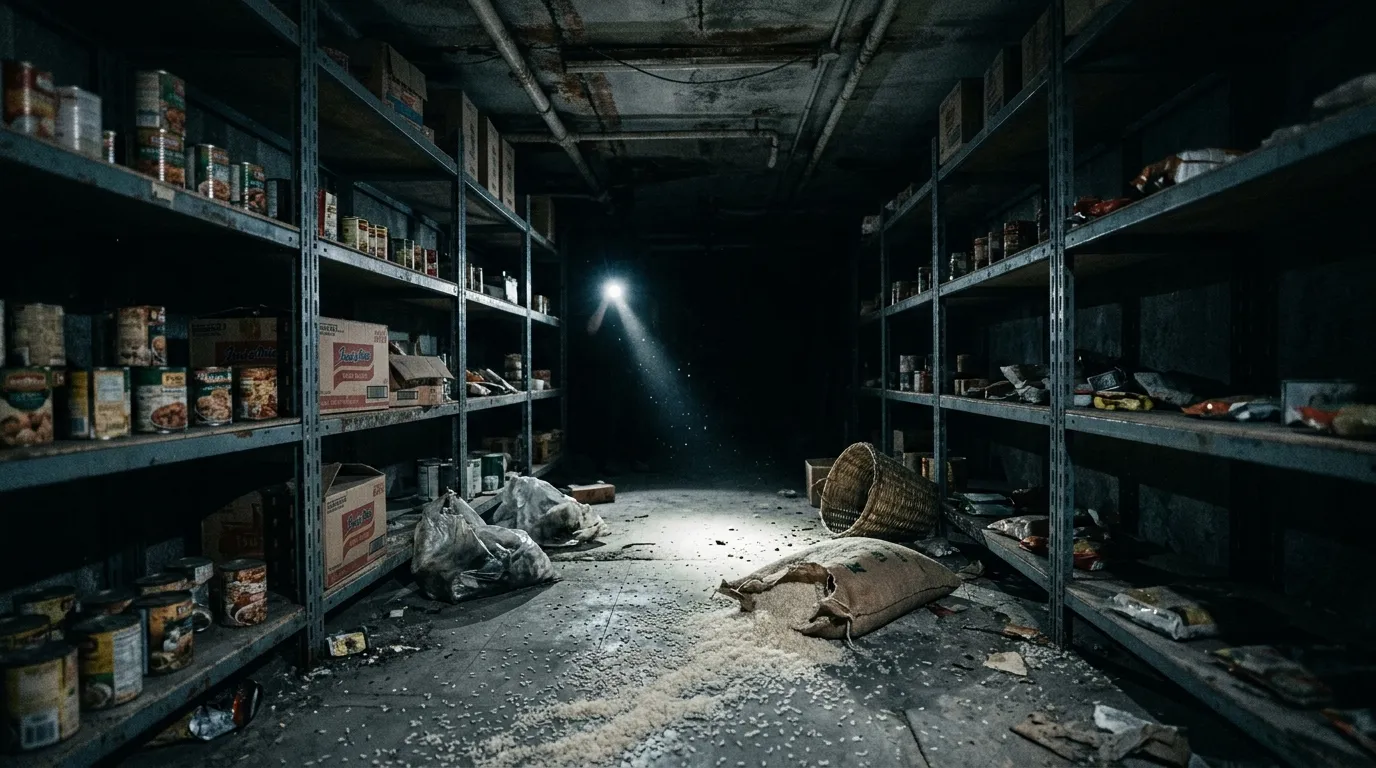
The market was dark inside. Low ceiling. Three steps past the doorway and the only light left was that long strip at the entrance. The air was stale, laced with something cloyingly sweet gone wrong—the refrigerated section. Pèiqí pressed her sleeve over her mouth and refused to think about what was happening over there.
“Dry goods are on the right.” Xiǎolì’s voice barely carried.
Jiànhóng already had his flashlight on, beam narrowed, illuminating one meter ahead of his feet. He moved first, past a row of metal shelving still loaded with plastic baskets. Pèiqí followed, scanning: canned goods—tuna, corn, meat sauce. Instant noodles stacked in cases, the top one torn open, a few packs missing. Rice, a five-kilogram bag, tipped over on the floor, corner split, some grains spilled.
“Grab what we can carry,” she said.
Jiànhóng swept cans into his backpack, working down the shelf: six tuna, four corn, two peanuts. He picked up the third can of peanuts and paused for a second—turned it over and checked something. Pèiqí caught him reading the expiration date.
She didn’t laugh. She wanted to.
“Noodles.” She pointed. Jiànhóng grabbed the half-case. Xiǎolì had found a roll of garbage bags nearby, tore off two, and started sweeping the spilled rice into them. She crouched carefully, left leg barely bending.
Yòu’ān stood next to Pèiqí with Xiǎo Bào in his arms and breathed: “Mommy, it smells really bad in here.”
“I know. Almost done.”
Yòu’ān turned to look at something on the shelf. “What’s that?”
“Tapioca pearls.”
“Can we make boba?”
Pèiqí turned his head back around. “No. Let’s go.”
On their way back toward the door, Pèiqí heard it.
From deep inside the market. Not metal. Not something falling. Something vaguer—like fabric dragging across the floor, or a center of gravity shifting slowly.
She stopped mid-step. The flashlight beam didn’t reach that far. The dark back there was thick, solid, like a wall.
She looked for one second.
Then turned and kept walking.
Jiànhóng was at the door. He saw Pèiqí’s face and asked: “What?”
“Go.”
They pulled the gate shut and rewound the chain. No lock, but it looked locked.
Two infected appeared at the far end of the alley. About fifty meters out. Both in a roaming state, drifting in a direction that wasn’t toward them. But that was now. Pèiqí didn’t linger.
“Get on.”
They rode out. The alley was narrow, Jiànhóng in front, handlebars nearly scraping the wall. Pèiqí didn’t look back. Xiǎolì rode behind them, the garbage bag of rice hanging from her handlebar, left hand steadying it, right hand on the grip. She said nothing.
Two turns later, Jiànhóng slowed and drifted closer.
“Those two back there. They didn’t follow.”
Pèiqí nodded.
They kept riding. The wind died down, and the sun began to carry some warmth. Yòu’ān leaned against Pèiqí’s back, face buried in the side of her backpack—could have been fear, could have been sleep. Yòutíng rode beside them, sitting straight, glancing back now and then, making sure nothing followed.
Then Xiǎolì spoke from behind Pèiqí, barely above a murmur, almost to herself.
“Do you know what happened to my building… after.”
Pèiqí didn’t answer. Wasn’t sure she was supposed to.
“The whole building went down.” Xiǎolì said. “Starting from the third floor. Up. One floor at a time.”
Pèiqí’s grip tightened on the handlebars.
“Because someone got bitten and didn’t say anything.”
Pèiqí’s pedaling stuttered.
The security gate. The neighbor’s voice. Her own hand, three centimeters from the latch.—Different. That one was trying to get in from outside. This one was brought back from outside, already inside.
She pushed the pedal down again.
“He looked totally fine when he came back, right,” Xiǎolì’s voice dropped lower, “so everyone let him in. And then in the middle of the night—”
She didn’t finish.
The wind blew in, carrying the smell of something that had already burned.
“What happened after?” Pèiqí asked.
“After that you run.” Xiǎolì said. There was a thin smile in her voice. “Everyone who could run, ran. Everyone who couldn’t… didn’t.”
Pèiqí didn’t ask more.
She could hear her own breathing, heavier than usual. She closed her mouth, inhaled through her nose—the way you steady yourself before picking up a baby who just woke crying. A motion her body had rehearsed for over a decade. Muscle memory.
She kept riding. The sun climbed higher. Shadows shortened. She didn’t know the road ahead, but Xiǎolì did, and she chose to trust that.
Behind her, the sound of tires followed. Light, steady, keeping pace.