Chapter 5
Chapter Five: The Bridge
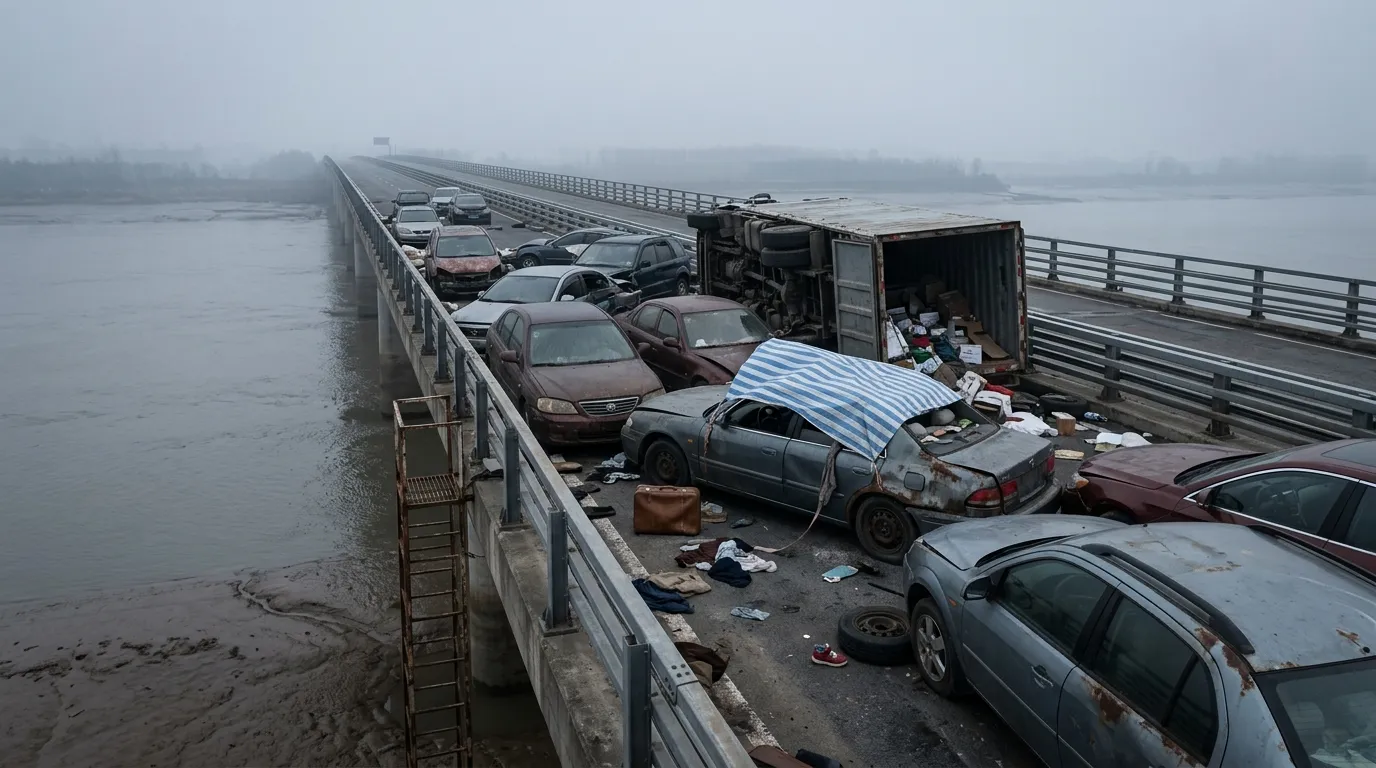
The wind off the river carried the smell of something burning.
Chén Jiànhóng squeezed the brake, put one foot down, and looked up.
The bridge wasn’t long. Four lanes, a pedestrian walkway on each side. On a normal day, driving across took under three minutes. But now the cars on the bridge deck—stopped, flipped on their sides, rear-ended into accordion chains of sedans and trucks—had turned the whole thing into a maze. The exit was on the far bank, and he couldn’t make it out. Too far, wrong angle, and the afternoon haze blurred the opposite shore into something half-rendered, like a data packet that cut out midway through transmission.
His index and middle fingers tapped the handlebar twice.
Behind him, Pèiqí pulled her bike up next to his. Yòu’ān was asleep on the rear rack, head drooped against the side of her backpack, still clutching that plastic dinosaur—Xiǎo Bào. Yòutíng got off, glanced back the way they’d come out of habit—nothing moving—then turned to face the bridge. Xiǎolì stopped last, right foot down first.
“Detour,” Jiànhóng said. “Head south. There’s an old bridge downstream, about five extra kilometers.”
Pèiqí didn’t answer right away. She was looking at the bridge.
“The cars on the deck are a mess,” he continued. “I can confirm maybe the first third by sight. The back two-thirds are unreadable. No idea what’s on the other side. Too many variables. Detour’s safer.”
“Five kilometers,” Pèiqí said. “That’s not a number. That’s Yòu’ān’s condition right now, Xiǎolì’s foot, and our water.”
Jiànhóng glanced at Yòu’ān. The boy was sleeping.
He knew she was right. She always spoke from evidence—this wasn’t her being emotional, this was her folding every detail she’d been tracking into those few words. Yòu’ān hadn’t eaten enough this afternoon. He’d only had water once. Xiǎolì drew a tiny breath every time they hit a pothole. Pèiqí had seen all of it. He’d seen it too—he just hadn’t said it out loud.
His fingers tapped twice more.
The real problem was that he couldn’t run the numbers.
He was good at numbers. A five-kilometer detour, at their current speed, meant roughly forty extra minutes. Calorie burn was calculable, the water deficit could be estimated—those all had values. But the far end of that bridge—he scanned the blurred outline again—numbers went in, nothing came back. He didn’t know what was on the other side. Didn’t know if the haze was hiding empty road or a wall of bodies.
In the one second he stared at the bridge, his stomach clenched.
Not a conclusion arrived at through rational assessment. Something earlier, faster—it reached him before the logic had time to boot up. The moment he looked at that bridge, his first thought wasn’t too many variables. It was that he didn’t want to go across.
He didn’t want to.
He pushed the thought down, the way you close a pop-up warning, and opened another window to start calculating.
“The cars on the deck give us cover,” Pèiqí said. “Open road is actually more dangerous. If there’s a problem on the far side, at least on the bridge we have things to hide behind.”
Jiànhóng looked at her.
She was right. He knew it.
“The bikes won’t make it through,” he said. “We ditch them and go on foot.”
They leaned the four bikes against the railing at the bridgehead, shouldered their packs, and woke Yòu’ān. He opened his eyes and went blank for about three seconds, took in the scene in front of him, shoved Xiǎo Bào into his pocket, and said nothing.
Jiànhóng stood at the bridgehead and scanned once more.
The gaps in the car pileup had a pattern—he read it like a map, tracing a route. The widest gap ran along the right side, near the walkway, enough for two people abreast. Midway there was an overturned van; they’d need to skirt past its front end. The back section he couldn’t see clearly, but that was a later problem.
“Stay close. No talking. Watch your footing.” He stepped onto the bridge deck.
Their footsteps sounded too loud between the dead metal. He softened his deliberately; the others followed suit, and the whole group became a line of shadows drifting forward. Yòu’ān had a fistful of Pèiqí’s backpack strap. Yòutíng walked in the middle, turning his head to check behind them every few steps. Xiǎolì brought up the rear.
Jiànhóng didn’t look back. But his ears stayed open.
Sometimes there were sounds from inside the cars—the first time he heard one, his adrenaline spiked a notch and he froze, only to find it was a door that hadn’t been latched, rocking in the wind, moaning on its hinges. He let himself exhale, and kept walking.
At the bridge’s midpoint, he saw the van.
Not the one he’d planned to skirt around. A different one, parked near the railing, engine still holding a faint trace of warmth. Large boxes were strapped to the roof, covered in a waterproof tarp, cinched down tight.
The window was half open. Someone was inside.
Jiànhóng stopped.
An old man sat in the driver’s seat. Seventies, maybe. White hair, glasses, no visible injuries. In the passenger seat, an old woman—asleep, or eyes closed. The back seat was stacked with things. Jiànhóng’s eyes swept over them—food. Bags, boxes. Roughly a week’s worth.
The old man watched them. Said nothing.
“Are you—” Jiànhóng started.
“You go on ahead,” the old man said. His voice was calm, like he was stating something decided long ago. “We’re not leaving.”
Jiànhóng looked at him. The old woman didn’t move.
“It’s not safe here,” Pèiqí said softly.
“We know,” the old man said. “It’s all right.”
A corner of the tarp on the roof lifted in the wind, settled back, lifted again. Jiànhóng stared at that corner, at the week’s worth of food, at the old man’s calm face. He wanted to say something, but no logic could assemble a complete sentence inside this scene.
“Dad.” Yòutíng’s voice came from beside him. Very quiet. “Are they going to die?”
Jiànhóng turned to look at him.
Yòutíng was looking straight at him. No fear in his eyes—just a nine-year-old using the incomplete language he had to ask a complete question.
Jiànhóng didn’t answer.
He put his hand on Yòutíng’s shoulder, gave a gentle push, and kept him walking.
The haze on the far bank began taking shape when they were three-quarters across.
The shape of people. A lot of them.
Jiànhóng saw it, stopped first, then registered what he was seeing. Not one or two—a crowd, spreading from the far bridgehead onto the deck, movements loose and aimless, but the sheer number added up to something his mind labeled query avalanche: each one individually was no threat, but together they’d choke every lane at once.
A muffled boom rolled in from the distance, like something had detonated a few blocks away.
The crowd moved faster.
“Side,” Pèiqí said. She was already scanning the railing. “There’s a ladder.”
Jiànhóng followed her eyes and found it—a maintenance ladder on the outer face of the bridge. Vertical, iron, rusted. It led down to the embankment. He calculated for one second. Wide enough for a person, but single file only. The infected on the far end were still some distance off, but that distance was shrinking. Every second, shrinking.
“Go,” he said. “Yòu’ān first. Yòutíng after him. Pèiqí, you anchor. Xiǎolì—”
“I’m fine,” Xiǎolì said.
They moved to the edge. Pèiqí carried Yòu’ān the last few steps, and at the top of the ladder Jiànhóng crouched down to his level: “One rung at a time. Don’t jump. Grip tight.” Yòu’ān put Xiǎo Bào in his mouth and bit down, then grabbed the iron rails with both hands.
Jiànhóng held him until his head dropped below the bridge deck, then let go.
Yòutíng was next. Didn’t wait to be told. Started climbing down on his own.
Jiànhóng stood up. The infected had passed the halfway mark. The car pileup wasn’t slowing them—they flowed over rooftops, around chassis, loose but relentless.
Pèiqí went down.
Jiànhóng turned to Xiǎolì. “You.”
Xiǎolì grabbed the railing and started her descent.
He watched her left foot land on the first rung, and there it was—a hairline hesitation. Not reluctance. Absorption of impact. Second rung. Third. Every rung she planted firm, didn’t make a sound, didn’t even change her breathing. But he saw it. He saw that with every rung her left foot dropped to, her right hand gripped a fraction tighter.
He filed the detail behind his eyes and didn’t say a word.
When Xiǎolì was halfway down, he swung onto the ladder. From up here the river was gray, water level low, the embankment exposing a wide stretch of brown mud. The shadow under the bridge pylon ran deep.
They pressed into the shadow of the pylon.
Yòu’ān sat on the ground, took Xiǎo Bào out of his mouth, wiped it on his shirt hem, and clutched it in his fist. His eyes were still a little swollen, but he wasn’t crying. Yòutíng stood next to Jiànhóng, face tilted up toward the bridge deck overhead. The footsteps of the infected came through the concrete—low, scattered, like rain gone out of tune.
Pèiqí was counting heads, even though everyone was right there.
Jiànhóng leaned his back against the pylon and let the cool of the concrete seep through his shirt. He closed his eyes for a moment, and in the dark behind his lids he sorted through a few numbers: how much water was left, how far to the next stretch, whether the kids could hold up.
Then he opened his eyes.
The footsteps thinned out, fading until only the river wind was left and the occasional distant sound.
“They’re gone,” Yòutíng said.
Jiànhóng waited thirty seconds. No new sounds.
“Move,” he said, standing, settling his pack, turning toward the south bank embankment. “Keep going.”
He didn’t look back at the bridge.
The old man in the van, and the calm way he’d said it’s all right—Jiànhóng didn’t let himself think about it again. Some variables, once you fed them in, produced no output. They just dragged every other calculation down with them.
He stepped onto the embankment and walked forward.
Behind him, four sets of footsteps followed.