Chapter 6
Chapter Six: Night Road
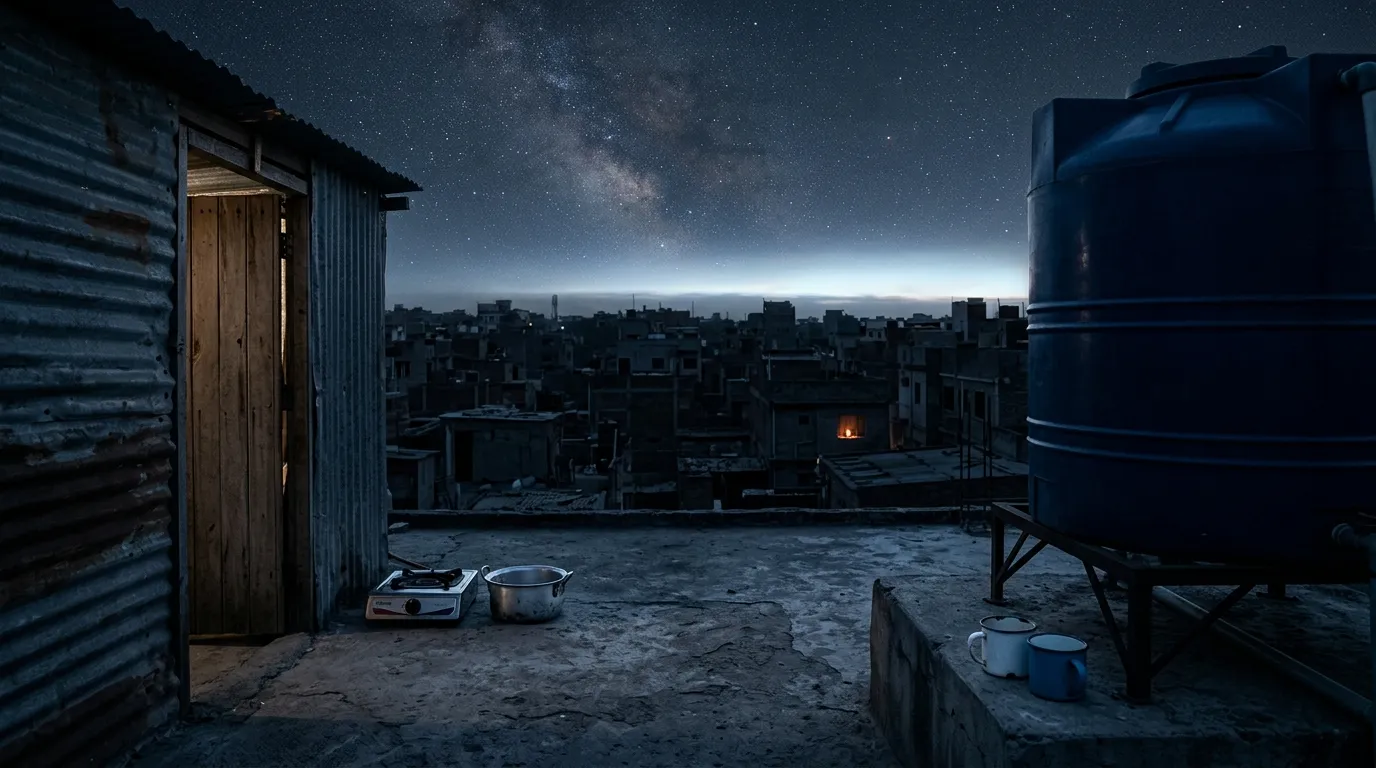
The door of the corrugated metal shack bolted from the inside—a piece of rebar threaded through two iron rings.
Pèiqí tried it. The rebar was rusted, but it still moved. When she pulled it free, the metal let out a dull clang that scattered into the rooftop air. She waited five seconds. No response from the stairwell below.
“In.”
Jiànhóng went first, flashlight sweeping a circle: maybe forty square feet, sheet-metal walls, corrugated roof, a spring bed in the corner—mattress yellowed but still intact. Next to it, a plastic water tank. She reached over and knocked on it. Still had water, sounded about half full. One window, palm-sized, bars welded shut.
One way in, one way out. A tin wall that would carry sound. High ground.
“This works,” she said.
Yòu’ān was already half asleep when Jiànhóng carried him in. One foot kicked the air, but he didn’t wake. Pèiqí beat the dust off the spring bed, spread a towel over it. Yòu’ān lay down, curled into a ball, Xiǎo Bào clenched in his fist, lips moving faintly—like he was briefing someone on something.
Yòutíng walked in on his own. He stood by the door for a moment, looking out.
“Closing the door,” Pèiqí said.
Yòutíng nodded and stepped back. Pèiqí slid the rebar through the rings and latched it.
Xiǎolì came in last. She paused on the threshold—that hitch when her left foot landed, Pèiqí had been watching it all day. Every time it was the same, every time that fraction-of-a-second delay. She said nothing.
Pèiqí set her backpack down in the corner. The moment her shoulders loosened, she felt the welts the straps had pressed into her skin. Jiànhóng’s pack went beside hers. Xiǎolì’s cloth bag stayed near the door.
Jiànhóng found a small gas stove in the corner of the tin wall—single burner, half a canister of gas still attached. Pèiqí dug a can of tuna and a packet of instant noodles out of her pack, dropped them into the aluminum pot, added water from the tank, and lit the flame.
The flame jumped once. The shack warmed by a degree.
Yòu’ān stirred on the towel, caught the smell, and opened his eyes. He looked around—tin walls, unfamiliar ceiling, his mother crouched by the stove.
Then he cried.
Not a startled cry. This was a nine-year-old emptying two days’ worth of everything at once. No buildup, no trigger. Mouth open, volume louder than Pèiqí had expected—the whole shack rattled with it.
Pèiqí crossed the space in two steps, crouched, and pulled him into her arms. His face buried into her neck, snot and tears smearing together against her skin, his body shaking like a high fever. She pressed one hand over the back of his head, fingers spread, holding him steady.
“Okay. Cry. You can cry.” Her voice stayed low, lips against the top of his head. “It’s okay now.”
Yòu’ān cried for a long time. The noodles in the pot went from hard to soft to nearly mush. Jiànhóng turned the flame down somewhere in the middle.
When the sobs finally thinned to hiccups, Yòutíng came around from the other end of the bed. He didn’t say anything. He took Xiǎo Bào out of his pocket—scooped from his brother’s hand at some point nobody noticed—and touched the dinosaur’s nose to his brother’s cheek, nudging a tear away.
Not something an adult had taught him. His own version.
Yòu’ān reached out and took Xiǎo Bào back, gripped it tight, voice still shaking: “Xiǎo Bào is scared too.”
“Yeah,” Yòutíng said. “He’s smaller, so he’s definitely more scared.”
Pèiqí’s nose stung. She turned her face away, drew a breath, and stood up.
“Eat.”
Yòu’ān sniffled and glanced at the pot. The instant noodles and tuna had cooked down into an unrecognizable paste.
“What is that?”
“Dinner.”
“It looks like Xiǎo Bào’s poop.”
Pèiqí almost laughed. She held it. “Eat.”
After the kids ate, they slept. Yòu’ān hugged Xiǎo Bào, Yòutíng lay on his side next to him, one hand resting on his brother’s backpack strap—whether out of habit or to make sure his brother was still there, hard to say.
Xiǎolì said she’d take the first watch. “You guys rest first—I can’t really sleep anyway.”
Pèiqí glanced at her. Xiǎolì sat on the ground by the door, back against the tin wall, left leg stretched straight, right knee drawn up. Flashlight off. The only light was a sliver of moonlight through the door gap, cutting her outline into one half bright, one half dark.
Pèiqí didn’t lie down. She walked out to the rooftop and sat down next to the water tank.
Jiànhóng was already there.
He was leaning against the tank, head tilted back, looking at the sky. With every light in the city gone, the stars were absurd. Pèiqí had grown up in rural Chiayi and she’d never seen this many—or maybe she had, and forgot.
“When did you come out here?” she asked.
“After they finished eating.” A pause. “Couldn’t stay inside.”
Pèiqí sat down beside him, one fist’s width of distance between them. Wind came across the rooftop carrying rust and the smell of something burning far away. Her shoulders only now dropped—a full day of carrying that pack, the skin under the straps raw, cool and stinging.
“What are you looking at?”
“Stars. Never used to see this many.”
“Mm.” She looked up too. “Too bad Yòu’ān’s asleep. He’d definitely ask if the stars can get infected.”
Jiànhóng didn’t laugh, but the corner of his mouth moved.
She waited. Jiànhóng’s fingers tapped the tank’s metal surface twice. She recognized the rhythm—not calculating something. Looking for a way in.
“On the bridge,” he said, voice half a notch lower than usual, “I said the detour was the safer call.”
“Yeah.”
“It wasn’t.” He stopped for a second. “It wasn’t because it was safer. I looked at that bridge and I was afraid. First glance—I wasn’t running numbers, I just didn’t want to cross. All the analysis after that was me finding a reasonable-sounding name for my fear.”
Pèiqí didn’t turn her head. She watched the dark silhouettes of a few buildings in the distance. On one of them, partway up, a point of firelight swayed.
“The market,” she said.
Jiànhóng didn’t respond. He knew to let her finish.
“There was a sound inside. I stopped. I looked.” Her pace was the same as always, like she was briefing Jiànhóng on tomorrow’s route. “Then I turned and walked away. It wasn’t that I didn’t have time to see. I chose. I chose not to look.”
Wind crossed the corrugated roof. A wave panel let out a faint creak.
“I knew there might be someone in there. Alive.” She laced her fingers over her knees. “I walked away. And I could walk just fine.”
She stopped. The rest didn’t need saying.
Jiànhóng reached over and placed his hand on top of her interlaced fingers. She didn’t move.
They sat by the water tank. The stars were many. The city below was dark. From inside the shack came the sound of Yòu’ān turning over, the springs giving one small creak.
From below came the sound of the gas stove clicking to life—a tiny puff. A while later, Xiǎolì brought three cups of water up. Boiled from the tank, a faint taste of rust, but hot.
“Thanks.” Pèiqí took one.
Xiǎolì sat at the edge of the rooftop, a few steps away from them. She held her cup, fingers thin, the remnants of pink nail polish catching the moonlight like something shattered.
After a few sips, Xiǎolì spoke.
“Pèiqí-jiě.”
“Hm?”
“If… one of you two got bitten. What would the other one do?”
The rooftop went quiet. Wind. A low, distant thud from some direction. Her own breathing.
Pèiqí didn’t answer right away.
She could feel Xiǎolì watching her. But she didn’t look back. The way the question came out of the girl’s mouth was wrong—it didn’t sound offhand. It sounded like something held in the mouth for a long time before being let go, every word chewed before release.
Jiànhóng’s finger tapped the tank once. Just once.
“It’s late,” Pèiqí said, setting her cup by her feet. “Get some sleep. Jiànhóng and I will switch shifts later.”
Xiǎolì didn’t say more. She finished her water, stood, and walked slowly back into the shack. Her left foot hitched on the threshold.
Pèiqí watched her silhouette disappear into the half the moonlight couldn’t reach.
She woke to cold.
No idea what time it was. The moon had shifted, and the shadows on the rooftop pointed a different direction. Jiànhóng was against the tank, chin dropped, breathing steady—held out until now before falling asleep.
Pèiqí didn’t wake him. She got up and walked toward the shack. The door was half-open, inside darker than out.
Yòu’ān and Yòutíng were still asleep. Yòu’ān’s grip had loosened; Xiǎo Bào had slipped to the edge of the pillow. She bent down, picked it up, and tucked it back into his hand. His fingers tightened automatically—a program that didn’t need consciousness to execute.
She turned her head.
Xiǎolì wasn’t by the door.
The back of Pèiqí’s neck went cold.
The corner. Near the water-tank piping. Xiǎolì was crouching on the ground, back to her.
Moonlight came in only through the small window, reaching Xiǎolì’s shoulder and half an arm. She had pushed her left pant leg up. Both hands were touching her own calf. The motion was gentle—like checking whether something was still there.
Pèiqí stood in the dark.
She couldn’t make out a thing. Not enough light. What was under the pant leg, what the fingers were touching, what was wrong with that leg—all of it hid behind that insufficient moonlight.
Xiǎolì’s hands stopped. She pulled the pant leg back down, slowly.
Pèiqí took half a step back, to the doorway. The tin floor made no sound.
“Xiǎolì?” She let her voice sound like she’d just walked in.
“Mm.” Xiǎolì stood, turned. Moonlight caught her face—expression normal. “Just went to the bathroom.”
“Mm. Get some rest.”
Pèiqí walked back to the rooftop. Sat down.
The wind was colder than before. On the eastern horizon, a thin line of light—impossible to tell if it was dawn or something burning somewhere.
She felt like she should tell Jiànhóng something. But she didn’t know what to say. She hadn’t seen anything clearly.
She put it away, the way you put away a notification you haven’t opened—it’s still there, but now isn’t the time to look.
Dawn was coming. They still had to walk.