Chapter 7
Chapter Seven: The Choice
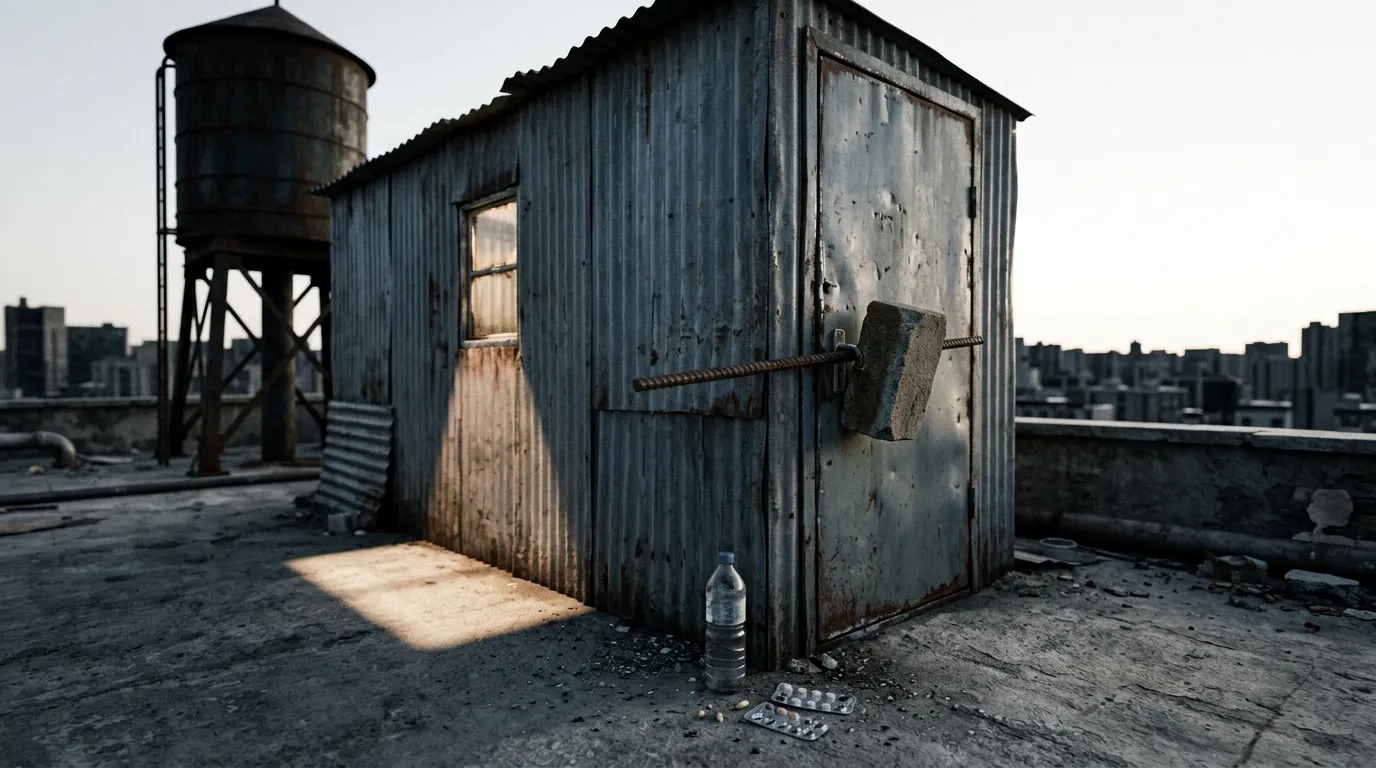
Dawn came in quietly. No birdsong—two days now since they’d heard any. Light seeped through the tin shack’s only window, palm-sized, and landed on the floor in a small patch, like a note someone had slipped under the door.
Jiànhóng woke first. He’d spent the night leaning against the water tank, neck crooked to one side, left shoulder so stiff he could barely raise it. He shifted, glasses sliding to the tip of his nose. Pushed them back. Blinked twice.
Enough light in the shack to see: Yòu’ān clutching Xiǎo Bào, mouth slightly open, deep asleep. Yòutíng on his side, one hand resting on his brother’s backpack strap, breathing steady. Pèiqí sitting by the door, head against the tin wall—from the look of it, she’d taken the last watch shift and held on until morning.
Xiǎolì was in the corner. Curled up, back to everyone, blanket pulled to her shoulders. Looked like she was sleeping.
Jiànhóng stood. His knee cracked once. He walked to the door, lifted the rebar a few inches, and looked out. The rooftop was empty, the water tank’s shadow stretched long by the early light. The city skyline in the distance looked like an overexposed photograph—too quiet, quiet enough to be fake.
He set the rebar back. Turning around, he nearly kicked Pèiqí’s foot.
Pèiqí opened her eyes. Not the way someone wakes up—the way someone who’s been awake the whole time finally stops pretending.
“What time is it?” she asked.
Jiànhóng checked his phone. “Five forty-two. Seventeen percent battery.”
Pèiqí nodded and stood. The red welts where the straps had pressed all night showed at the edge of her collar. She ignored them, crouched by her backpack and started sorting through it, movements light, soundless. Canned food in one pile, water bottle out, first-aid kit opened and checked—her hands running on autopilot, like a pre-opening routine.
“Fill the water,” she said, voice low. “Eat something before we head out. Instant noodles take too long. Crackers and canned food.”
Jiànhóng crouched to help. The two of them divided food in the dawn light without a word, like a couple that had made breakfast together for twenty years.
“Xiǎolì,” Pèiqí said, even quieter.
Jiànhóng stopped.
Pèiqí didn’t look at him. She tore open a packet of soda crackers, put them in a ziplock bag, sealed it. Finished the motion before she spoke.
“Her injury isn’t a sprain.”
Jiànhóng’s fingers froze on the can.
“I’ve been looking after kids for over ten years. What kind of injury haven’t I seen.” Pèiqí slid the ziplock into the side pocket of her pack, pulled the zipper halfway and stopped. “A sprain doesn’t make you walk like that. Sprain swelling spreads evenly. Hers doesn’t.”
She turned to look at him. Light from the window cut across half her face.
“Last night I saw her rolling up her pant leg. Couldn’t see clearly. But the location, the shape—” She paused for a second. “Back when I was nannying the second kid at the Zhāng house, he got bitten by a dog. I treated it. What bite marks look like—I know.”
Jiànhóng said nothing. He took his hand off the can, tapped his knee three times—not calculating. Processing.
“You’re sure?”
“I’m not sure. I didn’t see clearly. But the way I’m not sure is wrong.” Pèiqí’s voice didn’t shake. “If I really thought it was nothing, I would’ve let it go yesterday. I held on to it because I was afraid to look.”
Jiànhóng took his glasses off and wiped them. Nothing on the lenses needed wiping. He put them back on.
“Ask her straight.”
“What if she wasn’t? What if it really is a sprain and we ask—‘Hey Xiǎolì, were you bitten?’—then what? How does she look at us? How do we look at her? You ask that and there’s no going back.”
“Carrying it and not asking—there’s no going back from that either.” Jiànhóng’s voice was nearly a whisper. “Pèiqí, if it’s real—”
“I know what happens if it’s real.”
They looked at each other in the corner of the tin shack. On the spring bed Yòu’ān rolled over, Xiǎo Bào slipping from his hand and getting snatched right back. The air smelled of rust and the oily residue of last night’s instant noodles.
“You go.” Pèiqí stood up.
“What?”
“I’ll go.” She corrected herself. “She talks easier with me. Take the kids to fill the water.”
Pèiqí waited until Jiànhóng had walked to the rooftop water tank with two bottles. Yòu’ān was still asleep. Yòutíng had sat up on his own, rubbed his eyes, seen his father filling water, and gone over to help hold the bottle without asking why.
Pèiqí walked to Xiǎolì’s side. Crouched down.
Xiǎolì’s back was still turned. But the breathing was uneven—not the breathing of someone asleep.
“Xiǎolì.”
”…Mm.” Voice scratchy, a nasal edge to it.
“Sit up a sec.”
Xiǎolì turned over slowly. In the morning light her face was paler than yesterday. Lips cracked, bruise-colored shadows under her eyes. A thin film of sweat on her forehead.
Pèiqí looked at that sweat. Early morning. The shack wasn’t warm.
She knew. The moment Xiǎolì turned over, she knew. But she didn’t say it. She waited for Xiǎolì to say it herself.
They looked at each other for a long time.
From outside the shack came the sound of water running from the tank into a bottle. Yòutíng asked something. Jiànhóng gave a short hum in reply. Far away.
Xiǎolì looked away first. She stared down at her own hands. The remnants of pink nail polish on her fingernails caught the light and looked especially broken.
Then she bent down and slowly pushed up the left pant leg.
Pèiqí didn’t move.
The outer side of her calf. A bite mark. Not large, but the shape was unmistakable—a curved impression, several deeper punctures at the center, the surrounding skin a dark red that had spread outward in a small ring. Not a fresh wound. At least a day old.
Pèiqí’s breathing hitched. Just for one beat.
“I know.” Xiǎolì’s voice was very quiet. “I’ve known since yesterday.”
Pèiqí said nothing.
“It started feeling wrong when we were crossing the bridge. I thought it was just swelling from a twist… but I knew it wasn’t.” Xiǎolì pulled the pant leg back down, slowly, like covering something that no longer needed covering. “The fever started in the middle of the night.”
She looked up. Her eyes were dry.
“I just didn’t want to die on that bridge.”
The way this sentence came out of her mouth was flat. No crack in the voice, no plea in the tone. Like something thought over for so long, chewed for so long, that by the time it finally came out there was no flavor left.
Pèiqí’s nose stung. She pushed the sting back down.
“Why didn’t you tell us?” She heard her own voice come out steadier than expected.
Xiǎolì looked at her. In that look was something very brief—not guilt. More like an exhausted kind of clarity.
“What would you have done if I had?”
Pèiqí didn’t answer. Because she knew. And Xiǎolì knew she knew.
The shack was very quiet. Outside, Jiànhóng was talking to Yòutíng—words indistinct, only the rise and fall of his voice. Yòu’ān seemed to be waking up, calling for his mother.
Xiǎolì moved her gaze from Pèiqí’s face toward the door.
“That question last night,” she said. “You never answered.”
Pèiqí remembered. If one of you two got bitten, what would the other one do?
“You not answering was an answer.” The corner of Xiǎolì’s mouth moved. Not a smile. A kind of acceptance.
Jiànhóng didn’t ask a thing when he came back. He looked at Pèiqí. Pèiqí looked at him. Enough.
He crouched down and opened the first-aid kit. Painkillers. Six left on the blister pack. He took the whole strip out and set it in front of Xiǎolì.
“Anti-inflammatory, painkiller, fever reducer—all in one.” His speech was fast, like running through a spec sheet. “One every four to six hours, not on an empty stomach. Drink plenty of water.”
Xiǎolì took them. “Thanks.”
Jiànhóng stood. His hands went into his pockets, came back out. He didn’t know where to put them.
“The door,” he said. “I’ll barricade it from the outside. Rebar through, then something heavy on top. The stairwell door one floor down—I’ll block that too.”
He was speaking in engineering. It was the only language he had.
Xiǎolì nodded. “Okay.”
Pèiqí called the children in to eat. Soda crackers and half a can of corn. Yòu’ān chewed his cracker and asked: “Isn’t Xiǎolì-jiějie going to eat?”
“She’ll eat later,” Pèiqí said.
Xiǎolì took things out of her cloth bag. A few packets of dry noodle snacks, two cans of tuna, the bag of rice, two bottles of water. She arranged them neatly on the floor, then folded the cloth bag and placed it on top.
“Fare for the road,” she said.
Pèiqí’s hands stopped.
Xiǎolì looked at the items, expression calm. Or rather, calm in a way no twenty-four-year-old should be. She had already cried—Pèiqí could tell; the redness in her eyes wasn’t from now, it was from hours ago.
“How far have you gotten? Near the school?” Xiǎolì asked.
“Yeah.” Pèiqí’s voice squeezed out of her throat.
“Still a ways to go, huh.” Xiǎolì pushed the cloth bag toward her. “I won’t be needing it.”
Pèiqí crouched down and packed the items into her backpack. Her movements were slow. Each can going in made a small sound, aluminum against nylon, very soft.
She wanted to say something. Her mouth opened.
Nothing came out.
Jiànhóng spent ten minutes barricading the shack door. Rebar threaded through from the inside, a concrete block from beside the water tank wedged against it on the outside. Not foolproof, but better than nothing.
He went down one floor and dealt with the iron door to the stairwell—a pried-off railing jammed through the handle, both ends braced against the walls.
When he came back he stood in the doorway. Xiǎolì was sitting on the edge of the spring bed, back against the wall, legs out straight. She’d taken one painkiller. The water bottle was within reach.
“Is there anything else you—” He stopped halfway.
Xiǎolì shook her head. “It’s enough.”
Jiànhóng nodded. He turned. Took two steps and stopped.
“If someone passes by, knock three times.” He didn’t know why he said it. “Three knocks in a row means it’s a person.”
Xiǎolì looked at him. “Okay.”
He walked out.
When Pèiqí shouldered her backpack, the straps pressed into yesterday’s welts. A flash of pain. She didn’t move.
Yòu’ān stood at the doorway, looking back.
“Why isn’t Xiǎolì-jiějie coming with us?”
Pèiqí crouched to adjust his backpack straps. Her hands moved, her mouth spoke—two operations running separately.
“She’s staying to wait for someone to pick her up.”
“Who’s picking her up?”
“Someone.” Pèiqí tightened the straps. “Let’s go. Hold my hand.”
Yòu’ān wanted to ask more, but Pèiqí was already leading him forward. He looked back once at the shack door—it was shut. He lifted Xiǎo Bào to eye level and waved the dinosaur toward the door, a small wobbling motion—like saying goodbye.
Yòutíng said nothing.
He walked behind Pèiqí, hands in his pockets. Coming out of the shack, he glanced at the rebar on the door and the concrete block braced against the outside. He didn’t ask why the door was barricaded from the outside.
At the top of the stairs, Pèiqí said: “Careful. One floor at a time.”
Yòutíng followed. Down two flights. To the building’s entrance. The light was bright, the air outside warmer than inside the shack.
When they came out of the alley, Yòutíng looked at Pèiqí.
Not a nine-year-old’s look. The look of someone who knows the adults are lying, knows why they’re lying, and chooses not to call it out. Mouth closed, chin drawn slightly tight, eyes resting on the side of Pèiqí’s face for about two seconds.
Then he turned his gaze back to the road ahead.
Pèiqí felt it. She didn’t turn her head.
They walked south. Jiànhóng in front, phone held at hip height, checking the offline map. Pèiqí holding Yòu’ān’s hand. Yòutíng in the middle.
No one looked back.
At the corner of the alley, Pèiqí’s feet stopped.
Not her decision. Her legs decided. Her hand found the wall, fingernails scraping against the rough concrete, and her breathing broke apart—air going in got caught halfway by something and sent back, she bent at the waist, shoulders shaking twice, no sound, but all her weight pressed into that one hand on the wall.
Three seconds.
Yòutíng glanced back at her.
She shook her head. Straightened up. Wiped under her nose with the back of her hand—there was nothing there, but she wiped anyway.
Then kept walking.
The apartment building behind the alley grew smaller and smaller until the corner swallowed it. The rooftop shack was invisible from the street—always had been, too low, hidden behind the parapet wall.
Xiǎolì was inside. Door barricaded from the outside. Six painkillers. One water bottle.
Twenty-four years old. Pink nail polish on her fingernails.
They kept walking.