Chapter 8
Chapter Eight: The Last Stretch
The strap dug into yesterday’s welt—a red groove that had gone from sharp to dull. Pèiqí pulled the strap outward, shifting it to a different angle. It held for about twenty steps, then slid back. She stopped adjusting.
Ahead of her, Jiànhóng’s back leaned slightly left—the right strap had been shorter than the left since they’d set out, and he’d never fixed it, or stopped caring. His phone was at hip level, brightness as low as it could go. The blue line on the offline map was almost at its end.
The road went from alleys to a four-lane boulevard. Buildings on both sides started getting shorter—apartments gave way to townhouses, townhouses to corrugated-metal factories, then even the factories thinned out. In the distance to the front right, the outline of hills, a grey-green line across the horizon, low, like someone had drawn it in with a careless stroke.
Yòu’ān’s hand grew heavier in hers. Not from gripping tighter—from letting go. The kind of looseness that comes after walking too long, fingers still resting there but the strength draining downward.
“Mama, how much farther?”
Pèiqí glanced at Jiànhóng. He didn’t turn around. His left hand made some gesture at his side—she couldn’t see it clearly, but after fourteen years together she could read his back. It meant almost there.
“Almost there,” she said.
“You said that last time.”
“And the time before that.” Yòutíng’s voice came from behind.
Pèiqí almost laughed. Almost. The corner of her mouth moved and pulled back—laughing takes energy, and she had none to spare.
After about an hour of walking, Jiànhóng stopped.
He stood next to a bare roadside tree, staring at his phone. Pèiqí walked up to him and he tilted the screen toward her. The blue line had a final stub left; the endpoint was marked with a tiny school icon.
“Just over a kilometer,” he said. His voice was sand—he’d barely spoken all morning, and whatever had been in his throat had dried there.
Pèiqí looked back at the kids. Yòu’ān was squatting on the ground, Xiǎo Bào perched on his knee, letting the dinosaur “sit and rest.” Yòutíng stood beside him, hands in his pockets, staring down the road ahead. He’d said fewer than five sentences all day.
“Eat something.” Pèiqí set her backpack down and dug out the last packet of soda crackers. Four pieces. She broke each in half and divided them between the two boys. Jiànhóng shook his head. She didn’t eat either.
Yòu’ān chewed twice and crumbs fell on Xiǎo Bào’s head. He brushed them off with his finger, very carefully.
“Let’s go.” Jiànhóng put his phone away. Before the screen went dark, Pèiqí caught the battery level—9%.
They heard it first.
Not the sound of the infected—people. Someone was shouting something, words indistinct, but the cadence was unmistakably alive. Emotion in it, rhythm in it, the expectation that whoever was listening would respond.
Pèiqí’s step faltered. Jiànhóng stopped too.
Two hundred meters ahead, a wall.
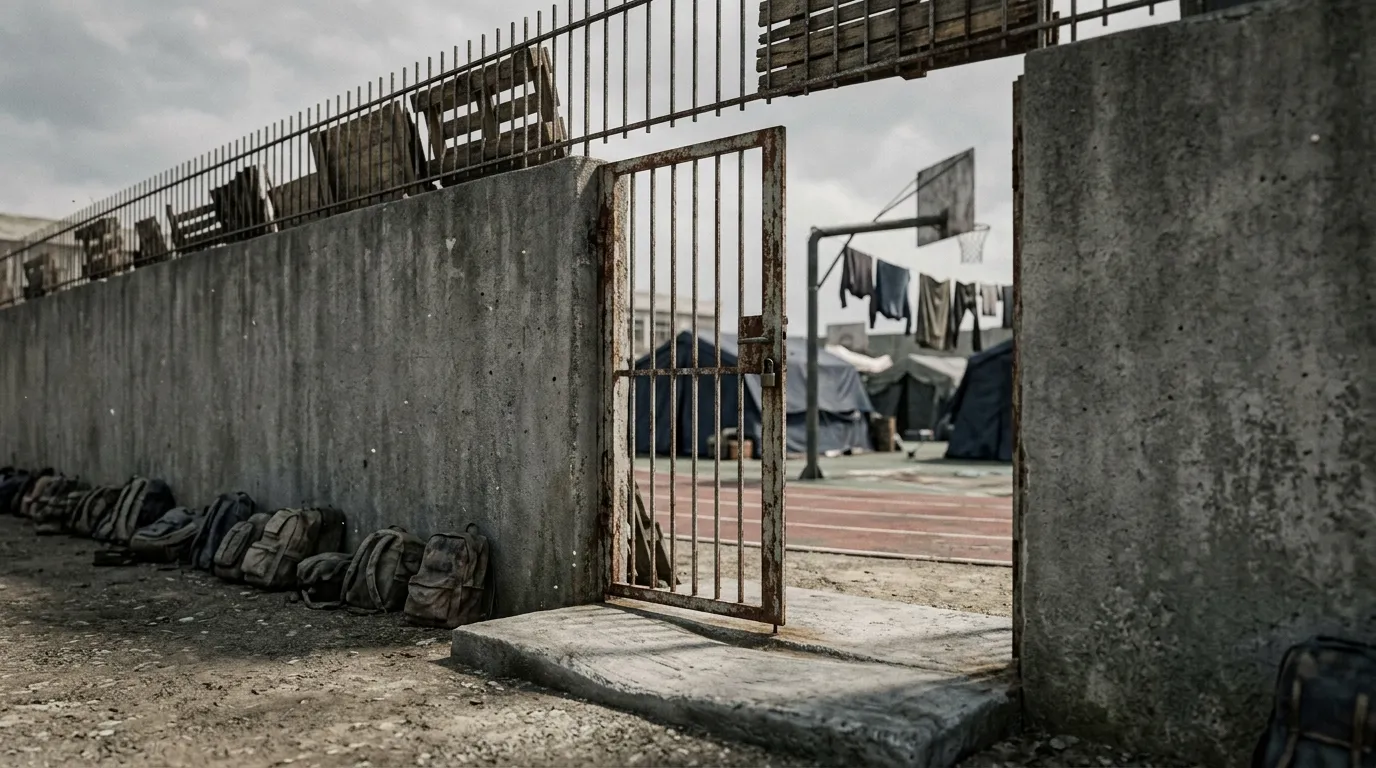
Grey concrete, topped with iron railings, and above the railings wooden pallets nailed on to add more height. Two silhouettes stood on top, faces unreadable at this distance, but their posture was looking down.
A school.
Something in Pèiqí’s chest came loose. Not loose—snapped. A wire that had been taut since the day they’d left, suddenly without tension. Her knees buckled for a moment. She caught herself.
“Are we there?” Yòu’ān tugged her hand. “Mama, are we there?”
“Mm.”
Yòu’ān didn’t cheer. He was too tired for that. He just said “oh,” picked Xiǎo Bào up from his knee, and held the dinosaur toward the wall so it could see.
Up close, they saw the full picture.
The school’s main gate had only a narrow opening, barely wide enough for one person. Two people flanked it—baseball bats. Not a batter’s grip. The grip of someone ready to hit something.
A dozen or so people queued outside. Quiet. No shoving, no yelling, no cutting. Each person stood about half a meter behind the one in front, packs at their feet or on their backs, every face wearing the same unsettling expression: exhaustion, blankness, waiting.
A line. Pèiqí looked at it and an absurdly out-of-place thought flashed through her mind—gas stations before a typhoon. Costco anniversary sales.
At the front of the line, an argument.
A man. Mid-thirties, T-shirt, right arm wrapped elbow to wrist in a strip of cloth, the cloth stained dark. He was facing a volunteer at the gate, his voice held low but failing, words pushing out one sentence at a time: “I told you it wasn’t a bite—I cut it climbing a wall—look, look at the shape—”
The volunteer shook her head. Said something. Pèiqí was too far away to hear.
The man stepped forward. Both bat-holders swung their bats horizontal at the same time.
“Let me in.” The man’s voice cracked upward. “I walked two days. Two days. I have nothing left. Let me in.”
The volunteer said something else.
The man’s face twisted. He turned and slapped the gate—not knocked, slapped, full palm against metal. The iron hummed.
Jiànhóng’s back straightened.
Pèiqí saw his shoulders tighten, both hands at his sides, fingers spreading open and closing again. His head tilted at a slight angle—not watching the man. Listening.
The man hit the gate a fourth time. A fifth.
Jiànhóng’s fingers moved. Against his thigh, lightly, like he was counting.
Pèiqí reached over and took his hand.
It was cold. She held on for a moment before his fingers slowly responded. He didn’t turn his head. Neither did she. They stood side by side, facing forward, in the line, watching what was ahead.
The man was pulled away by two volunteers. His feet dragged on the ground, sneakers scraping out a long sound. He’d stopped shouting. Stopped hitting. When they brought him to the far side of the wall he went limp, leaned against it, and slid down to sit on the ground.
Pèiqí’s hand moved. Toward him, just slightly.
Then pulled back.
She lowered her head and looked at the toes of her shoes.
The line shifted forward one space.
By the time it was their turn, Pèiqí’s palms were slick with sweat.
The volunteer was a woman in her fifties, short hair, surgical mask, holding a pen and a sheet of paper. Her eyes swept over the four of them—brief, but enough.
“How many?”
“Four,” Jiànhóng said. “Two adults, two children.”
“Where from?”
“North side of the city. Three days walking.”
The woman wrote something on the paper. “Anyone injured?”
Pèiqí’s breath caught for half a beat. A completely irrational thought flashed through—if she sees the red marks on our shoulders—then reason pushed it back down. Strap welts. Not bite wounds. She knew that. But her heart was hammering.
“No,” Jiànhóng said.
“Roll up your sleeves, please.” The woman nodded toward another volunteer by the gate. A young man came over. “All four. Arms, neck, ankles. Children too.”
Jiànhóng rolled his sleeves first. Pèiqí followed. The young volunteer checked quickly, circling each of them once, crouching to inspect ankles—they had to hike up their pant legs. Pèiqí pulled hers up too fast—she knew it was too fast, but her hands had already moved. The volunteer didn’t give her a second look.
“The kids?” The woman crouched in front of Yòutíng.
Yòutíng glanced at Pèiqí. She nodded. He rolled up his own sleeves and turned in a circle, movements smooth and cooperative, like he’d done this many times before.
“Last one.” The woman looked at Yòu’ān.
Yòu’ān took a step back and bumped into Pèiqí’s legs.
“No.” His voice was very small.
Pèiqí crouched down. Her eyes met Yòu’ān’s, level. His eyes were rimming red, lower lip trembling.
“Baby, the lady just needs to take a look. Like a doctor.”
“I don’t want to.” Yòu’ān pressed Xiǎo Bào against his chest, as if the dinosaur were a shield that could block everything. “Will she take me away?”
“No. Mama’s right here. Not going anywhere.”
The woman didn’t rush him. She waited beside them, pen tucked between her fingers, posture patient—she’d seen this before. Many times.
Pèiqí eased Yòu’ān’s sleeves up slowly. His arms were thin and pale, nothing on them. She turned him in a circle—wrists, inner elbows, both sides of his neck. Two tears dropped from Yòu’ān’s eyes, but he didn’t step back again.
The young volunteer circled Yòu’ān once and nodded at the woman.
She made a checkmark on the paper.
“Go on in,” she said. Stepped aside.
Pèiqí stood up. The pack pressed down on her shoulders, the welts throbbing. She took Yòu’ān’s hand and walked forward.
The gate.
Not big. One person wide. Iron, paint mostly gone, weld marks where the frame had been reinforced. The concrete beneath the threshold had been worn into a shallow groove by many feet.
Pèiqí stepped over the threshold.
Yòu’ān stepped over the threshold.
Yòutíng stepped over the threshold.
Jiànhóng last. He paused at the gate for less than a second. His eyes swept the frame, fingers twitching once—touching nothing, just moving in the air.
Then he stepped through.
The field.
Tents. A dozen or so, dark blue and grey, not quite aligned but evenly spaced. Ground covered with moisture-barrier mats and flattened cardboard. In the corner, someone hanging laundry—T-shirts draped over a basketball hoop.
The classroom building’s windows, some open, some shut. People sitting in the corridor. People walking. Someone standing on the second floor, looking down.
Disinfectant. Pèiqí smelled it. Strong. Like a hospital corridor, but underneath it the smell of playground dirt and tin roofing baked by the sun.
No cheering. Nobody ran over to say welcome. A person in a reflective vest pointed toward the area near the stage and said, “Find a spot over there. Porridge’s coming soon.”
Pèiqí’s feet touched the rubber track. Red. Cracked in a few places, weeds growing through the splits.
Yòu’ān took two steps and looked down at the ground.
“Mama, this is a field.”
“Mm.”
“Same as at our school.”
“Mm.”
Yòutíng walked alongside them. His hands were out of his pockets. He was looking at everything around him—tents, people, laundry on the basketball hoop.
Someone came over. A middle-aged man, apron on, carrying a plastic crate. Inside: water—unlabeled bottles, dates written on the caps in marker.
“Four?”
Jiànhóng nodded.
The man handed over four bottles. Jiànhóng took two, Pèiqí took two.
She passed one to Yòutíng. He took it, twisted the cap off, drank. Said nothing.
She passed the other to Yòu’ān.
Yòu’ān couldn’t get it open. Pèiqí twisted the cap for him. He tilted his head back and took a long gulp. Water leaked from the corner of his mouth and dripped onto his T-shirt.
He lowered the bottle. Wiped his mouth with the back of his hand.
“This is the best water I’ve ever had.”
Pèiqí looked at him. She couldn’t crouch down anymore. She stood on the field, pack pressing into her shoulders, sun overhead, surrounded by tents and strangers and the smell of disinfectant.
Her lips moved.
Not to hum anything. Not this time. They just moved, and then closed.
Jiànhóng beside her drank half his bottle. He turned to look at her. She turned to look at him.
Neither said a word.
It was enough.