Chapter 9
Chapter Nine: Alive
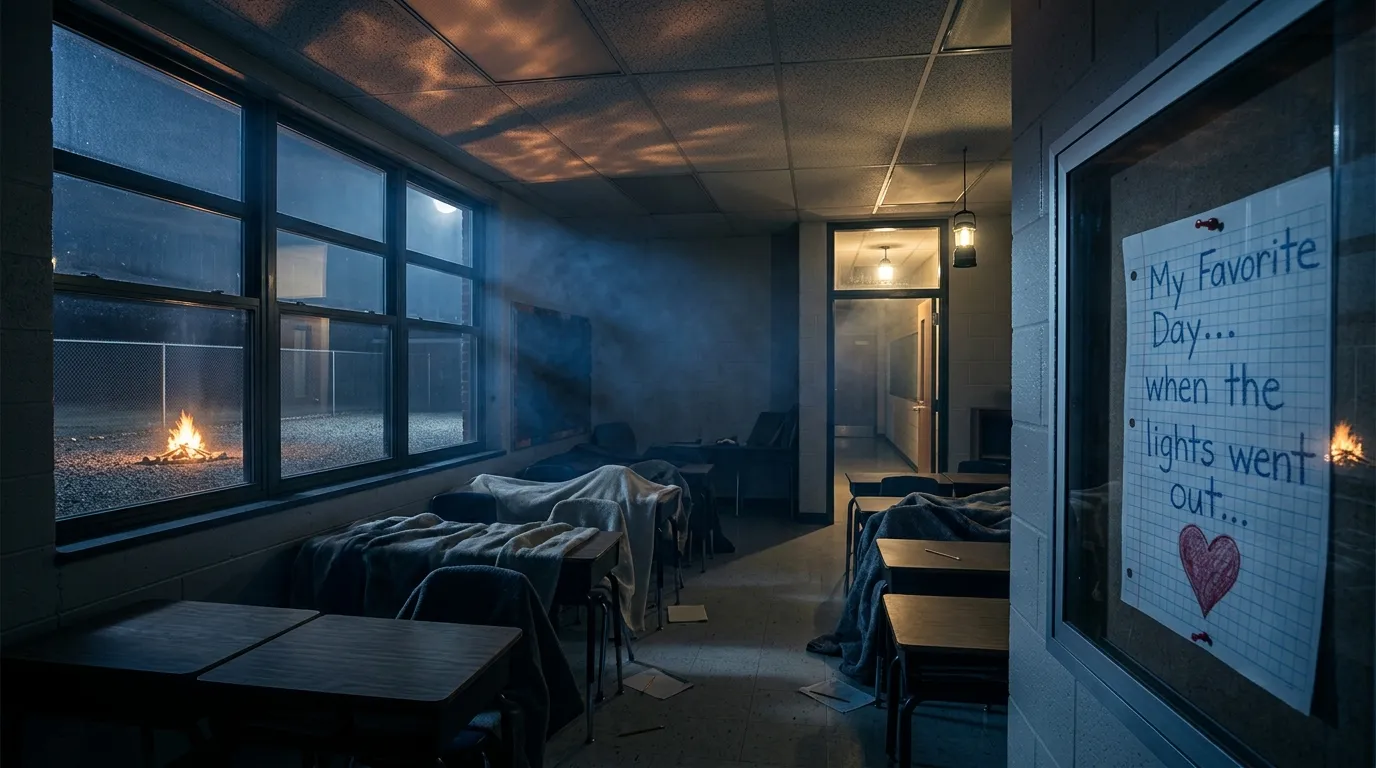
The classroom desks had been pushed to the walls, paired up two by two, draped with thin blankets and jackets left behind by people no one could name.
Jiànhóng sat on the edge of one set, bracing his weight on his palms. The welts on his shoulders hurt worse after the backpack came off—pressure gone, nerves finally remembering to complain.
Across the room, Pèiqí was pulling off Yòu’ān’s shoes. His eyelids were losing the fight, body swaying on the desk, fingers clutching Xiǎo Bào with a grip fading at the same rate as his consciousness.
“Lie down first.” Pèiqí’s voice dropped to a volume Jiànhóng could barely hear. She rolled a jacket into a lump and wedged it under Yòu’ān’s head.
When Yòu’ān lay back his mouth moved once, as if to say something, but only a puff of air came out. Xiǎo Bào was pinned between his chin and chest, the dinosaur’s head facing outward—standing guard over the room for him.
Yòutíng was already down. He’d climbed onto the desk himself, pulled the blanket up himself, taken off his own shoes and set them beside the desk leg. Lined up neatly. Both of them.
Jiànhóng dug his phone out of the backpack. The screen lit up and he squinted—9%. No signal. He checked the time: 9:13 p.m. Then turned the screen off.
Conserve it. Three days of habit, not yet unlearned.
The hallway outside the classroom was dark. At the far end, a camping lantern hung from the handle of a broom closet, casting a murky pool of yellow.
Jiànhóng walked barefoot on the tile floor. Cold. He lightened his steps, pressing his soles flat and sliding forward. Light leaked from the next classroom over—low voices inside. One room farther, a baby crying. Not a full cry. The hiccupping kind, the sound of a baby who’d cried itself out but hadn’t quite stopped.
The bathroom was at the end of the hall. He pushed the door open. Disinfectant and the stale dampness of a room sealed too long. The sink had only cold water. He washed his hands, then cupped a palmful and pressed it to his face. Ice cold. His glasses fogged. He took them off and wiped them with the hem of his shirt. Put them back on. Still streaked.
On his way back he passed the bulletin board.
Small. Wooden frame, acrylic panel, a few sheets of paper pinned inside. He hadn’t planned to look—but the camping lantern at the end of the hall threw its light just right, and a few characters jumped into view.
An essay.
Grid paper, red lines, a child’s handwriting—crooked, strokes spilling outside the squares. Jiànhóng’s feet stopped.
The title on the top sheet: “My Family.”
He stood in front of the bulletin board.
The characters were big—too big for the squares, the kind that refused to be contained. The essay said Dad makes curry, Mom can sing, little brother is noisy. The last line read: Our family is the best, followed by a hand-drawn heart.
The teacher’s comment was in red ink: Good job, but remember to keep your punctuation inside the squares!
Jiànhóng stared at the heart.
He didn’t know where this kid was now. Maybe sleeping in one of the classrooms in this school. Maybe not.
His fingers moved. Against his thigh. Once.
Then he turned and walked back.
The classroom was darker now. Someone across the hall had dimmed their lantern, and the light coming through the transom above the door carved a blurred edge across the ceiling.
Yòu’ān had rolled over. Xiǎo Bào was pinned under his stomach, the dinosaur’s tail poking out beside his elbow. Four years, and the chip on that tail was still the same shape—it wasn’t going to get any worse.
Yòutíng hadn’t moved.
Jiànhóng thought he was asleep.
“Dad.”
Very quiet. Jiànhóng stopped beside the desk.
“What is it?”
A few seconds of silence. Yòutíng’s eyes were bright in the dark, lying on his side, looking toward Jiànhóng.
“Xiǎolì-jiějie wasn’t waiting for someone. Was she.”
Not a question. No rising inflection. Like reading aloud a sentence he’d already gone over many times.
Something blocked Jiànhóng’s throat.
He looked at Yòutíng. Nine years old. A mole on his ear. His expression unreadable in this light, but Jiànhóng knew—the boy wasn’t waiting for an answer. He was waiting for someone to be willing to give him a real one.
Jiànhóng remembered his own silences. More than once.
This time, he didn’t.
“No.”
Silence.
Jiànhóng waited. For Yòutíng to press further. To ask why, to ask what happened, to ask the questions Jiànhóng wasn’t ready for.
Yòutíng didn’t ask.
“I know.”
He rolled over. Faced the wall. Pulled the edge of the blanket up over his shoulder.
And that was it.
Jiànhóng stood where he was, listening to the breathing of two children. Yòu’ān’s breath was heavy, with a faint nasal edge. Yòutíng’s was shallow—not asleep yet. But he didn’t need anything more.
Jiànhóng sat down slowly. The edge of the desk dug into the backs of his thighs. The hand bracing him against the desk suddenly lost its strength—the heel of his palm slipped, his center of gravity lurching for an instant. His fingers clenched the desk surface, knuckles white, and stayed that way for a long time before they loosened.
He took off his glasses. Not to wipe them. Because he didn’t want to see anything through lenses. He closed his eyes and pressed his thumbs into the grooves on either side of his nose bridge, pressing hard—hard enough for that pain to stand in for another kind.
Pèiqí made no sound when she came over.
That was just how she was. Always walked light—trained into her from years of moving around sleeping children, existing beside them without existing.
She sat down next to him. Shoulder against his shoulder. Neither spoke.
Outside the window, firelight on the field. Someone had built a fire from broken desk planks and cardboard boxes. Small, but in a field with no other light source it looked like a hole, pulling the surrounding darkness into itself. A few silhouettes sat by the fire.
Jiànhóng could smell smoke. Faint. Mixed with disinfectant and the chalk dust of an old classroom.
“I was thinking, while we were in line today.” Pèiqí spoke. Quiet enough that Jiànhóng wasn’t sure if she was talking to him or to herself.
“If they hadn’t let us in.”
A pause.
“What I would have done.”
Another pause. The firelight wavered against the ceiling.
“Anything.”
Jiànhóng didn’t turn his head. He knew she was looking out the window. He was too. The fire cut a sharp line along her profile—sharper than he remembered.
“I know,” he said.
Not it’s okay. Not that wouldn’t have happened. Not any kind of comfort.
She had stated a fact. He confirmed it.
That was enough.
Quiet for a long time. The fire flickered. Someone threw something in; sparks flew up, existed for a second in the dark, and went out.
Then Pèiqí said: “When I used to work at Mrs. Zhāng’s place.”
Jiànhóng turned to look at her.
“Her kid had a dinosaur too. Plastic. A bit bigger than Xiǎo Bào, the green kind.”
The corner of her mouth moved.
“I’d step on it every single time I swept the floor.”
Jiànhóng didn’t react right away. His brain needed two seconds to shift out of the weight it had just been carrying.
“Step on it?”
“Mm. On the living room floor. Always right in the path I’d have to walk.” Something in her voice bent—not quite a laugh, but no longer a straight line. “One time I stepped on it so hard I started swearing in Taiwanese, right there in someone else’s house.”
Jiànhóng glanced at Yòu’ān’s outline in the dark. Xiǎo Bào’s tail jutting out beside his elbow.
“Xiǎo Bào doesn’t have a floor deployment problem,” he said. “Its deployment environment is Yòu’ān’s hand.”
Pèiqí’s shoulder shook once. Not crying. Laughing. Small, barely audible.
Jiànhóng laughed too. The corner of his mouth pulled—barely, the muscles in his face as spent as his shoulders, too tired to spare anything for expressions. But the curve was real, there in the dark.
Firelight coming in. Not bright. But enough.
Outside, someone was coughing. Farther off, a dog barking. The fire on the field threw a few people’s shadows against the wall, stretched long.
Yòu’ān rolled over and made a blurred sound—like talking to Xiǎo Bào in a dream.
Yòutíng’s breathing had deepened. Asleep.
Pèiqí leaned against his shoulder, and when the weight settled he didn’t shift away. The spot where the strap had dug in flared once. He didn’t move.
Three days. From the balcony at home to this classroom. Fifteen kilometers.
They were alive.
Not whole. Cracked. Welts on their shoulders, images in their heads that could never be walked back, lies told and words left unsaid still lodged inside.
But alive.
Firelight wavered on the ceiling. Jiànhóng closed his eyes. Pèiqí’s breathing slowly steadied into a rhythm.
He wasn’t asleep. But he kept his eyes closed, and listened.
Two children breathing. One heavy, one shallow.
Enough.