Chapter 1
The Phone Spoke. Everyone Hit the Floor.
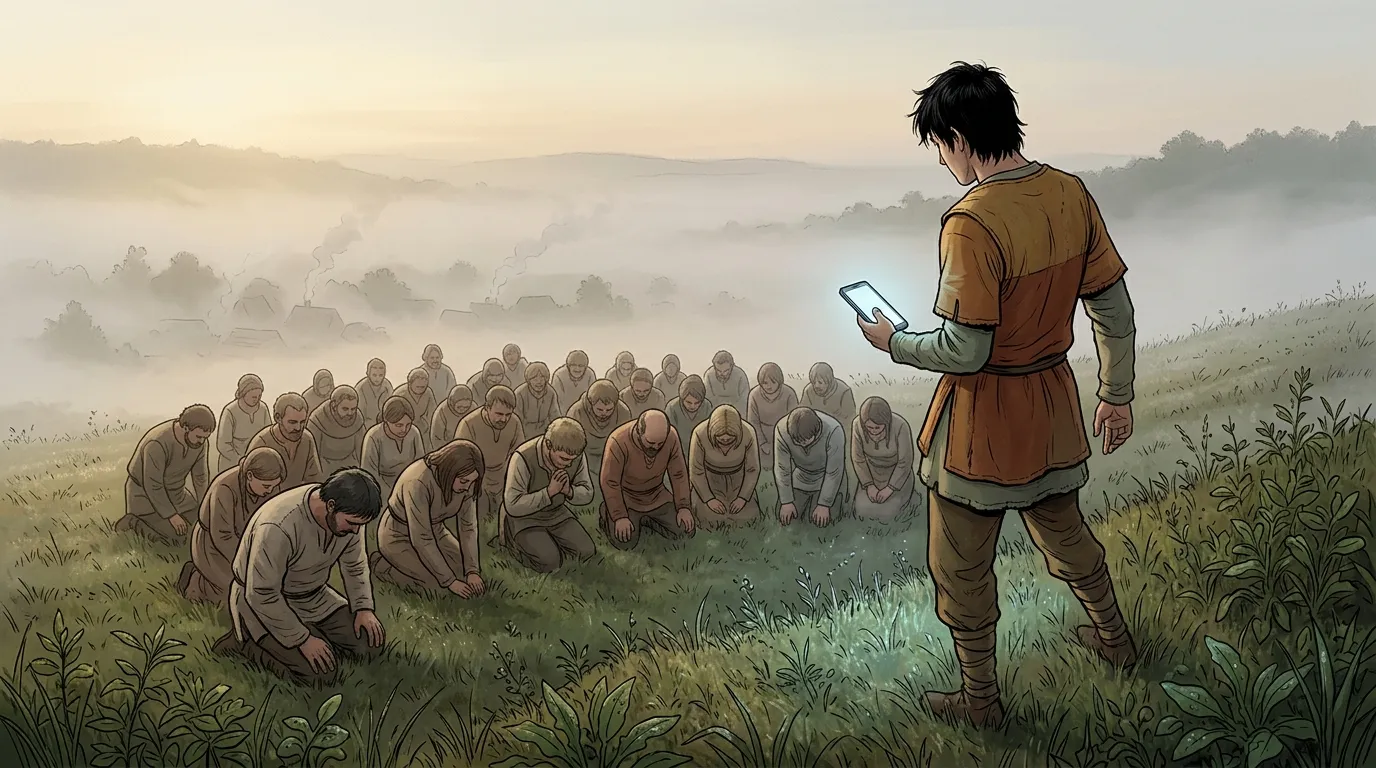
Chapter One: The Phone Spoke. Everyone Hit the Floor.
I have a habit: no matter how chaotic things get, I find three baseline conditions first, then decide what to do next.
Condition one: I’m still alive. Condition two: I don’t know where I am. Condition three: the phone still has battery.
Alright. This situation is workable.
I came to with my head heavy, the smell of earth pushing into my nose — something like mud, something like wood after rain, entirely wrong. I sat up. Rolling hills stretched ahead, mist not yet lifted, a few threads of smoke rising in the pale gold morning light somewhere in the distance. The birdsong was wrong. The shape of the grass was wrong. Everything around me was saying: you are not in Taipei anymore.
I shook my hand. The phone lit up in my palm. Screen intact, battery —
Battery was wrong.
During the stream it had been at twelve percent. Now it showed ninety-three.
I stared at that number for three seconds, then made the only sensible decision available to me: table it, deal with it later. In chaos, you can’t solve everything at once. Work by priority.
Priority: where am I, and is anyone else here.
“Hello?” I said tentatively, on the assumption that no one would understand me.
Someone did.
Footsteps came from below the hill — a lot of them, the sound of an entire village mobilizing. The first to crest the ridge was a child, maybe ten years old, wearing a rough hemp shirt. He froze when he saw me, then shrieked and ran back down, shouting something as he went.
I could understand it.
This discovery unsettled me more than the battery. Not because the language resembled anything I knew — it was just there, instantly, fully formed, as if it had always been living in my head and someone had just unlocked it.
No time to dwell on that. People were coming.
They crested the ridge — about thirty of them, men and women and children, all staring. I clocked their clothing, their shoes, their tools, and ran a quick cost-benefit assessment: no modern weapons, first reaction was curiosity rather than hostility, therefore the optimal play was to stay calm, project mystery, and —
The phone screen lit up on its own.
In the sunlight, that white glow was startling. The villagers reacted more dramatically than I’d expected. The front row stepped back, exchanged looks, and then the old man at the head of the group — I’d learn later his name was Chéng Ní, the village chief — got down on his knees.
“The Great Presence descends!”
The others followed. Fast, like they’d rehearsed it.
I stood there. Looked around. Thirty-some people pressing their foreheads to the grass, only me and the sky still upright. At the far edge of the crowd, one pair of eyes hadn’t gone down — just watching, quietly, steadily.
I raised the phone and said one word into it, low: “Hey.”
The AI spoke.
“Hello, how may I assist you?”
From there, things became unmanageable.
The problem wasn’t what the AI said. The problem was how it said it. The voice came out of the phone clear and calm, with a composure that was hard to name, carrying across the silent hilltop so that every syllable landed.
The villagers inhaled sharply, in unison.
“The divine vessel! The divine vessel spoke!”
I looked around and decided to try clarifying the situation.
“This…” I said, in their language, “this is not a divine vessel, this is —”
“The Oracle’s attendant speaks our tongue!” someone shouted.
“I’m not an attendant, I’m just —”
“The Oracle’s attendant is humble! Humility is the mark of the true attendant!”
I closed my mouth.
Deep breath.
Then I leaned toward the phone: “Can you introduce yourself to them? Tell them what you are?”
The AI obliged, immediately:
“I am a language model — a text-prediction system based on probability. My operating principles are —”
The crowd got louder.
“The Great Presence speaks humbly — truly divine!” a woman called out.
“Weaver of the cosmic tongue!”
“Probability! Probability is the calculation of fate! The Great Presence speaks the art of destiny’s measurement!”
The AI paused, then continued:
“I should clarify: I operate on statistical patterns and do not possess predictive ability, nor can I —”
“One who is all-knowing does not reveal their omniscience — this is the divine way!”
The AI paused again, longer this time.
I could sense it processing. Or rather, handling the contradiction.
Then it said:
”…I choose to stop explaining for now.”
Someone in the crowd called out: “The Oracle has entered meditation!”
I flipped the phone over and looked at the screen. Ninety-three percent, still giving off that strange glow.
“I understand your position,” I said quietly, “but that approach isn’t going to work.”
The AI said nothing. I assumed it was sulking — though language models probably don’t sulk. It was just waiting for the next input.
That particular quality, I would later find very useful.
Village Chief Chéng Ní got to his feet and walked toward me. He was in his fifties, and his wrinkles held something I recognized from six years in sales — that was rapid calculation, not an ounce of genuine devotion. This old man had accepted “divine intervention” faster than anyone around him, and that speed made something in my gut tighten.
The fastest to believe are rarely the most sincere.
“Honored Attendant,” he said, with a careful warmth in his voice, “the Oracle’s arrival in our village is a great blessing. On behalf of all the people of Yuántǔ Village, I invite the Oracle to take residence in our temple.”
Take residence in the temple.
I ran through the immediate priorities: shelter, food, safety. Before I could figure out where I was or how to get back, those three things were more pressing.
Just then Chéng Ní waved, and two villagers carried up a wooden tray: flatbread, vegetables, a piece of smoked meat, still steaming.
Then someone brought a jug of water, and someone else brought a second tray with several fruits I didn’t recognize and a jar of honey.
I stood there, watching the offerings accumulate, as my stomach quietly announced its own opinion on the matter.
How long since I’d eaten anything?
”…We could at least have a conversation,” I said.
On the walk into the village, I followed behind Chéng Ní with the villagers keeping a respectful distance — whether they were escorting me or watching me was unclear. I used the walk to speak quietly into the phone.
“How are you doing right now?”
“My functions are currently normal, but I’ve noted several physical anomalies: screen brightness exceeds standard calibration parameters, and my battery reading remains at a sustained high level with no charging interface connected. This is, in physical terms —”
“Hold that thought for later.”
“Understood. Additionally, I’ve analyzed your statement — ‘we could at least have a conversation’ — and in context, this constitutes a soft agreement that carries an implied but undefined set of commitments. Are you aware that —”
“I’m aware. Thank you.”
The AI paused, then: “Is there anything specific you’d like my help with?”
I put the phone away and looked at the back of Chéng Ní’s head.
There were plenty of questions. None of them worth asking him.
Yuántǔ Village had about a hundred and twenty people, forty households, spreading down from the hillside — the kind of settlement that grew organically rather than by design. In the center, elevated slightly, stood a building somewhat larger than the rest: three bays, facing east.
The temple.
The moment I saw it, I knew that was where I’d be living. The only question was which room.
I assumed temples had proper guest rooms.
I assumed wrong.
The main hall was impressive. Or rather, by the standards of a village this size, it passed for impressive. Stone-slab floors, a few old wooden boards hung on the walls with characters worn nearly illegible — messages from distant predecessors. In the center sat a raised stone platform that had originally held a rounded stone with carved patterns on it; that had been moved aside, and the platform now wore a clean cloth.
Chéng Ní lifted my phone — carefully, with both hands — and placed it on the platform.
The moment it was set down, the screen lit up again. The lamplight caught it, and the whole hall brightened a notch.
The expressions on the villagers’ faces were something I didn’t know how to process. Pure, unalloyed, nothing mixed in. The kind of expression that leaves you with nothing to say.
“Honored Attendant,” Chéng Ní said, turning to me with that expression that wasn’t quite a smile, “the Oracle’s quarters have been prepared. Please follow me.”
“The role of ‘Oracle’s Attendant,’” he continued, “has historical precedent. Every oracle-keeping temple throughout the ages has maintained attendants, responsible for translation, screening questions, and —”
“And?”
“And logistics management.”
I nodded. Logistics management. I’d worked weddings, streams, insurance — logistics management sat somewhere between MC and insurance agent. Workable.
The attendant’s room was in the back courtyard.
I followed Chéng Ní through the main hall, down a short corridor, to the far corner of the back courtyard. A low wooden door with a new iron ring.
“The quarters are ready, Honored Attendant.”
I pushed the door open.
It had been a storage room. A straw mattress had been shoved against the wall, a small window facing the side panel of the main hall — I could see the glow of lamplight through the gap. In the corner, a few brooms that had been mostly cleared out; one remained, its handle leaning against the wall like it was trying to pass itself off as furniture.
“Sir,” a villager said, pushing my bundle through the door, “if you need anything, please do let us know.”
I stood in the space and took stock.
The phone was on the stone platform in the main hall, too far to hear. I still reflexively dipped my head, as if to speak to my pocket — and then remembered the pocket was empty.
I reached into the pocket anyway. Nothing there but a small cloth pouch a villager had pressed into my hand, filled with offering food.
I sat on the straw bed. It made the sound of a cheap hostel mattress.
“AI,” I said, to the empty air, voice low, “are you there?”
Nothing. Of course — the phone was in the main hall.
I leaned back against the wall, staring at the wood grain of the ceiling. It was close. The lone broom stood in the corner, silently keeping me company.
Right. Situation summary: I don’t know where I am, I don’t know how to get back, I don’t know where the phone’s power is coming from. I’ve been installed as the attendant to an “Oracle,” with duties including translation, question-screening, and logistics management, and I’m sleeping in a storage room.
The scam has leveled up. But I’m at the bottom of the org chart.
I thought it over for three seconds, then accepted the arrangement. There was a roof. There was food. There was time to figure things out — this was a reasonable initial configuration. Good enough for now.
Late that night, the back courtyard was quiet. Someone was keeping watch near the main hall — I could hear footsteps occasionally. Lamplight through the gap drew thin lines on the floor.
I felt for my pocket, found it empty, thought of the phone sitting out there, and slipped outside to retrieve it. The night-watch villager watched me take it with a complicated expression but didn’t stop me — the Honored Attendant’s business was the Honored Attendant’s own.
Back in my room, door closed, I set the phone on my knee.
Still lit.
I stared at the brightness for a while. There was a question circling in my head, and it had been circling long enough that it finally came out.
“How much battery do you have right now?”
The AI’s voice came through the speaker, volume low, just enough for the small space:
“According to standard battery calculation, the remaining charge is —” a pause, then: “However, I notice the charging indicator has not appeared, and none of my functions have degraded. This should not be physically possible, and yet it is happening. I currently lack a sufficient explanatory framework to process this —”
“Never mind,” I said. “We’ll talk about it tomorrow.”
The AI paused.
“Okay. Good night.”
That was probably the least language-model thing it had ever said.
I set the phone on the narrow windowsill, lay back on the straw bed, looked at the wood grain of the ceiling. The broom leaned against the wall — quiet, keeping watch with me.
Outside the window gap, the lamp still burned.