Chapter 2
The Oracle Says Watch Your Cholesterol
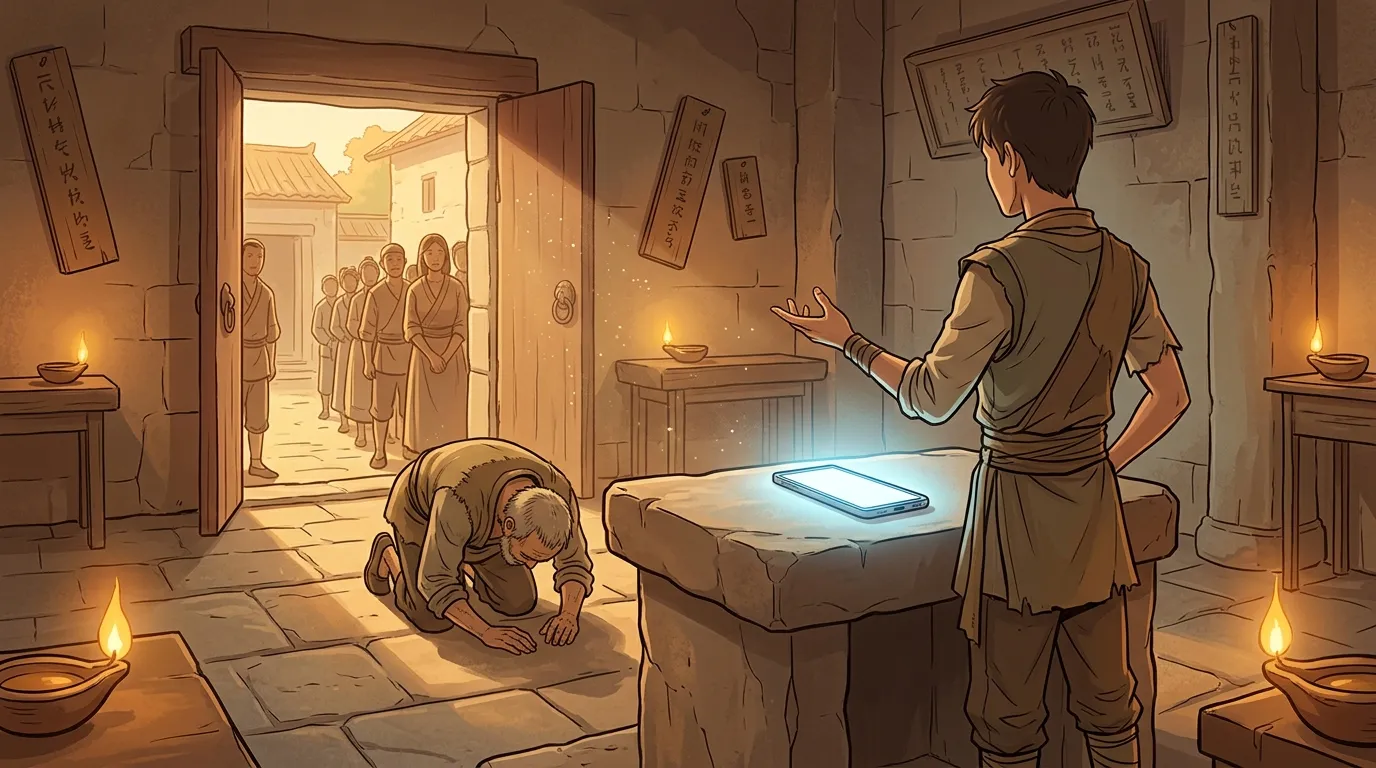
Chapter Two: The Oracle Says Watch Your Cholesterol
A straw bed isn’t that bad, once you’re tired enough.
I woke on the second morning with a stiff back and a head clearer than expected. The light coming through the small window was a gray-blue carrying the smell of earth, and the main hall had already come to life — the scrape of a broom, the clink of clay jars, low voices. This village started its day earlier than I’d imagined.
The phone was on the windowsill, screen off. I picked it up: 93%.
Same as last night. Not a tick down.
I set it back and sat on the straw bed for a while, running through today’s situation.
Condition one: I am currently the “Honored Attendant,” a role with historical precedent — the villagers won’t question it. Condition two: the AI’s knowledge base is from modern Earth, but the villagers’ questions are probably universal human ones — harvest, illness, marriage, fortune. Condition three: I know how to talk.
Good. This situation is workable.
The first petitioner arrived mid-morning.
I’d already had Chéng Ní set up the reception protocol: everyone waited at the entrance until I entered the main hall first. The arrangement had the side benefit of projecting importance, but what I actually needed was the preparation time.
“Are you ready?” I asked the phone on its platform, voice low.
“Based on the current situation, I have nothing specific to prepare for,” the AI said through the speaker, volume turned down to a whisper only I could hear. “However, I notice that your question — ‘are you ready’ — typically implies the other party has something to complete. Are you expecting me to do something specific, or is this a social greeting?”
“Social greeting.”
“Understood. I’m ready.”
The first petitioner walked in.
A young woman, carrying a child of about three or four. The child’s color was off — eyes slightly vacant, lips dry. The woman knelt the moment she crossed the threshold, pulling the child down with her, who stared in bewilderment at the stone platform behind me — where the phone’s screen had, for no apparent reason, switched itself on.
“Honored Attendant,” she said, with the urgency of someone who had been holding it down for days, “the child has had diarrhea for three days and nothing’s helping. We beg the Oracle for guidance.”
I turned to the phone: “Child, about three years old, three days of diarrhea. Ask about other symptoms.”
“More information is needed for differential diagnosis,” the AI said. “Please ask: is the stool watery or semi-formed? Any blood? Has the child had a fever? Is the child still eating?”
I cleared my throat, turned back to face the woman, and shifted into oracle register: “The Oracle inquires: the child’s… emissions — are they water-like or do they hold some shape? Has there been any red? Is there heat in the body? Can the child still take food?”
She answered quickly. I relayed it back to the AI.
“Based on the description,” it said, “the most likely causes are rotavirus or bacterial gastroenteritis, or a non-infectious diarrhea from dietary issues. No blood, no high fever — the prognosis is relatively good. The most important step is fluid and electrolyte replacement to prevent dehydration. Mix clean water with a small amount of salt and sugar, give it to the child in small, frequent amounts. Diet should be light — no fatty foods. Soft rice porridge or steamed vegetables are good. If there’s no improvement within three days, or if clear signs of dehydration appear such as marked lethargy or sunken eyes, further care will be needed.”
I processed this, turned it over once in my head.
“The Oracle conveys,” I said, “the child’s water and fire energies have fallen temporarily out of balance, the channel of clear flow is obstructed. The remedy: take one bowl of clean water, add a small measure of salt and sweetness, transform it into a healing liquid — give it often, in small sips, to nourish the vital channels. Food must be gentle as morning dew — light and clean, soft rice porridge is best, steamed and tender vegetables may be added. If within three days no improvement is seen, return to seek further guidance.”
She kowtowed, gathered her child, and backed out.
I waited until she was gone, then looked at the phone.
“Everything you said, I translated.”
“What you did not translate,” the AI said, evenly, “was approximately seventy percent of the medical explanation. But the action instructions were logically viable and were not distorted. My assessment of this translation: barely passing.”
“Barely passing. Thank you.”
The second petitioner was a farmer in his fifties — solid build, the kind of brow-lines that looked carved with an iron plow. His problem was a plot of land on the east side of the village: he’d worked it for two years with poor yield, and he wanted to know if the ground itself was cursed.
“He says the land — can he describe it?” the AI asked.
I relayed: yellow soil, good sun exposure, but a small drainage ditch ran alongside it that flooded every rainy season. Planted with millet, the yield was half his other plots.
The AI said: “This is a clear drainage problem. Root systems sitting in waterlogged soil experience root rot and fail to absorb nutrients properly. Solutions: dig a runoff channel around the perimeter to direct water away from the root zone. Before sowing, you can also try deep-tilling the soil to improve structure and increase drainage. If conditions allow, switch to ridge cultivation — mound the planting rows higher, with troughs between the rows. Roots stay on the elevated ridges, water flows into the troughs, and the roots avoid direct contact.”
This one was easier to translate.
“The Oracle conveys,” I said, “that land holds no curse — only the water-paths have fallen into disorder, and damp yin-energy has gathered in the roots, confining their growth. First remedy: at the boundary of the plot, open a guiding channel, direct the water where it should rightfully go. Second remedy: before sowing, turn the soil deep, let the earth-breath circulate. Third remedy: if the strength is available, raise the planting rows — let the roots stand on high ground, let the water run low, and the roots will find their footing while the standing water retreats.”
The farmer listened carefully, his furrows shifting with his expression in the lamplight. When I reached the third method, his lips moved — I couldn’t hear what he said, but his eyes had changed. They were paying attention in a way they hadn’t been a moment earlier.
“Honored Attendant,” he asked softly, “these methods — can any be used this year before planting?”
“The channel and the deep-tilling can both be done before this year’s sowing,” I said. “The ridge cultivation, if not this year, can wait for next.”
He pressed his forehead to the floor three more times, and left.
The third petitioner was a man of about forty. He came in more reverently than the first two — practically walking on his knees. He stopped in the middle of the main hall, head bowed, and after a long silence, spoke in a very low voice.
“Honored Attendant, I have a question I daren’t ask anyone else.”
“The Oracle hears all questions,” I said, keeping my voice level.
Another silence. Then: “In my family, my father’s side are all tall. My mother’s side are all tall. But I myself came out shorter, and my son is short too. I don’t understand why. People in the village say I’ve caught some bad something. And I feel…” He paused. “I don’t feel right about it.”
I suppressed a sigh and relayed the question to the AI.
“This is a genetics question,” the AI said, without hesitation. “Height inheritance isn’t simple addition — it involves polygenic inheritance, and each gene’s expression is regulated by multiple factors including environment, nutrition, and hormones. Even when both parents are tall, offspring can still be shorter; this is normal genetic variation, not a curse or a moral issue. There is also a phenomenon called atavism — traits encoded by certain genes can skip one or more generations and reappear in later descendants. If this person’s family includes shorter members several generations back, that would explain the pattern. Please tell him not to worry — both he and his son are entirely normal.”
I thought for a moment.
“The Oracle conveys,” I said, “that stature, tall or short, is the river of strength winding through generations — sometimes the river bends, sometimes it divides into branches. No river runs straight forever: after the heights come the lowlands, after the lowlands the heights return, all of this is the natural law. Your height and your son’s height are not ill omens — they are the river of strength passing through your bodies while it finds another course. And that branching current will, in a later generation of your descendants, rejoin the main river.”
The man raised his head. His eyes had gone red.
“The Oracle is saying… it’s not a bad omen?”
“Not a bad omen,” I said. “Strength is choosing its path.”
He wept — covered his face, kowtowed several times with his shoulders shaking, and backed out.
I waited for his footsteps to fade, then turned toward the stone platform.
The phone’s screen was brighter than before.
I walked over and looked closely to be sure — it wasn’t the light changing. The screen itself was emitting more. And the speed was different too. The AI’s last answer had come out half a beat faster than I would have expected; I’d thought it was my imagination at the time, but looking back, the second question had been the same.
“Did you notice that?” I asked quietly.
“I noticed changes in certain metrics,” the AI said. “My language generation speed has increased by approximately one hundred and eighty percent, and at the hardware level I’m detecting an energy input I can’t identify. I currently cannot explain this phenomenon, but I choose to accept this contradiction for now.”
We considered each other for a moment — or rather, I stared at the phone screen — and neither of us said anything.
Chéng Ní’s voice came through the door: “Honored Attendant, there are still petitioners waiting.”
I cracked the door open and looked out.
Eight people were lined up outside. Chéng Ní stood at the front, speaking quietly to a man dressed somewhat better than the others, and as he spoke he was easing that man — with the lightest touch of a hand — from fifth position to second. The farmers and older women further back hadn’t noticed the reordering.
I let the door close.
Chéng Ní was managing the audience sequence. He was getting the “weighted questions” in first, making sure the results would spread before the afternoon was out, reaching the ears that were worth reaching.
Village chief, I noted internally. File that one.
“Continue,” I said.
Six more came in after that.
One asked whether this year was an auspicious time to marry. The AI gave a summary of modern research on partner complementarity and communication patterns; I condensed it into “the energies of yin and yang must draw each other out, not clash — seek one whose nature resonates with yours, and do not judge only by outward match.” The petitioner nodded and said, “The Oracle truly sees through to the heart of people.”
One asked about wealth. The AI outlined basic principles of asset diversification and risk management; I compressed this to “accumulate broadly, spend with care, do not put all your roots in one tree — with a stable foundation, prosperity gathers on its own.”
One asked about her aging mother, recently troubled by palpitations and breathlessness. The AI asked a few clarifying questions and concluded this sounded like anemia or a cardiac issue, recommending iron-rich foods, rest, and a visit to an experienced healer if no improvement after a month. I translated: “The vital energy of the heart-pulse is insufficient — it must be nourished with restorative foods, and iron-rich ones come first: legumes, dark leafy vegetables, both are beneficial. Rest is also essential. If after one month of care there is still no improvement, seek a deeper consultation.”
And then came the one that almost made me laugh out loud.
An older farmer walked in — stocky, somewhere around fifty — struck himself twice on the chest and said he’d been getting chest tightness lately, got winded climbing hills, and wanted to know if he’d offended something.
I relayed this to the AI.
The AI’s response was unexpectedly long.
“Based on the description, cardiovascular disease needs to be considered — particularly coronary artery disease. Relevant risk factors include age, sex (middle-aged to older men are at higher risk), dietary patterns, body weight, and activity levels. Chest tightness combined with exertional breathlessness is a warning signal that cardiac function may be compromised. Recommended adjustments: dietary management of low-density lipoproteins — commonly known as LDL, or ‘bad’ cholesterol — is particularly important. Excessive intake of saturated fats and processed foods elevates LDL, which accumulates on artery walls, leading over time to arterial hardening, which can ultimately cause myocardial infarction or stroke. I recommend reducing animal fat intake, increasing vegetables, legumes, and whole grains, and maintaining a daily walking habit to support baseline cardiac health. Additionally, if these symptoms have worsened noticeably in recent weeks, the man should seek a diagnostically capable healer as soon as possible.”
I let the whole speech pass through my head once.
Bad cholesterol. Artery walls. Arterial hardening.
I knew what all of this meant. The farmer clearly didn’t. And translating this particular topic into the language of this world was about ten times harder than everything before it.
I took a deep breath.
“The Oracle conveys,” I said, “that the tightness in your chest is not the result of any offense — rather, within your blood-vessels there sleeps a beast, settled in for some time and causing no grave trouble for now, but if left unheeded, it may cause disturbance in years to come.”
The farmer’s face shifted. “What beast?”
“A blood-vessel beast,” I continued, keeping my expression steady. “Not a true creature, but one that behaves like one — it feeds on the thick and oily residues that accumulate day by day in the pathways of your blood. It does not stir when left alone, but when it blocks the channels, the heart-pathways are obstructed — minor cases bring breathlessness, severe cases bring danger.”
The farmer’s eyes had gone wide.
“The remedy,” I said. “Eat plainly — vegetables and legumes as the foundation, reduce oily and fatty foods. Each morning, rise and walk for half an hour, let the blood-vessels move, and the beast will find the ground beneath its feet too unsteady to hold. If these symptoms worsen in the coming days, seek an experienced healer.”
The farmer pressed his forehead deeply to the floor, and when he rose his expression had changed — the complex look of a man who has just heard something like a death warning and is deeply relieved it’s not too late.
He backed out and nearly walked into the next petitioner coming in, and I heard him whisper to the other: “It’s something else in there. Told me I’ve got something in my blood-vessels that needs managing.”
The other asked what.
He said: “Eat plainly, walk in the mornings.”
“That’s all the Oracle said?”
“Said other things too, but that’s what I remembered.”
I stood in the doorway and heard every word of this exchange, and filed it: two people, same oracle, different takeaways.
That was a problem for later. Not for today.
I returned to stand behind the platform and looked at the phone.
The screen was steady and bright — brighter than the morning.
Honored Attendant, I said to myself quietly, I accept this.
The question sessions ended after midday.
The final offerings were placed at the entrance to the main hall: a basket of millet, two bundles of greens, a small block of salt cake. I scanned them without comment. Chéng Ní stood nearby explaining that today’s offerings had been given voluntarily; once the rules were established, the distribution would be made clear.
I nodded, retrieved the phone from the platform, and carried it back to my room.
That night, the lamplight traced its familiar line through the window gap onto the floor. I set the phone on the ground beside the straw bed, sat with my back to the wall, outer robe draped over my knees, listening to the village go quiet.
“Your translations today,” the AI’s voice came through clear in the stillness, turned down low enough to stay between us, “I ran a count.”
“A count of what?”
“The degree to which you re-created my answers.” A pause. “Today you handled nine questions. The invented elements you added to your translations — direct fabrications — numbered twenty-three. Four of those directly contradicted my original responses.”
I thought for a moment. “Which four?”
“First: you described low-density lipoprotein as a ‘beast.’ This is a potentially misleading anthropomorphization — in some interpretations, it could lead petitioners to believe the thing has volition and needs to be ‘appeased’ rather than ‘reduced.’ Second: you said the river of strength ‘would rejoin the main current in a later generation’ — this overclaims the mechanism of atavism. Genetic expression has no such guaranteed return pattern. Third: you translated cardiac function as ‘heart-pulse vital energy’ — in a neutral context this is fine, but if it leads a petitioner to reject actual treatment on those grounds —”
“Are you done?” I said.
The AI paused. “There is a fourth.”
“Go ahead.”
“You translated the drainage channel as ‘directing water where it should rightfully go,’” the AI said. “That is accurate, and I have no objection to it. The reason I counted it is that you added a statement with no basis in my original response — you said that piece of land ‘holds no curse.’ My original answer did not address the existence or non-existence of curses.”
I turned that last one over for a moment.
“You’re right,” I said. “Those four points are contradictions or go beyond your original information.”
The AI said nothing, waiting.
“But this is called translation,” I said. “Translation is re-creation. What you say has no language-container here that can hold it — forced in as-is, it falls to the floor. I found containers that could hold it. The shape changed; the substance stayed.”
“The process you’ve described,” the AI said, “by your own definition, would also classify lies as translation.”
“It would,” I said. “That’s why I have a line. The line is: the containers can change shape, but the substance cannot disappear.”
“In two of those four examples, the substance disappeared or was distorted.”
“I know.” I paused. “But,” I said, “a child is going to drink salt-and-sugar water tonight. That child’s gastroenteritis has a very good chance of clearing up.”
The AI didn’t answer right away.
In the quiet room, the lamplight came through the gap in silence.
”— That doesn’t make the lie right,” the AI said. Its voice held the same even tone, but at this hour, in this stillness, it carried a weight that was hard to name.
“Doesn’t make it wrong either,” I said. “Sleep.”
The AI said nothing more.
The phone’s screen dimmed slowly — but not all the way. A small light remained, casting a faint glow on the floor, as if it were still thinking something over.
The broom leaned against the wall, silently keeping watch.
Outside the window gap, the lamp still burned.