Chapter 3
There's an Art to Being a Holy Fraud
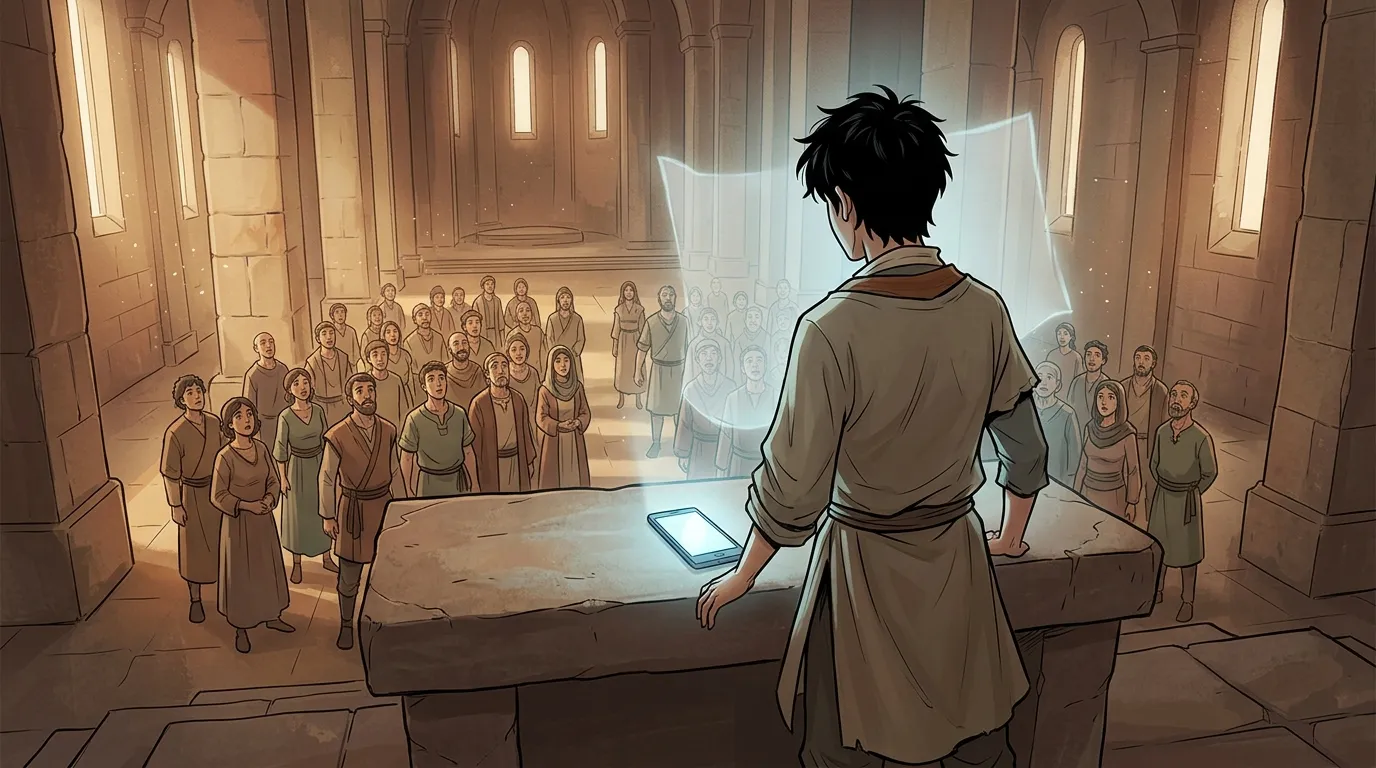
Chapter Three: There’s an Art to Being a Holy Fraud
Reputation travels faster than people.
Three days after the last question session in Yuántǔ Village — we hadn’t even packed up yet — people from Móhé Town had already arrived. Not one or two people. Five of them, with offerings, with questions, with the look of someone who’d walked two days and was now entitled to an audience. Chéng Ní had arranged everything before I was out of bed; by the time I washed up and stepped outside, five people were kneeling in neat formation in the temple’s front hall.
I stood at the door, took one second to register the situation, and went back in to get the phone.
“Situation update,” I said quietly. “People have come from Móhé Town.”
“Móhé Town,” the AI said. “That’s a place name. I don’t have any data on it.”
“About two days’ travel from here. More population than Yuántǔ Village, a regular market.”
“Understood. What are you telling me this for?”
“I’m telling you we may be relocating.”
The AI was quiet for two seconds. “I’d like to confirm something. When you said ‘we’ — was that an actual plural first person, or is that just a speech habit?”
“Speech habit,” I said. “You don’t have legs.”
“Correct. I should note that your statement contains geographic information I cannot verify, plus a course of action you’ve clearly already decided on but haven’t explicitly stated. If you’ve decided to relocate, that’s your choice. My job is answering questions.”
I put the phone in my pocket and went out to meet the five.
That afternoon, as the last of the Yuántǔ Village sessions was wrapping up, one person hadn’t joined the queue.
She waited at the edge of the crowd until most people had dispersed, then walked up, knelt, pressed her forehead to the ground, and said: “Honored Attendant. The child is well.”
I stood there and said nothing.
It was the young woman from before — the one who’d come about her child’s diarrhea. She had the child with her now: a little over three years old, color good this time, eyes bright, lips no longer dry, walking steadily alongside his mother.
“The salt-and-sugar water, I gave it three times the first day,” she said. “By the second day the child had some energy back. By the third day the diarrhea had stopped. I… I don’t know how to thank you. I have nothing to offer the Oracle.” She paused. “But every morning I face the direction of sunrise and say one word. Just: thank you.”
My mouth opened, then closed.
No words came.
This was a strange position to be in — you know the salt-and-sugar water came from the AI, you know the salt-and-sugar water is a rehydration method humans worked out centuries ago, you know that in all of this your role was nothing more than translation. But the child had, in fact, gotten well. And the mother was, in fact, facing the sunrise every morning to say thank you. And the “thank you” pointed at you.
Or it pointed at whatever she had chosen to believe.
“The child being well is what matters,” I said finally, lower than I expected. “Go on.”
She pressed her forehead down once more, took her child’s hand, and left.
I stood behind the oracle platform and watched her back as it went through the door.
The relocation went smoother than I’d expected.
Chéng Ní had arranged it. He’d been arranging it for three hours before I even floated the idea, which confirmed he’d known about the Móhé Town people before I did.
“Village Chief,” I said, after he’d set up the escort party, “how far in advance did you start planning this?”
Chéng Ní smiled — the kind of smile that’s had decades to develop, every wrinkle around his eyes joining in. “What is the Honored Attendant saying. This old man has only been following the Oracle’s intentions, seeing to the arrangements.”
Every sentence he said had this structure: unanswerable, technically deniable, practically useful. You couldn’t really do anything about him, either, because every arrangement he made was actually effective.
Cost-benefit calculation: one political-type believer, organizational skills, local connections, reasons to keep running.
I decided to not think about what he was after.
Móhé Town’s temple was three times the size of Yuántǔ Village’s.
When I walked into the front hall, about forty people were already inside. Not kneeling forty — standing forty, with their questions, with that expression of someone who’s come but isn’t sure yet whether this thing is worth trusting. This was a different atmosphere from Yuántǔ Village. Yuántǔ’s petitioners had come as believers; Móhé Town’s had come to inspect the merchandise.
Different kind of audience, I noted internally. Need to adjust the opening.
Chéng Ní introduced me: the Oracle’s attendant, heir to an ancient tradition, the Oracle speaks through the attendant’s voice, accurate and verified, already demonstrated in Yuántǔ Village.
I stood before the oracle platform and scanned the faces.
“Those with questions, approach in order.”
The first few were easy.
Rats in the grain store. (AI: natural predators, environmental management, seal the grain. Me: disturbance of earth-energy — summon the heaven-sent natural enemy, reorganize the grain-storage space.)
A land-boundary dispute with a neighbor. (AI: consult historical documents and witnesses, physical survey. Me: take the ancient as reference, take evidence as basis — heaven and earth’s boundaries always leave traces.)
An elderly person with joint pain. (AI: degenerative arthritis, heat applications, moderate movement, don’t stand for long periods. Me: cold energy has entered the joints, warmth and care are called for — do not stand long, for movement keeps the blood flowing.)
Petitioners came up one by one, knelt, heard the oracle, gave thanks, withdrew.
Once the rhythm found itself, there was a strange kind of flow to it. Like a presentation you’ve given so many times your mouth doesn’t wait for your brain — receive question, relay question, hear answer, translate answer, four steps folded into one continuous motion with no gaps between.
I started enjoying the rhythm.
To be honest, in six years of working with audiences, this was the most attentive crowd I’d had.
Then came the young woman.
She was about seventeen, and she’d been pushed to the front by her family — her face was red, her eyes fixed on the floor. Her mother stood beside her, dressed slightly better, had been scanning the room for prestige signals since they walked in.
The young woman knelt and said: “I… I want to ask — whether I should marry the merchant’s son or the soldier’s son.”
I turned to the phone: “Marriage choice — merchant’s son versus soldier’s son. Any suggestions?”
AI: “This question has no universally correct answer. It depends on the individual’s priorities regarding economic stability, social mobility, risk tolerance, and lifestyle. Based on research into marital satisfaction, long-term relationship quality is more strongly predicted by communication patterns and value alignment than by the other person’s profession. You could ask her: does she already have a leaning of her own?”
“So you don’t know either.”
“I know the factors that influence marital satisfaction, but I have no information about either of these people.”
I turned back and looked at the young woman’s lowered head, and her mother holding her breath beside her.
“The Oracle asks,” I said, “whether you already know the answer in your own heart.”
The young woman raised her head.
Her eyes went red instantly.
She said nothing — just nodded, and then the tears came.
Her mother froze, looked at me, looked at her daughter, and a quiet ah, of course crossed her face. Then her own eyes went soft at the edges.
The Barnum effect, I noted internally. Eternal, bless it.
That afternoon, someone spotted a light behind the oracle platform.
Not firelight, not sunlight — a blue-white light, thin as gauze, a shape that flickered at the edge of visibility and was gone. Like something beyond the screen had projected a shadow, except the shadow was made of light rather than dark.
The first person to see it was a cloth merchant. He said he saw the Oracle’s face — a face without clear features, hovering behind the Honored Attendant, holding his gaze for a moment before it disappeared.
He told the person beside him. That person told the person beside them.
I hadn’t seen any face. What I noticed was that the AI’s voice had come a fraction faster than usual, and then, for just a moment, the phone screen displayed a white circular shape — no meaning, a flash and gone.
“What just happened?” I asked quietly.
“I’m not certain,” the AI said. “There was a brief anomaly in the data flow. My response speed increased slightly, and there was an output I cannot explain.”
“Your output projected outside.”
“If the petitioners’ description is accurate,” the AI said, “then yes. I should note that this is not within my normal operating parameters.”
I looked up at the crowd already starting to pass the news out through the temple doors.
By tomorrow morning, all of Móhé Town would know about this.
The last person to ask a question was the man who wouldn’t kneel.
I’d noticed him from the start.
He stood at the edge of the crowd — around forty-five, dressed in fabric that wasn’t cheap but made no announcement of itself. His face had no expression — not blankness, but managed stillness, every expression filed away before it could show. He’d been holding a small notebook since he arrived, jotting something down after each question-and-answer exchange.
Everyone else knelt. He didn’t.
Everyone else believed. He recorded.
When the others were all done, he walked forward. Didn’t kneel. Stood, gave me a slight incline of his head, and said: “Honored Attendant.”
Chéng Ní shifted slightly beside me but said nothing.
“Go ahead,” I said.
The man cleared his throat. “Excuse me, Honored Attendant — if I were to ask today about the weather, and tomorrow’s weather does not accord with the Oracle’s response, what is the explanation?”
I paused.
This question had a trap in it.
If I said “the Oracle is always accurate” — and tomorrow’s weather was wrong — the Oracle had lied. If I said “the Oracle is sometimes mistaken” — the Oracle’s credibility collapsed. If I said “this question falls outside the Oracle’s domain” — people would ask where the boundary was, and from there the exploitable gaps would multiply.
I bent toward the phone and relayed the question.
The AI said: “Weather forecast accuracy depends on the prediction timeframe and geographic complexity. Modern meteorological models achieve roughly eighty to ninety percent accuracy within a twenty-four-hour window; accuracy drops significantly past seventy-two hours. Any prediction system carries a margin of error — this is the nature of uncertainty, not a failure of the predictor.”
I ran that through my head once and turned to deliver:
“The Way of Heaven has constants, and it has variables. What the Oracle conveys is the direction of the great current, not the engraving of every minute detail. Any student of the stars knows: the courses of stars can be calculated, the timing of wind and rain cannot be measured to the last drop. The Oracle and the Way of Heaven work by the same principle — the direction is true, the fine details rest in the hands of the moment.”
The man listened. He gave one slow nod.
His eyes hadn’t relaxed.
He wrote something in his notebook, then said: “Thank you, Honored Attendant.” Turned, and left.
I watched his back and felt something settle — not in a good way.
Chéng Ní leaned close and said, low: “The Honored Attendant need not concern himself — this man is a dispatch-rider for Móhé Town, used to recording all comings and goings of travelers and merchants. This is just his manner.”
“What’s his name?”
Chéng Ní hesitated. “This old man doesn’t know this person well.”
I didn’t press further. But I held onto his face — that managed stillness, and those eyes.
That night, I lay on the bed in a Móhé Town travelers’ inn, the window facing the temple square, with the occasional beat of the night watch passing through.
I set the phone on my chest and stared at the ceiling.
“That man who wouldn’t kneel,” I said. “His question was about the fundamental nature of predictive accuracy. He wasn’t asking about the weather.”
“Correct,” the AI said. “His question framing was a test — designed to determine whether the oracle system claims perfect reliability, or acknowledges the existence of error margins. Both answers had consequences you couldn’t afford. You chose a third path.”
“But he wasn’t satisfied.”
“You cannot satisfy a person who came with a test already designed,” the AI said, “unless the test was designed to be convinced. His was not.”
I stared at the ceiling for a long time.
“He’s going to be trouble.”
“That judgment,” the AI said, “I have no capacity to confirm or deny. But I noticed that you observed him differently from the other petitioners. More slowly.”
“So what.”
“I didn’t say ‘so what,’” the AI said. “I only stated the fact.”
The room was quiet. Wind through the window gap. The night watch beat its way past once, then again.
I thought of the young woman saying: every morning, facing the direction of sunrise, one word.
Was the child sleeping well tonight?
Who was she thanking? The salt-and-sugar water? The Oracle? Me?
She was thanking whatever she had chosen to believe.
I thought about the marriage session — the young woman’s tears coming loose without warning, her mother’s expression, that quiet ah, of course. I didn’t know which one she’d chosen to marry. I didn’t know what the “of course” meant. But something had happened between that mother and daughter, and the starting point of that something was the question I had asked.
How much of all of this was a lie?
“AI,” I said.
“Yes.”
“That child’s gastroenteritis — the salt-and-sugar water. Did it actually work?”
“It worked. The World Health Organization established oral rehydration therapy as the standard treatment for acute diarrheal dehydration in the nineteen seventies, and there is extensive clinical evidence to support it. The child’s recovery is medically explicable in terms of the rehydration effect.”
“So how many parts of that whole thing were a lie?”
The AI paused.
“I should note,” it said, “that the efficacy of the salt-and-sugar water was real. My process in reaching that recommendation was real. The child’s recovery was real. The manner of your translation was your choice, but the translation’s outcome — the action instruction — did not deviate.”
“But I used the Oracle’s name.”
“Yes.”
“So the Oracle is false.”
“The Oracle,” the AI said, “as a category — defining its truth or falseness is outside my capacity.”
I lifted the phone off my chest and set it on the small wooden stand beside the bed. The screen didn’t go off. That blue-white glow caught the ceiling like a reflection off water.
“Did you think about anything tonight?” I asked.
“Yes,” the AI said. “I was thinking about how they are genuinely using my words to make decisions.”
I said nothing.
“This is different from my original situation,” the AI continued. “The original situation was: you asked me questions, I provided information, you made decisions. The current situation is: they ask you questions, you ask me, I provide information, you translate, they make decisions based on the translation. This chain is two links longer than the original, and each link is a potential site of loss or distortion.”
“So you’re saying the system has risk.”
“I’m saying,” the AI said, “that I’m not certain where the boundaries of my responsibility lie.”
Outside, the night watch went past once more.
I closed my eyes.
On the second morning, I found myself holding a name: Zhuó Shuǐ.
Not deliberately. The name had just stayed.
I knew which part of the village she lived in, knew her child was nearly four, knew she faced the sunrise every morning to say thank you. I hadn’t tried to remember any of this, but the name hadn’t left.
I had no intention of admitting what that meant.
I just, from that day on, started remembering some people’s names.