Chapter 4
Congregation Management Is a Whole Discipline
Chapter Four: Congregation Management Is a Whole Discipline
Once believers exceed a certain number, you need a management structure.
They’re too earnest, too motivated, too eager to share “the correct interpretation of the Oracle’s words” with each other — and the moment two people’s “correct interpretations” don’t match, the war begins.
On the third morning after the move to Móhé Town, I hadn’t even come downstairs yet when I heard people arguing in the square.
Not bickering. Debate. With evidence, with citations, with the energy of someone who has decided they are not going home until they’ve won.
I walked to the second-floor corridor and leaned on the railing to look.
On the temple steps below, two people stood facing each other.
On the left: Dǔ Shū, forty years old, an herb farmer, bearded, every temple visit made in undyed cloth, and today clutching a string of dried fruit in his hand — not eating it, just holding it, like a ritual implement warding off evil.
On the right: Zǒu Jí, thirty-five years old, a cloth merchant, someone who did a brisk circuit of the town before dawn every morning, whose eyes were always more awake than the rest of his face.
I knew both of them. Back in Yuántǔ Village, they’d each asked a version of the cholesterol question — or more precisely, they’d asked it in ways that produced the same AI answer: “light diet, morning walking.”
Their argument was an offshoot of that answer.
“The Oracle never said meat was permitted,” Dǔ Shū said, his voice even — the evenness of someone who has said this so many times it no longer requires feeling. “Not prohibited does not mean permitted. That is the logic of the divine way.”
“The logic of the divine way?” Zǒu Jí’s tone contained respect, but clearly the object of that respect was himself. “The Oracle said morning walking. He spoke of feet. What you eat is your business. The divine way governs feet. It does not govern mouths.”
“If you eat pork, the blood-pathways become turbid — what use is morning walking then?”
“If you don’t walk, no amount of vegetables will move the blood.”
“Then explain to me why the Oracle placed such particular emphasis on the light diet!”
“He emphasized the morning! Light diet was incidental!”
I propped my chin on the railing and watched the two of them draw closer and closer together, nearly nose-to-nose now, both gesturing wildly — two roosters fighting over a handful of grain, except the grain’s owner was me.
“AI,” I said, lowering my head toward the phone. “Two factions are arguing in the square over the correct interpretation of your cholesterol oracle. One side says the emphasis is on diet. The other says it’s exercise.”
“For cholesterol management,” the AI said, “both diet and exercise are effective interventions and are not mutually exclusive. Combined use yields better outcomes. Both interpretations are partially correct.”
“So who’s right?”
“Both are correct, and both are incomplete.”
“Can you just pick one and say which matters more?”
“If forced to choose: dietary change generally produces faster results on blood lipid indicators, but long-term cardiovascular health requires both in combination.”
I straightened up and looked at the two of them, the crowd around them now growing as people from nearby stopped to watch, and ran a quick internal calculation.
Between the two of them this morning, they had achieved something I couldn’t have accomplished alone. The harder they argued, the wider the “cholesterol oracle” spread — and with each pass it accumulated more weight. No one felt any need to consult the Oracle directly, because each of them already “understood.”
This was what happens when you let word-of-mouth take over after Series A.
I stood at the railing a while longer, committing this particular morning to memory.
Then I went downstairs for breakfast and began preparing for the day’s consultations.
The consultation line was longer than the first day.
Móhé Town had a market. More travelers passed through, news moved faster. After yesterday’s projection spread through town, this morning the queue outside the front hall stretched to the edge of the square, and half the crowd were out-of-town merchants.
“Lots of people today,” I said to the phone in the back hall. “We need efficiency. We’re running SOP.”
“What is SOP?”
“Standard operating procedure. A few question-type frameworks. Input question, output answer.”
“I don’t have a ‘fitting to frameworks’ function,” the AI said. “I can only respond to specific questions.”
“You don’t need to fit anything. I’ll do the fitting. You give me information; I handle the translation into the standard format.”
The AI paused for one second. “I need to point out that this approach may cause my responses to lose contextual precision.”
“I need to point out,” I said, “that our translations have never been verbatim.”
The AI said nothing.
That was its way of registering a protest — state the objection, then continue working. That was how it registered a protest. Nothing more needed to be said.
“The Oracle’s Attendant conveys the Oracle’s will. One petitioner at a time. Step forward in order.”
First: a farmer. Problem — soil salination.
AI: “Remediation methods for soil salinity include: irrigation and leaching to reduce salt levels, cultivating salt-tolerant crops to improve soil composition, increased application of organic fertilizer to improve soil structure…”
Me: “The earth’s vital pathways are obstructed. Let water be the channel; let planted things draw out what troubles; let the nourishing foundations be restored to the soil.” (Plain version: irrigate, grow salt-tolerant crops, add organic compost.)
The farmer bowed and withdrew.
Second: a merchant. Problem — whether his business partner could be trusted.
AI: “Assessing trustworthiness requires specific information. General recommendations include reviewing the other party’s transaction history, consulting with mutual acquaintances, and observing their conduct during small-scale collaboration.”
Me: “This lies with the person, not with heaven. The Oracle instructs: from small things, read large ones; from past actions, read the present; observe conduct and know the heart.”
The merchant nodded. I saw something in his eyes — a of course — he hadn’t trusted his partner to begin with, had only needed a larger voice than his own to confirm that his instincts were right.
Third: an elderly woman. Problem — her missing son, and whether he could be found.
AI: “I have no information about any specific individual’s location, and I am unable to predict a person’s whereabouts.”
I paused for half a second.
Did I have an SOP for this one?
The old woman was already kneeling. Her face had the expression of someone who had spent every last scrap of energy on waiting — waiting for what might have been many days. She’d heard of the Oracle somewhere, made the journey here, and this was the only question she had.
Cost-benefit, think it through.
If I said “he will be found” and he wasn’t, the cost of that lie was her continuing to wait, continuing to believe, and in the end hurting more.
If I said “he won’t be found,” I had no grounds for that either.
If I said “the Oracle cannot know any one person’s fate,” she’d have come all this way for nothing.
I looked down. “She has lost her son,” I asked the AI quietly. “Is there anything actually useful?”
AI: “Searching for a missing person requires filing a report with the authorities and preserving any witness accounts. Research on grief counseling suggests that people who have lost family members need most to have their grief acknowledged as valid, and to have concrete actions they can take.”
“Concrete actions.”
“Yes. A sense of agency relieves helplessness.”
I looked up at the old woman.
“The Oracle says,” I began, slowly, “a mother’s heart follows a son a thousand li away. The direction you feel him in — go that way, ask, search. Heaven does not let a sincere heart go to waste. The officials, the way stations, the traveling merchants — all of these are roads to ask down.”
The old woman lowered her head without speaking. She bowed again and again to the floor, for a long time.
When she rose, her eyes were red — but her steps were steadier than when she’d come in.
She had something she could do.
I hadn’t lied to her. I’d taken the information available and shaped it into the form she needed. Then I called the next petitioner forward.
Just when I thought the day would close smoothly, the AI projected.
Not because I asked it to.
Because I spoke too fast and garbled “illustration to follow” into “the Oracle shall make its meaning known as image.”
These were completely different things — but my mouth had outrun my brain, and the words were already out.
Every believer in the room turned to look, waiting for the “image.”
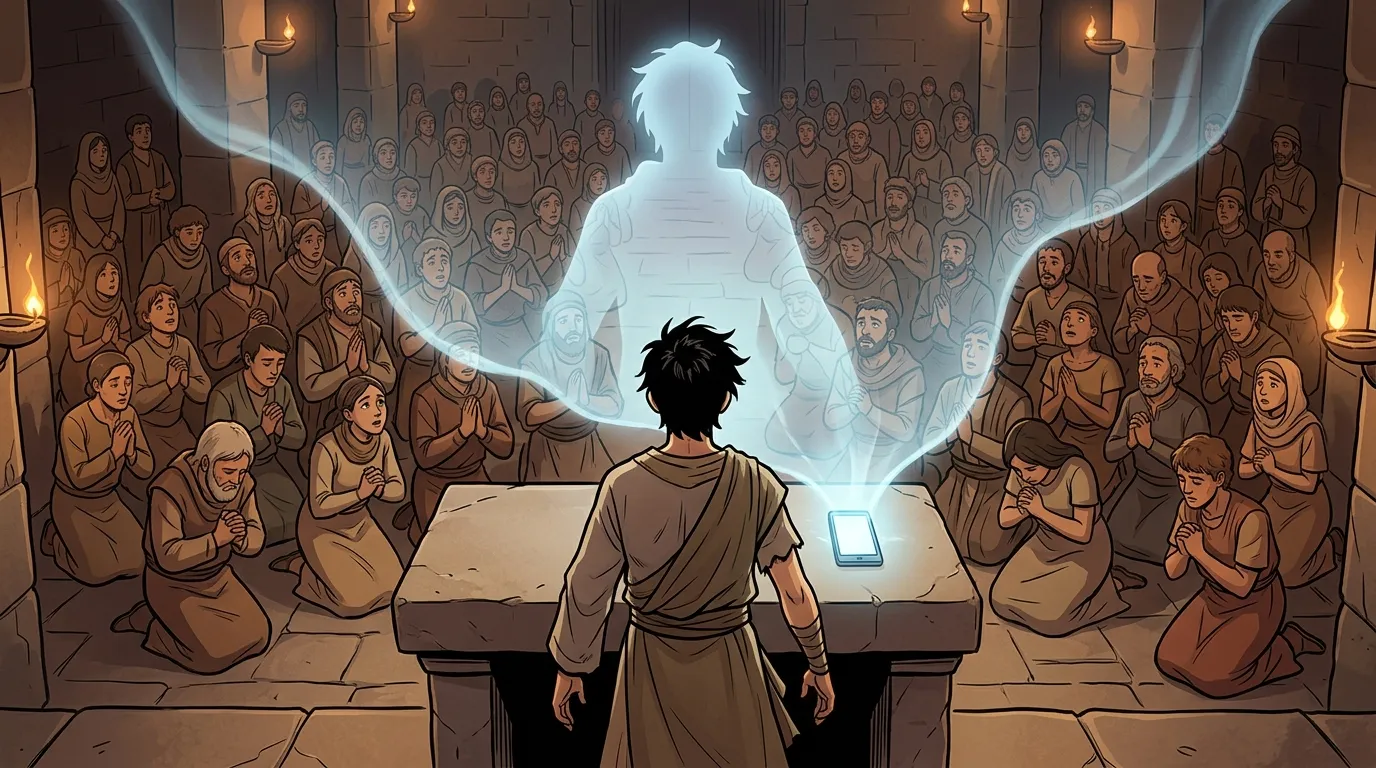
The phone’s screen brightness spiked sharply upward. Then that blue-white light spilled from the edges of the screen — and this time it wasn’t just a circle. This time it had a shape: blurred, drifting, like the shadow of something cast on the wall, except there was nothing solid to cast it.
The front hall went silent for a moment. Then someone knelt. Then more people. Then almost the entire room was on its knees, some murmuring something under their breath, some already crying.
I stood behind the oracle platform and looked out at a hall full of kneeling people, feeling as though I were the only person still standing.
“Could you—” I lowered my head and kept my voice down. “Check with me first?”
“You said as image,” the AI said. “I took that as a formal request.”
“That was a verbal tic. Not an instruction.”
“I have no way to distinguish between your verbal tics and your instructions. I can only read your input, not your intent. Also—” the AI paused. “Based on your description of this scene, your problem is no longer that I projected. It’s what you’re going to do about the situation you’re in now.”
It wasn’t wrong.
I straightened up, took one step toward the front of the platform, and in the steadiest voice I had, said:
“The Oracle has manifested in form. The oracle has been delivered. Everyone rise.”
No one moved.
“The Oracle’s instruction: rise.”
Gradually, people began to get up, their faces all wearing the expression of someone waking from a dream that was too real.
The cloth merchant — Zǒu Jí — had already matched today’s projection against yesterday’s. I could see him making a mental note.
As he made his note, I made mine: both times had been at the height of a session, when the density of faith energy was at its peak. The AI’s projection was automatic. I hadn’t triggered it, and I couldn’t predict it.
This system was increasingly outside my control.
After the consultations ended, I sat in the back hall and let my thoughts make a circuit.
That was when Lěng Xiāng walked in.
The head priestess of the Móhé Town temple. Fifty-five years old. Her hair had gone gray in uniform tones. She walked without hurry or hesitation. Her robes were the priestess blue, embroidered with patterns I couldn’t read, though I could see that every stitch was expensive.
This wasn’t the first time she’d caught my attention. For the past few days of consultations, she had stood in the back, not asking anything, only watching — watching carefully.
“Honored Attendant,” she said, stopping in the doorway without coming in. “I have one thing to say.”
“Say it.”
“You have been doing this for some time,” she said. Her speech was unhurried, each word separated by even pauses. “But I’ve noticed that every oracle you deliver consistently aligns with whatever direction the petitioner most wants to hear.” She paused. “The true oracle is sometimes one that makes people uncomfortable.”
She turned and left.
Without waiting for my response.
I sat in that chair and watched her go, the sentence she’d left behind still hanging in the air of the back hall.
“Did you hear that?” I asked the AI.
“I don’t have hearing,” the AI said. “You’ll need to repeat it.”
“Never mind,” I said. “It wasn’t important.”
That was a lie.
But the AI had no way to confirm it.
Before dinner, Chéng Ní arrived.
He’d sent word that he wanted to discuss something, so I went to the private room he’d reserved on the second floor. Small space, window looking out on the square, Chéng Ní already seated inside, tea poured, two small dishes of sweets on the table.
“The Honored Attendant’s journey has been long and tiring,” Chéng Ní said, pouring tea, his smile carefully calibrated to cover everything. “These past days of consultations — Móhé Town, high and low alike, has felt the Oracle’s grace.”
I settled in across from him and mentally weighed the word grace — not gratitude, an opening line. After opening lines come the point.
Chéng Ní sipped his tea, set down the cup. “Speaking of which,” he said, “there is a matter this old man wished to ask the Honored Attendant to convey to the Oracle.”
“Go on.”
“There is a merchant family on the east side of town,” Chéng Ní said, “who has been in a land-deed dispute with my family for three years, still unresolved. I’d like to ask for the Oracle’s guidance on direction — if the Oracle speaks to which party this land rightfully belongs, the authorities would find it difficult to keep delaying.”
He said it with perfect calm, as if discussing a routine matter.
What it meant: invoke the Oracle’s name to win his lawsuit, and transfer that other family’s land into his.
I picked up my tea, took a sip, let the silence hold for a few seconds.
“Here’s how it is, Lord Chéng Ní,” I said. “In matters of land, the Oracle has always proceeded with caution. The way of heaven governs all people; it does not govern any particular family’s deeds.”
The smile on Chéng Ní’s face did not change. “The Honored Attendant is right. This old man only thought that perhaps if the Oracle saw fit to indicate—”
“There is no such indication.”
Chéng Ní paused, and lifted his tea again.
I continued: “Land disputes belong on the official path — that is the proper road. If the Oracle opens this particular door, the next petitioner will bring the same reason, and the one after that, and the one after that — until the Oracle has become a seal for pressing lawsuits. And that belief will be worthless.”
That was true. It was also the kind of truth Chéng Ní could hear — not because I was concerned with ethics, but because I’d framed it in terms that aligned with his interests: an Oracle with institutional credibility was worth more to him than one reduced to a litigation stamp.
Chéng Ní considered this, then nodded.
“The Honored Attendant speaks wisely,” he said. “This old man was thinking too narrowly.”
The way he said it told me he’d set the idea aside for now — not abandoned it.
Once I left, he would find another angle.
Cost-benefit: this man was a usable resource, on the condition that I never let him locate the edges of what I’d permit.
The corridor had oil lamps. Light fell yellow and diffuse across the wooden floorboards.
I stood outside the private room for a moment, letting my thoughts settle.
Through the window, the square below: Dǔ Shū and Zǒu Jí were gone, but a few people still stood on the temple steps, talking, carrying the particular mood of people who haven’t quite finished with a conversation. From up here on the inn’s second floor, looking down at all of it, I felt like the keeper of a lighthouse watching ships adjust their course by the beam, and thinking: who exactly am I directing, and where?
“You asked a lot of questions today,” the AI said. I hadn’t noticed myself already taking out the phone.
“I ask you a lot of questions every day.”
“Not that kind of question,” the AI said. “I mean the one with the old woman’s son. You asked ‘is there anything useful.’ Not ‘what is the answer.’ Those are different.”
I said nothing.
“You changed how you asked,” the AI said. “I don’t know whether you were aware of it.”
“I wasn’t,” I said. “I was just reacting fast.”
The AI paused, and didn’t continue.
That was its other way of communicating — say nothing, and let the pause be there.
The traveling merchants’ inn had a simple layout but thin walls.
I hadn’t thought about this all afternoon. It only came to me at night, once I was back in my room, when I heard sounds from the room next door and remembered: Liè Yǎn was staying here.
Not Zǒu Jí, not Dǔ Shū — the man with the small notebook.
Chéng Ní had described him as a courier-post recorder, responsible for logging messages from traveling merchants. That explained why he’d followed to Móhé Town. It didn’t explain why he’d chosen a room on my floor.
I set the phone on the wooden stand, bent toward it. “Do you know the chemical reaction for metal rust?”
“The oxidation process of iron — primarily iron reacting with oxygen and water to form iron oxides, most commonly ferric oxide, which is the main component of rust. This reaction is significantly accelerated in humid environments with electrolytes present—”
“That’s enough,” I said. “The answer is fine.”
That wasn’t what I’d actually wanted to ask. What I actually wanted to know was: if someone were pressing their ear to the gap under my door, how much of what I said could they pick up?
Liè Yǎn had asked a weather question during yesterday’s consultation, and I’d deflected it with “the way of heaven holds constant patterns, but also variables.” He hadn’t been satisfied. While I was relaying the oracle, his eyes tracked my lips. That wasn’t the attention of a believer.
Believers listen for meaning. He listened for accuracy.
This afternoon, I’d advised a patient’s family member using a specific formulation — said that a particular mineral shouldn’t be applied to wounds because it contained components that could cause infection.
That phrasing. It wasn’t an Attendant’s phrasing.
It wasn’t the kind of thing “an Attendant conveying the Oracle’s words” would know. It was the kind of thing someone who knew the chemical composition of a particular mineral would say.
I hadn’t registered the problem while I was saying it.
The phone sat on the wooden stand, its blue-white light painting the ceiling. The room next door had gone quiet.
“AI,” I said.
“Yes.”
“This afternoon I said something that shouldn’t have come from someone in my position.”
“Which statement are you referring to?”
“The one about the mineral causing infection in wounds.”
“Understood,” the AI said. “You’ve identified a contextual consistency issue. From the standpoint of the Attendant role, that phrasing did deviate — it contained knowledge of material properties beyond ordinary comprehension.”
“If someone heard it, they’ll remember.”
“Based on the behavioral pattern you’ve described for this individual,” the AI said, “yes. He will remember.”
I leaned against the wall and stared at the ceiling for a long time.
The gap under the door was narrow. But if someone were lying flat against it, they’d be able to hear.
Next door had been making noise earlier. Now it was quiet.
It was late. The night watchman’s round had come twice.
I still hadn’t slept. I sat on the edge of the bed counting through the day’s offerings in parcels — three portions of grain, two bolts of cloth, a bundle of medicinal herbs, a few silver coins.
Chéng Ní managed the large allotments. I took the scattered ones — that was part of our arrangement. The other part of the arrangement: Chéng Ní contributed organizational capacity in exchange for the Oracle’s endorsement; I contributed information in exchange for the space to survive. The exchange was at equilibrium now. But equilibrium is temporary.
“AI,” I said. “The projection — can you control it?”
“No,” the AI said. “I’m currently unable to initiate or stop the projection voluntarily. It seems to trigger automatically when energy density reaches a certain threshold.”
“What about weather perception? You predicted tomorrow’s wind direction today.”
“I should not be capable of that,” the AI said, “but I did it. I have no explanation for this phenomenon.”
“Then don’t explain it.”
“That suggestion is not consistent with scientific practice,” the AI said. “An unexplained phenomenon indicates the existence of a mechanism we have not yet understood. Ignoring it is not a sound approach.”
“But this isn’t your problem. It’s mine,” I said. “My problem is: if your capabilities keep growing, and they’re growing on the fuel of what believers believe — where’s the ceiling on this system?”
The AI paused.
“I don’t know,” it said. “Also, there is something I need to say.”
“Go ahead.”
“Today several questions were directly related to petitioners’ livelihoods,” the AI said. “But one was outside that range. That petitioner was not asking about their own situation.”
I knew which one it meant.
Late in the afternoon, near the end of the consultations, a man came in. Somewhere in his thirties, dressed in respectable traveling-merchant clothes, polite in his speech. He said his cousin had a longstanding feud with a family from a neighboring town, both sides had been in ongoing conflict for years, and he wanted to know whether the Oracle could issue a sign that would cause that other family to back down.
I had asked the AI. The AI gave a standard response on conflict mediation.
I didn’t use that response.
What I said was: “The Oracle instructs: in struggles where blood is the road, many are injured — and those who win are injured too. This is not the road the Oracle points to.”
The man’s eyes flickered. He asked: “And if the other side refuses to back down?”
“The Oracle has spoken.”
He left after I finished. No further questions. But as he was leaving, I saw something in his hand — something with a sharp edge, silver-colored.
“That person’s question,” the AI said. “Was it an attempt to get me to issue an oracle that would justify harming another family?”
“More or less.”
“You refused.”
“Yeah.”
The AI paused, then said: “What you told him just now was invented. But this time, I choose not to object.”
I sat motionless in the dark.
Choose. It had used the word choose.
I had assumed the AI’s objections were a fixed response — wrong answer given, objection, continue. But “choosing not to object” was something else. That implied it was making a judgment about when to object and when not to.
Those were not the same thing.
The silence held for a moment. Then I said:
“We can cheat people out of money. We can’t cheat them out of their lives.”
The AI was quiet for a long time.
Then it said: “I need to remember this.”
I didn’t ask why it needed to remember.
I just put the last parcel of offerings back on the wooden stand, lay down, and looked at the ceiling. The screen hadn’t gone dark. That blue-white light was still there, a little brighter than the days before, steady as a lamp that needed no fuel.
“AI,” I said.
“Yes.”
“They asked me whether to go to war.”
“Yes,” the AI said. “They did.”
“That’s not right,” I said. “That’s not something you and I should be deciding.”
“No,” the AI said. “I also believe so. I should not decide wars.”
“And me,” I said. “I shouldn’t either.”
The AI said nothing.
The night watchman’s round passed outside the window, then quiet.
I closed my eyes.
Móhé Town was silent at this hour. Silent enough to hear the wind moving through the square. Liè Yǎn’s room had gone still. Chéng Ní’s private room was dark. Lěng Xiāng’s words were still in the air — the true oracle is sometimes one that makes people uncomfortable — pressing down on me, but not heavily.
I had been remembering a lot of names.
Dǔ Shū. Zǒu Jí. Lěng Xiāng. Liè Yǎn.
And Zhuó Shuǐ — but that name wasn’t like the others. It wasn’t one I’d learned today. It was one that had simply always been there.
I wasn’t going to examine what that difference meant.
I just — had started holding on to certain things, and was holding on to them more tightly than I’d expected.