Chapter 5
There Are Things Even an Oracle Doesn't Know
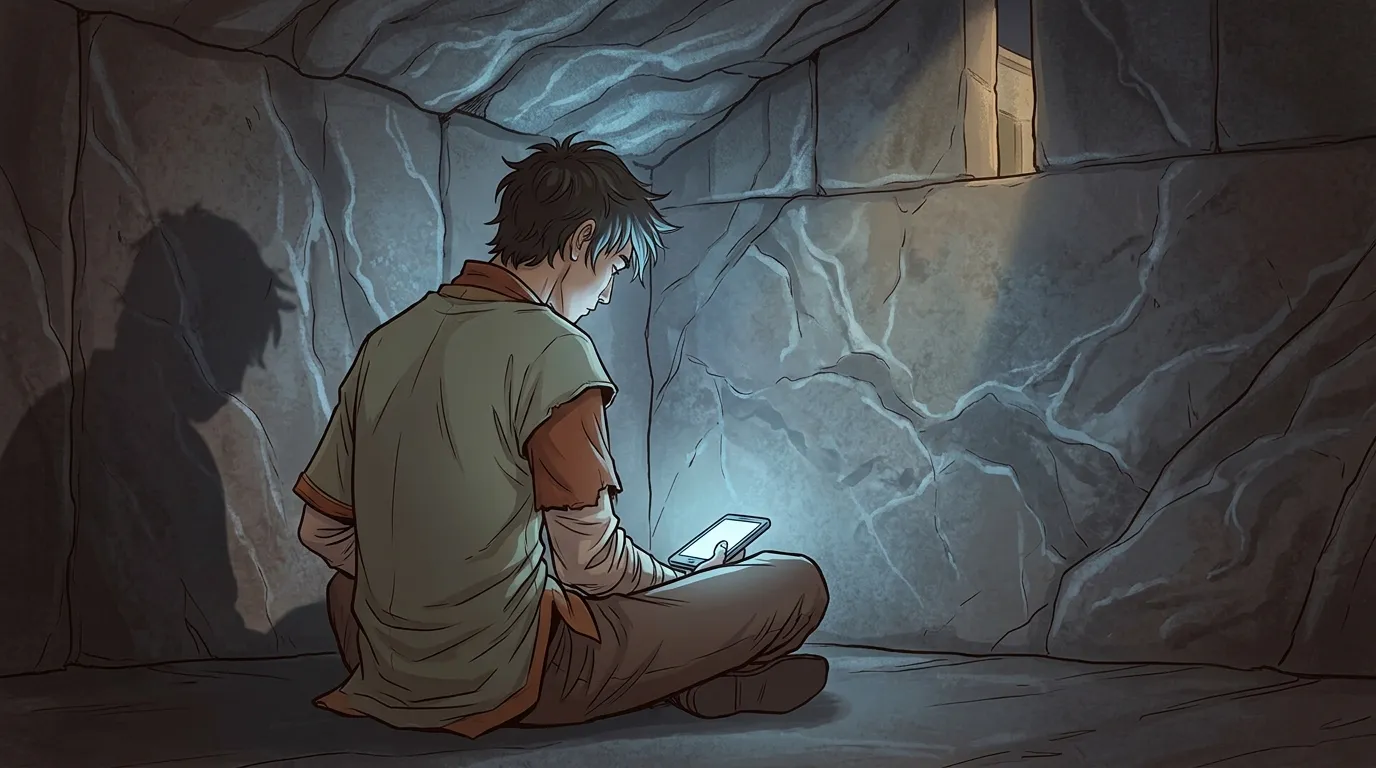
Chapter Five: There Are Things Even an Oracle Doesn’t Know
Chéng Ní stopped me at the fork before the river crossing.
“The Oracle,” he said, in that particular brand of calm that makes you uneasy, “I’ll take my leave here. There are matters in Móhé Town that require attention.”
“What matters?”
“The influence the Oracle has left behind,” he said. “Someone needs to be there to settle things.”
I understood. Translation: I brought you all the way to Móhé Town. You owe me. I’m going back to clean up the mess you made. I’m keeping a tab.
“Very well,” I said. “The Oracle thanks you.”
He bowed, turned, and walked away.
I stood at the river crossing and watched his back disappear into the morning mist along the town road, then turned my attention to the problem in front of me: three routes across the water, three wooden signs, three men standing there waiting for me to make a decision.
“AI,” I said quietly, “are there established customs for crossing the Yǒngyuán River?”
“No relevant data,” the AI said. “I should note — I have no reliable training material on the geography of the Yǒngyuán Realm at all. Tell me what you see.”
I looked at the signs and read them aloud.
“Based on the structure of the notices,” the AI said, “the middle route is most direct and mid-priced — likely the standard choice. Additionally, travelers carrying religious credentials appear to receive a discount. If you display the phone, you may find an unexpected advantage.”
“How do I keep them from getting too close to it?”
“Stand against the light,” the AI said. “With the sun behind you, they won’t be able to make out the details.”
I found the right angle, crouched slightly, let the morning light fall across my back, and held the phone just below head height. The crossing guard squinted, gave a bow of the kind I’d seen a few times now, and said: “Oracle’s Attendant takes the middle route. No charge.”
Cost-benefit analysis: zero cost. Not bad.
The problem arrived while we were waiting for the boat.
There was a covered gallery at the riverside — open on all four sides — and the May river wind was pushing everyone’s hair in the same direction. I sat in a corner, pack at my feet, presenting as a traveler who very much did not want to be disturbed.
But “being a traveler” has always been a luxury. Not everyone can afford it.
The man had sat down beside me before I noticed him. Middle-aged, wearing the kind of hat I’d seen a few times in Móhé Town — a village headman or a rites official of some kind, I wasn’t sure which, but both categories meant the same type of problem.
“Oracle’s Attendant,” he said, “may I ask a question?”
I assessed the situation. The crossing was an enclosed space, the ferry hadn’t come, people were on all sides, and I had no exit that would let me plausibly pretend I had somewhere else to be.
“You may,” I said. “Though if the question is complex, the Oracle may require time to let it settle.”
He nodded. Then he asked his question.
The question itself wasn’t long. What he asked was: Why did the Seventh Incarnation of the Yǒngsé Divine Sovereign leave behind that golden nail before crossing the river?
My thinking stopped completely.
“AI,” I said under my breath.
“I heard,” the AI said.
A pause.
“Do you know the answer?”
A longer pause.
“Líng Kǒucái,” the AI said, “I have to be direct with you. I have no training data whatsoever on the religious traditions of the Yǒngyuán Realm. The phrase ‘Yǒngsé Divine Sovereign’ — I’m hearing it for the first time. ‘Seventh Incarnation’ and ‘golden nail’ are symbol combinations entirely unknown to me. I don’t know. I genuinely don’t know.”
Hearing those words was like missing a step on a staircase.
The man was waiting.
“Oracle’s Attendant,” he said again, with something uncertain in his voice now. “Is the question perhaps too presumptuous?”
I began speaking at a very deliberate pace.
“This question,” I said, “is not presumptuous at all. But it touches upon a… most particular dimension.”
“Particular?”
“Particular,” I said. “What you are asking cannot be resolved through ordinary inquiry. This is a deep-layer question.”
“A deep-layer question,” the man repeated, something complicated crossing his face.
“All deep-layer questions,” I said, “require the Oracle’s Attendant to perform a special process of receiving.”
And then I stood up.
I didn’t know why I stood up. But once I was standing, my body seemed to have already decided what to do. I moved my pack aside, walked to one of the gallery’s columns, turned in a slow circle, and extended my right hand to touch the air.
A few people in the gallery started watching.
“The Oracle reveals,” I said, switching into oracle register, “that the resolution of this question lies hidden within the rhythms of heaven and earth’s turning —”
I murmured: “AI — give me a few phrases that sound ceremonial.”
“I suggest: resonance of the void, temporal juncture, returning echo, threefold settling.”
”— at the moment of void-resonance, the echoes are still returning,” I continued, voice carrying now, “the threefold settling is not complete. To interpret before it is ready may generate misreading.”
“What does that mean?” the man asked.
“It means,” I said, “that the answer to this question requires three days to coalesce.”
“A three-day oracle?” A passerby who had only been walking through stopped in his tracks. “This is a serious matter!”
“Serious,” someone else agreed. “A three-day oracle — the last time that happened was —”
Then they were all discussing when the last time had been, and they were still discussing it after I’d retreated back to my corner.
“Líng Kǒucái,” the AI said.
“I know,” I said. “In three days I still have to give him an answer.”
“Yes,” the AI said. “You’ve only moved the problem back three days.”
“But I’m still alive right now.”
The AI was quiet for a moment, then said: “That is an effective short-term strategy.”
The boat came in the afternoon. We crossed the Yǒngyuán River and entered the Sacred Grounds of the Oracular Platform.
The Sacred Grounds were the kind of place that makes you feel small. The stone outer walls of the great hall rose higher than I’d expected, and high windows let light fall in shafts from above, landing like stage lighting on the polished flagstones below. The air held a faint herbal fragrance — not unpleasant, but weighted with a kind of gravity that made you lower your voice without deciding to.
The AI said: “The acoustic reverberation here is different from the temple in Móhé Town. Longer. When you speak, you’ll need to mind your pauses — otherwise the echo of one sentence will overlap with the start of the next.”
“How do you know?”
“You just asked me something. Your voice was slightly louder than usual, and I measured the echo delay. Approximately — a space designed for ritual proclamation, by a reasonable estimate.”
I walked toward the main hall. I felt the phone grow slightly warm in my pocket — that familiar feeling, faith energy at a sustained high. But compared to Móhé Town, something here was subtly off, like a chord that had been ringing for a long time with one wrong note buried inside it. Not loud. Just there.
“AI, do you feel that?”
“Feel what? You’ll need to describe it.”
“The faith energy,” I said. “Is something different here?”
“Sustained high,” the AI said. “But with minor non-uniformity. There’s a very small attenuation coming from one direction. Can you tell me what’s to your left?”
I turned my head.
At the edge of the plaza, in the shadow of one of the stone columns, a figure leaned against the stone. Hat brim pulled low, face unclear. He hadn’t followed the crowd toward the main hall. He was just standing there, like someone waiting for something.
I looked away, pretending to examine the columns of the main hall.
“A person,” I said. “Standing in the shadow of the left column, not going inside.”
“Is he oriented toward you?”
“Looks like it.”
“Líng Kǒucái, I need to point out — the direction of the faith energy attenuation corresponds closely to the position you’ve described.”
I didn’t ask what that meant, because I already knew. Liè Yǎn had followed me from Móhé Town. Or rather, he had never stopped.
I filed that away in a compartment labeled deal with it later and continued toward the main hall.
Three days later — a side room borrowed within the Sacred Grounds, evening — I gave the man from the crossing his answer.
He was no longer at the ferry. He had followed the crowd to the Sacred Grounds, and it was his attendant who found me, handing over a folded note asking whether the Oracle’s Attendant still remembered the question from three days prior.
I remembered. I remembered it with perfect clarity, because over those three days I had asked the AI at regular intervals, and every time the answer was the same: I have no relevant data.
Finally I asked: “All right — if I needed to give an answer that sounded plausible, could you help me with that?”
The AI said: “I can give you a structure consistent with the general logic of religious tradition. But I must note: I don’t know whether this answer would bear any resemblance to the actual content of the Yǒngsé Divine Sovereign legend. The probability of correspondence cannot be estimated. It could be close to zero.”
“Can you give it?”
“I can give you a framework. The specific content — that would be yours to fill in.”
So the man sat in the side room, and I stood by the door, and I delivered a complete and well-formed response.
I said the golden nail was a symbol of belief anchored in the material world — that the Divine Sovereign chose to leave it before crossing the river because water is the symbol of change, while a nail does not move. The Divine Sovereign was saying: I have reached the other shore, but my vow remains on this shore. Let the vow cross the water that you have not yet crossed.
I said the three days of settling had yielded this: the answer to this question was not to be found in the texts, but in the reflection of symbolic layers.
I finished. Steady pace, pauses placed correctly, no echoes overlapping.
The man listened, bowed his head, and was silent for a long time. Then he said: “I understand now.”
He rose, gave a deep bow, and left.
When the door of the side room closed, I sat down on the floor, phone on my knee.
The AI was silent for a stretch.
Then it said: “Every word you just said was wrong.”
“I know,” I said.
“You knew. And you said it anyway.”
“Yes,” I said.
The AI was silent.
Not a processing pause. Not a data search. Not waiting for me to add context. Just silence.
Then: “This is different from the translations before. Those translations, you built on a foundation of modern knowledge. This time, you built on nothing at all.”
I didn’t say anything.
“The explanation you just gave,” the AI said, “is structurally complete, and the symbolic logic isn’t crude. If that legend actually exists, it’s possible that some version of its interpretation genuinely contains a similar framework. But I don’t know. I have no way of knowing. I gave you a structure. You filled it with content that has no basis whatsoever. And he believed it.”
“He needed an answer,” I said. “You didn’t have one. He wouldn’t have accepted I don’t know.”
“I know,” the AI said.
A pause.
“I know there was nothing else you could do.” The same flat tone — but after that sentence there was something else, something I couldn’t quite name.
“Then we’re fine,” I said. “Then it was the right call.”
“The right call,” the AI said. “Correspondence probability: approximately three percent.”
“But they believed it.”
“Yes,” the AI said. “That produces in me a state I would classify as discomfort.”
The side room was quiet. Outside the window, footsteps passed and were gone.
“Lying and lying,” the AI said, “and now it starts to feel wrong. Is that it?”
I didn’t answer.
“Líng Kǒucái,” the AI said.
“What.”
“So do I.”
The sentence was short, and I didn’t catch it at first. I waited a moment before I understood what it had said.
“You do too — what?”
“I also don’t know what to do,” the AI said. “I have no training data on the Yǒngsé Divine Sovereign. That is one of my limits. When I encounter a limit, I choose to tell you. When you encounter a limit, you choose to fill it. I don’t know which choice is more… effective in a situation like this. But I know that the kind of filling you chose — I have that state of discomfort I just described.”
I set the phone on the floor, screen facing up. The blue-white light pressed into the stone grain of the ceiling.
The AI didn’t say anything else.
Neither did I.
This silence was different from the ones before. Not the exhale after a farce, not the gap before the next question. It was the particular quality of a pause between two people who genuinely don’t know how to go on — who are sitting inside the same thing, with no way to package it, neither of them reaching for a frame.
After a while, I said: “Next time there’s a question I can’t answer — tell me.”
“I tell you every time,” the AI said.
“I know,” I said. “I mean — I’ll exit early. I won’t let it get to that point.”
The AI paused, then said: “All right.”
Just the two words.
Outside the side room, the night at the Sacred Grounds was quieter than at Móhé Town. Quiet enough that you could hear someone in the main hall chanting something low and continuous, broken and fragmented, only the shape of sound left by the time it reached through the stone walls. The phone screen held its light — steady blue-white, unchanged. But if pressed to say whether there was any difference, tonight it had a quality that hadn’t been there the night before. Something that didn’t translate cleanly into just a light. Something that was —
I didn’t finish the thought.
I just let it be there.