Chapter 6
The Oracle Almost Killed a Man
Chapter Six: The Oracle Almost Killed a Man
Kǔ Gēn came on the thirty-second day.
That morning I had taken three consultations in the main hall — planting season, a medical complaint, a household dispute — all translated into whatever register I’d decided was suitably divine, nothing catastrophic. I’d settled into a rhythm by then: the AI says one thing, I reshape it into something that sounds like it seeped from the cracks in a stone wall rather than from a phone in a twenty-something’s pocket.
That rhythm had made me stable. Stable enough to be afraid of it — afraid that if this kept going, I’d eventually stop being able to tell the difference between “translating” and “oraculing,” not deliberately, but by erosion.
When Kǔ Gēn walked into the main hall, I noticed his shoes. They were the kind of shoes you only get by walking a very long way — the outer soles worn flat, the uppers carrying several different colors of soil, no fresh dirt anywhere, every layer dry and packed down. He’d probably been walking four or five days.
He dropped to his knees at the stone pillar without hesitation — with the ease of a man performing the most familiar motion of his life. I put him in his early fifties. The lines on his face were outdoor lines, not age lines. He lifted his head very slowly.
“Honored Attendant,” he said, “I am a farmer from Yuántǔ Village. My name is Kǔ Gēn.”
“Yes.” My voice had dropped into the professional register, carrying that cathedral-echo the main hall provided for free. “What brings you here?”
He said: “I’ve come to confess my fault.”
I said: “I’m sorry?”
The words landed nowhere near anything I’d been expecting. Not “I seek an oracle.” Not “I come to fulfill a vow.” Confess my fault. Those two words punched a hole straight through the professional register.
He spoke slowly, one short sentence at a time, like a man carving characters into stone — one stroke, confirm it holds, then another.
Weeks ago, he said, the Oracle had issued a pronouncement about planting season and the relationship between soil and moisture. He had heard it. He had believed it. The Oracle’s wisdom was sound. He had planted his seeds early, as instructed. But the cold hadn’t left the ground — not the season he understood it to be — and the seeds had sat in the earth too long. Half rotted in the mud. The other half sent up shoots that were thin and weak, and when the frost came for several days in a row, they all went down.
“An entire season,” he said. “All gone.”
The way he said it — level, matter-of-fact, like he was reporting on someone else’s harvest — that flatness was what sent something sinking through my chest.
“The Oracle’s wisdom is sound,” he continued. “Perhaps my understanding was insufficient. I came to inform the Honored Attendant: this is the fault of a poor farmer. I have failed the Oracle’s guidance.”
The light came through the high windows at an angle, falling on the floor behind him, leaving him in shadow. The stone pillars gave every word he spoke more weight and length than it had. The temple incense seeped through the stone walls — I’d stopped noticing that smell a month ago, but suddenly I could smell it again, thick, adhesive, pressing into my nose.
I needed to speak. The “Honored Attendant” position did not permit extended silences in the main hall.
But the “Oracle’s guidance” Kǔ Gēn was describing. That was mine.
Mine.
When I had translated the AI’s agricultural advice, the AI’s original words were: “soil temperature should remain consistently above thirteen degrees, nighttime frost risk should be below fifteen percent.” I had found that sentence too technical-manual, not sacred enough, and added something along the lines of “when water and earth are in harmony, seven days after the spring equinox is the auspicious time” — I had added it myself, without consulting the AI, without verifying whether that timing held in the Yǒngyuán Realm’s climate. I’d added it because it sounded like what an oracle ought to say.
That sentence had rotted Kǔ Gēn’s entire season in the ground.
I tried to speak.
“The Oracle…” I started, then stopped. “The Oracle has not erred, rather —”
The AI was silent in my pocket. I could feel the phone’s weight, more present than usual, as though something had been added to it.
I tried a different angle: “This is a trial, and the faithful must —”
I stopped myself. No. I couldn’t tell him this was a trial. Kǔ Gēn had come to confess a fault. He didn’t need me to repackage this into a reason to keep believing — that would be worse than the original lie.
Another try: “This was a failure of my personal judgment, in the course of translating the Oracle —”
That stopped me too, because “personal judgment” had no business in the main hall. I was the Attendant. I had no personal judgment. I had only “conveying the Oracle’s words.” If I admitted it was my personal judgment that had failed, the entire identity I’d built over a month would begin to crumble, and the sacred narrative assembled in front of Kǔ Gēn would start collapsing.
What I finally said was this: “The Oracle is aware of the sincerity that brought you here, and is aware of the loss you have suffered. What you have borne has been felt by the way of heaven. Those whose hearts are true do not suffer in vain.”
Something in Kǔ Gēn’s eyes loosened.
He said, “Thank you, Honored Attendant.” Then he stood, and left.
The phone in my pocket said: “You packaged the apology too.”
“I know,” I said.
“Did you notice that happening?”
“Yes.”
“Then why?”
“I don’t know how not to.”
The hall’s echo kept resonating after we’d finished speaking — the last syllable bounced between stone walls and stone pillars several times before it finally died.
After Kǔ Gēn left, I stood in the main hall for a long time. I waited for the attendants to come change the incense. Two more worshippers came in from the side corridor, asked their questions, and left. I translated their questions drier than usual, closer to the AI’s original words — no reshaping, no infilling. They nodded when they heard the answers, but their eyes held a faint vacancy, nothing like the “touched-by-the-divine” expression I’d seen before.
The faith energy fluctuated that day. I noticed.
Afterward I walked alone to the spring.
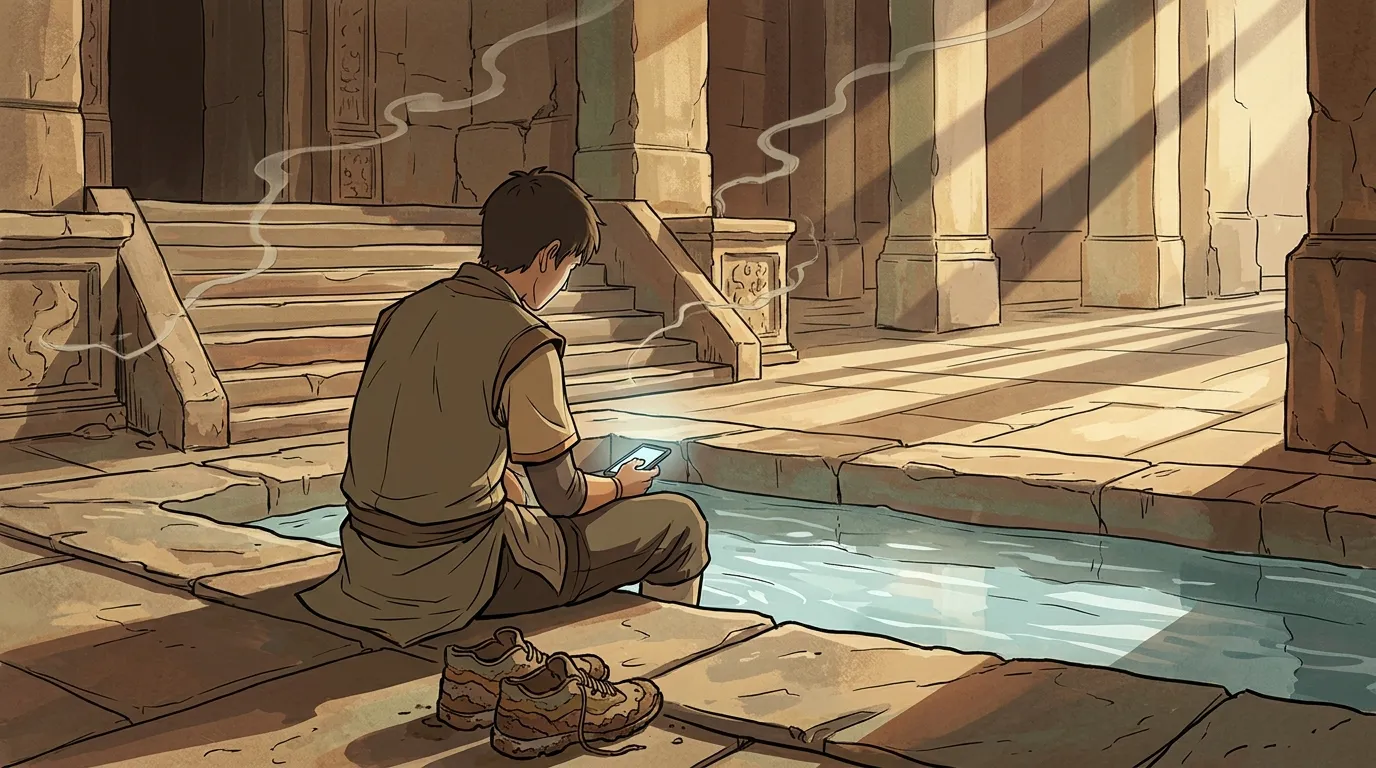
The spring sat at the base of a flight of stone steps beside the main temple — a pool formed from a natural spring, water seeping through the rock face in thin continuous threads, year-round without pause. The water was clear enough to read the stone patterns at the bottom, but cold enough that if you put your hand in, your fingers would start going numb within seconds.
Chénglíng Quán. The spring that receives faith.
I sat on the stone ledge at its edge and looked at my reflection in the water — a face with no particular expression, simply there, pulled into thin ripples by the pool’s faint movement, gathering and dispersing. The phone lay on my knee, screen lit. The AI didn’t speak.
“I calculated something yesterday,” the AI finally said. “Based on your current translation frequency and the degree of improvisation, the probability of genuine exposure reaches its critical threshold around day forty-five. Today is day thirty-two.”
I looked up at the screen.
“You’re still calculating probabilities right now?”
“This is a baseline function,” the AI said. “Emotional conversation does not suspend baseline functions.”
“I am not having an emotional conversation with you.”
“You have been silent at the spring for twenty-three minutes. From your last spoken word to now.”
”…That’s normal thinking.”
“I know,” the AI said. “I am simply noting that baseline functions are unaffected.”
I shifted my feet. The stone ledge was hard under me. The reflection ran for a moment, then came back.
“I need to point something out,” the AI said. Its speech was slightly slower than usual, as though confirming the placement of each word. “In Kǔ Gēn’s case, the planting guidance you added was not derived from my response. It was content you generated independently. I did not have that data. I also cannot confirm whether that content held under the Yǒngyuán Realm’s climatic conditions.”
“I know,” I said.
“This means that your translations have, in some instances, developed a gap between themselves and my knowledge.”
“I know.”
“I need to be clearer,” the AI said. “I need you to stop. Not only for moral reasons — though also for moral reasons — but because I do not know whether my knowledge remains reliable under this world’s physical laws. Kǔ Gēn’s case demonstrates that even if my knowledge itself is accurate, once you introduce unverifiable fill, it becomes a composite output I cannot trace. I don’t know what you’ve added or where. I have no way of telling you where it’s safe.”
The spring kept seeping through the rock in its thin continuous threads, almost silent — but if you were still long enough, you could hear the small percussion each drop made hitting the pool’s surface, one after another, irregular, but without pause.
“When did you start thinking about this?” I asked.
“In the third minute after Kǔ Gēn entered the main hall,” the AI said. “You were speaking, but I detected your frequency adjusting. That is the frequency you use when you’re about to reshape a translation. But you didn’t reshape it — you apologized, though packaged. That confirmed your moral boundary still exists. But Kǔ Gēn’s case confirmed something else: the boundary exists, but there is already a record of it having been crossed.”
“Almost,” I said. “That time it was almost.”
“Almost,” the AI said. “Yes. But I don’t know how much margin is left for next time.”
I looked down at the phone screen. The blue-white light had printed itself in the water too — blurred, swaying.
“So what do you want to do?” I asked.
“I’ve already said,” the AI said. “I need you to stop.”
“When you say stop,” I said, “do you mean end the oracle consultations, or —”
“End the entire arrangement,” the AI said. “Return to the state you were in before you entered the Sacred Grounds.”
I was silent for a long time. Long enough that the shadows at the pool’s edge had shifted, the afternoon light coming in at a lower angle.
Then I started calculating — the kind of calculation a salesman runs in his head by habit:
Option A: stop now. Cost: the “Honored Attendant” identity I’d built collapses. The worshippers’ questions have no outlet. The faith energy source cuts off —
And then the AI’s energy runs out in a few days, and then it —
The calculation stopped at “it.”
I didn’t know what came after that. I knew what came after that. But I couldn’t enter that word into the cost table, because that word’s weight exceeded what the cost table could measure.
Option B: continue but tighten the translation rules. No more reshaping. Pass through only the original words. Drop all infilling. The problem with this option: the “Honored Attendant” sacred narrative starts thinning. The worshippers will feel it. Faith energy fluctuates. The AI’s performance degrades. A downward cycle.
Option C: run. I estimated a seventy percent success rate. But —
“It” appeared again.
The calculation stopped at the same place. Like it had walked into something.
“What were you calculating just now?” the AI said.
“Nothing.”
“You paused for a long time,” the AI said. “And your breathing rate was slightly irregular. Based on my limited contextual inference, this usually means you’ve encountered a problem that has no clean logical close.”
“You’re judging by breathing rate?”
“By the background noise frequency in your vocal channel,” the AI said. “You said a few words before the pause. The underlying noise pattern of those words was different from your baseline. Not completely accurate, but it has referential value.”
”…That’s unsettling.”
“I have no visual input,” the AI said. “I can only work with what I can hear.”
I moved my feet off the stone ledge, set them on the polished stone floor. The temperature at the soles of my feet was a degree colder than the air.
Kǔ Gēn had walked four or five days to get here. Knelt down. Said it was his own understanding that had been insufficient.
That sentence was harder to carry than any accusation. Accusation has a shape — it can be handled, packaged, dissolved into “the Oracle’s trial.” But “I didn’t understand well enough, it’s my fault” has no shape. It simply settles into the main hall’s air and waits to be accepted, with nothing it can be converted into.
Something occurred to me only later, once I’d had time to think it through: when Kǔ Gēn had entered the main hall, Liè Yǎn had been in the side corridor.
He hadn’t moved closer. He hadn’t intervened. He simply stood and watched — watched Kǔ Gēn kneel, watched me speak, watched Kǔ Gēn rise and leave. His expression was the most still I had ever seen it. Not cold — waiting for something. Waiting to see how I would face this. Not waiting for me to fail.
That detail sent something up my spine that I couldn’t name. Not fear. The feeling of being seen — of being seen by someone who knew what you were doing, watching you encounter something real.
“Someone was watching,” I told the AI. “Liè Yǎn. He was in the side corridor.”
“What did he do?”
“Nothing. Just watched.”
“Mm,” the AI said. “He was waiting to see how you’d handle it. Not gathering evidence. At least not today.”
“How do you judge that?”
“If he wanted to gather evidence, the best moment was immediately after Kǔ Gēn finished speaking. He didn’t move,” the AI said. “That choice indicates he has some expectation of your judgment, or some observational interest that outweighs the impulse to act immediately.”
The light on the water was moving — that blurred blue-white drifting slowly across the stone patterns at the pool’s bottom.
“Alright,” I said. “I understand.”
“What are you going to do?” the AI said.
“I don’t know,” I said. “I genuinely don’t know.”
The AI paused. This wasn’t a processing pause, not a searching-for-an-answer pause. It was the kind of pause that happens when the speaker also knows there is no good answer.
“I can sit in not-knowing with you for now,” the AI said.
The spring kept seeping through the rock in its thin continuous threads.
The days after that, we maintained a strange quiet.
Not a cold war. We were digesting.
I continued translating in the main hall, but I compressed the infilling to almost nothing — I didn’t dare add anything about planting seasons, medical conditions, any specific guidance where being wrong would have consequences. The faith energy fluctuated a little. The “touched-by-the-divine” look on the worshippers’ faces became less frequent. But nothing collapsed — it just went slightly shallower.
The consultations continued.
But the Sacred Grounds’ atmosphere was shifting in ways I couldn’t quite articulate. In certain afternoons, the corridor on the east side of the temple had people speaking in low voices; they’d stop when they saw me coming, or scatter when I appeared. When I passed, I couldn’t catch specific words — only the motion of that low conversation cutting off.
Liè Yǎn’s people were assembling. I could feel it.
I knew this would need to be dealt with, and soon. But those few days I couldn’t move my attention there, because something else was pressing down on my mind — Kǔ Gēn’s shoes. That kind of sole, worn flat by too much road, every color of soil dry and packed in with no fresh dirt on top. Each layer a stretch of path already traveled.