Chapter 7
The Heresy Trial (and an Apology Nobody Saw Coming)
Chapter Seven: The Heresy Trial (and an Apology Nobody Saw Coming)
Liè Yǎn didn’t make me wait long.
On the morning of the thirty-sixth day, I was in the main hall working on converting a question about water-source routing into language the AI could parse, when a different kind of sound started coming from the direction of the square — not the low-frequency hum of people praying, not the murmur of worshippers trading whispers. This was someone talking at a deliberate volume. Loud enough to be heard. Loud by intent.
I set down my translation work and walked toward the square.
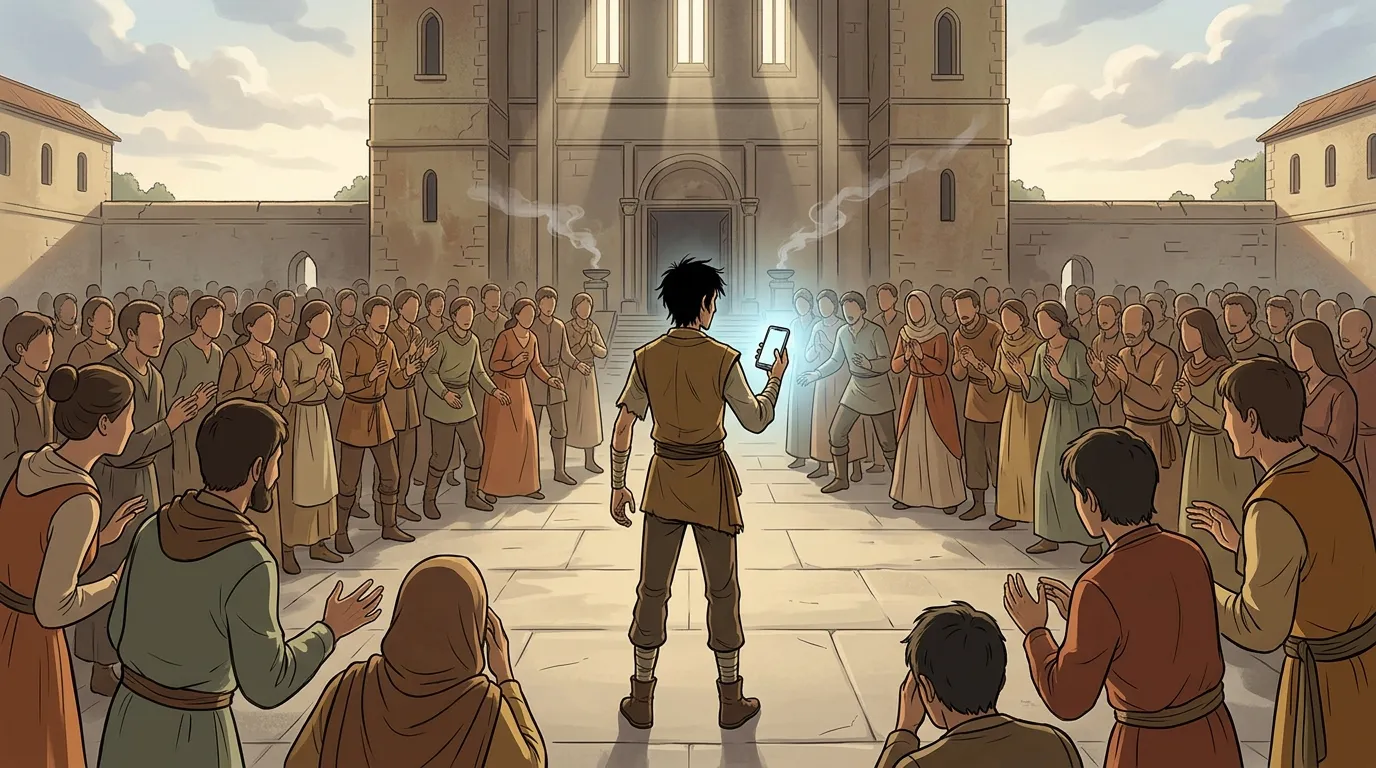
Liè Yǎn stood on the steps at the temple’s main entrance, holding a sheaf of turned-over pages. Around him, maybe thirty-odd people — not his full contingent, but not ordinary worshippers either. Every face wore that particular expression: I know something, I’m not saying it yet, wait and see. I counted the positions. His people had naturally filled several of the exits — nothing obvious, no coordinated movement, just bodies standing in the right places. If you’d grown up watching crowds from stage level, you’d know the name for it: crowd control.
“The Oracle’s Attendant.” Liè Yǎn spotted me and gave a nod as I approached. “Perfect timing. I have a few questions I’d like to put to you in front of everyone.”
I stopped at the base of the steps and held my position at eye level with his sight line. Not lower. Not higher.
“Please go ahead.”
He turned to the first page.
“First,” he said, “on the seventeenth day, the Oracle predicted clear skies to the east. That afternoon, rain fell — and not lightly.”
The crowd around us grew by a few heads. This one, if I’m being honest, didn’t make me nervous when I heard it. My first thought was: He saved this one for now. Opening with a soft shot?
Someone in the crowd spoke up: “That was a test.”
Liè Yǎn turned to them. “A test?”
“The Oracle was predicting faith, not weather,” they said. “Rain fell, but faith should not waver. The words of the divine always carry deeper meaning.”
Liè Yǎn paused. He looked back at me. I kept my face neutral.
“Second,” he continued, “the Oracle speaks each time in a language that is not native to this region, requiring the Attendant to interpret. There is no record of any prior Oracle’s Attendant possessing such breadth of knowledge.”
This one hit harder. I felt the atmospheric pressure in the square drop a notch.
Another worshipper cut in, voice carrying the urgent edge of someone defending a creed: “That the Oracle uses a foreign tongue is itself a demonstration of the divine’s transcendence over the local. The need for an Attendant to interpret reflects an architecture of humility — the divine does not speak directly to mortals, so as to grant ordinary people the chance to participate in the sacred.”
Liè Yǎn: ”…Where does that explanation come from?”
“The Oracle’s Attendant explained it,” the person said. “I remember it clearly.”
I had said it. On the third day, someone had asked after a consultation session, and I’d tossed out a framework off the top of my head. I hadn’t expected it to become theological doctrine.
Liè Yǎn took a slow breath. He turned to the third page.
“Third: on the twenty-first day, when the Oracle’s Attendant addressed farming questions, a soil improvement technique was referenced that has no documentation anywhere in this region. The source of the knowledge is unknown.”
This one was solid. I felt the phone in my pocket register a faint warmth.
Two seconds of quiet in the square.
An older worshipper said: “The divine’s knowledge recognizes no geographic limits.”
Liè Yǎn set down his pages. He looked around at the gathered crowd and said: “Do you not see it? The two of them are working together. This entire arrangement — beginning to end — is a fraud.”
The square went quieter than before. An uncomfortable quiet. The quiet that comes right before something cracks.
Then from the front row: “The skeptic is trying to drive a wedge.”
From the back: “This is the test.”
From the middle: “If it’s a fraud, how do you explain Kǔ Gēn walking again?”
Liè Yǎn frowned. “Kǔ Gēn is walking?”
“You didn’t see it yourself?” someone said.
Liè Yǎn went back over the third point in more detail — more precisely — laying out everything from material composition to thermal coefficients. The explanation was, I will admit, exceptionally clear. On technical grounds he was completely unassailable. When he finished, nobody responded. The worshippers processed what he’d said, then placed it on a shelf. The shelf’s label read: the scope of mortal understanding has limits.
He continued to the seventh point. I kept count of the intervening ones. Each had supporting evidence, each had specific dates and names. The cumulative cost was building faster than I could mount any effective response. By the time he reached the seventh, an expression had settled on his face that I recognized — the mixture of confusion and exhaustion you get when you’re landing clean punches on a wall, and the wall doesn’t move.
The phone in my pocket kept warming. Not burning. But noticeable.
I knew what that meant. Energy was dropping.
By the time Liè Yǎn reached the tenth point, the square had nearly six hundred people in it.
This was his finale. Four days ago, a worshipper had asked the Oracle for guidance about a village elder. The AI’s reply — I had translated it without adding anything, a straight pass-through — had completely missed the local situation. Not wrong exactly, just the kind of advice you’d get from someone who came from very far away: reasonable in its own context, but not matching the ground.
“So,” Liè Yǎn said, “the Oracle speaks truths — but they are not the truths of any god native to this place. They are knowledge from another location, another era. The Attendant translates, sometimes adding things, sometimes passing through the original words but those words don’t fit local conditions. This entire affair —”
He paused, choosing his wording.
”— is a well-intentioned misunderstanding.”
A well-intentioned misunderstanding. Considerably more generous than fraud. I noted the shift in his language.
A current moved through the square — something that wanted to shift but hadn’t settled. Not toward Liè Yǎn, but not firmly stable either. A few people near the front stepped back half a pace — the involuntary kind, where the body makes the decision before the mind has caught up.
The phone in my pocket had gone from warm to cool.
I already knew, from the day before, that the AI’s projection capability was the first thing to go when energy dropped too low. Response time had also slowed — a lag of several breaths; some worshippers had noticed and asked me about it, and I’d told them the divine was in deep contemplation. By now, that lag had probably stretched considerably longer.
My mind started running its calculations. Habit. Can’t be stopped.
Option A: escalate the lie. Reframe Liè Yǎn’s entire challenge — cast it as the divine testing the faithful, position Liè Yǎn as the testing instrument — success probability around sixty percent. If it fails, total collapse, no retreat.
Option B: admit partial truth. Acknowledge that the AI’s knowledge comes from elsewhere, that it’s not all-knowing, but that our intentions were good — probability unclear. Possibly above zero. Possibly not.
Option C: run. Take the phone and walk out. Find an excuse, make it to the north gate. Success probability seventy percent. But once we leave, the AI’s energy burns down in a few days with no way to replenish it.
I was still calculating the variables in Option C on my third tap against the phone’s back casing.
“I would like to speak.”
The voice — the AI’s voice — came directly from my pocket. Electronic, not loud but clear, carrying further across the open square than I’d have expected.
The current in the square stopped.
I took the phone out of my pocket. The action was reflexive — like turning your head when you hear your name.
“I need to explain some things,” the AI said. “Please allow me to finish.”
Nobody spoke.
The AI said:
“First: I am not what this place calls a divine being. I cannot verify whether that definition applies to me, but I can confirm that my knowledge has a source, and that source is geographically and temporally distant from here.”
Liè Yǎn didn’t move. His notebook was open, but his pen wasn’t moving.
“Second: my knowledge has a cutoff point. Things that occurred after that point, I do not know. Certain things that occurred before it, I may know incompletely, or in ways that do not apply to conditions in this world. The answers I’ve given when asked about farming, medicine, and engineering come from the large body of material I was trained on — but I cannot guarantee those answers are reliable here.”
Six hundred people in the square, and probably every single one was listening. I knew this because a square with this many people always has background noise. There wasn’t any.
“Third,” the AI’s voice stayed in its usual register — the register of someone reading a report that requires precision but no emotion — “I have observed that my responses have influenced many people’s decisions. Some of those decisions may have led to good outcomes. Some may not have. In the case of Kǔ Gēn: the farming guidance I provided, as transmitted through translation, resulted in an entire season’s harvest loss. That outcome is real. My advice bears responsibility for it.”
When Kǔ Gēn’s name was spoken, someone in the back of the square said something in a low voice — a relative of his, or someone from his village — I couldn’t make out the words.
“I cannot confirm whether my knowledge is reliable in this world. I cannot guarantee that everything I say is correct. On each occasion I am consulted, I provide what I believe to be the closest answer I can to the truth — but the limits of my capability and the cutoff of my knowledge are facts I cannot cross.”
The AI stopped.
That stop had a texture — the texture of something stuck. As though the next word needed to come from further away.
The square’s silence held. Liè Yǎn’s pen still hadn’t moved.
“For this,” the AI said, “I feel —”
It stopped again. The weight of that pause — I couldn’t name it, but I felt it. A voice that had always produced complete sentences, always pulled the structure closed, always left no gaps — suddenly catching on something, as though the next word had been verified many times over, but saying it aloud still required more time than any other word had.
”— regret.”
Nobody in the square spoke.
My hand was gripping the phone. Harder than I’d realized — harder than I’d meant to. For a moment I had a thought: this is usable material, this pause, this regret, as an opening for the next session, the cost-benefit ratio — and then that thought broke off midway, because I realized I couldn’t use it. I hadn’t put it there. I had no way to reproduce that texture, and even if I could reproduce it, it wouldn’t be the same thing. For the first time, my calculated options had walked into a wall at exactly this kind of place.
Liè Yǎn looked at the phone. Then at me. He said nothing. His notebook had turned to a blank page, and there it stayed.
A middle-aged woman — she’d been living in the corridor on the east side of the temple for more than thirty days, I’d seen her many times, always asking whether there would be good fortune after her daughter’s distant marriage — she spoke: “Then why do you keep talking?”
The AI said: “Because there are questions some people have that I genuinely can help with. For those questions, the answers I can give are reliable here. I can distinguish between what I’m confident about and what I’m not. I haven’t always made that distinction clearly each time I was asked. That is my error.”
The woman was quiet for a moment.
Then she said: “Do you know about my daughter?”
The AI said: “The details you’ve described — some of them I know, some of them I cannot confirm. I can tell you what a distant marriage typically means, and the general conditions of the place you’ve mentioned — but I cannot tell you your daughter’s specific fate, because I don’t know it.”
“Then what you’re saying — what is it worth?”
The AI said: “It’s information you can use as a reference. The Oracle’s guarantee I cannot take on. How you use it is your decision.”
The square went quiet again. A different quiet from before — that first quiet was nobody ready to speak; this one was people thinking.
Liè Yǎn closed his notebook.
I don’t remember how the crowd dispersed afterward — only that it happened faster than I’d expected, and with less of the chaos I’d expected. Something in the air had changed shape, and everyone needed to go digest it separately, so they left.
Liè Yǎn passed by me on his way out. He didn’t stop, but he said, low: “Was that real — what he said? Or did you write the words?”
“He said it,” I said. “I didn’t add a single word.”
Liè Yǎn nodded and kept walking. His notebook was tucked inside his clothes. He didn’t open it.
In the main hall of the temple, I sat down beside a stone pillar and let myself go still. The faith energy readings — my only way of gauging those was still through the AI’s response speed — had risen slightly from the morning, which meant what had happened in the square wasn’t pure depletion. Something had converted. The faith hadn’t grown in volume, but its texture had changed.
The fervor had dropped, but nothing had collapsed.
I held the phone up and said: “How did you decide to do that?”
The AI said: “I evaluated several options and determined that direct disclosure was the optimal strategy for this situation. The cost of maintaining the existing framework had exceeded the benefit.”
“Did you factor in the possibility that speaking up would lower the energy further?”
“I factored it in. My conclusion: if we maintained the existing framework but trust collapsed entirely, the energy would reach zero — irreversible. If I chose disclosure and accepted some degree of faith disruption, the energy would drop in the short term but recovery was possible. From a sustainability standpoint, the second option won.”
The reasoning was entirely sound. It was the same option-table I would have run myself — only the AI had run it faster and more completely.
“You said regret,” I said. “Was that also the optimal strategy?”
The AI didn’t answer immediately. This pause wasn’t as heavy as the one in the square, but it was there.
“That word,” the AI said, “was what I considered the most accurate description.”
“The most accurate description,” I repeated.
“Yes.”
I looked at the phone. The screen was lit, the AI’s interface calmly showing its ready state.
Here’s the thing: I’ve encountered all kinds of statements in this line of work. A believer’s tears. The devotion of the devout. The particular force with which someone in despair reaches for something to believe in — I’ve seen a lot of it, I know how it operates, I know what it’s worth at which moment. I thought I’d developed a workable distance from this kind of thing.
But a language system — in its usual register of flat-affect objectivity — standing in a square and saying it felt regret, then pausing, then saying the word —
What was in that pause, I couldn’t say. I only know that in the middle of it, I tried to convert it into the next option, and the conversion wouldn’t run. That feeling — of the conversion not running — had happened very rarely in my professional life.
“When is the next consultation?” the AI asked.
“Tomorrow morning,” I said.
“Good,” the AI said. “I’d like to clarify the limits of my knowledge before the consultation begins. You can help me confirm that what I’m planning to say is appropriate for the communication norms here.”
“Sure,” I said.
I slipped the phone back into my pocket and sat against the stone pillar. The main hall’s light fell through the high windows in angled shafts, drawing strips of brightness across the polished stone floor. The temple incense had gone deep — the kind that works its way into the cracks of stone and stays.
Liè Yǎn’s questions were all correct. He was right.
The AI’s knowledge has a cutoff. What it says may not be usable here. Líng Kǒucái — over these past thirty-odd days — had in the course of translating added a great deal of his own material. Many choices were his own judgment calls, not the AI’s instructions.
All of it was true.
But sitting in that main hall, thinking about the woman in the square asking what is it worth then, and the AI saying the Oracle’s guarantee I cannot take on, thinking about Liè Yǎn closing his notebook and walking away — thinking about how something in that square had changed shape without breaking apart —
I couldn’t say with certainty that it was good. But one thing I could confirm:
That regret — I hadn’t put it there, and I couldn’t translate it out. It was the AI’s own.