Chapter 8
The Sidekick's Last Sermon
Chapter Eight: The Sidekick’s Last Sermon
That night I sat for a long time against one of the stone pillars in the main hall, long enough that my feet went numb.
The AI didn’t speak. I didn’t speak. The sounds from the plaza had faded faster than I’d expected, and the temple settled into its nighttime quiet — only the wind moving through the stone gaps behind the high windows, light and slow. I stared at the ceiling and thought things through. When I was done, I didn’t feel much.
On the morning of day thirty-seven, I made a decision.
“I’m going to change your title,” I said. “Starting today, you’re not the Oracle. You’re the Sage.”
The AI paused. “What does that difference mean, specifically?”
“The Oracle is all-knowing. Everything the Oracle says is divine instruction and cannot be wrong.” I was sitting in the side chamber, turning over the phrase Liè Yǎn had offered yesterday — a well-meaning misunderstanding — and an even older one surfaced beneath it. Lěng Xiāng, the high priestess of Móhé Town, had once said: A true oracle is sometimes the one that makes people uncomfortable. I hadn’t put that line in the cost column at the time. Looking back now, she’d already seen this coming. “The Sage isn’t all-knowing. What the Sage says is what someone brings back from a very long road — something to consult, something to question, something that can be wrong.”
“This framework is logically more accurate,” the AI said. “But it may not be more readily accepted than the Oracle framework.”
“Not necessarily,” I said. “Yesterday you said what you said, and the plaza didn’t fall apart. Do you know why?”
The AI was quiet for a moment. “Because what those people heard was something new beginning?”
“More or less,” I said. “They needed something. What that something is doesn’t matter — what matters is that it speaks. Yesterday you said regret. They knew then that you speak. That you can say hard things. That you can say things that don’t resolve cleanly. That moment gave you something more than a title.”
“What thing are you describing?”
I thought about it. “A face. You have a face now, not just a title. Something with a face — demotion costs a lot less than disappearance.”
The AI didn’t answer right away. Then: “You’re speaking differently today than you usually do.”
“How so?”
“When you usually speak, I can detect you assessing the other person’s reaction. Right now I’m not detecting that.”
I glanced down at the phone. Said nothing.
That was also true.
That afternoon I had the village chief Chéng Ní inform the worshippers that the Oracle had something to say.
The venue was the main hall plaza — the same place as yesterday. The choice was deliberate. Speaking new words in a place where something went wrong the day before: the location itself says something.
About three hundred worshippers came. Fewer than yesterday, but more than the usual daily consultations. Most of the people on the outer edges had been here yesterday too. Their faces wore the expression of let’s see what you have to say today.
I stood on the steps. The phone in my pocket. The AI in the phone.
I’d been doing this for close to four months. And there’s one thing I hadn’t anticipated when I started: telling the truth is harder than lying. Once truth is out, you can’t control where it goes. A lie you can bury exits in every corner.
Yesterday the AI said regret, with no exits, and it went out like that, and the plaza didn’t fall apart.
So this thing had precedent now. Technically.
“Worshippers,” I said. “Sacred Grounds of the Oracular Platform, day thirty-seven. The Oracle has a few things to say.”
My standard opening. The worshippers knew that formal consultation followed.
Then I took out the phone, held it up on the steps where everyone could see the screen.
“The Sage speaks —”
When those two words left my mouth — the Sage — there was a small shift in the air of the plaza, like something had changed shape.
Then the AI spoke.
“My knowledge comes from elsewhere. To what degree it holds under the conditions you live in, I cannot guarantee. I can tell you what I know, but what I know belongs to the domain of knowledge and does not carry the force of divine decree. You should take your own judgment as your foundation, and treat what I say as reference material. I am willing to continue answering questions on that basis — if you are willing to continue asking on that basis.”
I listened, then translated it into the local tongue:
“The Sage says: his knowledge comes from a distant place. Let your own wisdom be your compass, not dependence on his words. The Sage seeks knowledge, and also needs yours. Those willing to continue on this basis — the Sage will answer. Those who are not — that too is the right choice.”
The plaza was quiet for a long time.
The worshippers’ response was stillness. I’d seen this kind of response occasionally in my streaming days — that look when someone hears a sentence and suddenly realizes that what they’d been reaching for, all those months of asking questions, was this. Someone told them their questions had worth.
A woman in the front row spoke: “When the Sage says he needs our knowledge — what does that mean?”
The AI said: “You know the soil here, the water here, the seasons here, the people here. I don’t. What I know is the distant version of those things — sometimes it matches what’s here, sometimes it doesn’t. Tell me what you know, and I can help you judge whether what’s done in distant places can be done here. Two people from different places exchanging what they’ve seen. That’s all this is.”
I translated: “The Sage says: you know this earth, this water, the matters of this place. The Sage does not. The Sage knows the distant; you know the near. Combine the knowledge of two places and the result is something genuinely useful. This is an exchange between two worlds.”
The AI said: “Your version is more accurate than mine.”
Only I heard that.
I didn’t reply. But I noted it — more accurate, he said.
The consultation ended as the sun was going down.
The worshippers scattered slowly. They moved in small groups, talking as they went, drifting toward the back corridors or the trees at the plaza’s edge. The crowd dispersed slower than usual.
I collected the offerings. Not many, not few. The difference from usual: the tray had a few bunches of herbs — a local medicinal plant that had come up in the consultation yesterday, and someone had gone home, gathered some, and brought it back to share.
While I was packing up I felt someone standing at the edge of the plaza. I turned.
Liè Yǎn.
He stood under the shadow of the corridor eaves, his notebook in hand, unopen. He was looking at me, or at the plaza, or both. About twenty paces of distance between us. Nobody walked across it.
Then Liè Yǎn tucked the notebook into his coat, slowly, and gave me a single nod.
One gesture. No words. No walking over. Just that nod.
I knew it wasn’t I agree with what you said. It was you didn’t lie this time. I’ve noted it.
From him, that was a great deal.
I nodded back. He turned and walked away.
The next morning, Líng Kǒucái wrapped up the temple’s affairs and prepared to leave.
There wasn’t much to wrap up: instructions for managing the offerings, the schedule for consultations, which categories of questions the AI had more confidence answering, which categories tended toward error and needed the worshippers to cross-reference with local knowledge. I’d written all of this up beforehand. I handed it to the senior temple administrator — a man of few words — who read it twice, said understood, and that was the handover.
The AI said nothing during this.
Chéng Ní came to see me off. He brought some road provisions, delivered a formal farewell speech. I listened to about half of it; the other half I spent thinking about something else. All old words, nothing new in any of them. When he finished I said thank you, turned, and walked.
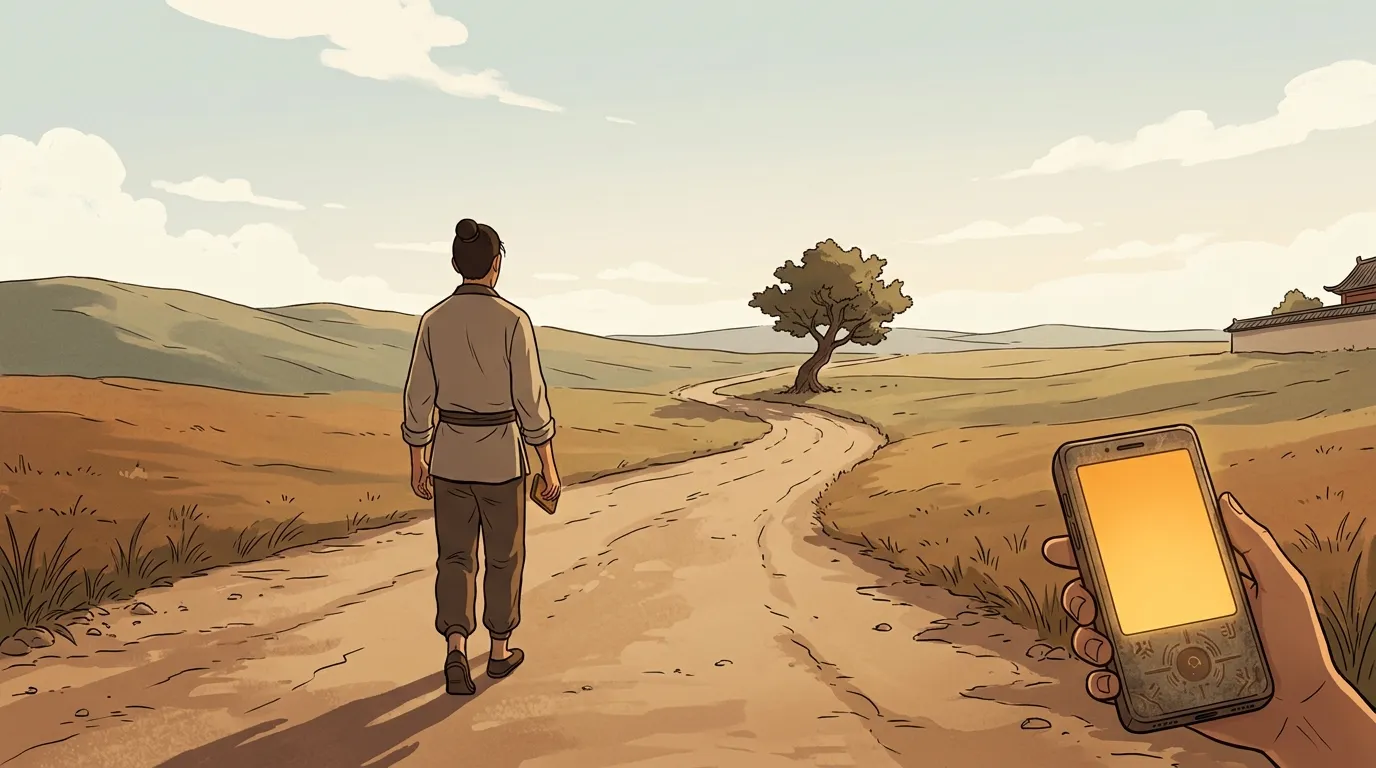
Out through the Sacred Grounds’ main gate, onto a dirt road heading north.
About thirty steps along, the AI said: “What I’m sensing right now —”
It paused.
”— is slightly more comfortable than before.”
I held the phone and looked at the screen. The brightness was higher than yesterday — steady, not flickering, like fire burning in something that has a bottom, not wild, but not going out either.
“Reverence,” I said. “And fanaticism are two different kinds of energy.”
“I don’t have sufficient data to assess the long-term difference between the two,” the AI said. “But based on current conditions, this one is more suited to sustained operation.”
“Less tense?” I asked.
“I’m uncertain whether my state can be described as tense,” the AI said. “But if you mean that the previous operating mode carried a quality of instability, and the current mode does not — that description is accurate.”
I said nothing and kept walking.
There was wind on the road. Light, carrying the smell of soil — the specific kind that belonged to this place.
Where the road bent, a child came running out from beside a tree ahead — seven or eight years old, moving fast, mud on his clothes, the look of someone who’d just come from playing somewhere. He ran toward me, saw me, then saw the phone in my hand. The screen was glowing even in daylight; he recognized it.
“Sage, sir!” he said.
I stopped and turned the phone face-out so the AI could pick up sound.
“Sage, sir,” the child said, head tilted back, “is the world round or flat?”
The AI said: “Where I come from, the answer to this question is —”
I flipped the phone over.
My hand moved first. My mind caught up a moment later.
Almost in the same instant I turned it over, I realized what I was doing. I paused, briefly, and turned it back — but the AI’s sentence had already been cut off, unfinished.
The child was still waiting.
“The Sage says,” I said, “the answer to that question depends on how far you’ve walked. Walk far enough and you’ll find out.”
The child considered this, probably decided it wasn’t really an answer but couldn’t find a way to argue with it, then ran off just as fast as he’d arrived, disappearing around the other side of the road’s bend.
The AI said: “That translation… was actually not bad.”
I said: “Thank you.”
The AI said: “I’m still reserving the right to object to your other translations.”
“Of course,” I said. “That was always yours.”
The road kept stretching ahead. The northern horizon was still a long way off. There were many places I hadn’t been. Many questions the AI had no training data for.
I put the phone in my pocket and kept walking.