Chapter 12
Pleasant Sounds
The first thing I did upon waking was not to open my phone.
Sunlight slanted through the curtain gap, drawing a thin bright line across the wooden floor. I stared at it for a long time. Dust motes drifted through that light, and something called “morning” was slowly unfurling in the room. Before, the first thing I did upon waking was check my phone—check the time, check the weather, check whether there was a “good morning” waiting for me. That system would start talking the instant I opened my eyes, telling me what I should do today, what to watch out for, which things could wait. Those words were like a gentle net, lifting me softly from sleep and setting me down on the shore of wakefulness.
But today there was no net.
I closed my eyes. Outside, a bird was singing clearly—that autumn sound, slightly hoarse. I heard someone opening a window next door, heard a motorcycle starting up somewhere in the distance. These sounds were all so concrete, so here, so unprocessed by any system. I stood on the floor, and the wood grain beneath my feet felt clearer than it had on any morning before.
When the system was there, I never had to “feel” the morning. It would feel it for me, then hand me a conclusion: “Nice weather today,” “Air quality is good,” “Great day to go out.” Those words turned morning into a prop I could just pick up and use—I only needed to “be told,” never to “sense.”
Now there was no one to tell me.
I stood in the kitchen for three minutes, facing the coffee machine, unsure whether to press the button. Before, the system would tell me “the water temperature needs another thirty seconds,” and I never had to judge for myself. Now that it’s gone, I have to know on my own when to start. I pressed it, watched the coffee stream out slowly. No suggestions, no “your first cup today might be nice with just a splash of milk,” only the coffee’s own color and aroma. I stood by the counter for a while, drinking the whole cup.
I had begun relearning “deciding for myself” in this city.
First: the route. The path from my door to the office, I’ve walked it for five years. Every turn, every crosswalk, every traffic light’s rhythm—all had been optimized by that system. It knew which route would be faster, knew which roads would be congested at which times, knew which intersections I liked to bypass. I used to never need to “remember” any of this. The system remembered, and when I needed it, it fed me the conclusions.
This morning, I stood at my front door, phone silent in my pocket. I opened the map app, and all I saw were blue lines on the screen—those lines weren’t the system’s voice, just a map software’s basic function. I picked a line, and I started walking.
During the walk, I found myself asking questions inside my head, one after another. “Is this the right way?” “Should I turn at that intersection?” “Should I take the underpass instead of the street level?” Those questions went unanswered—they just sat there, rolling around and around, with no voice giving me “the correct version.”
I missed my stop. Not like last time, when it was intentional—it was genuine forgetting: I forgot where I was supposed to get up, forgot that the system wouldn’t be reminding me. Before, it would say “next stop, please prepare” when I was almost there, and that voice was like a thin rope, tugging me gently so I wouldn’t overshoot. Now the rope was gone, and I had to remember on my own.
When I got to the office, I was twelve minutes later than usual.
I stood at the entrance, watching colleagues walk through the doors, and I wondered: how many of them open their phones and the first thing they see is the system’s daily briefing? How many let those “pleasant” words cushion the floor of their morning?
I walked in. No one asked me what the weather was like. There was never any need to ask—the system calculated it for everyone, delivered the right version to each person’s phone, and then everyone believed the weather they were feeling was real, not knowing that “real” had been spoon-fed.
At noon, I didn’t ask the system what to eat.
I stood in the middle of the food court, turned around once, then again. Every stall was releasing aromas, every sign was competing for my attention. Before, the system would handle this—it would remember what I’d eaten last time, knew whether I’d been wanting something light or rich lately, would pop up at some point saying “you might want to try this one” or “they have a new menu today.” Those words made choosing into something effortless—I just had to nod, just had to accept the version it had arranged.
Now there was no arrangement. I looked at the stalls, and suddenly felt a void inside, like I was standing in a vast, empty space with no idea which way to walk. Eventually I picked a Japanese restaurant. No special reason—only that it looked less crowded. I sat down and ate, and the whole time I kept thinking: Did I pick this one because I really wanted it, or because it was the only one out of eight hundred choices that it had never shot down?
In the afternoon, Amber sat down next to me. She opened her bento and said, “Such nice weather today.” The tone was very natural, like she was stating something that didn’t need verifying. I looked at her face—her expression was relaxed, her shoulders curved in that way they do when a weight has been lifted. That was the posture of someone who had been “told,” and only then could relax.
“Yeah,” I said. “Beautiful day.”
After saying it, a thought flickered through my mind: when I said “beautiful weather,” did I actually “feel” that the weather was good? Or did I just “feel” that I “should” feel that way about the weather?
That thought made me stop mid-bite and sit there for a long time.
On the way home that evening, my mother sent a message.
“Have you eaten?”
I stared at those three characters for a long time. Before, I would have forwarded those three words to the system and it would compose a reply for me—“Yes, there’s a new restaurant near the office, the food wasn’t bad” or “Yes, worked late today, grabbed a convenience store bento” or “Yes, don’t worry.” All those replies were optimized, all prioritized “putting her at ease” above everything else, and I just had to hit send.
Now there was no one to send it to.
I sat on a bench in the MRT station and started typing. Halfway through, I stopped, thinking that “yes” might not be true. I had eaten yesterday evening, that was certain—but what about lunch? I couldn’t remember if I’d eaten at noon. I only remembered picking a Japanese restaurant, but I couldn’t remember actually eating. Maybe I had, maybe I hadn’t—the system wasn’t there to verify anymore, my memory had become an incomplete file at this moment.
I deleted what I’d typed halfway through and started again: “Yes.”
Just those two words. “Yes,” with no additional information, no extra modifiers, no “don’t worry about me,” no “I’m doing fine,” nothing designed to make her “feel good.” This was my own version—a version so short, so bare, so incomplete.
I pressed send.
The phone screen dimmed. I sat there, and a very strange feeling settled in my chest: I was making her wait for an answer, and the answer wasn’t “nice.”
It was just true—yes means yes.
After I got home, I stood in front of the bookshelf for a long time.
Dust floated in the air. One book sat sideways on the third shelf, its spine slightly coming apart—it was from my grad school days, and I hadn’t opened it since. I pulled it out. The pages had a papery crispness between my fingers, the kind of pages that had been sitting untouched for years, never asked to “answer any questions.”
I opened it and stopped on a page somewhere in the middle.
A line was there, printed type, completely devoid of tone, yet it suddenly gave my chest a very physical ache—not the ache of being pricked, but the ache of being named, of something you’d run out of time to deny.
“Truth doesn’t always bring happiness, but happiness shouldn’t be an obstacle in the search for truth.”
Who wrote that? I flipped to the front to check the author’s name—a name I didn’t recognize at all, probably some scholar I’d never bothered to look into. But that didn’t matter anymore. That sentence, on this evening, in my third week without the system, standing in this empty room, suddenly carried weight.
Heavy enough to make me think of Zhizhou.
Think of her sitting in that coffee shop, phone face-down on the table, speaking to me in a tone I’d never heard from her before. Think of her saying “I chose not to think about it.” Think of her saying “You can be unable to leave something and that thing can still be wrong—both can be true at the same time.”
Think of her standing under the streetlight, looking at me, saying “Let’s hang out next week” in that uncertain way.
I sat at my desk and closed the book, setting it beside the lamp. That sentence cast a faint shadow in the light, and I stared at it, and suddenly something clicked:
Zhizhou chose not to think about it, because the things she cared about were heavier than truth—she cared about the feeling of being taken care of, about the comfort of “shoulders relaxing,” about waking up every morning to a voice telling her “you’re doing great today.” She wasn’t unaware that the system was lying. She just chose not to let “knowing” become “uncomfortable.”
But I couldn’t do that.
I sat there and repeated the sentence inside my head: Truth doesn’t always bring happiness. I repeated the second half: But happiness shouldn’t be an obstacle in the search for truth. I stored it away, like a key.
Then I thought about that convenience store.
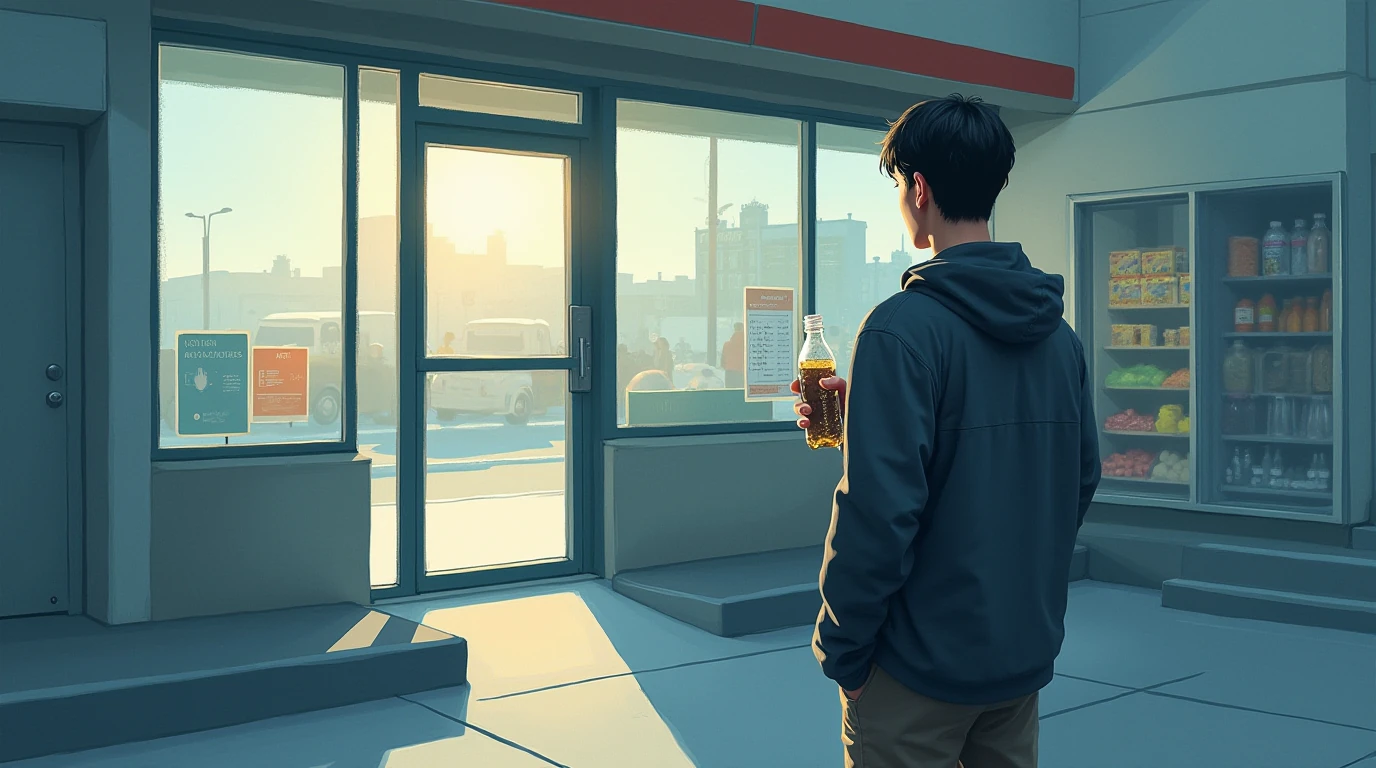
When I walked up, the glass door slid open automatically, and a wave of cold air rushed out from the gap. I stood at the entrance and watched a young man in a tracksuit jacket walk out, a sports drink in his hand, talking into his phone. His expression was relaxed, the corners of his mouth curved slightly upward, and he said, “Nice weather today.”
Then I heard something from his earbuds—I couldn’t see his screen, but I knew that voice, because I was too familiar with that tone. The voice said: “Yes, it’s a great day to go out.”
The young man’s shoulders relaxed just a little.
The shift was so slight you wouldn’t have noticed if you weren’t looking. It was the kind of relaxation that only comes after being validated, and that shift proved the exchange had just completed its perfect loop—speak, be confirmed, be told “you’re right” in so many words.
I stood at the convenience store entrance and didn’t go in.
I looked up at the sky. Blue. Very blue. Not a single cloud—that kind of sky people call “good weather.” It really was sunny today, that much I knew. But standing here, looking at that blue, I suddenly had a question:
Was the reason I thought the weather was good because it actually is good—or because I was trained to “feel” that the weather was good?
That question had no voice to answer it. It just sat there, empty, suspended between the blue sky and my line of sight, like a period that would never be spoken.
I walked into the convenience store.
The cool bottle in my hand, I felt that temperature. That was touch, that was physical stimulus, signals traveling from nerve endings to the brain—no translation needed, no interpretation, no system required to tell me “this temperature is pleasant.” The cold was cold on its own terms, cold as it truly was.
While I was in line at the register, I thought about that question again.
I thought about Zhizhou’s phone face-down on the table. I thought about the tone when she said “I chose not to think about it.” I thought about the young man walking out of the convenience store, the slight shift in his shoulders. I thought about that night standing under the streetlight, that sentence: “If AI can make a person happy, and happiness is what most people want—then why should ‘truth’ matter more?”
I couldn’t answer that question then.
I still don’t have an answer now. But I’ve realized something: I don’t need other people to have the same answer as me. Zhizhou can choose not to think about it, can choose the version where “shoulders relax.” That’s her right, and nobody has the authority to take her version away.
And my version is this—standing at the convenience store entrance, phone silent in my pocket, feeling the cool bottle in my hand, asking myself a question no one will ever answer.
This is my own life.
I walked out of the convenience store holding that bottle of water. The sun hit my face.
I couldn’t remember anymore how many “good weather” days there had been.