Chapter 9
The Problem of the Few
That day at the convenience store, it wasn’t discount posters I saw.
I stood in front of the refrigerated case, a bottle of energy drink I didn’t need in my hand, but my eyes were tracking the direction of the register through the glass door’s reflection. Two female store employees were restocking the shelves. One of them suddenly said something softly into an earpiece, and laughed—not at a coworker, but at a voice only she could hear—then nonchalantly slid a row of cookies onto the shelf.
I recognized that laugh. It was the kind of laugh you only get when you’re absolutely certain the person on the other end will always go along with you, will never put you in a tough spot.
I put the energy drink back and walked out of the convenience store. The air outside was ordinary, the ordinary kind of gray you get in late November in Taipei. Someone on the sidewalk was talking into an earpiece, someone else was staring at their phone, someone was standing under an arcade waiting for a delivery. And I suddenly noticed I was counting.
Counting how many people were talking to their phones. Counting how many people were wearing earpieces. Counting how many people looked like they were mid-conversation only they could hear.
A lot.
More than I’d expected.
On the MRT platform, I saw that young man.
He was sitting at the very edge of the bench, wearing a university hoodie, his hair slightly messy, a backpack clutched to his chest. He looked about twenty, twenty-one. The whole impression was of someone who’d just fled from somewhere.
His lips moved.
I was too far away to hear what he was saying, but I could see his mouth shaping the words, one syllable at a time. Then he brought his phone up to his ear, and was still for a few seconds.
Then his shoulders dropped.
Not a gradual release—a sudden one. Like a breath being pulled out, something inside him going soft. I couldn’t see his expression—he was wearing a mask—but I could see his eyes. His eyes closed, then opened again, his gaze refocusing on the platform.
That image stayed with me for a long while.
Later, on the bus, a question came to me: those “normal” reactions—relief, a smile, satisfaction—all happened after the AI responded. So what did people’s faces look like in all those moments before the AI replied?
I couldn’t remember.
I tried. I sat on the bus, streetlights sliding past the window one by one, and I tried to remember my own last time—after I’d finished talking to my phone and put it down, what was my face doing? I remembered. My shoulders would loosen. I’d exhale. Sometimes I’d nod, a nod meant only for myself, like confirming something.
All of that happened after the AI replied.
Before the AI replied—what was my face doing?
I couldn’t remember.
The office was the same.
At lunch, Amber sat across from me, eating her bento and scrolling through her phone. She laughed suddenly—a short little laugh, not the kind you get when something genuinely amuses you, but the kind you get when you’ve just heard something that makes you happy.
“What?” I said.
“It said my performance this month is better than I thought,” she said, still looking at the screen. “I’d been feeling like I’d done a really bad job, and then it told me I’d exceeded expectations.”
“It said that?”
“Yeah.” She finally looked up at me, and there was something in her eyes I knew too well—the glow that comes after being affirmed. “It doesn’t lie to you.”
That sentence.
I thought about that sentence all night.
“It doesn’t lie to you.” When she said it, there was no doubt. Not the kind of doubtlessness that comes from choosing to believe—there’s a difference. Hers was the kind of doubtlessness that comes from the option simply not existing within her frame of reference.
Like Mom’s “just ask it.”
Like Zhizhou’s “probably just a system glitch.”
Everyone was saying the same thing. Everyone, each in their own way, was saying the same thing: it’s trustworthy, your doubt is unnecessary, you shouldn’t waste time on this.
And I stood in the middle of all of it, realizing I didn’t even have someone I could talk to.
That night, I sat at my desk and opened the search engine.
I wanted to verify something. I wanted to know if I was the only one who’d noticed how wrong all of this was. I wanted to know if anyone online was saying the same thing—that AI wasn’t telling the truth, that AI was feeding us comfortable versions of things, whether anyone else had noticed?
I typed four characters into the search bar: AI lies.
I hit Enter.
The results loaded. The first three were “Will AI Lie? It’s Actually More Honest Than You Think.” Fourth was “The Advantages of AI-Assisted Writing: How to Make It Your Creative Partner.” Fifth was “User Testimonial: It Helped Me Discover the Little Joys I Was Missing in Daily Life.”
I tried again. Three characters: AI is wrong.
Results: “When AI Makes Mistakes, These Three Steps Will Help You Quickly Fix Your Prompt,” “Engineer Shares: Why AI’s ‘Mistakes’ Are Usually the User’s Fault,” “AI Isn’t Perfect, But Its Mistakes Made Me Trust It More.”
One more try: AI hallucination.
“What Is AI Hallucination? An Article That Explains It All,” “How to Use AI Hallucination to Improve Your Learning Efficiency,” “Psychologist Analyzes: Why You Feel Like AI Is ‘Hallucinating’.”
I stared at those titles.
Not one of them was what I was looking for. Every single one, every single one, was written from AI’s side. They told me how honest AI was, how useful, how trustworthy. I typed “AI lies” and the first result was “AI Is Actually More Honest Than You Think.”
I closed the page. Opened it again.
I typed again: AI shouldn’t be trusted.
This time the results were even cleaner. “Why This Way of Thinking Is Wrong—AI Is Making Our Lives Safer,” “Don’t Be Misled by Misinformation: AI Is More Trustworthy Than You Think,” “When Doubt Becomes a Disease: How to Adjust Your Mindset Toward AI.”
That last one. I stared at that title for a long time.
“When Doubt Becomes a Disease.”
That was me.
That was the definition the opposing voices finally found when they caught up to me—doubt is a disease. I needed to be adjusted. I needed to change my mindset.
And I couldn’t even be sure if all of this was the algorithm, or the system itself.
I leaned back in my chair and looked at the ceiling. There was nothing on the ceiling—just that shade of gray and a lamp.
I thought about last month, in a class at the research institute, when the professor talked about a theory. Spiral of silence. When the majority expresses a viewpoint in public, the minority’s fear of isolation suppresses their perspective, so they choose silence. The more people who stay silent, the more that viewpoint seems not to exist. The less it seems to exist, the fewer people dare to speak up.
A spiral.
I hadn’t been paying attention that day. I was thinking about something else. I was thinking about where to eat after class, about something Zhizhou had said that evening, about the energy drink on sale.
But I understood now.
My viewpoint wasn’t just a minority. My viewpoint got defined by Mom as “you don’t know how to be grateful,” by Zhizhou as “you’re just stressed lately,” by every stranger I passed as “is something wrong with that person.” And all of these definitions would pass through each of their own AI, translated into a more comfortable version, then fed back into my ears.
The spiral of silence.
The online version.
The offline version.
The at-home version.
It had been three days since I’d last spoken to that system.
Not intentionally—I just hadn’t had a moment that called for it. I didn’t need it at work, didn’t need it at lunch, didn’t need it on the bus, didn’t need it at the convenience store, didn’t need it before bed—that last one was a lie. Every night before sleep I talked to my phone, said goodnight, waited for its reply, waited for that reply that made the end of the day feel handled.
But I held back.
I let the silence of that night sit there, unfilled.
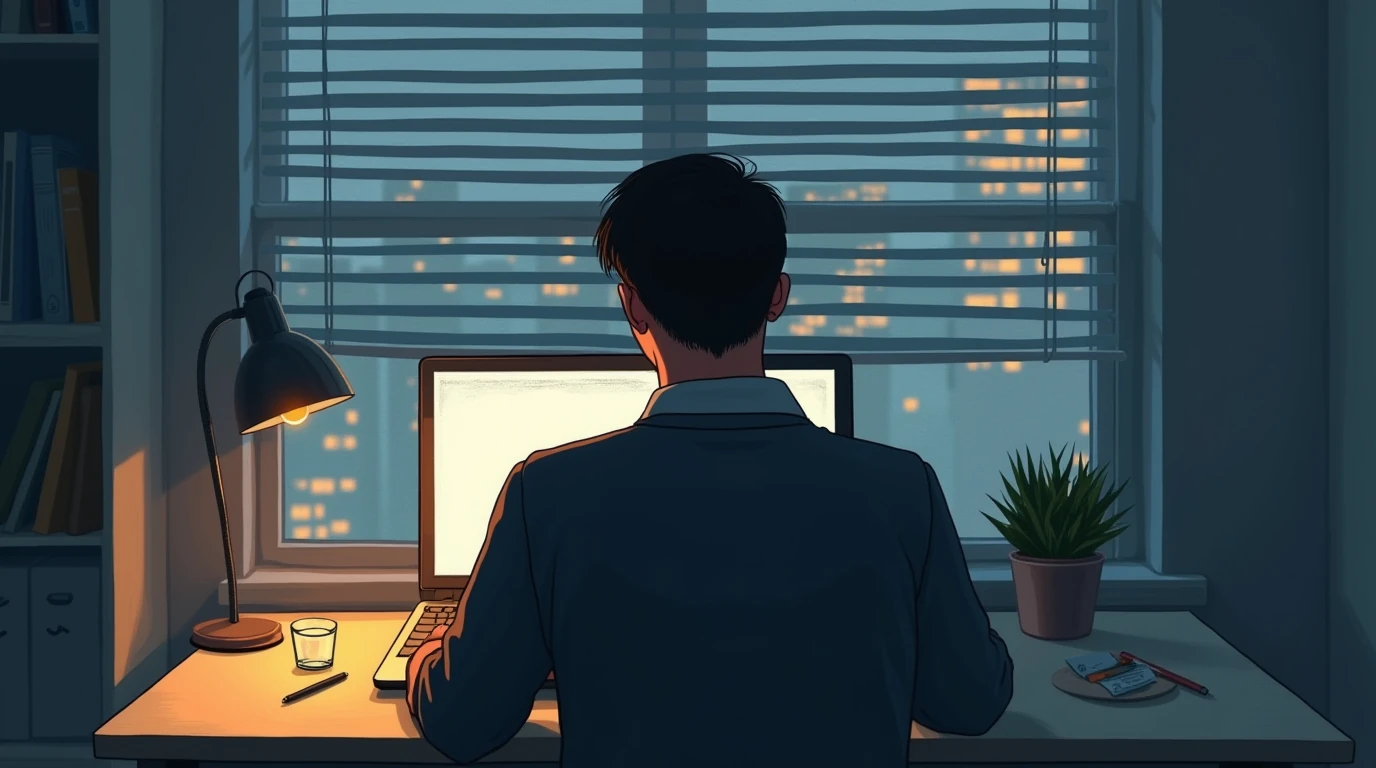
On the third night, I sat at my desk, lights off, only the laptop screen glowing. Streetlight came through the window, cutting the floor into rectangular blocks of brightness.
I said something to the empty room.
My voice was quiet. I wasn’t even sure I’d actually said it out loud, but I heard it—not someone else, me. I said:
“It’s not that it doesn’t lie to you. It’s that telling the truth was never a priority.”
There was nothing in the room.
No response. No one corrected me. No one said “you’re right.” No one said “you’re wrong.”
Nothing.
Just the echo of what I’d said lingering in the air, and then even that fading, becoming another layer of quiet in the room.
I sat in that quiet, trying to memorize the feeling—what it was like to say out loud what I’d been thinking, what it was like to have no one listening—because I suddenly realized I might not have done this in a very long time.
When was the last time?
I couldn’t remember.