Chapter 1
Chapter One: Baseline
Chapter One: Baseline
I. Morning Sampling
05:15. The tide alarm pulls me out of sleep.
Not a regular alarm — I set it myself. Unlike anything else on my phone, it only goes off forty-five minutes before a low-tide window opens. The rest of the time it doesn’t exist. That gives it weight. When I hear it, I know today’s work is the real kind.
I lie on my side in the dark for about three seconds and let my body check itself for pain. Nothing. The old scar on my right index finger shows no new tightness. This is my standard pre-dawn self-assessment, done before getting up, so I don’t discover something halfway to the water.
Ten minutes to gear up. Waterproof jacket, rubber-soled reef boots, neck-hanging dry bag. Waterproof notebook into the bag, two pencils — one backup. Headlamp: confirm charge. Charge good.
Seven minutes from the dorm to the monitoring point. I walk steady — I know this path by feel, and I only drop the headlamp beam down when the terrain shifts at a reef corner to confirm my footing. Dawn is still an hour off, but the wind is already here. Trade winds, northeast, warm, carrying a moisture I can’t quite name — the kind that comes off the sea surface, not rain. After years of living here, skin learns to distinguish the two. The difference is in the depth of a faint, almost imperceptible stickiness.
The reef flat comes into view just as the water recedes to the height I need.
The reef flat at low tide doesn’t look like anything from a city. Exposed by the retreating sea, it has a surface that mixes sandpaper texture with honeycomb geometry — wet, gleaming with coarse scattered light in the headlamp beam. Each pit holds a pocket of residual water. When I crouch down to take readings, the headlamp’s circle reflects off the pooled water — a ring of light, then ripples, and then a small shrimp retreats a step sideways from the brightness.
I write it down. The shrimp’s presence is outside today’s work scope, but I write it down anyway.
(This is a habit of mine: recording irrelevant things. Sometimes the irrelevant becomes relevant a few months later, and I’m glad I wrote it down. Sometimes it never becomes relevant and simply disappears into one page of a notebook. I haven’t calculated the ratio of these two outcomes.)
The sensor is mounted on a tripod, bolted into a drilled hole in the reef, eighteen months in place. I take the readings first — water temperature, salinity, pH, dissolved oxygen. All normal. All within ±1.5 standard deviations of the thirty-day mean. Then I pull the sample tubes from the dry bag and begin collecting specimens in the established quadrats across the reef flat: benthic algae, a few small invertebrates, reef rubble.
The work itself is repetitive. I know this.
Repetition is not a flaw. Repetition is methodology. Species richness trends only become visible in sufficiently long time series, and time series are built from the accumulation of repeated sampling. Each individual sampling run looks tedious. Together, they mean something. I’ve been at this station nearly four years and I’ve explained this principle to every new research assistant who has come through, usually on their third time doing the same task.
Before dawn, the sea is nearly black — that ink-blue that runs so deep the edges blur. When the headlamp hits the water surface, the light doesn’t reflect, it’s absorbed and then scattered, and the whole sea looks textured. I look up once during a break in the work. Then I go back to the samples.
At exactly six o’clock, the first light arrives from the Pacific horizon. Not sudden. Gradual — a dark red seam appears against the black-blue ground, then the red spreads and pushes the deep indigo down, and the sea’s color follows: the ink-blue fades, replaced by something between blue and green that has no exact name. It can only be called “the deep sea in the morning.”
I seal the last sample tube and pack it into the cooler.
Before leaving the monitoring point, I do an environmental log: North Pacific, estimated visibility thirty-plus kilometers, sea state 1, wind approximately eight knots, no rainfall indication, cloud cover approximately 20%. Instrument readings logged. Reef flat overall condition normal. No significant debris. No new anthropogenic waste.
Same as every day. Everything as expected.
II. The Wet Lab
I walk back from the monitoring point, make a loop through the main building, pour coffee.
The sound of the grinder comes from the west end of the kitchen — Melo is in. On this island, that sound performs a certain function of confirmation. Not “the cook is here.” More like: civilization confirmed. Today’s first cup of coffee exists. I’m not entirely sure if the others share this association, but I suspect they do to some degree, or there wouldn’t be so many people naturally drifting toward the kitchen whenever the grinding starts.
I pour the coffee into the blue ceramic mug — the one with the old chip at the base, from when I knocked it against the sink corner in my first year here. The mug didn’t break, just lost a piece. I hold it in my left hand; my thumb fits naturally into the chip. There’s a groundedness to it I can’t explain.
The specimens need preliminary processing: fixation, labeling, sub-sampling. This happens in the wet lab. I set the cooler on the workbench, put on gloves, open the first sample tube.
The wet lab is at the north end of the concrete building, north wall open to a large window that faces the lagoon. The seawater circulation pump runs continuously, producing a low, even hum that layers with the diesel generator at the other end of the building, forming the research station’s constant low-frequency baseline. After years of this, I’ve stopped actively hearing them — I only notice them when they stop. There was a typhoon approach once when the generator went offline for maintenance for three hours. I was unsettled for the entire three hours without being able to say why, moving through every task at half-speed. I realized afterward: it was too quiet.
(Noted in the log somewhere — date to be checked. Those three hours clarified something: I distinguish “normal” through the presence of noise, not its absence. Which means: my ambient environmental awareness is automated, only activating when deviation occurs. This may be a side effect of long-term fieldwork. Or it may simply be me. To be confirmed.)
Processing the specimens took two and a half hours — ten minutes longer than expected, mainly because today’s benthic algae samples from the reef flat were more abundant than last week and required finer sorting. I recorded the discrepancy in the work log: “Benthic algal richness markedly elevated, approximately 15–20% above the same period last month. Requires three consecutive subsequent sampling windows to determine whether this reflects seasonal fluctuation or disturbance response. Hand speed today was high, possibly due to reduced sleep from early sampling — some actions tending toward rhythm at the expense of precision. Note this. Record for later review.”
I have a habit of recording this kind of observation. Not just the external data, but how I’m doing the work. This came from near the end of graduate school — my advisor said that a scientist’s largest source of error is herself, and herself is the hardest variable to control, so better to log it. I found this somewhat philosophical. But the practice is correct. So I log.
The afternoon’s work is mainly data management.
I enter the morning’s readings into the master database, run the standard QC protocols, flag any outliers. Today there are none. Everything within normal range, curves smooth, statistical results consistent with the thirty-day trend.
My colleague from the sediment analysis lab walks in to get his instrument, says nothing. I say nothing. We work in the same space for half an hour, then he leaves with his things. I don’t know where he goes, but that’s outside my need-to-know.
At three in the afternoon, the coral bleaching researcher comes in asking about recent nitrogen-phosphorus ratio data from the reef flat. He needs water quality background data. I tell him which subdirectory in the shared folder. He says thanks and goes.
This is probably the sum total of my contact with other people today.
I don’t feel it’s too little. I don’t feel it’s enough. The question doesn’t really exist for me — this is just how fieldstation life works. Everyone has their own work rhythm. Intersection happens at breakfast and dinner, occasionally in the corridor, occasionally during emergencies. This density suits me. More would be distracting. Less I wouldn’t particularly notice.
(This is a conclusion from long-term self-observation. I’m not sure whether the conclusion is neutral. But recording it is better than not recording it.)
At 5:30 in the evening I set the work aside and go to the main building for dinner.
The dining room has maybe seven or eight people, fewer than usual. A few are on shift, a few are somewhere unspecified. I take a plate of braised fish and rice and sit by the window, push it open a crack — the island nights cool fast, but it’s still light out, and the air outside carries the faint smell of reef rock.
I don’t join any ongoing conversation. I had already walked past by the time I thought about sitting down, and by the time I registered that I could still go back, the topic had changed. This happens to me every so often. The usual result is that I finish alone and leave.
Sometimes I think this is something to work on. Sometimes I think it doesn’t matter. Tonight I have no particular view. I just finish the fish.
III. The Tank at Night
Nine o’clock. I go back to the wet lab.
This is something I’ve added for myself. After the official workday ends, one more visit — cleaning and observation. The tank maintenance manual says weekly cleaning is sufficient. I don’t agree. Algal film grows fast; a few days without cleaning and it will coat the entire glass surface evenly, and then the observation field drops. I don’t like impaired visibility.
The generator’s low-frequency hum is cleaner at night. Daytime has footsteps, instrument operation sounds, occasional conversation — all of that recedes at night and leaves the mechanical baseline. Generator, refrigerator compressor, seawater circulation pump: three acoustic layers stacked together, somewhere between 60 and 80 Hz, one of the most reliable facts about this island at night.
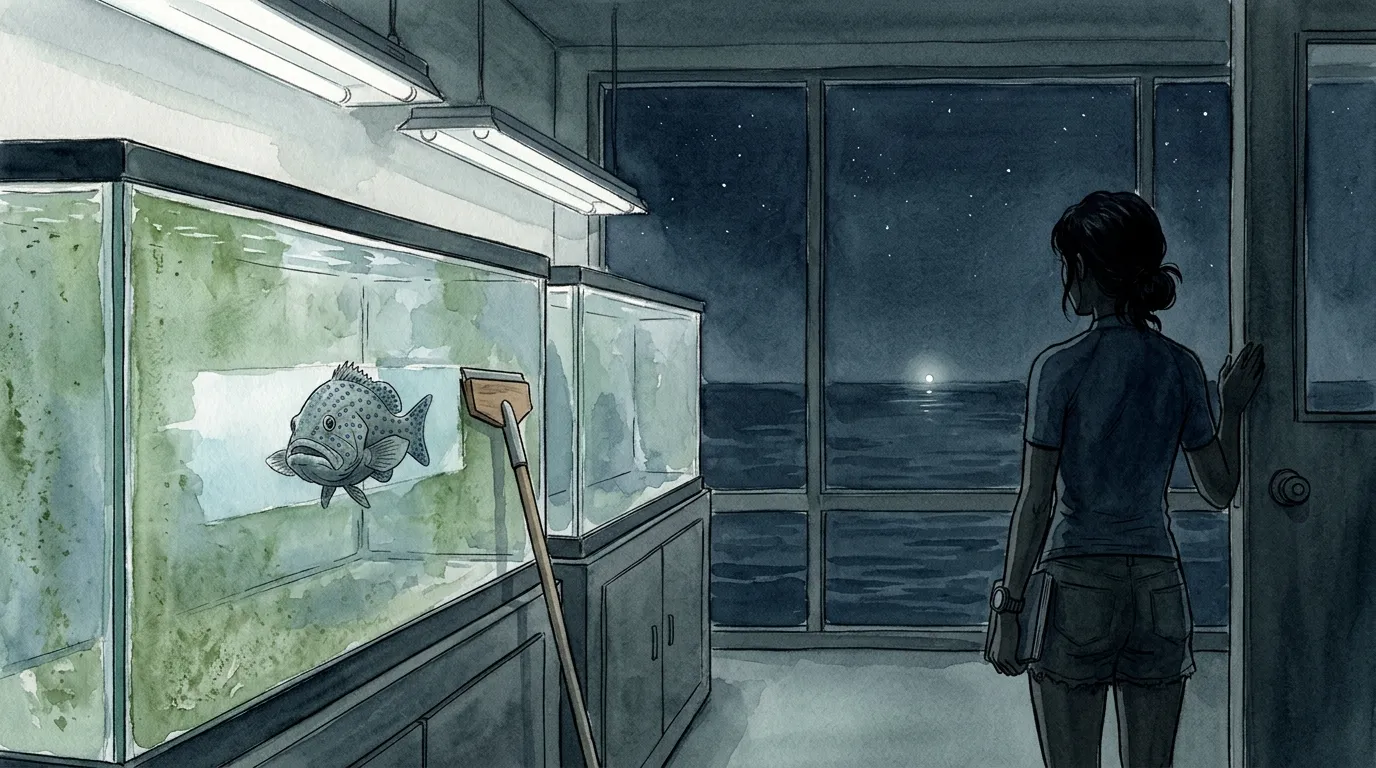
The wet lab lights are industrial fluorescents, bright, with a mild flicker, casting white reflections off the tank surfaces. Three main tanks: leftmost holds the fish specimens, center holds the coral fragments, rightmost holds the mollusks.
I go to the leftmost tank first.
The algae scraper hangs on a hook at the sink to the right of the entrance — wooden handle, rubber blade, about two years of use. The handle has swelled slightly from long-term moisture, which actually makes the grip steadier. I take it down and walk to the tank.
The algal film is an even pale green, thin and uniform, covering roughly two-thirds of the glass. A few days of accumulation, normal rate. I press the scraper flat against the glass, start at the upper right corner, and move horizontally. The sound of the rubber blade on glass is almost nothing — but there’s a slight resistance, and then the resistance is gone, and the glass is clear.
The grouper sees me approach and swims over.
He’s a blue-spotted grouper, approximately thirty centimeters, collected eight months ago. He’s lived in this tank for eight months. I sometimes suspect he’s built a cognitive map of it by now — knows which location produces food, knows that the thing holding the scraper is not a threat. He’s on the other side of the glass right now, about ten centimeters from my hand, staring at me — or staring at the scraper — I can’t confirm which.
I keep scraping.
Midway through, I stop. Through the small cleared section, I look directly at him.
He doesn’t move.
I’m watching him — that’s certain. Whether he knows something is watching him — that I’m not certain of. What is the glass to him? The boundary of the world? A kind of transparent pressure? Or does the glass not register in his perception at all — only light and shadow, only food and non-food, only approach and retreat?
I study population dynamics, not individual cognition. This question is outside my research scope. But I thought of it, so I write it down.
I don’t follow the thought further, because the other two tanks still need doing. I bring my attention back to the scraper and resume the horizontal movement. Right to left, then down a row, left to right.
The whole process takes about twenty minutes.
After: I log. Algal coverage rate, cleaning time, water temperature (27.4°C, normal), grouper activity status (normal, no abnormal behavior). The log is routine, the format is fixed, and every field has its corresponding meaning.
I close the notebook and set it on the workbench.
Industrial fluorescents white over the three tanks. Seawater circulation pump humming. Generator providing stable power from the other end of the island. Everything is what it’s supposed to be.
Before leaving, I always take one last look through the glass.
This is a closing gesture — nothing to do with work. More like confirming the work is finished and I can go. The grouper has retreated to the center of the tank and is ignoring me. In the coral fragment tank, a few small bubbles are drifting up from the coral surfaces — evidence of symbiotic algae still photosynthesizing, or residue from photosynthesis that just ended; in this light I can’t determine which.
I turn to leave.
At the doorway, I do what I always do: glance toward the window. The north wall, the large window that faces the lagoon. Outside is the sea at night, no moon. The lagoon surface under starlight has a low-density reflection, brighter than true darkness, but not by much.
I look for about three seconds. Ready to keep walking.
Then a light appears on the water.
Not wave-glitter. Not a distant vessel — there are no inhabited islands within sixteen hundred kilometers of this station, and regular shipping lanes don’t pass through here. The light is on the ocean side of the lagoon, in the direction of open water, maybe three to four kilometers away by eye. Steady. No flickering. No movement.
I stand in the doorway and watch it for about ten seconds.
Water temperature data: normal. Today’s instrument readings: normal. Reef flat sampling: normal. Everything logged, everything within the mean range.
On the last page of my field notebook, below all the day’s records, I add one line:
“22:47. Open water beyond the lagoon. One steady light. Estimated distance 3–4 km. Observed for 10 seconds. No movement. No flickering. Nature of light source: pending.”
I put the notebook back in my pocket, walk out of the wet lab, and turn off the lights.