Chapter 2
Chapter Two: The Record
Chapter Two: The Record
I. The Monitoring Point
It takes me about five minutes to walk.
Out the wet lab’s north door, left turn, along the gravel path at the north end of the reef flat, through a stretch of naupaka, to the edge of the reef platform. I know this path. I’ve walked it at night before. I don’t keep the headlamp pointed down the whole way — only at the rocky corners, where the terrain shifts and I need to confirm my footing.
I’m thinking about the light the whole way there.
Not “thinking” — more precisely, I’m reconstructing the observation. I saw it through the north wall’s large window, angle from interior looking out, through glass, restricted sightline. I had no way to confirm bearing from that position. The light was steady, no flickering, on the ocean side of the lagoon, roughly north of the outer reef flat. I need the monitoring point for an accurate bearing.
That’s what I’ve confirmed during the walk.
I haven’t thought about anything else.
(That’s a lie. I’ve also been thinking “what if it’s gone when I get there,” and “what if it’s still there when I get there.” I don’t have an answer to either question, so I put them in parentheses and keep walking.)
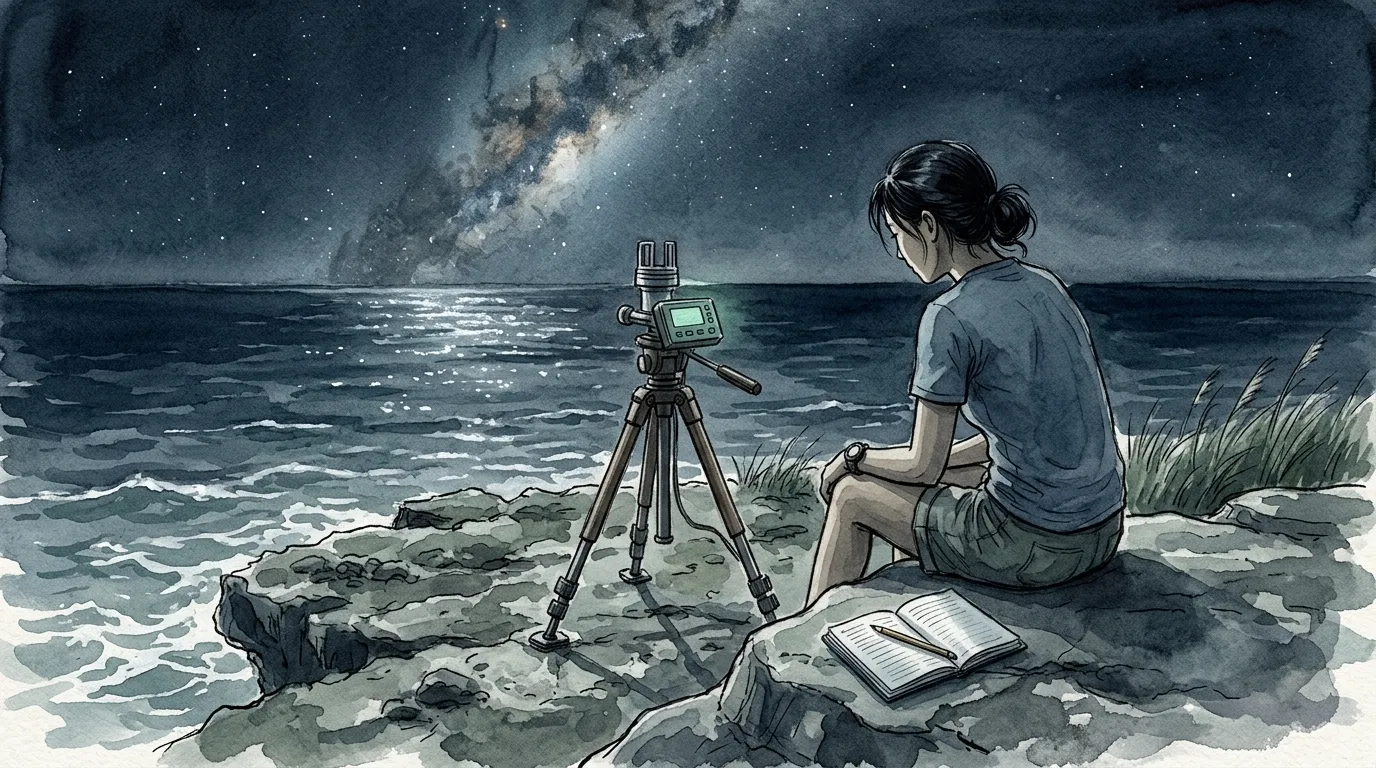
The trade winds are blowing. Northeast, warm, carrying moisture evaporated off the sea surface. No moon, but the Milky Way is clear — at Palmyra, with no ground-based light pollution, the Milky Way is ordinary, not exceptional. I’ve long since stopped noticing it. Underfoot, the reef flat gradually shifts from sand to reef rock, the rock surface showing a grayish-white dry pallor in the headlamp beam, coarse and porous.
The monitoring point.
I stand at the north edge of the reef platform, put the headlamp into my bag, and wait for my eyes to adjust to the dark.
About thirty seconds. Then the sea surface takes shape before me.
The wave sound from the direction of the outer reef is low-frequency — like distant muffled thunder, regular. The wind is constant. The sea is black, holding a low-density reflection in the starlight, the same as what I saw from the wet lab window: brighter than true darkness, but not by much.
East-northeast. Five hundred to eight hundred meters out.
Nothing.
I stand there and sweep my gaze along the sea surface from left to right, then right to left. Nothing. No light, no abnormal brightness or shadow, nothing on the sea surface that shouldn’t be there.
Then I hear something.
— No. I don’t hear something. I hear the absence of something.
The generator’s constant low-frequency baseline, audible from this distance on a normal night, a faint undercurrent, like the island’s own pulse — somewhere between 60 and 80 Hz. It’s still there. I can still hear it. But the tone is off. There’s a slight shift in the frequency I can’t quite name, like someone at a far end has nudged a dial just a fraction — the difference is almost nothing, but it’s there.
I stand and keep listening.
About thirty seconds. Then the tone returns to normal.
I’m not sure whether what I heard was real, or whether my ears have started looking for things to hear in the quiet of this night. Two possibilities, and both require documentation. I switch the headlamp back on, take the waterproof notebook from my bag, open to a new page, and write:
“23:04. Monitoring point. Suspected audible voltage micro-fluctuation. Generator baseline frequency showed brief, slight variation, duration approx. 30 sec., then returned to normal. Subjective perception only — no objective instrument confirmation. Auditory error not excluded. Light: visual search, no finding.”
I pause, then add a line below:
“Light previously sighted (22:47, wet lab north window, observed for 10 sec.). Arrival at monitoring point approx. 23:04. Elapsed interval 17 min. (walking approx. 5 min. + notebook retrieval and preparation approx. 4 min., remainder for condition assessment). Light absent during this interval, or moved to non-visible position, or is a non-persistent phenomenon.”
I close the notebook and look up.
The sensor on the tripod is still in place, fixed in the drilled hole in the reef — I last serviced it three days ago. The digital display panel gives off a faint green glow in the dark. I walk over and crouch to read it.
Water temperature: 27.3°C. Salinity: 34.9 ppt. Voltage reading: main circuit showing slight fluctuation, within 0.2%.
I add this to the log, then look up.
The sea is still nothing.
Then, in the east-northeast direction, below the sea surface.
Something falls in.
I can’t see it — in that direction the sea surface looks the same as everywhere else, black, holding starlight — but the sensor reading has, in that instant, a very brief deviation: 0.1%, practically at the edge of the instrument’s measurement error. I watch the display panel, see the deviation appear, then watch it return to baseline.
About two seconds total.
I stand there and don’t move.
The generator baseline is still there. The trade winds are still there. The low-frequency impact of the outer reef waves is still there. The sea is black.
I open the notebook and write: “23:06. Voltage reading deviation. Amplitude 0.1–0.2%. Duration approx. 2 sec., then returned to baseline. Deviation direction: east-northeast — consistent with observed bearing of light. Single data point. Insufficient for viable hypothesis. Instrument error cannot be excluded.”
Then I stop, pencil in hand.
After the phrase “insufficient for viable hypothesis,” I want to add something. I don’t add anything.
II. The Record
I decide to stay at the monitoring point and make a complete record.
The decision was between walking back to get equipment and staying where I am to keep observing. I choose the latter. The instruments are already here, the angle is established, any new reading deviation can be captured in real time. Walking back to the main building means losing this window.
This is a professional judgment. I trust the judgment.
(There’s another reason, held somewhere else in my mind, that I don’t write in the notebook. The reason is: walking back means facing other people, and right now I’m not sure what I have to tell other people. A reading deviation, once, at the edge of measurement error, non-repeatable. At best, a single observation — far short of a report.)
I set the sensor on the tripod to continuous recording mode, set to log every thirty seconds, then sit on a reef rock to the east — the one that rises about fifty centimeters above the others, high enough to observe the sea surface from a better angle — spread the waterproof notebook on my knees, and begin a full record.
22:47. First sighting. 23:04. Arrived at monitoring point. Visual search, no finding. 23:06. Voltage reading deviation, amplitude 0.1–0.2%, duration approx. 2 sec.
I continue.
Optical observation: east-northeast direction, from 23:04 to present, no anomalous visual features on sea surface. Clarity good, visual range estimated 30+ km. Star conditions: good (no moon, Milky Way clear, visibility high).
EM readings: sensor voltage, baseline stable, occasional micro-fluctuation of 0.1–0.2%, irregular intervals, no clear pattern.
I stop at the words “no clear pattern.”
Then, on the line below, I start a new line in slightly smaller writing:
“Readings consistent — no spikes, no abrupt drops, no deviation pattern exceeding measurement error. If you plotted tonight’s readings, they would look nearly identical to any normal night in the past thirty days.”
I stop at the word “nearly.”
“Consistent.”
I pause on “consistent” for a moment, not sure if that’s good or bad.
In my work, “consistent” is normally good. Consistent data means a stable environment, means my measurements are reliable, means samples collected today can be compared to yesterday’s, last month’s, the same period last year — means the time series is meaningful. I’ve been doing research at Palmyra for nearly four years, and “consistent” is what I’ve been after. It’s the foundation. It’s the justification.
But now, facing this particular consistency, I have a feeling I can’t articulate in technical terms —
I don’t keep writing.
I keep making the record.
Water temperature: monitoring point sensor, 27.3°C, 0.1°C from the seven-day mean, within normal seasonal variation range. EM readings: see above, slight fluctuations persist, no pattern, no spikes, overall at the error margin. Acoustics: outer reef waves, regular, no significant change in frequency or amplitude compared to recent readings. Generator baseline: see above, the slight tonal variation noted, currently returned to baseline.
After finishing the electromagnetic readings section, I add a parenthetical line in the notebook:
(Recording physiological state: I notice my breathing has accelerated. Heart rate approximately 90–95, estimated by palpating the carotid artery with my fingers, measured twice, results consistent. Slight tremor in the hands — primarily in the left, since I hold the notebook with my left and write with my right, so it’s the slight tremor in the right hand that affects writing precision. I assess the effect on measurement accuracy: may cause unstable handwriting in recorded readings, but does not affect the readings captured by the electronic sensor. This physiological state may affect my observation judgment — I’ve noted it here for later reference.)
Then I continue recording external data.
I stay at the monitoring point for about forty-five minutes.
During this time, the readings hold in what I’ve described as that “consistent slight fluctuation” pattern — not completely flat, but no single reading exceeds 0.3% of normal measurement error. Nothing visible appears on the sea surface.
At around 23:40, the voltage reading shows a second brief deviation, amplitude close to the first, lasting about a second and a half. I note it in the log.
23:41. Deviation gone.
I sit on the reef rock and look at the sensor’s display panel, then raise my head and look at the sea surface once.
Nothing.
Everything on the record.
I have a complete observation log: two voltage reading deviations, timestamps, amplitudes, durations, all noted. Visual search: no finding. Acoustic record: generator baseline slight tonal variation, returned to baseline. Physiological self-monitoring: elevated heart rate, slight hand tremor, on the record.
This is an adequate observation log.
I take one last look at the sea surface and stand up.
Wake Takeguchi.
III. The Director’s Door
Main building dormitory corridor, far end.
Takeguchi’s room is the sixth one, deepest into the corridor, the side closest to the generator. I walk over, pause for a moment outside the door, then knock twice.
Silence.
I wait ten seconds, then knock twice more.
“What is it.”
The voice is alert — not the kind of hoarseness that comes from being woken up. He may have been awake to begin with, or he’s the kind of person who’s fully conscious in a second.
“Takeguchi-san, there’s something on the water.”
Silence.
That silence wasn’t him preparing to speak — he was making sure he’d heard correctly.
“Is it a whale?”
I pause.
“Not a whale.”
“Sea turtle?”
”…Not a sea turtle.”
“Then it can wait till morning.”
“I’m not entirely sure morning is still useful.”
Another silence. This one longer than the ones before — about five seconds. I stand outside the door, listening to the low-frequency baseline coming from the generator at the end of the corridor, and count five beats.
Then the light comes on.
Light seeps through the gap at the bottom of the door, and then the door opens. Takeguchi comes out in work trousers and a worn collared T-shirt, a small flashlight in hand, hair uncombed — but his eyes are alert, the kind of alert that doesn’t need time to come into focus. He looks at me, then glances down at the notebook in my hand.
“Go ahead.”
I do.
I open the notebook and start from the first sighting — 22:47, wet lab north window, the light, steady, ten seconds, no flickering, no movement. Then the walk to the monitoring point, then the visual search with no finding, then the voltage reading deviations, two of them, timestamps, amplitudes, durations. Then the parenthetical with the physiological self-monitoring.
I speak at an even pace — I’m used to this, because an uneven pace influences the listener’s emotional assessment, and emotional assessment is not what I need Takeguchi to be doing right now. What I need from him is to look at the data and determine next steps.
He listens without asking anything, looks at the notebook in my hand for about three seconds, then says:
“The voltage fluctuation was 0.2%.”
“Yes.”
“Within instrument error range.”
“Yes.”
“You’ve confirmed the sensor’s calibration status?”
“Serviced three days ago, readings normal. Confirmed again before tonight’s log.”
He nods, holds a silence for a moment, then says:
“The light lasted ten seconds.”
“Yes. Before writing it down I estimated seven to ten seconds. I took ten as the conservative figure.”
“You didn’t take a photograph.”
Not a question.
“Insufficient light, phone in the dorm, insufficient time to decide,” I say. “I judged that getting the notebook took priority over going back for a camera.”
He doesn’t respond to the judgment, doesn’t deny it either. He turns; somewhere further down the corridor, a dormitory room, someone coughs lightly — a person who sleeps lightly. He lowers his voice:
“Where’s Melo?”
“Kitchen. The grinder —” I pause, do the math, ”— he usually wraps up around two in the morning. It’s now” — I check my watch — “23:52, so he should still be in.”
The kitchen light is on.
Melo is at the worktop at the back of the kitchen, an open binder in front of him — looks like an inventory list or shift schedule — a half-finished cup of tea beside his hand. He looks up when Takeguchi and I walk in, his gaze moving between us once, then settling on my face.
“What happened?”
I go through it again, shorter this time. The light, the monitoring point, the voltage fluctuations, the readings, two deviations.
Melo listens without interrupting. When I finish, he turns and looks at the small north-facing window at the back of the kitchen — that angle faces the back of the main building, no view of the reef flat, no view of the sea, only darkness. He turns back and says:
“Doesn’t look like anything I’ve seen before.”
He says it without any stress on any particular word, the way he’d confirm a stock count. Calm, direct.
Neither Takeguchi nor I say anything.
Melo sets down his tea and says: “What do you need? Recording equipment? Backup power?” He thinks for a moment, then: “I topped up the generator yesterday, supply’s fine. Backup power is second row on the north side of the warehouse — charge status confirmed last week.”
He stands up, thinks again, then says: “Has anyone eaten anything?”
“I’m fine,” I say.
He takes my answer and moves past it, doesn’t follow up, turns to the coffee machine, takes a cup, pours manually, then turns and hands it to me.
I take it.
“Have you eaten?” he asks.
I think for a moment.
Tonight’s dinner. I had braised fish and rice in the dining room. After that, back to the wet lab, cleaned the tanks, then saw the light, then walked to the monitoring point, then walked back to get Takeguchi, then now.
“Yes,” I say. “Earlier. Around dusk.”
He nods, no comment, turns off the coffee machine, faces Takeguchi: “I’ll go pull the backup equipment over. You’ll be at the monitoring point?”
Takeguchi says: “Communications first.”
IV. Iridium
Takeguchi’s station director office has two Iridium satellite phones — one his personal unit, one the station’s official spare. He takes the official one from the desk drawer, confirms the charge, slides back the protective cover, powers it on.
About thirty seconds to boot.
“Who can we reach at this hour?” I say from the doorway.
“NOAA Pacific Islands Research Center has an emergency line,” Takeguchi says, not looking up, his fingers pausing on the keypad. “Coast Guard District Fourteen. I’ll try NOAA first — they have twenty-four-hour duty.”
He dials.
Silence, then the thin chirp of a satellite connection establishing — not like a landline. About ten seconds. Then the other end picks up.
Takeguchi speaks. English, even pace. States his name and position, then the research station location, then “non-emergency but requiring documentation,” then a basic account of the event — Qín Sīyù’s name, the time of the sighting, the voltage reading deviations, two of them, the bearing.
I stand in the doorway and listen.
Whatever the person on the other end is saying, the voice is too low for me to make out words — I catch only the tone, the flat professional tone of a duty officer, no alarm, no particular weight, no dismissal either. Then a few seconds of silence.
Takeguchi says: “Understood. We’ll wait for your confirmation.”
He hands me the phone.
I take it, and run through what was just reported again, because they need it directly from the witness, not second-hand. I say: 22:47, wet lab north window, steady light, no flickering, no movement, ten seconds, estimated three to four kilometers, ocean side of the lagoon, east-northeast. Arrived monitoring point 23:04, visual search negative. 23:06 and 23:40, one voltage reading deviation each, amplitude 0.1 to 0.2%, duration one to two seconds, then returned to baseline.
The duty officer asks two confirmation questions. I answer them.
Then the duty officer says: “Please stand by, need to verify procedure.”
I say: “Understood.”
Then the line goes quiet.
That’s the silence of being put on hold — behind it, a very faint satellite noise, like the white noise of open ocean. I’m standing in Takeguchi’s office, night outside the window, office lights inside, my hand holding the Iridium phone, waiting.
About forty seconds.
Then the line cuts.
Not on hold — cut. Then silence. Then the phone screen returns to the basic display.
I lower the phone from my ear and look at the screen.
“Call Ended.”
I set the phone on the desk and stand there.
Takeguchi is looking at me.
“It dropped,” I say.
“Call again?” he says.
I think for a moment, say: “Wait five minutes first. See if they call back.”
My own phone is in my pocket, the Iridium is on the desk, and I stand there and wait five minutes. Takeguchi stands on the other side of the office, not speaking, just waiting. Five minutes pass. No incoming call.
Then something occurs to me.
Before the duty officer said “please stand by, need to verify procedure,” I had given all the readings, all the timestamps — but had I described the light itself clearly enough? Not a fishing vessel, not an atmospheric phenomenon — had I said that part?
I reconstruct the call in my head. I said the distance, I said the bearing, I said the duration, I said “steady, no flickering, no movement.”
“No flickering, no movement” is a description of properties. It’s not an explanation.
Did I say “not a fishing vessel”?
I didn’t say that.
Did I say “not an atmospheric refraction phenomenon”?
I didn’t say that either.
I gave an incomplete description. The duty officer said “stand by,” then the line dropped.
Why the line dropped — there are several possible explanations. Technical issue, procedural issue, the duty officer deciding to escalate to a superior and losing the connection midway. None of that is what I’m concerned about.
What I’m concerned about: did I say enough? Did they understand?
I look at the Iridium on the desk. The screen has gone dark — battery save mode.
Who exactly did I just reach.
Takeguchi says, beside me: “Write it down first. Try again in the morning.”
I nod, take out the notebook, and write on a blank page:
“00:12. Iridium call, NOAA Pacific Islands Research Center, duty officer, filed basic event information report. Response: ‘need to verify procedure.’ Approx. 40 sec. later, line disconnected, reason unknown. No return call received.”
Then below that, a parenthetical:
(To confirm: whether call content was complete — whether the other party understood the nature of the event, not only the readings.)
I close the notebook and put it in my pocket.
The office light is on. The generator baseline is steady. Night outside the window. The sea surface in the direction of the monitoring point, five hundred to eight hundred meters out, fifteen to twenty-five meters below the surface, there is something.
It hasn’t moved.
It hasn’t responded.
It isn’t sending any signal.
It’s just there — readings “consistent,” consistent enough to be explained by instrument error, consistent enough that I’m not sure I can tell anyone right now “this is real.”
But I was there. I saw it. The readings are there.
I’m in this building’s director’s office, holding a waterproof notebook full of tonight’s observation data, and my hands have stopped trembling — or the amplitude of the trembling is smaller than it was an hour ago, which is also worth noting — and I think for a moment, then open the notebook again and, at the very bottom of the most recent page, add one line:
“23:52, reported to Station Director Takeguchi. 00:03, Melo informed. 00:12, NOAA call, result unconfirmed. Current status: three people know. Remaining station personnel unaware. Next call attempt 06:00.”
Then I close the notebook. Really close it.
From the corridor side, Melo’s footsteps come from the direction of the kitchen, then head toward the warehouse — probably to get the backup power he mentioned.
I glance at the clock. 00:18.
The date hasn’t turned yet, but it will any moment now.