Chapter 3
Chapter Three: The Window
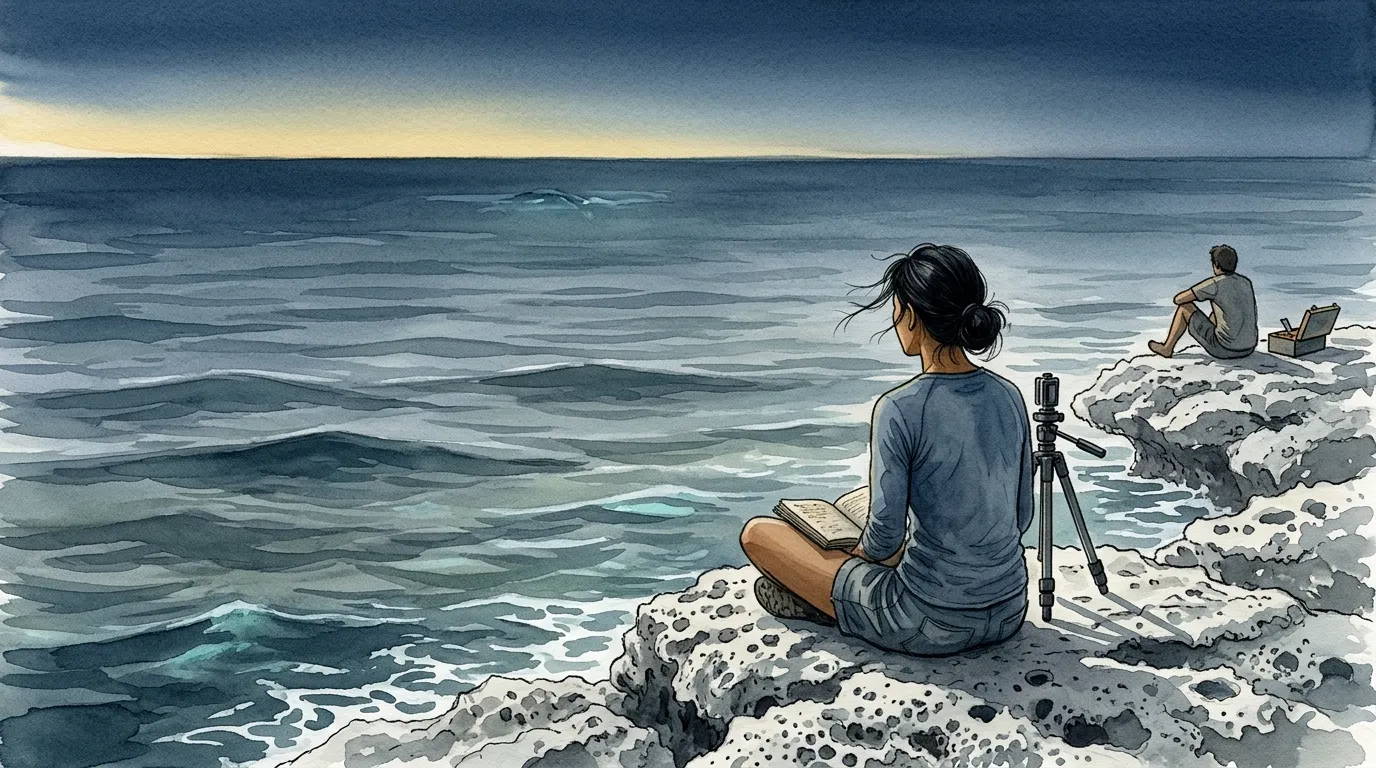
Chapter Three: The Window
I. The Full-Station Meeting
05:47. Takeguchi’s voice comes through the corridor intercom: “All hands, dining room, fifteen minutes.”
The voice itself is calm. The act of using the intercom is not. He doesn’t normally use it — calling down the hallway is enough for a twelve-person station, and sound carries a long way through concrete. The intercom means he doesn’t want to walk room to room looking for people. It means he needs everyone. It means he’s preparing to say something formal.
I’m already in the dry lab at this point, at my workstation, looking at last night’s voltage graphs.
I’m waiting to try the NOAA call again at 06:00. Right now it’s 05:47. Thirteen minutes.
After the intercom, I hear footsteps in the corridor — sandals, flip-flops, someone running past in thick-soled sneakers. The sounds of lives, but not at the rhythm you’d hear before an ordinary breakfast. This hour is normally quiet, most people still in bed. The fact that there’s movement now means the intercom woke some of them, and they’re heading to the dining room still not quite ready for the day.
I save a copy of the voltage graph, close the screen, and walk to the dining room.
The dining room is at the west end of the main building.
Less than twenty minutes after the intercom, everyone has gathered. A few people are holding coffee mugs. A few have damp hair. Priyanka is leaning against the wall outside the kitchen, one elbow propped on the surface, her expression the kind that hasn’t decided yet what today’s expression is going to be — I can’t tell if she’s just woken up or fully awake.
Takeguchi is standing in front of the two long tables, to the side near the whiteboard.
He says: “Something happened last night. I need everyone to know.”
Then he tells us.
His account is brief. Late last night, the monitoring point sensor recorded two voltage reading deviations, at a location on the outer reef flat in the east-northeast direction, amplitude at the edge of instrument error, cause currently unknown. Additionally, at 22:47 last night, researcher Qín Sīyù observed an unidentified point of light through the north window of the wet lab, bearing consistent with the direction of the voltage deviations, which disappeared after ten seconds. The NOAA call has been attempted, the connection dropped, will try again this morning.
I’m standing near the door on the far side of the dining room while he speaks. I don’t look at anyone else.
Then he says: “Per protocol, I’ve decided to initiate a Level 2 safety assessment today. This doesn’t affect routine work for now. I’ll update everyone after communications are confirmed. If anyone wants to see the observation records, they’re with Qín — let me confirm that with her first —” He turns and looks at me. “Is that all right?”
“Yes,” I say.
He turns back. “During the assessment period, anyone going outside needs a partner, and everyone must be back inside the main building before dark. Those are the only two rules for now. Questions, come find me.”
He stops. Doesn’t say “any other questions.” Doesn’t say “dismissed.” Just lets the silence stand for a few seconds, then steps away from the whiteboard and walks toward the station director’s office.
After the silence ends, the dining room fills with sound.
“If the voltage deviation was within error range — does that even count as a real anomaly?”
This is Lu, the tidal current researcher. He likes asking questions that can be answered with numbers.
I say: “Two deviations, consistent bearing, interval of approximately thirty-four minutes, direction matching the visual sighting. Looking at the numbers alone: within error range. Looking at the pattern: there’s a common directionality worth documenting, but no causal relationship can be confirmed at this point.”
He nods. The answer seems to be enough for him.
Over by the coffee machine, two people are talking — voices low, I can’t catch all of it, only: “is that kind of light sighting common?” and “probably an atmospheric phenomenon” and “it’s not like strange things don’t happen here.” I don’t plan to join any of those conversations. Not because they’re wrong, but because what they’re saying isn’t yet at the core of the problem — and the core of the problem can’t currently be described in the language available in this dining room.
Melo is on the kitchen side, pulling out the breakfast materials — oatmeal, fruit, the leftover fried rice from yesterday. His back is to everyone, but the set of his shoulders is loose, not tight. He knows. He’s already processed it. He’s on the next step.
I check the clock.
05:59.
One minute, and I need to try the NOAA call.
I walk toward the dining room door.
At that moment, Priyanka moves in close — not blocking my path, just close enough to talk without raising her voice.
“Qín,” she says. “Last night — you were there.”
“Yes.”
“Were you scared?”
She asks it the way you ask something you’ve already thought about for a while, waited until you were sure you wanted to say it out loud.
I pause. Think about my observation log from last night, think about the physiological self-monitoring in the parentheticals.
“Heart rate elevated. Slight hand tremor,” I say. “Both are recorded in the observation notes.”
Priyanka is silent for one second.
That second has weight — it isn’t waiting for me to go on, isn’t deciding how to respond. It’s a second where something crosses her face and I don’t catch what it is.
She says: “Thank you.”
Then she turns and walks back to her seat.
I stand in the doorway, think about what I just said, don’t find anything wrong with it, then check my watch.
06:00.
I walk out of the dining room and head to the station director’s office.
The NOAA call connects this time, but there’s no new information.
The duty officer says the event record from last night has been logged, currently classified as “pending-verification anomalous observation event,” to be forwarded to the relevant department for assessment, timeline uncertain, follow-up contact to come.
I ask: “Is last night’s call fully on record?”
The duty officer says: “Yes, the content before disconnection is in the system.”
I say: “Cause of the disconnection?”
The duty officer says: “Technical issue. I can’t confirm from here, but the record is complete.”
I ask two follow-up questions, confirm the record number, confirm how follow-up contact will come. Then end the call.
Takeguchi is in the office. He waits for the call to finish, then says: “Result?”
I say: “With them. Timeline uncertain.”
He nods, holds a silence, then says: “They’ll send people. First a consultant, then we’ll see. It’s procedure — I’ve been through a few calls like this. Whenever there’s an unexplained phenomenon to report, someone ends up coming out.”
His tone is flat. The tone of stating an established procedure, not of saying something that requires special handling on my end.
“Timeline?” I ask.
“Hard to say,” he says. “Could be days, could be longer — depends how they classify it. Right now the question is this forty-eight hours. Communications are still up. The window is still open. Is there anything you want to continue doing?”
He says it as a professional question. Not a suggestion, not an instruction.
“I want to go back to the monitoring point,” I say.
He looks at me.
“Keep recording,” I say. “The next forty-eight hours — communications still up, no one’s here yet. Before this window closes, it’s the only window I have.”
Takeguchi is silent for about three seconds.
“Outside with a partner,” he says. “That’s the rule I just announced.”
“I know,” I say. “I’ll find someone.”
He says: “Fine.”
Then he looks back down at the work on his desk. That’s his way of ending a meeting.
II. The Monitoring Point
Melo is willing to come with me.
He doesn’t ask why. I say “I need someone to come out to the monitoring point,” he says “give me a minute to finish the breakfast pots,” and ten minutes later he appears at the main building’s north door with his own water bottle and a small backpack.
We walk along the north end of the reef flat, through the naupaka.
About three minutes in, Melo says: “That light you saw — you said it lasted ten seconds.”
“Yes.”
“Have you seen anything like it before?”
“No.”
“Neither have I,” he says, the way you confirm something you already know.
After that he doesn’t say anything else, and neither do I. We reach the monitoring point. In the morning light the reef platform is pale gray-white, dry, rough surface, the sensor tripod standing at the north edge, display panel facing me.
I take the readings first.
Water temperature: 27.2°C, slightly lower than last night. Salinity: 34.9 ppt, normal. Voltage: baseline steady, 0.0% deviation.
I write the readings in my notebook, then raise my head and look out at the sea.
East-northeast. Five hundred to eight hundred meters. Below the surface.
Nothing. Nothing is correct — it was never visible. The readings are the faint trace at the edge of measurement error; that’s the visible part. The sea surface is the invisible part. Neither one changes.
I sit down on the reef rock, spread the notebook across my knees, set the sensor to continuous recording mode.
Melo settles on a reef rock slightly behind me and to the side, takes a drink from his bottle.
“You’re not leaving,” he says.
“Forty-eight hours,” I say. “Communications still up, no one here yet — before this window closes, I want to keep recording.”
“And then after they arrive?”
I think for a moment.
“I don’t know,” I say. “Depends how they classify what this is.”
Melo is quiet a moment, then says: “You sound like you’re talking about a tidal forecast.”
“Pretty much,” I say. “Both depend on an external timeline.”
He doesn’t press further. I go back to the record.
I sit at the monitoring point for about two hours.
During this time the readings hold in last night’s pattern: not entirely flat, but no deviation exceeding the error margin, no spikes, nothing that could support a hypothesis. The sea surface holds nothing. Trade winds steady, outer reef swell low-frequency, a bird calls from somewhere at the other end of the reef flat — distant.
Around the forty-five-minute mark, the readings show one micro-deviation — 0.1%, lasting about a second, then back to baseline.
I note it down, and keep waiting.
Melo is behind me. He has his own task — I notice later that he’s pulled a small plastic case from his backpack, reef-flat sampling gear inside, parts that need maintenance. He works quietly. Not interrupting me, not leaving. This is Melo’s way of being present: create the conditions that let you keep working, without explaining why.
At the end of the first hour, I write a line in my notebook:
“Cumulative observation: T+7h (zero point at time of sighting). Voltage deviation pattern holding, one new entry (T+6h45m). No visual signal. Reading character: ‘consistent.’ No significant difference from last night’s record.”
I stop and look at the word “consistent.”
In my marine biology work, consistency is one of the markers of a healthy ecosystem — stable population numbers, stable appearance rates for indicator species, environmental parameters within expected variation ranges: all of that counts as consistent. I pursue consistency, record it, use it to judge whether a reef ecosystem is still functioning normally.
Now this “consistent” points not to a reef ecosystem but to something I cannot describe. Its only observable characteristic is “same as the last observation, same as the one before that, same as the one before that.”
I’m not sure this means healthy.
I’m not sure it means unhealthy either.
I keep recording.
At the two-hour mark, Melo stands up and says: “It’s noon. Let’s head back.”
I glance at my watch. 11:23.
“One more minute,” I say. “I want to check whether the sensor’s recording frequency has drifted.”
“You serviced it yesterday.”
“Yes,” I say, “but if last night’s deviation affected the recording frequency baseline, today’s data will have a systematic offset.”
Melo looks at me, apparently confirming something he already knew, then says: “Fine. Tell me how many minutes.”
“Ten minutes.”
He sits back down, takes a drink.
I spend twelve minutes confirming the sensor frequency is stable, log it in the notebook, then stand up.
“Done,” I say.
He stands, shoulders his backpack, says: “Let’s go.”
We walk back to the main building, through the naupaka, along the reef flat path, seven minutes.
III. Night Communications Restriction
The research station enters semi-restricted status at around T+8h.
Takeguchi doesn’t make a formal announcement — he posts a handwritten sheet of A4 on the afternoon notice board: “VSAT Bandwidth Adjustment Notice: personal use internet (entertainment, family communication) moved to the 18:00–21:00 window. Other hours reserved for work communications for now. Specific arrangements subject to comms status.”
The format is the standard station-director font — he writes with the kind of evenness where every stroke lands in the right place, even for a casual notice tacked to the corridor whiteboard.
I read the notice, then walk to the dry lab.
The workstation is on, the air conditioning running, the compressor hum steady.
I’m at the first workstation, pulling all the voltage graphs from last night through this morning into a single folder: timestamps, deviation amplitudes, durations, baseline state before and after each reading. Every entry annotated, every anomalous point noted with observation conditions (weather, instrument status, operator position).
This is not yet a report. But it’s structured. Someone else could read it. It doesn’t depend on my memory or my interpretation.
I upload the folder to the station’s shared server, then draft a work summary for Takeguchi — placed at the top of the observation records folder so he can see the key numbers without digging through all the raw data.
After that, I open the VSAT upload tool, compress today morning’s raw sensor data, and queue it for upload to the NOAA data archive. This is routine — I upload once a week, on schedule, regardless of comms status.
But today comms status has changed.
The upload progress bar appears, then starts moving. Much slower than usual. Far more than twice as slow. The bar sits between 0% and 1% for a long time, then jumps to 2%, then stalls again.
The air conditioning compressor hums.
I stare at the progress bar and estimate the upload time: at this rate, today’s file will take two to three hours. Normal is fifteen minutes.
I don’t cancel it. I let it keep going.
The progress bar stalls at 3% for a long time.
I sit at my workstation and think about several unrelated things.
I think about Priyanka’s “were you scared?” this morning, and the physiological data I answered with, and the one second of silence. What was in that second, I still can’t say. Maybe a gap between what she was expecting and what I said — but where the gap is, what its nature is, I have no observational data.
The progress bar jumps from 3% to 4%.
I think about the grouper in the wet lab tank. About feeding.
I feed him every evening at a fixed time, within a twenty-minute margin, a habit I’ve kept for nearly four years. When I’m away, a research assistant covers the feeding, also at a fixed time. The fish’s behavior sometimes shifts a few minutes before feeding — clustering toward the surface, slight uptick in movement frequency. Not obvious, but readable to someone who’s watched long enough.
I’ve never been sure if this is conditioned response (behavior change induced by external stimulus) or anticipation (some kind of internal representation of a future event). The two concepts have a clear behavioral distinction, but what an observer sees on the surface is identical — the fish goes toward the surface, and feeding is about to happen.
Does it know feeding is coming?
Or is it the first time, every time?
Progress bar at 4%.
I flip to a blank page in my notebook and write a small line in the margin: “What does waiting feel like for a fish. Does it know feeding is coming? Or is it the first time, every time?”
This isn’t part of today’s observation record. But it’s written.
The progress bar stalls at 17% for a long time.
I lean back slightly in my chair, turn toward the door. The dry lab door is closed. Outside in the corridor, footsteps — someone walking past, unhurried, the kind of pace that isn’t going anywhere in particular.
Then two knocks.
“Come in,” I say.
Priyanka pushes the door open.
She glances at the workstation screen, glances at the progress bar, then looks at me.
“You’re waiting for an upload?” she says.
“Yes. Very slow.”
She comes in, stands beside the workstation.
She says: “I want to tell you, I’m afraid.”
Direct. No preamble. No “I don’t know how to say this, but” — just the sentence.
I look at her.
“Yes,” I say. “That makes sense.”
“I know it makes sense,” she says. “But knowing it makes sense doesn’t make it less.”
I think for a moment.
“Has it affected your sleep?” I ask. “If so, I’d suggest starting a sleep log tonight — pre-sleep mood, time to fall asleep, number of times you wake up. Having a record means you’ll have a baseline later.”
Priyanka is silent for one second.
That second.
It has the same length as this morning’s second, the same texture — something passes through it that I can’t measure with any instrument but that exists somewhere, and then it’s gone.
She says: “Thank you.”
Then she says: “I’ll go now.”
She walks to the door, pushes it open, it closes behind her.
I sit there, looking at the progress bar — 17%.
It stays on that number for a long time.
19:44.
The progress bar moves to 23%, stalls for ten minutes, then jumps to 24%, then stalls again.
The air conditioning compressor hums. The corridor outside has gone quiet. Most people have gone back to their rooms. Work hours are over. The personal comms window is 18:00–21:00 — somewhere in the building people are on video calls, people are scrolling through messages. The bandwidth consumption isn’t coming from me, but it’s not under my control either. All I can do is wait.
Melo left dinner outside the dry lab door at 19:00 — no knock, just a box on the floor: white rice and braised fish, a piece of fruit on the side. I went to get it when the progress bar was at 20%, came back and kept sitting.
I spend the waiting time continuing to organize the observation records.
Today’s work is detailed: every reading cross-referenced against its timestamp, every suspected deviation flagged, notation format unified, searchable, exportable. I build an index column listing every known deviation by time and amplitude. The final column is “Notes,” and every note is explicit: “at the edge of instrument error,” “environmental interference cannot be excluded,” “no corresponding visual signal.”
I don’t write “anomalous,” because that word has a precise technical meaning — a reading that exceeds a preset threshold — and my readings haven’t exceeded any threshold I can concretely define.
This is an honest record.
“Honest” here means: it doesn’t say more than the data says. And it doesn’t say less.
21:17.
Progress bar at 38%.
Most of the main building has gone quiet. Air conditioning still on, compressor still on, occasional footsteps in the corridor, then silence. The generator’s baseline comes through the walls, low, even, tone normal today — different from last night’s subtle variation.
I look at 38% and think through what happened today: full-station meeting, two hours at the monitoring point, afternoon records work, communications restriction, waiting for this upload.
All of it adds up to today.
I have about forty hours left in my window — before whatever consultant they send arrives.
Forty hours. What I can do: keep observing and recording, organize the data, make sure the readings are saved with structure. Increase the monitoring point sensor’s recording frequency — yesterday was every thirty seconds, I’m planning to change it tonight to every fifteen, double the sampling density. If there’s a pattern in the readings I haven’t seen yet, higher frequency might let me see it.
Then there are the two things Priyanka said this afternoon, and the two silences. Did I write those in the notebook?
I check.
I did. Below today’s last observation entry, in parentheses, in small writing: “(19:02, Priyanka reported emotional state: fear. I suggested a sleep log. Her response: one second of silence, then thank you, then she left. The function of this exchange I can’t quite locate.)”
I stop at the last line.
“Function I can’t quite locate” — this isn’t standard log language. I read it again, don’t delete it, leave it there.
Progress bar at 41%.
I flip back to the page with the margin note — “what does waiting feel like for a fish” — read it once, don’t feel any particular need to add to it, flip back to the observation records.
Today’s readings: from T+6h (Qin Siyu’s full-day observation start) through this evening, four recorded voltage micro-deviations, amplitude 0.1–0.2%, duration one to two seconds each, all returning to baseline, intervals irregular. No visual signal. No acoustic anomaly. No other measurable environmental indicator outside normal variation range.
Readings “consistent.”
The alien object is there. East-northeast. Five hundred to eight hundred meters. Fifteen to twenty-five meters underwater. Not moving. Not responding. Not transmitting any signal. Not harming anyone. Readings at the error margin.
I chose to stay and keep recording.
I made that choice yesterday, when Takeguchi said “is there anything you want to continue doing.” It wasn’t impulse. It was a calculation: this window will close. They’ll send people. After they arrive, the rules won’t be my rules. The time when I can record freely is now, not later.
I understand that I’ve taken a strange path.
The strangeness isn’t in the act of continuing to observe. It’s in the feeling the act produces in me: I don’t feel like I’m resisting something, or protecting something, or pursuing a conclusion. I just want to see clearly. Before that window closes, to look as many times as I can.
This feeling is stranger than fear.
Progress bar at 42%.
The air conditioning compressor hums.