Chapter 4
Chapter Four: The Consultant
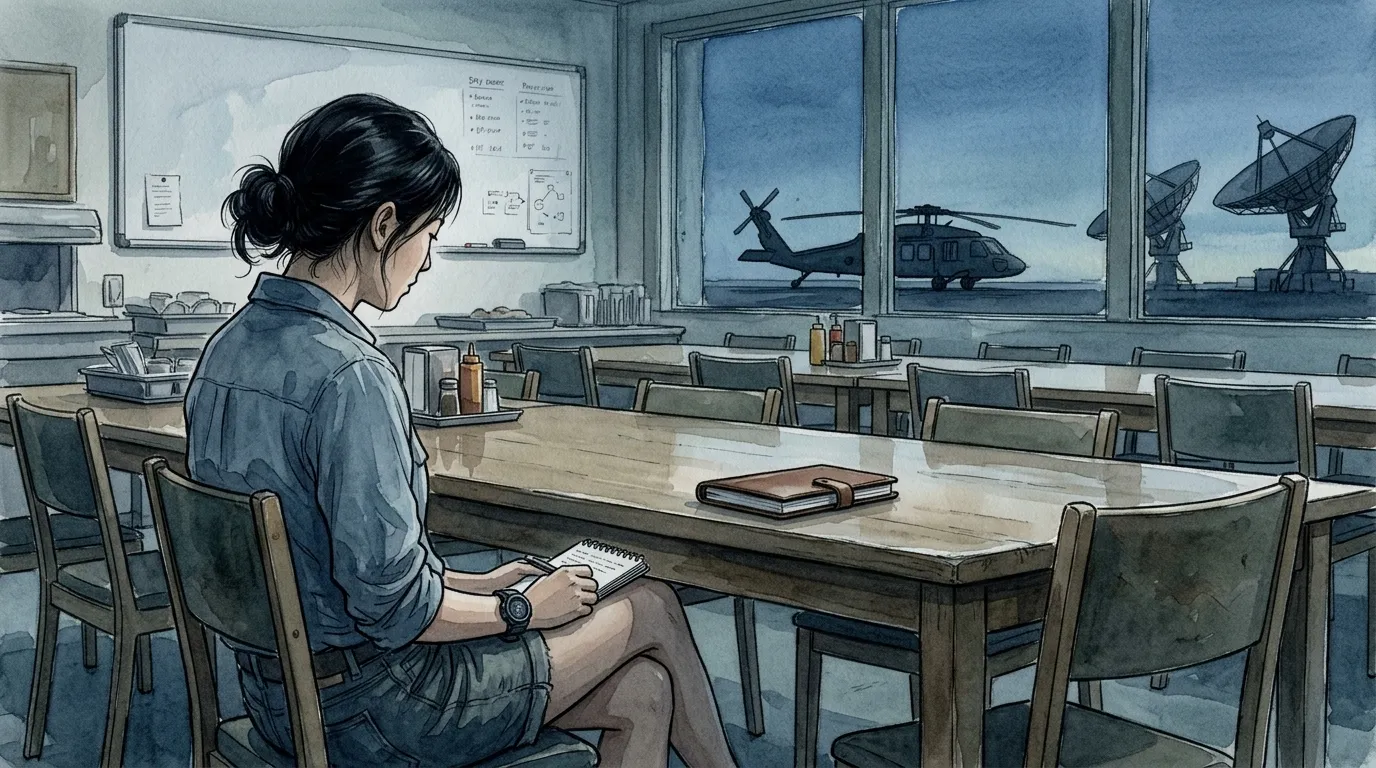
Chapter Four: The Consultant
I. The Helipad
I slept for about four hours.
I say “about” because I’m not sure that counted as sleep — the progress bar was at 42% when I leaned my head back against my chair, thinking I’d check again in a moment, and then I woke up and it was 05:31, the dry lab’s cold-white fluorescents still on, the progress bar at 78%, the upload dialog showing the transfer had picked up speed sometime in the past few hours.
I sat at the workstation for a while, confirmed the bar was still moving, then went to wash my face, got some water, came back.
07:14. Upload complete.
I saved a screenshot of the completion notification to the desktop, then stood up and walked out.
The helicopter sound started at 09:43.
I was at the monitoring point at the time, alone. The two-person rule was for nighttime; Takeguchi had adjusted it for daytime — I’d logged the adjustment, knew the rule: daytime allowed solo movement within line of sight. The monitoring point was about four minutes’ walk from the main building, at the outer edge of line of sight. I hadn’t gone any further.
The sound came first. About two minutes before I saw it.
MH-60 rotors — I’d seen a few supply helicopters at the atoll before, but those were smaller models with a different frequency. This sound was lower, weightier, the vibration of a larger machine than the usual resupply birds. I knew that frequency wasn’t a supply run, but I finished logging the readings before I turned to look toward the northwest corner.
The MH-60 circled the northwest helipad once and landed.
About three hundred meters from the monitoring point to the helipad — I couldn’t make out the aircraft details, but I could see the door open and people come out. Four, five — pause — six. Then some moved toward the main building, others shifted between the helipad and the aircraft. The movements on the ground were orderly. Not rushed.
East-northeast of the research station, five hundred to eight hundred meters, underwater. The alien object’s readings: 0.0%.
I logged the time: 09:43, advance team arrival, six personnel, MH-60, northwest helipad, weather clear, sea state light swell, wind approximately ten knots.
Then I locked the sensor to continuous recording mode, packed my notebook, and walked back to the main building.
Takeguchi was waiting at the front entrance.
His expression was the settled kind — the kind of calm that belongs to someone who knew today would go this way. Not surprise, not tension. Just a person entering a mode of work he’d already prepared for.
“They’re here,” he said. A confirmation, not a question.
“Yes,” I said. “Six people. I watched them land from the monitoring point.”
He nodded. “They’re getting their equipment sorted by the helipad. Someone will come over shortly to introduce the situation.” He paused. “There’s something I need to tell you first.”
I waited.
“They’ve designated a science liaison,” he said. “You.”
I heard this sentence. I didn’t immediately grasp its implications — or rather, I grasped the literal meaning, just not what that would actually mean in the days ahead.
“It’s procedure,” he said. “The station gets one science liaison slot. They need a single point of contact for direct communication.”
“I understand,” I said.
He looked at me.
“Any questions, come to me first. Don’t carry it alone.”
He said it evenly. Not reassurance — a statement that the option exists.
“Understood,” I said. “I’ll document all exchanges for traceability.”
He nodded. “Good.”
Something passed across his face, briefly — I didn’t catch it — and then he turned toward the entrance. “They’ll be over soon. Let’s go to the dining room.”
II. The First Civil-Military Meeting
Nine people in the dining room. Three of the station’s twelve were outside on routine tasks; Takeguchi had decided to let them continue undisturbed.
The liaison came in wearing a khaki long-sleeve shirt and dark trousers — no uniform. The advance team wore civilian clothes; Takeguchi had mentioned this. He was somewhere in his early forties, hair neatly trimmed, with the walk of someone who has practiced looking relaxed in unfamiliar spaces. He scanned the dining room, located everyone, and moved toward Takeguchi.
“Takeguchi-san,” he said. “Thank you for the welcome. Smooth trip.”
His voice was measured — the kind that doesn’t need volume to hold a room.
Takeguchi said: “Please.” They all sat at the long table.
The liaison set a small brown notebook on the table and said: “I know everyone may have a lot of questions about today’s arrangements. Let me go through our plan first, and then if there’s anything you’d like to clarify, we can go through it together.”
He spoke for about ten minutes.
I took notes while he spoke, but what I was actually hearing was the structure between the sentences: every statement was complete, with a beginning and an end, but taken together the edges blurred — “we’ll make sure,” “at the current stage,” “per existing protocol” — these phrases filled every space that might otherwise have held a gap, making it impossible to see from the outside what shape the inside held.
“Regarding communications,” he said, “to ensure signal quality and security, personal communications will enter a unified management system — request-based, review time two to four hours, approved requests can proceed.”
“Personal communications,” someone said. “What does that cover?”
“Video calls, voice calls, personal email,” the liaison said. “Work-related scientific data transfers are outside that scope — work is unaffected.” A slight smile. “I know this is an adjustment, and we’ll do our best to keep the process simple.”
I noted this passage.
Not a single word was wrong. But I noted it, because later I might need to go back word by word and see what it had said — or hadn’t said.
Takeguchi added: “The VSAT console is currently being temporarily assisted by the liaison’s team to ensure communications stability.”
I glanced toward the dry lab where the VSAT console was — no windows in that direction, I couldn’t see it, but I remembered where that workstation sat. I work there every day. Now someone is there, assisting with management.
Assist with management.
I wrote the phrase in my notebook. No parentheses. Just let it sit there.
There was informal time after the meeting. Most people clustered in small groups. The liaison was talking to Takeguchi, and then he walked toward me.
“Dr. Qín Sīyù,” he said. “Hello. I understand your observation records of the alien object are the most comprehensive ones we have.”
“It’s within my area of work,” I said.
“Those records are extremely valuable,” he said. “If possible, I’d welcome the chance to go through them with you in detail.”
The way he said this made me feel he’d already seen them — though I wasn’t sure how, since I hadn’t sent that version anywhere outside official channels. But the NOAA call had been filed, and where that system connects I don’t fully know.
“Of course,” I said. “What part would you like to discuss?”
“The pattern of voltage deviations,” he said. “You used the word ‘consistent’ in your records. I’d like to understand your definition.”
He had read the records. He had read the word I used.
I explained what “consistent” meant in this context: each deviation fell within the same amplitude range, duration similar, all returned to baseline afterward, intervals irregular but the pattern stable. I said this wasn’t a strict statistical regularity — it was an observer’s descriptive judgment, and a longer time series would be needed before any hypothesis could form.
He listened without interrupting, wrote something in his notebook.
“Very clear,” he said. “Our assessment overlaps with your observations in some areas. I can share more with you later.”
I waited for him to say what “more” meant.
He didn’t continue. His smile held. His notebook was on the table. He was waiting for my next question.
I thought for a moment, then said: “Is there anything I can do to make the upcoming process run more smoothly?”
He said: “Continue your documentation work. That’s very important. We need your scientific perspective.”
Then he turned toward someone else.
I sat there, notebook on my knees, the structure of that exchange running through my mind. He had said a great deal. Not one sentence was one I could object to. Not one told me what “our assessment” contained, or when “later” meant, or what “more” covered.
I logged: “09:47. Initial meeting, science liaison role confirmed. Liaison has read NOAA submission, including the word ‘consistent.’ Follow-up discussion: pending.”
I used “pending” as a qualifier, because “pending” is more accurate than “didn’t say” — but “didn’t say” is more honest than “pending.”
III. The Form, the Record, and a Dash
At one o’clock in the afternoon, someone brought a form.
The liaison’s assistant — a younger man — set an envelope on my workstation, said “the liaison requests you fill out this observation data sheet, to assist with the assessment process,” and left.
I opened the envelope and looked at the form.
The header read: “Non-Traditional Phenomena Assessment Record (I-Form 9-2).” Standard government administrative format. Eight fields: Phenomenon Type (select one: Atmospheric / Marine / Geological / Biological / Other), First Observation Time, Observation Location Coordinates, Observation Frequency, Measurable Parameters (if any), Behavioral Intent (if any), Biological Characteristics (if applicable), Recommended Follow-up Action (optional).
Under “Phenomenon Type,” I filled in “Other.”
Then I reached “Behavioral Intent (if any).”
I looked at that line. Thought for a moment. Picked up my pen.
I wrote: “If any — but this object has not displayed any behavioral intent to date, though I’m also not certain whether ‘not displaying’ constitutes a form of intent in itself?”
I looked at what I’d written.
(I noticed I was using a question mark. This form is an assessment record, not a thinking exercise. Question marks do not belong to the grammar of assessment records.)
I drew a line through the whole thing and filled the field with a dash.
I turned to the next page, saw “Biological Characteristics (if applicable),” set the form down, and picked up my own notebook.
That field was not applicable. I wasn’t certain what “applicable” meant for this situation. If it became applicable later, I wouldn’t need to decide that within this form’s preset framework. I stayed with my own notebook.
At two-thirty in the afternoon I organized the morning’s observation data.
Voltage readings: T+35h (zero point at first sighting). Seven cumulative deviation records total. Most recent: today at 11:22, amplitude 0.14%, duration under two seconds, return to baseline normal. From advance team landing through my return to the workstation, the sensor had been in continuous recording mode — no spike values that appeared only while I was away, no reading interference clearly correlated with helicopter vibration. I noted this possibility in the technical addendum, because helicopters do affect the nearby electromagnetic environment — but the measurements showed the interference was not significant, or if it was, its magnitude was close to the alien object’s own deviation magnitude and currently cannot be fully separated.
The separation problem took half a page.
While writing, I noticed something: I now have a new interference variable. The variable is “military equipment operating on-station.” Any future deviation data will need this caveat — readings must be interpreted with this factor in mind.
Records are honest. But honesty requires context. The context increased today.
Two new antennas had appeared beside the dry lab workstation.
They were next to the VSAT antenna. Larger. Gray housing. They’d been installed while I was at the monitoring point; I found them when I got back.
I stood outside and looked at them.
They stood about a person’s height above my VSAT antenna, receiving dishes aimed at different satellite positions. Installed in the open space beside the VSAT antenna — not encroaching on my equipment, not obstructing my reception angle. I confirmed this: compass and elevation gauge, no occlusion.
My equipment is still there. My antenna is still there. But beside them now are two larger antennas, managed by someone else.
I logged: “14:23, north side antennas, dry lab exterior. Two new satellite antennas added. Model unconfirmed. Position does not affect VSAT reception. Management not station personnel.”
I didn’t know the model because I hadn’t walked close enough to read the placard.
I’m not sure why I hadn’t walked over.
IV. The Coordination Meeting, and Melo’s Food Theory
The 17:00 coordination meeting — Takeguchi called it the “daily information sync,” meaning: both sides go through the day’s events, the research station and the military advance team each in turn, confirming no misunderstandings.
I attended as science liaison.
The liaison on one side of the table, Takeguchi on the other, me beside Takeguchi. A note-taker at the table.
“Based on today’s preliminary assessment,” the liaison said, “we’ve decided that for the next forty-eight hours, we’ll focus on observation only, with no active intervention at this time.”
I wrote this sentence in my notebook.
“Is there any plan to restrict the object’s range of movement?” I asked.
“Not at present,” he said. “We assess that the moment for direct intervention has not yet arrived.”
“Regarding the scope of scientific observation,” I said, “my sensors currently have a logging station at the outer edge of the reef flat, approximately five hundred meters from the main position. Maintaining that equipment requires periodic visits —”
“Monitoring point maintenance should be fine,” he said. “Please continue scientific recording as normal.”
“I organized a deviation-pattern analysis today,” I said. “There’s a technical detail that may affect interpretation of subsequent assessments. I’d like to raise it for discussion.”
“Excellent,” he said. “Please go ahead.”
I went through the helicopter vibration interference problem, the contextual caveats future readings would need, the current limitations on the separation problem.
He listened carefully, wrote a few lines in his notebook.
“Very informative,” he said. “I’ll make sure the relevant personnel receive your analysis.”
Then he turned to Takeguchi and started on tonight’s personnel arrangements — part of the advance team would stay in tents near the helipad, the remainder in the main building’s spare rooms, no entry into the research areas.
I sat there and thought about the way “the relevant personnel will receive” combined as a phrase.
I had analyzed the deviation patterns, raised a technical detail, explained the interpretive limitations on future readings.
These had entered the “relevant personnel will receive” channel.
Where that channel leads, who those “relevant personnel” are, how that analysis enters their decision-making — I don’t know.
I logged: “17:08. Science liaison’s first formal technical input. Input: submitted, impact scope pending confirmation.”
“Impact scope pending confirmation” is an honest qualifier. But I knew it was close in meaning to “I cannot confirm whether it had any impact.” That distinction I didn’t write out.
After the coordination meeting, the liaison stayed behind.
Not in a meeting capacity — he set his notebook on the table and asked a question: “In your observation so far, have you noticed any response from the object?”
“Response,” I said. “What kind of response?”
“Any form,” he said. “Reaction to external stimuli, reaction to our presence, reaction to signals, any change you’ve noticed.”
I thought about today’s readings. Seven deviations, amplitudes consistent with yesterday’s pattern, no clear time point that shifted with the advance team’s arrival. I’d specifically looked at the readings after the helicopter landed: no spike, no sudden directional change.
“No,” I said. “Within the scope of my observations, the object’s behavioral pattern today showed no clear external response indicators.”
He nodded, wrote something in his notebook.
I watched his pen move.
He wrote something, then closed the notebook.
“Thank you,” he said. “Your work today was very important.”
He left.
I sat in my chair and didn’t get up immediately.
I had said “no” — but “no” meant no external response indicators I could identify, not “no response of any kind.” If it had some form of response that fell outside my recording framework, my readings wouldn’t show it, my notebook wouldn’t capture it, and my “no” would be my “no” — but that’s not the same as “no.”
I hadn’t said that distinction.
He asked. I answered. He wrote down my answer and closed his notebook. That notebook now contains my answer. I don’t know what version of my answer he wrote, and I don’t know whether there’s a gap between my answer and his record, because I didn’t see his notebook.
I’d held back from asking what he wrote.
I wasn’t sure why. Asking wouldn’t get an answer anyway, and asking that way would make me look like I didn’t trust him — and he hadn’t done anything, so far, that could be held against him. Or maybe I simply wasn’t sure whether I wanted to know. All three reasons hold. I couldn’t rank them.
I logged: “17:31. Liaison inquired about object response indicators. My answer: no (within observation scope). His record: unknown.”
“Unknown” is a legitimate log entry.
It’s also the actual state of affairs.
V. The Kitchen, and Things That Don’t Taste Good Don’t Look After Themselves
I found Melo around six in the evening.
Not that I’d gone looking — I was in the dry lab organizing the last batch of readings for the day, heard movement from the kitchen, went to look. Melo was making dinner. The kitchen sat between the dining room and the main corridor; push the half-door open and you could see inside. He was standing with his back to me, cutting something.
“Did you eat today?” he said.
He hadn’t turned around. I wasn’t sure how he knew it was me.
“A little at lunch,” I said. “Nothing in the afternoon.”
“Come eat tonight,” he said. “White rice and boiled fish, some freeze-dried green peas. We’re getting low on fresh.”
I stood in the kitchen doorway. Didn’t go in. Didn’t move away.
“I’ve been working on a theory,” Melo said, still facing away. “About that thing.”
“What theory.”
He turned, held out a mug of coffee. I stepped in and took it.
“If aliens wanted to eat us, they would have already,” he said. “Aliens aren’t eating us. Either we don’t taste good, or we’re too much trouble.”
I drank some coffee. Thought about it.
“That logic,” I said, “assumes alien behavioral patterns align with animal foraging logic. We currently have no data to support that premise.”
“Fair enough,” he said. “Still holds as a logic.”
He dropped what he’d been cutting into the pot and went back to what he was doing.
“You spent a lot of time talking to that person today,” he said. “The liaison. I saw you in the dining room.”
“Yes,” I said. “Job requirement.”
“He sounds easy to talk to.”
“Yes,” I said. “Very easy to talk to.”
Melo paused. Set down the wooden spoon. Turned to look at me.
“Is that a good thing or a bad thing?”
I drank some coffee and didn’t say anything for a moment.
“I’m not sure,” I said. “Everything he said was reasonable.”
“Mm,” Melo said. “Right. Things that don’t taste good don’t look after themselves either.”
I looked at him.
“You’re talking about me not eating dinner,” I said.
“Was I?” He picked up the spoon and went back to stirring. “Go sit. Ten minutes.”
I sat down in the chair by the kitchen, set the mug on the table, glanced out the window. The light outside was deepening. To the northwest, the sky was the dark orange that comes just after dusk, lights on at the helipad, the outlines of tents just visible.
I couldn’t see in the direction of the sea. The monitoring point was that way.
The sensor was in continuous recording mode. It didn’t need me watching.
I sat in the chair without reaching for my notebook. Not recording anything. Just sitting, waiting for Melo’s dinner to be ready.
I logged this later.
(I noticed how I wrote it: not “18:02, waiting for dinner in the kitchen” — but “18:02, temporarily not recording anything.”)
(I notice now that I’m recording even the not-recording. The act of observation has become its own object of observation. This is not a healthy recording habit. I’m not sure how to stop, or whether stopping is necessary.)
By the time dinner was done, most people had drifted into the dining room and sorted into small groups. The topic was today — what the military people were like, where the tents were, whether the communications request process was complicated.
Priyanka asked me about the deadline for communications requests. I told her I hadn’t applied today — work communications weren’t restricted for me, and I’d try personal communications later. She said she’d tried it: applied at three in the afternoon, approved at five. Slightly longer than the liaison’s “two to four hours.”
I noted the number.
“Are you worried?” she said.
I thought about her question.
“I’m not sure,” I said. “A lot happened today. I’m still recording, still organizing. The act of worrying — I haven’t found a place to put it yet.”
She looked at me. Didn’t say anything.
“Are you worried?” I asked her.
“Yes,” she said. “But I had breakfast this morning, lunch this afternoon, dinner just now. Melo says eating is important.”
I glanced over at Melo, on the other side of the room collecting plates. He wasn’t looking our way.
“He’s right,” I said.
I finished my coffee and set the cup on the table.
Tomorrow there’s another day. Another window. More readings. And whatever the liaison has in his notebook that I don’t know about.
I need to keep recording.
Keep recording, then verify the records, then organize the records, then think about what the records mean, then record the thinking about what the records mean.
I notice this loop.
I keep doing it.