Chapter 5
Chapter Five: Silence
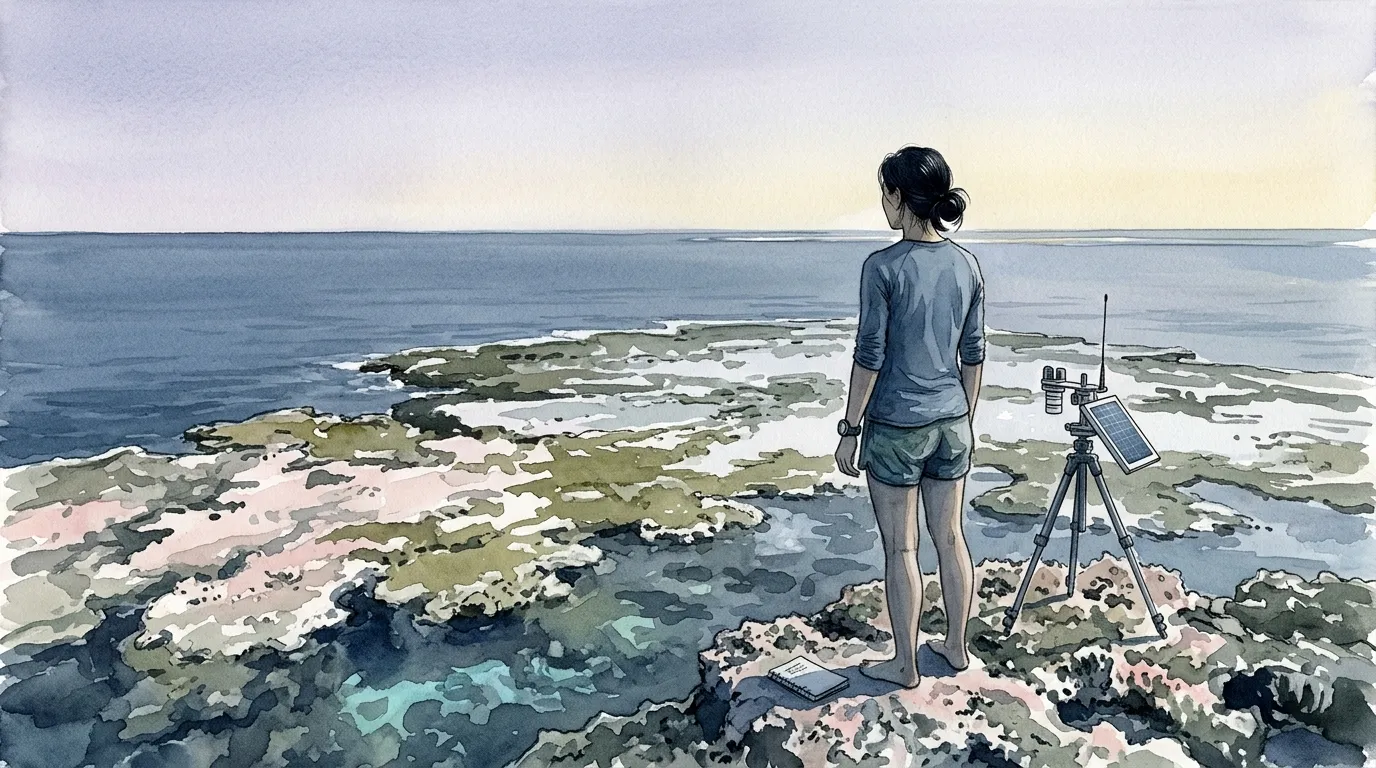
Chapter Five: Silence
I. The Monitoring Point
Six in the morning. I got up and walked to the monitoring point.
In the log, that sentence reads: “06:04, proceed to monitoring point, routine maintenance, sensor calibration, reading confirmation.”
That is an accurate description.
The monitoring point is at the north end of the reef flat, a four-minute walk. I’ve made this trip hundreds of times — this is my fourth year at the atoll, dry season and wet season, windy days and still days, morning and afternoon and the occasional evening, hundreds of times, until the soles of my feet carry a memory of the reef surface that doesn’t require looking: rough, flat, the occasional raised coral edge that wants skirting.
Today the path felt the same as yesterday, and the same as the day before.
I arrived, took out my notebook, and began the routine check: sensor tripod secured to the north rim of the reef platform, mounting bolts tight, ground contact clean, solar panel facing southeast, battery at 94%, antenna aimed correctly.
All normal.
After logging these, I set the notebook on the reef and looked around.
That, too, is something I’ve done hundreds of times. North is the outer reef, where waves break low and constant against the rim, sound carrying from a long way off, flat and unvarying, like white noise that was set up once and no one ever thought to turn off. South is the main building, most of its lights still on at this hour, a few silhouettes moving in the corridor. To the east-northeast —
East-northeast is the direction of the alien object. Underwater, five hundred to eight hundred meters, depth fifteen to twenty-five meters.
Reading: 0.0%.
I logged it: “06:09, east-northeast bearing, reading 0.0%, no deviation, normal baseline.”
Then I ran through yesterday’s data playback. Continuous sensor recording, five the previous evening to six this morning, thirteen hours of data. I scanned through it quickly.
One deviation. 20:17 the previous evening, amplitude 0.11%, duration one and a half seconds, return to baseline, normal.
I added it to the running record: eighth instance, T+45h, amplitude 0.11%, duration approximately one and a half seconds, return to baseline normal, no obvious external interference variable (military equipment operating at reduced nighttime levels, confirmed).
Eight.
I paused beside the word “eight” for a moment, then kept writing.
The trade winds came in from the northeast, warm, carrying the salt smell that seawater leaves behind when it evaporates — the kind of smell you stop noticing somewhere in your second year, until one day it registers again. At low tide, patches of coral are exposed across the reef flat: branching coral in dusty pink, massive coral in cream white, olive-green soft coral draped sideways, dark gray coral stone underneath. Water moves through the coral cavities with a faint gurgling.
All of that was the same too.
I finished the routine check and stood at the monitoring point for a few minutes. No particular reason. Just standing.
I logged this later: “06:21, routine check complete, stood at monitoring point approximately three to five minutes, weather clear, northeast wind, sea state calm, light swell at outer reef. Nothing new to report.”
That is an accurate description.
The few minutes I stood there, I didn’t think about anything — or more accurately, what I thought about was the kind of thing that can enter the log’s format: weather, readings, sensor status, the day’s work plan.
Thinking back, that state seems slightly odd to me. Yesterday I’d stood in this exact spot and watched the helicopter land, and my mind had been completely awake, every reading sharp, but my body had felt pulled in some direction — not fear, something closer to a vigilance I don’t have a good word for.
Today, none of that.
I stood there, trade winds blowing, the sound of the outer reef there, the sensor in continuous recording, the object —
The object was still there.
On my way back, I noticed the sentence I’d written in the log: “Object still there, readings normal.”
I had written that without pausing.
Walking back toward the main building, I turned the sentence over in my mind.
“Object still there.”
What did that mean?
— It is shorthand for “the object remains at its previous position.” Correct.
— It is one of the items in this morning’s routine check. Also correct.
— The sentence has the same grammatical structure as “the light’s still on” or “the buoy’s still there,” implying this is a known, can-be-assumed background condition, where deviation would be the anomaly worth recording.
I sat with that last part for a moment, then kept walking.
The reef surface was rough underfoot, its texture familiar.
When I reached the front steps of the main building, I stopped for a second on the reef stone threshold and jotted the thought in the margin of my notebook:
“Object still there (the way ‘still there’ sounds like ‘the light’s still on’). ?”
Just a question mark. No annotation.
II. The Dry Lab
Back at the dry lab: 06:41.
Workstation on, compressor hum a constant baseline, cold white fluorescents, air conditioning at 22 degrees. I’ve spent thousands of hours in this space; I have a memory for every one of its sounds — which hum frequency is the freezer unit, which high pitch is a certain old computer running too hot, the low drone in the corridor that belongs to the dehumidifier.
A new sound had joined them: the military antenna equipment on the north side of the dry lab, a low, regular sound, operating on a different rhythm from my own equipment.
I sat at the workstation and began organizing the previous day’s full dataset.
Items requiring logging this chapter:
Voltage deviation: T+45h, one instance, the previous night, amplitude 0.11%, eighth cumulative event.
Temperature readings: I stopped when I got to those.
There are three air temperature sensors at the atoll — distributed across the north side of the main building, the monitoring point sensor platform, and the weather station near the helipad. I consolidate all three each morning. The six days before this, all temperature records had been within normal error bounds: ±0.5°C intraday variation, consistent with standard mid-Pacific atoll patterns.
When I organized yesterday’s temperature data, I found a number: monitoring point sensor platform, 20:17 the previous night, +0.22°C, duration approximately forty seconds, return to baseline.
20:17 the previous night.
The voltage deviation at 20:17 the previous night was — I flipped to the voltage records.
20:17, 0.11%.
I held those two timestamps side by side for a moment.
±0.22°C is at the edge of instrument error. The atoll’s environmental temperature sensors have an accuracy of ±0.2°C, meaning that reading is strictly not within statistical significance. If I were writing a paper, I would not cite this number — instrument error would swallow it whole.
But it appeared at the same timestamp, in the same bearing.
Voltage deviation: the voltage sensor is at the north end of the reef flat. Temperature deviation: the temperature sensor is on the monitoring point sensor platform, also the north end of the reef flat.
Same bearing. Same time (difference within sensor recording frequency).
I logged it: “T+45h, 20:17, monitoring point platform, voltage deviation 0.11% (8th instance), temperature deviation +0.22°C (instrument error boundary, but bearing consistent with voltage reading). Note: temperature reading lacks statistical significance in isolation; viewed alongside voltage reading, bearing-time consistency merits tracking.”
Then I went back and checked the corresponding temperature records for all eight voltage deviation events.
Seven. In seven of the corresponding time windows, the temperature sensor registered a reading at the edge of instrument error, all of them in the direction of the monitoring point. I hadn’t noticed the earliest three because at the time I was analyzing voltage, not temperature — the temperature data lived in the routine collation after voltage events, but I’d never cross-referenced the two categories.
Now I put them in the same table.
Voltage deviation, temperature deviation, bearing consistent, time consistent, amplitude in every case at the edge of measurement error.
Any one of them in isolation could be explained by equipment aging, environmental factors, measurement error.
But they aren’t in isolation.
They are consistent.
I printed the table, pinned it on the wall beside the workstation, and stepped back a few paces to look.
Compressor humming, military antenna equipment droning low, air conditioning holding the room at 22 degrees.
The word “consistent” has appeared many times across all my records, starting from the first voltage deviation. I noted “consistent,” wrote it into the NOAA report, the liaison read it in that report and asked what I meant, and I explained.
Now I was standing here with a temperature dimension added, and the shape of “consistent” was more complete.
What might this mean?
I wrote two hypotheses in my notebook.
(1) Controlled: some form of deliberate suppression. The object is actively maintaining a state whose design parameters I don’t know, and these readings are a byproduct of its “operation,” deliberately held down to the edge of measurement error — enough for precision sensors to detect, but not enough for any single reading to appear anomalous.
(2) Background noise: coincidence arising from equipment aging and environmental factors. The sensors at the monitoring point have been operating in a salt spray environment for two years; aging can cause reading deviation, and the same applies to the temperature sensors. The bearing consistency is because the sensors all sit on the same platform, and mutual electromagnetic interference is also possible.
I wrote out both hypotheses and looked at them.
Problem with (1): it assumes the object has some form of “active” behavior, but there is currently no direct evidence that the object has any active behavior whatsoever.
Problem with (2): eight voltage deviations, seven corresponding temperature readings, bearing and time highly consistent — to attribute this to aging and coincidence requires believing that the equipment happened to age in a particularly regular way at this specific bearing and this specific time window. That explanation is available, but it requires a more complicated coincidence chain than “controlled.”
Occam’s razor doesn’t apply here, because both hypotheses require additional assumptions. The nature of the assumptions differs.
In the white space between the two hypotheses, I wrote half a sentence in light pencil, then stopped:
“If something is —”
I looked at the sentence.
The zoo hypothesis.
If something is observing us, the most effective method is to ensure we don’t know we’re being observed. Deliberately maintaining minimum interference, keeping the behavior of the observed at its natural baseline, so that the resulting data is truly representative. If that hypothesis held, “consistency” would be a designed artifact, falling under the first of the two hypotheses.
I had encountered this idea during my graduate work in Monterey, as background material in a field observation ethics discussion — the observer effect, how the act of observation influences the behavior of what is observed, how to design a minimal-interference monitoring protocol. It was one of the frameworks in my dissertation; my reviewer said I “approached the observer effect with excessive optimism.” At the time I thought the reviewer didn’t understand what I meant.
Now I was sitting in the dry lab at the atoll, the alien object east-northeast, five hundred to eight hundred meters, and the sensor readings were “consistent.”
“If that were the case —”
I looked at the sentence, and didn’t continue.
Writing this line of thinking into the working log would be inappropriate — it is pure speculation, no testable hypothesis, just noise if written in. I put that half-sentence in parentheses, marked it “(speculation, excluded from formal analysis),” and turned to the next page.
Over an hour later, the military technician pushed open the door.
He was the one from the advance team’s six who handled equipment — early thirties, blue work vest, manner more direct than the liaison’s. He was holding a tablet. “Doctor, could you help me verify the baseline voltage records from last night? We’re cross-referencing against our own readings.”
“Which window?” I said.
“Eight to nine last night.”
I pulled up the raw records for that window and showed him. He stood beside me, scanned through it, noted something on the tablet.
“You picked up the same deviation?” I said.
“We did read one,” he said. “At the instrument error boundary — we wanted to cross-check against your data.”
“I have it logged. Eighth instance, amplitude 0.11%, duration under two seconds.”
He nodded, wrote another line on the tablet.
“Any corresponding temperature data?” he said.
I paused, then said: “The monitoring point temperature sensor has one entry, same timestamp, ±0.22°C, within instrument error range.”
“Good,” he said. “Thanks.”
He moved toward the door, then stopped in the doorway for a second and turned back. “What’s your read on these readings?”
The phrasing made me think for a moment.
“My read,” I said. “Within current interpretive scope: consistency pattern continues to hold, voltage and temperature readings correspond in bearing and time, but each individual reading is at the edge of measurement error. No valid hypothesis regarding causation can be formed at this stage.”
He listened, nodded.
“Your phrasing,” he said, “‘consistency’ — we’ve seen that word in another context.”
“The NOAA report,” I said.
“Right,” he said. “Interesting.”
He left.
I looked at the table on the wall beside the workstation. “Interesting” — I noted the word in my notebook without any analysis. This time, recording it didn’t require a reason.
III. The Corridor, and Melo’s Thermos
The afternoon, and the station’s daily operations continued.
Qin Duomi — the water quality researcher in her second year — was sorting sample bottles. Lu, the tidal current researcher, was at his workstation reviewing data, occasionally stepping out to confirm readings from the outer reef buoys. Priyanka had submitted a request for her afternoon communications window; every afternoon she sends a short email to her family in India — she is well, and the date — and she says the shorter the better, because approval comes faster.
I stayed in the dry lab until three in the afternoon, then walked out to the corridor to get some water.
Melo had left a thermos at the end of the corridor. The station’s own thermos, aluminum shell, brought in on a previous resupply run. He hadn’t put it there today — it had been there for months. But this afternoon I stopped and poured myself a cup as I passed.
Melo came out of the equipment room and looked at me.
“Afternoon,” he said.
“Yes,” I said.
He got his own cup and poured some water, then leaned against the corridor wall and drank.
“How’s today?” he said.
“Data work.”
“Anything new in the readings?”
“Eighth voltage event last night,” I said. “Temperature has a corresponding reading at the instrument error boundary — first time I’ve put the two datasets side by side.”
He drank some water without speaking.
“Did their antenna interfere with your readings?” he said. “Their antennas.”
“Confirmed it hasn’t — reception angle isn’t obstructed, electromagnetic interference magnitude within recordable range, already noted in the addendum,” I said. “Current assessment: impact on readings not significant.”
He nodded.
Melo let the air stand there without filling it with another question. The way he leaned against the wall and drank was the way of someone who doesn’t explain why he’s standing there. He was just there.
“How much did you sleep last night?” he said.
“About six hours,” I said. “Better than the night before.”
“How many hours the night before?”
“Four.”
He finished his water, set his cup beside the thermos, and said: “Get to bed earlier tonight.”
Then he walked back into the equipment room.
The whole exchange, there in the corridor, was maybe under five minutes. Afterward I thought about it and realized it was the closest thing to a normal conversation I’d had all day. I talked about data, he talked about sleep, and neither of us said anything about the thing — but the thing was there in the background of our conversation, the way the trade winds are always present, and nobody said it because nobody needed to.
I stood in the corridor with my cup of water for a moment.
Then I went to find Priyanka.
Priyanka was in her workspace, looking at something. When she saw me come in, she shifted to one side and cleared the space beside her chair.
“Sit,” she said.
I sat down in the neighboring chair without saying anything.
“You’ve been busy today,” she said.
“Data,” I said. “New finding with the temperature readings, still working through it.”
“Interesting?”
I thought about the answer to that question.
“Yes,” I said. “Corresponding readings for temperature and voltage, bearing and time consistent, all at the error boundary, but consistent — you call it interesting, I call it a pattern that merits tracking. Same meaning, different frame.”
Priyanka watched me say this, then said: “You sound okay.”
“I’m in better shape today than yesterday,” I said. “Yesterday I only slept four hours.”
“I only slept four hours too,” she said. “When I woke up I went straight to submit the communications request, then waited for approval — two and a half hours. While I was waiting this morning, I realized that what I was most anxious about was the approval time itself. Not knowing when it would come through, that uncertainty.” She paused. “I found that a little funny. And also a little sad.”
“Why sad?” I said.
“Because,” she said, “I thought I was afraid of something very large, and it turned out I was afraid of something very small. I’m not sure that makes things better or worse.”
I thought about that.
“Both fears can exist at once,” I said. “The large fear and the small fear aren’t mutually exclusive. Anxiety doesn’t come in just one unit.”
Priyanka nodded.
“What about you,” she said. “What are you afraid of?”
I didn’t answer immediately, because I was working out whether I could actually say the answer out loud.
“I’m not sure,” I said. “This morning at the monitoring point, I was doing the routine check, and I wrote in the log ‘object still there, readings normal,’ then walked back toward the main building, and partway back I realized I had written that sentence the way you’d write a note about the weather. Not the way you’d record an alien object.”
Priyanka was quiet for a moment, watching me.
“How did that feel?” she said.
“I’m not sure,” I said. “I wrote a question mark in the margin of the log. No annotation.”
“What should you have written next to the question mark?”
That question I didn’t answer, because I didn’t know.
Priyanka didn’t ask again. She turned back to her screen and said: “Tonight Melo says there’s fried rice. The fresh eggs are almost out — he said using them up today is better than using them up tomorrow.”
“Okay,” I said. “I’ll be there.”
I was getting up to leave when Priyanka said: “Qin.”
I turned.
“That thing you said about the question mark,” she said. “I think the question mark is right. Even if you eventually find the answer, the question mark is still right.”
I nodded, and walked out into the corridor.
IV. The Log
After dinner, the station’s nighttime routine.
I went back to the workstation and began the final round of data consolidation for the day.
T+55h to T+59h: voltage readings showed no new deviations, 0.0%, baseline holding. Temperature normal. Weather station wind speed eleven knots, northeast, sea state calm.
I filled all of this into the corresponding fields in the working log, format standard, entries complete.
Then I turned back to the sentence I’d jotted in the notebook margin this morning, on the way back from the monitoring point: “Object still there (the way ‘still there’ sounds like ‘the light’s still on’). ?”
I looked at it for a while.
Today: the eighth deviation, temperature readings, bearing and time consistent, first time two datasets analyzed together, two hypotheses, speculation excluded from formal analysis. Priyanka’s question — the question mark is right.
All of that was today’s work.
I turned to the last recorded page of the working log, and in the blank space at the bottom, began writing the daily summary.
“T+55h–59h. Voltage readings stable, no new deviations. Temperature readings at normal baseline. Military technician visited to verify readings, data sharing completed, details recorded. Completed temperature correspondence analysis for 8th deviation event; consistency pattern extends to temperature readings, assessment ongoing.”
That is the language of the working log: accurate, traceable, available for others to read.
Then I turned past the working log and opened a new page. This page belongs to my personal notes — a notebook I have not shown anyone and have not mentioned, because it is not part of the official record. It is where I put the things that enter under “readings normal” but are not quite data.
I began writing today’s personal notes: the morning at the monitoring point, the word “still there,” what the reef path felt like on the way back, the temperature reading analysis side by side, the two hypotheses, the half-thought about the zoo hypothesis that went no further.
I stopped there.
The working log on the page before, personal notes on this one, and somewhere between those two pages I sat without a format I could file in any field.
Today’s personal notes weren’t finished.
There was one more thing I hadn’t written.
This morning, in the middle of data analysis, for a stretch my mind left the readings and went somewhere I hadn’t planned to go —
I thought about Professor Chen.
Professor Chen, my doctoral advisor in Monterey. After I graduated he went back to teach in Taiwan. He’s not here. He has no connection to any of this. He doesn’t know the details of my fourth year at the atoll — he only knows the general shape.
I don’t know why I thought of him in that moment.
At the bottom of today’s page in my personal notes, I wrote this:
Professor Chen, I may have encountered something important today, but I can’t say what exactly it is. What I want to say is — I’m not sure that what I’ve been observing all this time is really what I thought it was.
I finished writing and looked at it.
Short. No data, no qualifiers, no format, no “current assessment” or “merits tracking” or “statistical significance.” Just a few words, for someone who isn’t here, about something I can’t put into words.
I didn’t delete it.
And didn’t send it anywhere. It just sat there.
I turned to the next page and continued filling in today’s environmental data summary: wind speed, wind direction, air temperature, water temperature, salinity, visibility, T+59h readings, field by field.
The table isn’t complicated. Usually it takes ten minutes.
Today it took fifteen.
Twice, in the middle of it, I looked back at what I had written.
Then I finished the table, closed the notebook, and set it beside the workstation.
Outside, the weather station readings: northeast winds at eleven knots, standard mid-Pacific nighttime trade winds. The sound of the outer reef reached in from several hundred meters away — low frequency, continuous, without variation.
East-northeast, five hundred to eight hundred meters, underwater.
Sensor in continuous recording.
Object still there.
I sat at the workstation and looked at the screen. 0.0%. Baseline. Normal.
This “normal” and the “normal” of the first day carry the same reading. I record it the same way.
But something is different. I’m holding it as a question mark for now, no annotation.
The words I wrote to Professor Chen are in the notebook. Not deleted. Not sent.
Tomorrow, keep recording.