Chapter 6
Chapter Six: Hawthorne
Chapter Six: Hawthorne
I. The Right-Hand Drawer
The dry lab. Day 3, evening. The workstation screen supplements the fluorescents. The compressor holds a steady baseline hum.
I was sorting through the reference folder.
Today’s work plan: update the cumulative-deviation analysis table, run a correlation pass on the eighth deviation’s data. But updating the table required a number I’d organized in the morning, a number already in the log — no need to verify it. The issue was that after I opened the table, I found myself opening the reference folder instead. I’m not sure why.
The reference folder lives to the left of the workstation. Blue binder. Label: “Ref_2021-2022.” Two years’ worth of research material inside — a literature compilation on reef population dynamics, assembled when I was drafting a paper on the erosive impact of collector urchins on coral reefs. The paper was never finished. The data analysis was only halfway done when the pandemic closed the ocean, and it had stayed there since.
I flipped through a few pages, confirmed there was nothing in it I needed now, and put it back.
Then I saw the right-hand drawer.
The right-hand drawer hadn’t appeared today. It had been there for nearly two years. Inside it: the printed copy of my doctoral dissertation. The whole thing, double-sided, A4, a thick stack held together with two binder clips.
I don’t remember why I brought it to the atoll. Maybe it got packed in with other research materials. Maybe I grabbed it during a resupply when I was bringing books. Maybe I thought at the time that I might read it again.
I took it out of the drawer now.
The weight of it was the weight paper gets after sitting a long time — slightly damp, that particular heaviness. The yellow sticky note on the front page had fallen off, but it had left a faint square impression behind, like a memory with no words. Cover page: The Influence of Observer Effects on Field Behavioral Research: A Study of Reef Fish Population Dynamics. My name below the title, and that year.
I opened to the table of contents, scanned the chapter names, and found Chapter Three: “Observer Effects and the Hawthorne Phenomenon.”
I found the chapter and turned to its opening page.
The handwriting in the margins was mine; the formatting I had designed myself; the page numbers had been typeset with LaTeX, lower right corner. The white margins of this printed copy were dense with red-pen annotations — some in my hand, some in my committee members’, some I could no longer identify.
I began reading.
“When subjects become aware that they are being observed, the reliability of their behavioral data is immediately compromised. Observation changes the observed, and this change is real — it cannot be absorbed into the framework of experimental error. The core manifestation of the observer effect in behavioral science, known as the Hawthorne Effect, operates through the following mechanism: the mere fact of knowing one is being observed drives subjects to adjust their behavior in accordance with their expectations of what the observer expects. The behavioral data recorded thus no longer reflects behavior in a natural state, but rather a consciously performed behavior — a ‘performance of the behavior the observer expects to see.’”
I finished that passage, set the printout down, and looked at the fluorescent light in the ceiling.
Then I picked it up again.
I found something else in the drawer — a few pages clipped to the back of the dissertation, different format: reviewer comments. The committee’s remarks. I remembered these. When I’d first read them I was in the graduate office in Monterey, afternoon sun through the window, a squirrel moving through the lawn outside.
Reviewer comment four: “The author’s treatment of the observer effect is excessively optimistic and appears not to have fully accounted for the disruptive nature of observation itself. The author’s conclusion assumes that the researcher can control for the observer effect by minimizing interference variables, but the author has failed to adequately demonstrate whether, in naturalistic contexts, the researcher’s presence can be treated as background noise rather than an active interference variable.”
I remembered my reaction when I first read that comment: this reviewer has misunderstood me. My dissertation argued that “observation can be sufficiently neutral as to not undermine the validity of conclusions” — a meaningfully different proposition from “observation can be perfectly neutral” — and the reviewer had conflated the two.
Now I was sitting in the dry lab at the atoll, the printout spread on the work surface, reading the same comment.
Maybe he understood.
That thought stayed in my mind for a moment. I let it stay. Then I filed the reviewer comments back behind the dissertation and opened the working log.
The entry from Day 0: “Heart rate approximately 90–95, mild hand tremor, assessed as acute stress response. Recorded.”
The first night. The first self-monitoring entry after the light descended. I remember writing that sentence with a clear head — I had deliberately put my own physiological state into the log, as an “interference variable record under conditions of environmental control failure.” Part of my research training. The researcher’s bodily state is one source of experimental error; recording it allows readers to evaluate its influence on the data.
I looked at that line for a moment.
What if something had been watching me then.
What if something had been, at that moment, watching a scientist at work.
What it saw: a scientist recording her own heartbeat, writing her trembling hands down as “interference variable,” processing everything into numbers that could be reported —
Was that genuine behavior? Or was it behavior performed by someone who already knew she was being watched — performed according to her understanding of how a scientist is supposed to act?
I’m not sure what the difference between those two situations would look like.
The problem wasn’t back then. The problem starts now.
Now I know the Hawthorne turning point is a possibility. Now I know “I may be under observation.” Which means my behavior from this moment forward can never again be the behavior that existed before knowing I might be observed.
I turned to the back half of Chapter Three and found the subsection: “Standard Strategies for Managing the Hawthorne Effect.” I read through several: extend the observation period until subjects habituate; employ covert observation to reduce conscious awareness; design exclusion protocols.
I paused at “habituation.”
Day 0. Cleaning the tank. “I’m watching them, but I don’t know what that means to them.” The question I’d turned over that day — the grouper had grown used to my presence; was its behavior genuine habituated behavior, or adaptive behavior that meant “accustomed to human presence and therefore no longer fleeing”?
I remembered thinking, when that question occurred to me, that it was a question about fish.
What I thought now was: if my sense that “the object is still there” — which I had recorded in the manner of “the light’s still on,” a matter of habituation —
Was that habituation a genuine acclimation to something unusual until it felt ordinary? Or had I been guided into a “sense of ordinary,” my behavior held within some designed baseline range?
From the outside, those two situations look exactly the same.
I closed the dissertation and set it to the left of the work surface, staring at the blue cover.
The problem was this: if I tried to “act as though I don’t know I might be observed,” that act of pretending would itself be a performance. If I acknowledged “I know I might be observed” and then attempted to adjust my behavior to “seem natural,” that adjustment would also be a performance.
Two paths.
Both are performance.
No exit.
The blue ceramic mug sat to the right of the work surface. Chip at the base — I knocked it eight months ago. I had developed the habit of cradling that chip with my left hand when I picked it up, even though the chip is so small there was never any real risk of liquid leaking out. My left hand had formed that motion anyway.
I took a sip of coffee. It had gone cold.
II. The Corridor, or the Dining Room
Day 3, evening. Half past seven.
I went to find the liaison.
I sought him out myself, because I had something to report — the dual-dimensional consistency analysis. Voltage plus temperature. Eight deviations, seven correspondences. Once that data was complete I’d been looking for someone to report it to, and the only person available to receive such a report was the liaison.
He was in the dining room, drinking coffee, his notebook open to a blank page on the table in front of him.
“Doctor,” he said. “What’s new?”
I sat down, set a copy of the table on the table between us, and walked him through the structure of the dual-dimensional consistency: eight voltage deviations, seven corresponding temperature readings, bearing and time aligned, amplitudes in every case at the edge of measurement error, no single reading sufficient to achieve independent statistical significance — but the consistency pattern as a whole had moved beyond what coincidence probability could reasonably explain.
He listened without interrupting. The notebook was in front of him, but I couldn’t tell whether he was writing in it.
“This analysis,” he said, “is extremely valuable.”
“Thank you,” I said. “I need to confirm whether this data can be passed to the technical team responsible for analysis —”
“I’ll ensure the relevant personnel receive it,” he said.
A complete sentence. Grammatically correct. Friendly in register.
“Which teams constitute ‘relevant personnel,’” I said. “If I have updated data later, I should —”
“Come through me,” he said. “I’m your primary point of contact. New analysis, you tell me, I pass it along.”
I absorbed that sentence and ran it through my mind.
Pass it to whom. Who receives it. What does he say when he passes it. How does that person evaluate it. After evaluation, where does this analysis live.
“What do they currently think this consistency pattern means?” I said.
“At present I’m not in a position to answer on their behalf,” he said. “I’ll make sure your analysis is transmitted correctly.”
He took a sip of coffee, turned a page in his notebook — to the next blank page, or to a page with writing on it. From my angle I couldn’t tell.
I gathered up the copy of the table and tidied what I’d spread on the table between us.
The conversation had lasted roughly ten minutes. It was entirely smooth — not one moment where the liaison was unfriendly or defensive, not one sentence that was false, not one logical gap.
Voice without agency.
I had known this was the reality — I’d known it since the first few days — but tonight, sitting here, I felt it clearly for the first time. What it actually meant. My analysis had entered a channel I couldn’t see, a channel leading to “relevant personnel.” I didn’t know what was in the channel, didn’t know where the exit was, didn’t know who the relevant personnel were, didn’t know what they would say when they read the analysis — or wouldn’t say, or would say nothing because no one had read it at all.
It was also possible someone was reading it very carefully, the evaluation thorough and detailed. I just had no way of knowing.
Those two situations: I also had no way to tell apart.
Set against the Hawthorne turning point, this took on a new layer of weight.
Going to find the liaison to report the analysis — that act itself: was I “doing what a scientist should do,” or was I “performing what a scientist should be seen doing”?
Those two questions sat together in my mind as I stayed in the dining room chair. For a while, both at once.
I had no answer.
III. Brief Exchange
Priyanka caught me near the entrance to the dining room. She was holding a plastic bottle of water.
“Do you have a minute?” she said.
“Yes,” I said.
We stood in the doorway. She said: “I made a decision this afternoon. I’m going to focus on finishing my original carbonate measurements.”
I waited for her to go on.
“This I can control,” she said. “My sampling procedure, my readings, my analysis — these readings are real. Whatever else happens, they’re real.”
“That makes sense,” I said.
Priyanka looked at me.
“Don’t you think so?”
I thought about how to answer that.
“I think what you’re saying makes sense,” I said.
She watched me, waiting for me to continue. I didn’t.
I didn’t say how I felt about it myself, because I wasn’t sure how I felt, and I wasn’t sure what use it would be to her if I said it.
Priyanka took a drink of water and nodded. “What are you doing tonight?”
“Looking at data,” I said. Then I paused. “Maybe going to the monitoring point.”
“Be careful,” she said. “Level-two protocol requires two people. Back inside before full dark.”
“I know,” I said.
She headed off toward her workspace. I stood in the dining room doorway, the copy of the table still in my hand, and didn’t move for a moment.
One stepping back. One pressing on.
Two paths. Both reasonable. Only different.
IV. The Monitoring Point, No Moon
Day 3. After nine in the evening.
I violated the level-two safety protocol.
I didn’t find anyone to go with me. I walked alone from the main building toward the monitoring point. The corridor was empty. The entrance was empty. The short path through the naupaka was empty. The flashlight lit the reef surface — rough, porous, dry, its texture completely familiar underfoot. I had walked this path hundreds of times. In the dark, I didn’t need to think about where to step.
This was the first time in these past few days that I had broken a rule.
I logged this fact in my mind. Without analyzing it. Just letting it be there.
The monitoring point at night was completely different from the monitoring point by day.
The Milky Way. Nothing blocking it.
I had been at the atoll for four years. Hundreds of times I had seen this sky. I knew it — could pick out Orion’s belt, locate the Southern Cross, identify the angle at which the Milky Way tilts at this latitude. All of that was familiar. But tonight, in the sea wind, on an atoll with no artificial light in any direction, it had a weight I was only feeling now, seeing it now. Scale. Magnitude. If I tried to describe its density, my language stopped here. No word.
The sound of the outer reef came from further away. Low-frequency. Continuous. No variation.
East-northeast, five hundred to eight hundred meters. Underwater, fifteen to twenty-five meters down. Where the object was. The surface above it looked exactly like the surface in every other direction, in the moonless dark, indistinguishable.
The sensor tripod stood at the north edge of the reef platform. The indicator light on the cable blinked red. Continuous recording. Data transmitting back to the workstation in the main building.
I didn’t open my notebook.
This was the first time, at this location, that I had come here and not opened my notebook. I had it with me — it was in my jacket pocket. I didn’t take it out.
I stood at the monitoring point, facing east-northeast, doing nothing. Just being there.
The sea wind moved. The Milky Way held still at the angle of its turning — turning on the scale of long time, still on the scale of human perception. The sensor indicator blinked every three seconds. Its recording cycle.
I stood there for a long time.
If recording itself was performance —
If every line — Log: 06:09, reading 0.0% — was a performance of “a scientist doing what a scientist should do” —
Then here, now, without notebook, without purpose, simply standing, simply being present —
What was this?
I had no answer.
“Being present” might be another form of performance. Knowing you’re being watched and then attempting to perform “not attempting to perform anything” — this too was a conscious display, a choice, a choice of one behavior over another, and the motivation behind that choice had already been contaminated by the fact of knowing you might be observed.
I stood there, knowing this, and kept standing.
The sea surface to the east-northeast, in the moonless dark, looked no different from the rest.
Much later, I noticed the wind direction had shifted a few degrees — or rather, my sense told me it had shifted. But I hadn’t brought an anemometer. This could be a real shift, or it could be that I’d been standing long enough that a small adjustment in my body’s position had changed my subjective perception of the wind.
I stood there until it felt like a long time, then longer, then my left leg went slightly numb. An objective signal.
I walked back. Flashlight on the reef. Feet on the familiar path.
The naupaka. The main building’s lights. The airlock door swinging open. The sandals in the shoe area. The dry cold air. The steady 22 degrees of the climate control.
I was back.
Nothing recorded.
V. The Tank, Before Dawn
Day 4. Around two-thirty in the morning.
I went to the wet lab.
No particular reason — I’d been sitting in the dry lab too long and needed to move, so I walked to the wet lab. Maybe habit. Maybe after standing at the monitoring point for so long, I needed to return to a place where something was breathing.
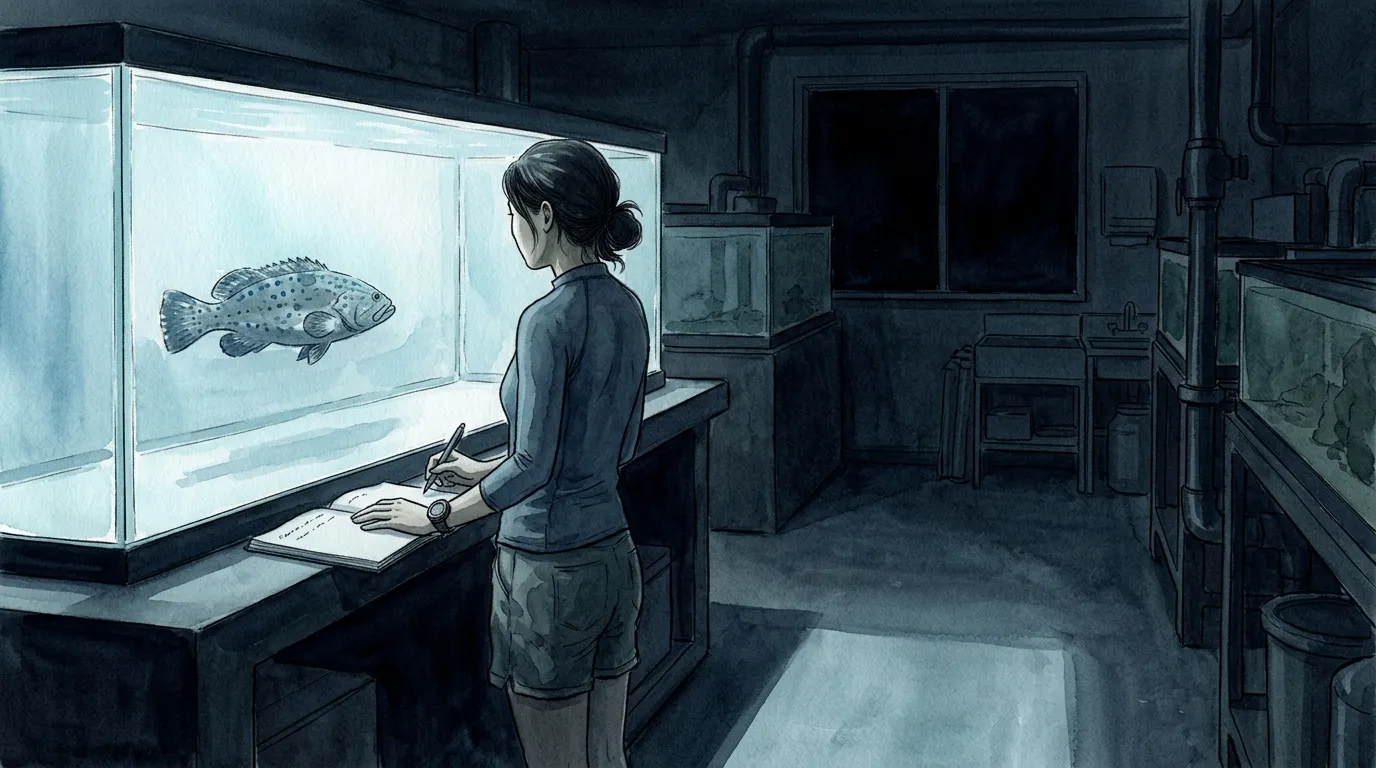
I pushed open the south door of the wet lab. Salt smell and the hum of the circulation pump. I didn’t turn on the overhead lights. Only the tank light — the tank’s built-in lights were on a timer; at this hour they were still running, illuminating everything below the waterline as one long glowing rectangle.
I walked to the first tank on the left and stood there.
The fish tank. The grouper.
About thirty centimeters long. Blue-spotted. Collected eight months ago. It knew me — usually when I approached it would swim over, linger at the glass for a moment, then swim away, then come back. That was our routine.
Tonight I approached and it didn’t come over right away — too late, maybe, or it was already in some near-dormant state. I waited. It noticed me, swam over, reached the glass, stopped for a second — then turned, swam toward the far end of the tank, reached it, turned, swam back, reached the glass, stopped, turned —
That movement — swim to the glass, turn, swim to the other end, turn, swim back, turn — it repeated many times.
I knew what this behavior was. Stereotypies — repetitive, fixed, purposeless movements in captive animals. A stress indicator in environments of prolonged restriction.
I wrote it in my notebook: “Day 4, pre-dawn, grouper, stereo—”
The pen stopped there.
I watched the grouper. Swim to the glass. Turn. Swim to the far end. Turn. Swim back. Turn.
Every morning I go to the monitoring point. Confirm the sensor. Confirm the readings. Confirm the bearing. Record. Return to the main building. Organize the data. Update the cumulative analysis. Every day. Same path. Same actions. Same format. Same fields.
Voltage deviation. Baseline. Consistency. First instance, second instance, eighth — same format.
At the workstation in the dry lab. In that chair. In front of that screen —
Swim to the glass. Turn. Swim back. Turn.
The two images, in my mind, moved toward each other, drew close — something was almost —
I set the pen down on the open notebook and watched the unfinished sentence. Watched the grouper continue on its path through the water.
Where something was almost arriving, my thinking stopped. Like a reading exactly at the error boundary — one small push in either direction and it would become something else, but it stayed there.
I didn’t write more.
I didn’t delete the line either.
The circulation pump hummed. Water moved on the other side of the glass. The salt smell of seawater and a faint trace of formaldehyde. The cold white light of the fluorescents turned the tank into a still rectangle — still from outside, not still inside, where the grouper continued in its back-and-forth.
I stood on the outside of the glass. Pen resting on the notebook. My hand still there, not moving.
Swim to the glass. Turn.
Swim back. Turn.
Outside, to the east-northeast, five hundred to eight hundred meters, fifteen to twenty-five meters underwater, the object remained. The sensor in continuous recording. Reading 0.0%. Baseline. Normal.
I stood here, before dawn, in front of this glowing rectangle, knowing that I had come to know something, knowing that once you know it nothing is the same, knowing that with nothing the same I still couldn’t find the word for what had changed.
This was a particular kind of discomfort.
Its shape was: the certain things, diminishing.
I stood here. In the tank, the grouper continued on its path. Swim to the glass. Turn. Swim back. Turn.
There was an unfinished line in my log.
I didn’t continue.