Chapter 7
Chapter Seven: Habituation
Chapter Seven: Habituation
I. Lockdown Confirmed
Day 4. Morning.
I sat in the wet lab until half past six without turning on the overhead lights.
The tank timer cut off at six on the dot, so after that it was only the diesel generator’s low rumble and the sky outside going pale. I sat in the dark — not asleep, not thinking much, just there.
Seven o’clock. Melo knocked three times.
“Morning,” he said. “There’s an all-hands.”
The all-hands was in the dining room, seven-ten. Takeguchi was there, Priyanka was there, a few other researchers were there, and I was the last one through the door. Melo stood at the kitchen threshold, a fresh pot of coffee at his feet, not moving — the way he had of making coffee available at any moment it might be needed without actively pressing it on anyone.
The liaison was standing beside the whiteboard bulletin board.
“Thank you all for coming in early,” he said. “There have been some new developments I need to share.”
His way of speaking hadn’t changed. Active voice, passive consequences. Every sentence complete, friendly, grammatically correct.
The lockdown was formalized. The Coast Guard security zone had been set up overnight. The FAA no-fly zone notice had been issued. Naval patrols had begun yesterday evening. The research station was officially inside the lockdown perimeter as of today.
“These are necessary measures to ensure the safety of all parties,” he said.
Priyanka was on my left, her notebook open on the table, pen in hand, not writing.
“Regarding the adjustment to your movement range,” he continued, “we need to ask that you temporarily limit yourselves to the following areas: the main building, the associated labs, and your current research monitoring point. The helipad and dock areas have been temporarily designated as restricted zones —”
“Can current research activities continue?” Takeguchi said.
“The movement restrictions do not affect your ability to continue current research activities,” the liaison said.
That last sentence was true.
What “current research activities” had been silently narrowed to mean — I couldn’t confirm. But the sentence itself was true, which left no foothold for objection.
I sat at the table and listened to all of it. No raised hand. No questions. Not because there weren’t any — there were too many, and not one of them could be asked in this room. I knew he wouldn’t answer what I actually wanted to know.
“Any questions, please feel free to find me afterward,” he said. “Thank you for your cooperation.”
After everyone dispersed, Melo brought the coffee pot in and set a few mugs on the table.
I didn’t move.
Priyanka stood, took a mug, walked to the patio, and drank standing up. Through the dining room’s glass door I could see her from behind — the angle of her shoulders, the way she held herself narrow, like bracing against wind. There was no wind.
I sat there, and a thought came to me:
The choice had been taken away by an outside force.
The feeling was strange — a strange kind of lightness. Without a choice, there was no question of “whether to keep going.” No question of “whether I should still be here.”
The lockdown had decided where I was. I hadn’t.
That fact made me think of its other side: if even whether I was here wasn’t my decision, what was the nature of the records I made while being here?
I set that question aside and reached for a mug of coffee.
After the meeting broke up, the liaison lingered at the dining room door until the others had all gone, then walked over to me.
“Doctor,” he said. “Yesterday’s analysis — I’ve passed it along.”
“Thank you,” I said.
“The relevant parties consider this consistency pattern a significant data point,” he said. “The current assessment —” He paused. “The current assessment is that consistent readings are an indicator of no anomalous behavior.”
I heard that sentence.
“Consistent readings,” I said, “as an indicator of no anomalous behavior.”
“That’s correct,” he said. “Stable readings indicate the object is not actively behaving. No movement, no discharge, no signal — these are all favorable indicators.”
A silence opened in the exchange.
I didn’t speak.
What I was thinking: if it has always been like this, then what is it waiting for.
But that was inference, not data. Inside that silence I had no way to do anything with it.
“Thank you for telling me,” I said.
He nodded and left.
I stayed in the dining room a while longer.
Melo cleared a few mugs. Mine was still there; he left it.
“Want a top-up?” he said.
“No thanks,” I said.
He nodded and went on clearing the others. Outside, the sun had fully risen. Priyanka’s silhouette moved from the patio toward her workspace and disappeared.
I thought about something: I had grown accustomed to the liaison’s friendliness, and this had happened without my noticing. On that first day when the liaison arrived, I had sat in the dining room with a feeling of discomfort I couldn’t quite locate — that feeling was still there, but its edges weren’t as sharp anymore. My body already knew what that friendly voice meant: complete sentences, true content, narrowed boundaries.
Once you know what it means, the discomfort becomes a known condition. It moves into the background.
Sitting here, I realized I had grown used to that friendliness. And that was the problem.
II. Movement Restriction Briefing
Day 4. Ten in the morning.
Takeguchi called me over at his office door and said there were things to discuss.
I went in and sat down. On his desk was a sheet of paper — a floor plan of the station, restricted zones marked in red alongside permitted ones.
“The liaison will do a more detailed briefing this afternoon,” he said, “but I want to run through a few things with you first.”
His tone was an extension of that morning’s register — flat, pragmatic, stating accomplished facts.
“You can still go to the monitoring point,” he said. “Advance notice required, two people, back before sunset. Follow the procedure, the location stays available.”
I sat in the chair looking at the floor plan.
“I remember the first call,” I said. “You mentioned their work schedule.”
“Right,” he said. “That’s how it runs, procedurally.”
“My sensor data,” I said. “Transmission cycle is twelve hours. I go confirm readings every morning, organize data in the afternoon — if that requires someone to come along —”
“Me or Melo,” he said. “You set the time, we work around you.”
I nodded.
“Communications?” I said.
“Still by request,” he said. “But the military is trying a new approval process — I asked yesterday, he said approvals within half an hour, as long as it’s not high-sensitivity content.”
“The definition of high-sensitivity content,” I said.
“I asked that too,” he said. “He said, ‘You’ll know it when you see it.’”
We both went quiet.
“That’s it,” Takeguchi said. “This afternoon, if you have questions, ask them at the liaison’s briefing. On the record.”
“Okay,” I said, stood up, walked to the door.
“Qin,” he said.
I turned.
“Did you sleep last night?”
“A little,” I said.
He looked at me. Said nothing more. I walked out.
The afternoon briefing was in the dry lab — researchers and the liaison, no other military personnel. The liaison’s presentation was thorough, clearly structured, warmly delivered: every layer of the lockdown covered — the maritime security zone’s perimeter, the administering authority for the no-fly zone, the new communications request process, the frequency of regular situation updates.
I sat in the second row and wrote it all down.
The format I used was the format I always used for meeting notes: time, attendees, agenda, conclusions, each item in its proper column.
Midway through, I noticed I was using a meeting-notes format to document a military lockdown briefing.
That realization paused in my mind for a second. Then I kept writing.
This was the third thing today that had made me aware of the word “habituation.” I didn’t write it into the notes. Some things, once you write them down, become something else — that feeling I still didn’t know how to process in any format.
The briefing ended. People dispersed.
I closed my notebook and walked out of the dry lab.
Outside, the light was the low afternoon kind — more horizontal than morning light, illuminating every detail on the ground: the porous faces of the reef stones, sun-dried seagrass roots, the route the power cables ran from the main building to the outbuildings. All of it had been there for years, all of it something I passed every day. But this angle of afternoon light showed me some details I didn’t usually notice.
The sensor data was waiting at the workstation.
I walked toward the wet lab, not the dry lab — because I suddenly didn’t want to sit in front of the workstation.
Pushed open the wet lab door. Salt smell. Circulation pump.
The grouper was still in its tank. The daytime lights on, it stayed in the lower half of the tank, not swimming. Typical for this time of day — only active in early morning and at dusk; now it was probably somewhere near a dormant state.
I didn’t disturb it. Stood in the doorway for a moment. Walked out.
III. Returning to the Wet Lab Alone
Day 4. After dusk.
I went to the monitoring point with Melo. Procedure compliant.
The sensor readings were the same as yesterday: voltage deviation 0.0%, baseline, normal. Temperature readings stable. The indicator light blinking, data transmitting.
“You come every day,” Melo said. “It’s the same every time.”
“Yes,” I said.
“That’s not a criticism,” he said. “Just — kind of remarkable. The sameness of it feels more unsettling than if it changed.”
I looked out over the sea to the east-northeast.
“Consistent readings,” I said. “The military reads that as an indicator of no anomalous behavior.”
“Mm,” Melo said.
Silence for a moment.
“But,” he said, “if you just don’t move — that’s also a strategy. Right?”
I didn’t answer.
It was the same question I’d asked myself the day before, but Melo had said it in fewer words.
The sun was low in the west. Reef stone shadows stretching long, the sensor tripod’s shadow slanting crooked across the reef flat, like an inexact pointer.
“Time to go,” Melo said. “Almost sunset.”
We walked back by the procedure.
I didn’t eat much at dinner.
Melo had set everything out in the kitchen — didn’t ask how much I’d eaten, didn’t ask what, just made the food available and let you help yourself. That was his way: creating conditions that could be used, without tracking whether anyone used them.
I ate in the corner of the dining room. Priyanka at another table, two other researchers by the window. The liaison wasn’t in the dining room tonight — either he’d already eaten or he wasn’t in the main building.
Halfway through, Melo came out of the kitchen and sat down across from me.
“Got a minute?” he said.
“Sure,” I said.
“I have a question,” he said.
“Go ahead.”
“If aliens actually showed up,” he said, “do support staff still have to come in?”
I looked at him.
His expression was serious — that particular kind of serious that’s holding something ridiculous in place.
“I mean —” he said, “my job description has a clause that says ‘maintain normal facility operations,’ but this situation feels like it exceeds the scope of the job description. I was wondering if there’s overtime pay.”
I didn’t laugh, but I wanted to.
“There should be,” I said. “Put in a request with Takeguchi.”
“He said the form needs updating. There’s no field yet for alien invasion overtime.”
Neither of us spoke.
“This station,” I said, “has no field for anything.”
Melo nodded.
Then he stood, picked up the mug beside him, said “let me check on the stew,” and went back to the kitchen.
That move — standing up, picking up the mug, giving a reason — I knew that move. It was the move of someone who had said everything they could say, and knew it was time to go.
I stayed in the corner and kept eating, not quite full, but finished.
After dinner, I went back to the wet lab.
It wasn’t planned — when I walked out of the dining room I was heading toward the dormitory. But at the junction between the main building and the wet lab, I turned left.
No particular reason. Maybe because it didn’t require anything from me. Nothing there asking me to open the workstation, organize formats, put things into fields.
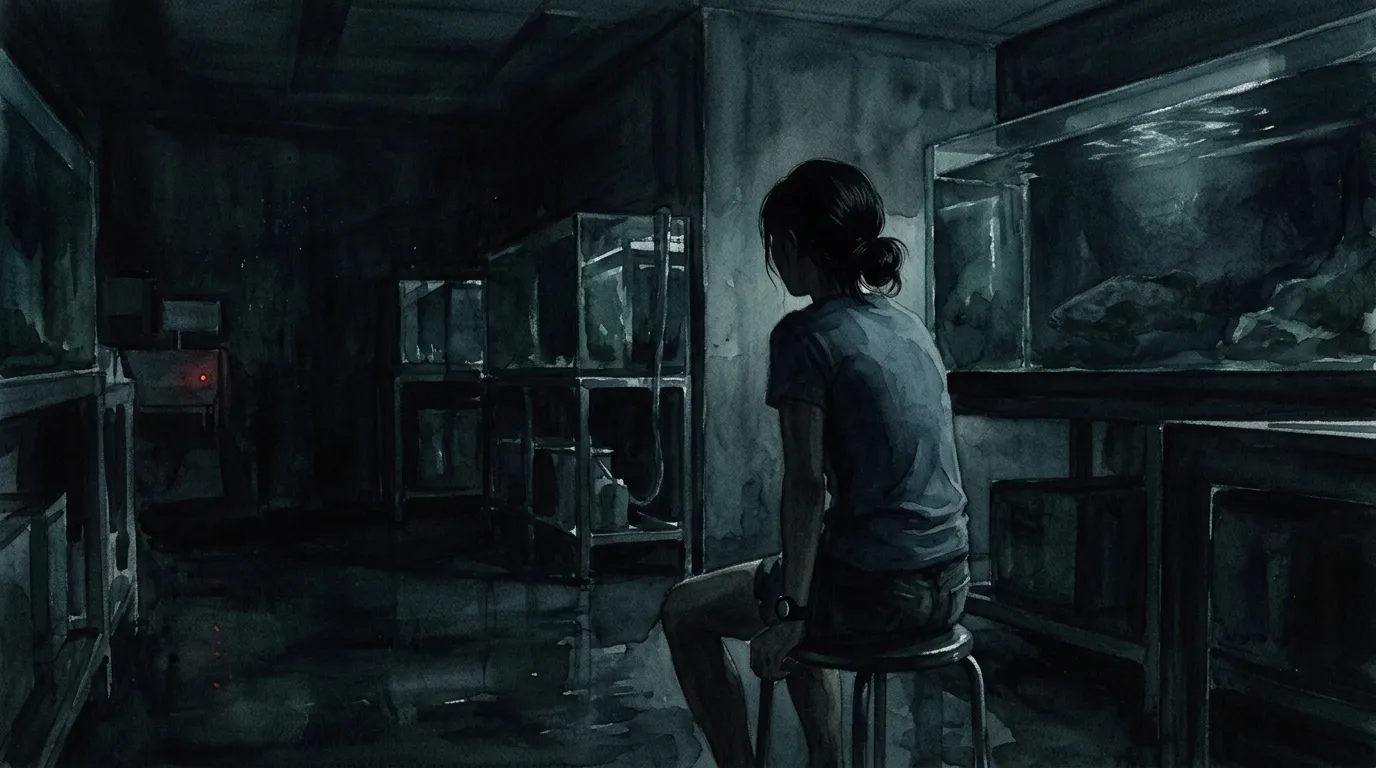
Pushed open the door. Salt smell and the circulation pump’s low hum.
I didn’t turn on the overhead lights. The tank timer hadn’t cut off yet — the tank light still on, turning the water’s surface into a low-lit rectangle, darker than daytime, brighter than full dark.
The grouper was in the tank. Dusk now, and it had grown active again — swimming to the glass, pausing, turning, swimming to the other end.
I stood in the doorway and didn’t approach the tank.
Just being here was enough.
Lockdown confirmed. Movement range adjusted. Communications approval process continuing. These had become established fact today.
The sensors in continuous recording. Readings stable. Same as ever.
“Same as ever” — I realized I had used that phrase in my mind more than once today. The object, same as ever out there. The readings, same as ever stable. The liaison, same as ever friendly. Me, same as ever walking to the monitoring point in the morning, confirming readings, organizing data, returning to the main building.
That phrase entered my language for the first time today as something taken for granted.
I stood at the wet lab door in the dark, thinking about this.
Then I set down my bag, walked inside, and sat down on the low stool near the tank.
No lights on.
I sat there for a while, not taking out my notebook, not checking readings, not analyzing anything.
The tank light was still on. The grouper kept to its routine — swimming to the glass, turning, swimming back, turning. The circulation pump hummed at its fixed frequency, the way it always had.
Outside. East-northeast. Five hundred to eight hundred meters. Fifteen to twenty-five meters underwater. The object was there. Readings stable. Same as ever.
I didn’t know what I was waiting for.
Not waiting for anything, either. Just being there.
The generator’s low-frequency vibration was detectable through the metal legs of the stool — I had never noticed that before. I noticed it tonight because I wasn’t doing anything else; my body’s attention had nothing else to distribute itself across.
The tank timer cut off at nine. The wet lab went fully dark.
I didn’t stand up. Didn’t take out my flashlight. Just kept sitting.
The dark at the atoll was volumetric — you felt it as something with weight, occupying space, an existing thing.
I sat in that existing dark for an hour and a half and recorded nothing.
Later, I turned on my flashlight, walked back to the dorm, and opened my field journal under the lamp.
I stared at the blank page for a while.
Then I wrote:
“Day 4. Movement range adjusted. Sample condition stable. Same as ever.”
I capped the pen, closed the journal, set it on the nightstand.
Outside, the generator was still rumbling. Low. Steady. Same as ever.
You live with that sound long enough and it becomes a signal of safety — it’s when the sound stops that something is wrong.
I listened to it and closed my eyes.