Chapter 8
Chapter Eight: Reflection
Chapter Eight: Reflection
I. Re-reading
Day 5. Morning.
When I woke, the journal was on the bedside table, exactly where I’d left it when I closed it last night.
The generator was still running. That sound helped me sleep last night. This morning it tells me I’m still here.
I lay there for a while without moving.
The fatigue was still in me, but that thing from last night’s darkness — the thing that had sat for an hour and a half without recording anything — it was gone now, or had moved into a different form. I couldn’t say what form. Only that something had shifted its position. The way it feels after you’ve moved something heavy: the weight is still there, but now it rests somewhere else.
I got up, washed my face, picked up the journal, carried it to the dry lab.
The dry lab at seven in the morning: the AC holding at 22 degrees, compressor humming, white light from the fluorescents, my workstation along the south wall toward the main building. Priyanka wasn’t there. Probably in her workspace. My blue ceramic mug sat to the right of the work surface, chip at the base face-down, yesterday’s coffee still inside, already cold. I thought briefly about making a fresh cup, then didn’t.
I set the journal on the work surface and opened it.
First page. Day 0, 23:41.
“Light point, first recorded. Bearing east-northeast, elevation approximately 12–15°, descent duration approximately three minutes. No light after descent. First voltage deviation — amplitude 0.14%, duration approximately two seconds, returned to baseline. Heart rate approximately 90–95, mild hand tremor, assessed as acute stress response, recorded. (Note for potential retrospective use: the observer’s own physiological state is one source of error. Recorded here for reader evaluation.)”
I stopped when I reached “heart rate approximately 90–95, mild hand tremor.”
That parenthetical — “the observer’s own physiological state is one source of error” — I remember the voice I was writing in when I wrote that. Dry. Precise. Logging my own trembling hands as an interference variable. I thought at the time I was doing the right thing: cataloguing every factor that might compromise data reliability, so readers could make their own assessment.
What was she thinking when she wrote that?
I thought for a second before realizing: “she” was me.
I turned a few pages and found the Day 1 entry: “VSAT bandwidth throttled, upload progress 7%, estimated 2–3 hours. Waiting.” And then a parenthetical: (Waiting is a strange kind of work — it is work, but it has no shape of work. While I was waiting I thought: if what happened today were ever recorded, what would it feel like to be the one recording it. Then I realized the person recording it was me, and that thought made me slightly dizzy.)
I remembered writing that parenthetical, but the version I remembered was different from the one I was reading now.
The version I remembered: a scientist passing time in the waiting hours, self-observing, wrapping a briefly philosophical thought in parentheses, then continuing to work.
The version I was reading: someone who had already begun to feel observed, using “made me slightly dizzy” to skirt around it, and then continuing to work.
The difference is where the reader stands. She was standing inside the parenthesis. I’m standing outside it now.
I turned to the Day 3 pages.
The handwriting had changed. I could see it was the same pen, the same person — but the spacing between lines was tighter than the earlier pages, the whole spread looking more compressed, as though something had been pressing inward.
Those pages read slowly.
The re-reading notes for the paper were up front: one passage in Chapter Three circled in pencil, a question mark beside it, written harder than usual. Then a paragraph with no heading, no bullet points, flowing:
“If something was watching me then — even without my knowing — I would have started performing. Pretending not to know is performance. Acknowledging you know and then adjusting is also performance. Performance has no exit.”
Then a few half-finished sentences, like rough drafts, incomplete. The observation log for the grouper’s stereotypies broke off mid-entry, skipped to a new line, started again from somewhere else, never closed out.
I stopped when I reached this.
When she was writing these pages, did she know her language was leaking? Or could she not see the cracks — did she think she was still recording normally, just a little scattered?
I turned forward a page and looked for a while.
Only now did I know: Day 3 was where she began to lose her ability to finish a sentence. She was too deep inside it then to see that.
Day 2’s page.
It took me a while to find it — the passage was written in the personal notes section at the back of the journal, outside the formal fields. The standard fields that day held a clean, bullet-pointed summary of the voltage and temperature parallel analysis, two hypotheses, neatly structured.
The personal notes came after the analysis summary, in a different register:
“I may have encountered something important today, but I can’t say what it actually is. What I’m trying to say is — I’m not sure what I’ve been observing all along is actually what I thought it was.”
Professor Chen’s contact information was written beside that passage, in a different pen, a little smaller than the main text.
I read the passage twice.
I knew why I hadn’t sent it. After writing it, I’d closed the notebook and gone back to filling in the environmental data table for that day, spent a little extra time on it, glanced at the passage twice, didn’t send it, didn’t delete it. The reason I didn’t send it — I can say it clearly now.
I know now why I didn’t send it.
At the time that passage couldn’t name what “that thing” was. Now I almost know. Not completely, not yet — but almost. The distance between almost knowing and can’t yet say has shrunk. The moment to send it has passed, because the question has taken a new shape. It’s no longer the question those words were asking.
I read the passage one more time, then closed the notebook.
The last page.
“Day Four. Activity range adjusted. Sample stable. Same as ever.”
I stared at that line for a long time.
She — I — wrote that line as a journal entry, as information, as a record. But reading it from outside now, what I read is something else: a person compressing language to its smallest possible size, keeping the maximum distance between the words and the blank space around them, so the blank space wouldn’t fill up with things she hadn’t meant to record.
“Same as ever.”
I’d used that phrase several times yesterday. Used it without noticing.
It means: “Not worth recording, because it’s exactly the same as last time.”
But I’m reading it now, and I know nothing yesterday was the same.
II. One Last Time
Day 5. Ten-thirty in the morning.
I opened the VSAT communications interface at my workstation, and in the request field entered: general notification, recipient: Chen Haotian (doctoral advisor, Monterey Institute of Marine Research), content: research progress update.
Waited eighteen minutes. Approved.
I opened the compose window.
The cursor blinked there. I watched it.
The communications log above held two years of exchanges between me and Professor Chen — progress reports, sampling data confirmations, a few discussions about publication strategy, one message where she had called to ask whether the typhoon track had affected the atoll, and I said I was getting enough sleep, and we both knew I wasn’t.
The cursor was still there.
I turned the journal to the Day 2 passage and propped it beside the screen, looked at it for a moment.
I knew what I wanted to say. What I couldn’t figure out was why I wanted to say it.
— Let her know what had happened here? She already knew. She’d probably seen the NOAA report.
— Give her some reassurance? What would that even reassure. The things she’d be worried about couldn’t be relieved by a message.
— Confirm something for myself: that I could still speak to her. That this channel still existed. That I was still the person I knew myself to be — the one who writes to her advisor.
That thought sat in my mind for a second. Then I knew it was right, and I knew it explained why I’d opened the compose window in the first place.
I closed it.
No request cancelled. No message sent. Just closed it.
The passage was in the notebook. That was enough. I knew the thing was almost ready to have a name. When it had a name — that was when there would be something worth saying.
III. Takeguchi
Day 5. Afternoon.
I ran into him in the main building corridor.
He was coming out of his office, a folder in hand, headed in the direction of the dry lab. I was coming from the other end.
“Morning,” he said — then caught himself, registering it was already afternoon. “Have you eaten.”
“Yes,” I said.
A pause.
He didn’t keep walking. Neither did I.
“Did you go to the monitoring point today?” he said.
“This morning,” I said. “Readings same as yesterday.”
“Mm,” he said.
Then he tucked the folder under his arm — a habitual gesture, like someone deciding on a next step.
“Come sit for a bit,” he said, nodding his head back toward the office. “No agenda. Just sit.”
I wasn’t sure whether I should say I had something to get to. I thought for a second, confirmed I had nothing pressing, and followed him in.
The office looked the same as a month ago, the same as a year ago. The map of the atoll’s reef on the wall, paper edges slightly yellowed, pinned to a corkboard. To the left of the work surface: this year’s administrative files, stacked to a certain height, not disordered, though you could see the orderliness had been trained into existence over time rather than coming naturally. A small desk fan pointed at his chair, running on its lowest setting — barely enough for you to feel the air moving, not enough to actually cool anything.
He sat in his chair. I took the one across from him.
No one spoke first.
I’d had this kind of silence in his office before, but in those instances it came after he’d said something specific — the silence was a coda to that particular thing. This silence preceded anything at all.
“What are you working on,” he said. “Today.”
“Reading the journal,” I said.
He waited, without pressing.
“My own,” I said. “From the beginning.”
“Mm,” he said. “Find anything.”
I thought about how to answer that.
“The person,” I said, “wrote more than she thought she was writing.”
He didn’t say “that person is you.” He let the sentence sit there.
“I know,” he said. “That’s usually how it goes. You’re editing while you’re recording. When you go back and read, you’re reading the whole thing for the first time.”
I hadn’t expected him to say that.
“Has that happened to you?” I said.
“Yes,” he said. “First year as station director, I printed out my daily work logs, kept them by month. Third year, I read everything from the first two years.” He paused. “You know what surprised me most? Things I thought I already knew — reading the logs, I realized I actually hadn’t. That gap was invisible while I was in it.”
The light outside was afternoon light, slanted, catching a few pools of water on the reef surface and turning them to flat glare. The fan continued at low speed.
“Do you regret staying?” he said.
The question landed heavier than I’d expected.
I had an answer ready. It had already taken shape in my mouth: “No, this is my research, my data, staying was the right decision, whatever this thing turns out to be —”
But what came out was:
“I don’t know.”
The answer stopped me for a moment too.
Takeguchi rested his hand on the back of his chair and said nothing. He was just there, letting the “I don’t know” stay in the air.
After a while, he said:
“Mm.”
“Me neither,” he said.
That “neither” landed, and I felt something I couldn’t name.
We sat there for a while.
Without speaking.
Later he stood up, said he was going to check the routine antenna report, did I want to come along. I said I was fine, I’d go outside for a bit. He nodded. I left.
The corridor was brighter than the office. I had to blink.
I walked outside without any particular direction.
IV. In Front of the Tank
Day 5. Night.
I had dinner with the others in the dining room, didn’t talk much with anyone — not deliberately, just no occasion that called for talking.
The liaison was there tonight, finished eating and left, friendly, quick about it. Priyanka was at a window seat, left partway through, probably heading back to her workspace.
After dinner, I walked to the wet lab.
It was already night. The timed lights were still on — about an hour before they’d switch off. The smell of salt hit me in the doorway, just like always. I took inventory of the lights and the pump sounds; everything the same as yesterday, same as every day.
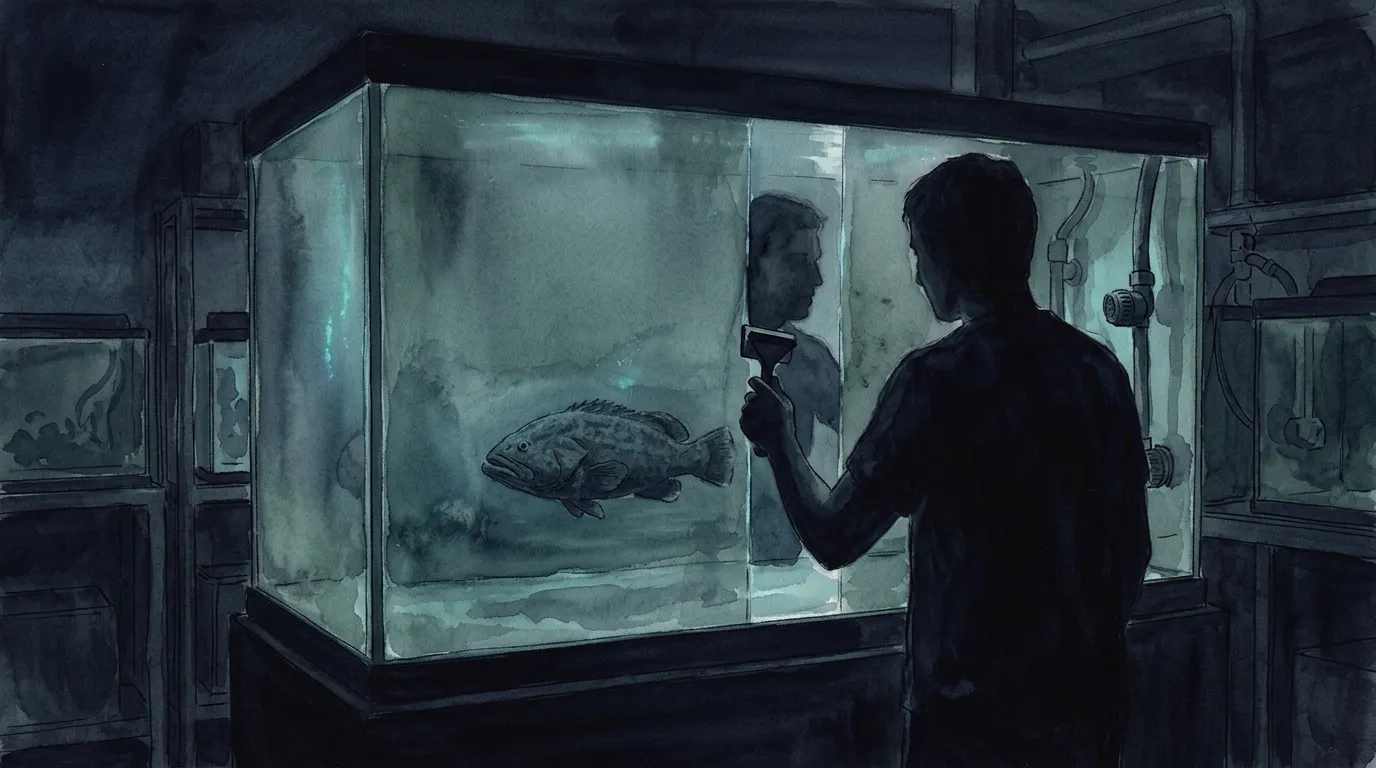
The algae scraper was on the metal rack where it lived.
Last time I’d cleaned the tank was four days ago, Day 1 morning — before the light point descended, back when I was cleaning the grouper’s tank because the maintenance schedule said to.
The schedule probably said to clean it today too. I hadn’t checked the schedule. I came anyway.
I picked up the algae scraper and walked to the leftmost tank.
The grouper was near the bottom. At this hour it was in the threshold between day and night — not especially active, not especially still. The timed lights had dimmed; the surface light was low, catching the algal film at the very bottom edge of the glass in clean relief — a thin layer, sky-blue-green, probably started forming yesterday.
I pressed the scraper against the glass, ready to begin.
The grouper, slowly, turned onto its side. The circulation current came in from the right; it habitually angled its flank toward the flow, letting the water pass over its gill covers. An ordinary behavior, one I’d seen hundreds of times, one I knew the meaning of.
My scraper was against the glass. I hadn’t made the first stroke yet.
It was moving, on that side. I was on this side, still.
The pump hummed. The circulation water’s soft murmur came continuously from the right side of the tank. The grouper’s arc of movement was tiny — barely a shift in center of gravity — but in the low light it brought its whole flank to a new angle. I watched that angle change. My hand didn’t move.
Four days ago I was here, cleaning, and then wrote one line: “What observation means to the grouper — to be answered.”
At the time, I thought that was a question about the fish.
Now I know it isn’t only that.
The grouper moved a little closer, stopped near the glass, maybe two body-lengths from the scraper. The fish’s perspective is different from mine — it senses light and current, not faces. But it was there, on its side of the glass. I was on mine.
I was watching it.
It was there, in the place it was.
Something I couldn’t quite think through, or had stopped trying to think through. The journal re-reading, the message that never left, Takeguchi’s “me neither” — these had arranged themselves into something today, a configuration that wasn’t an answer but had a shape to it. A shape I recognized, even if I couldn’t name the shape.
I moved the scraper to the glass and made the first stroke.
The glass cleared along that line — algal film receding, transparency appearing, the light from inside the tank passing through, a narrow strip now cleaner than before.
I looked through that transparent strip to the other side of the glass.
On the other side was my own reflection.
Incomplete — just a strip, narrow — but enough. My outline was there: dark, in profile, one hand raised holding the scraper.
I was looking at the person in the glass.
That person faced this direction too.
I kept cleaning.
Slowly. Stroke by stroke, the glass going transparent in increments. The pump hummed. The grouper moved to the far side of the tank, then back, its own rhythm. The timed lights held. Not yet off.
Halfway through, I stopped once and looked at the glass — the part I’d cleared, algal film gone, the reflection more complete on that half.
It took me a moment to recognize myself in the mirror.
Then I kept going.
Afterwards I put the scraper back on the metal rack, walked to the doorway, and stood in the corridor for a moment.
The atoll’s night sky was full of stars — clear air, sea wind at its ordinary pace, the generator’s low-frequency vibration coming up through the ground, steady.
I didn’t look back at the tank.
But I knew the lights were still on in there. The grouper was still there. The glass was clean.
I walked back toward the dormitory.
Tonight I’m going to open the working log and write more. More than one line.
I’m not sure what to call what gets written. Maybe there’s no format for it. Maybe no field to put it in.
But that’s fine.
Tonight I’ll allow that.