Chapter 9
Chapter Nine: In the Tank
Chapter Nine: In the Tank
I. Cleaning
The algal film was back.
I stopped for a second in the wet lab doorway, looking through the glass at the leftmost tank. A thin layer — sky-blue-green, pressed flush against the bottom edge, spreading neatly out to both sides. It takes a few days to grow back like this. A few days had passed. The algae remembered.
I pushed open the door. Salt hit me first.
The station’s weekly rhythm had returned a little — not fully, more like a version of itself with the volume turned down. Voices in the dining room, footsteps in the corridor, the dry lab compressor humming from where it was supposed to be. My working log had a new line every day, not many words, but what I was writing was different from the days before — those days I’d been writing same as ever. These days I was writing something else.
That morning I went to the reef flat for routine sampling. Water temperature normal, salinity normal, benthic algae species richness within the recent average range. The sensors were where they were supposed to be; the numbers were in the fields they belonged in. I entered the numbers into the database, ran QC, no outliers.
I’d also continued checking the observation log for the object every day. Walk over, record the numbers, walk back. The numbers were the same as the day before each time — I knew this was expected, the consistency itself was data, I recorded it. Only now when I recorded it, something about the way I did was different from before. I couldn’t say where it was different. Only that my hand moved at a slightly different pace when it wrote those numbers — not faster, not slower. Just different.
The seawater circulation pump was humming. The timed lights were still on — maybe an hour and a half before they cut off.
I went to the metal rack and took the algae scraper. Wooden handle, two years of moisture had swelled it slightly. Solid in the grip.
The grouper was in the lower right of the tank, close to the center line, still.
This was its usual posture at this hour — on the threshold between day and night, waiting. I’d seen this posture hundreds of times over four years. I knew what it meant, or I knew it didn’t mean anything, that it was simply there, in the place it was, doing what it did in that place.
It was a blue-spotted grouper. For a while I used to remember the collection date, remember the initial length estimate, remember how long it stayed at the bottom the day I put it in the tank before it finally swam. Then I stopped keeping track. It was still here. I still cleaned this tank.
I pressed the scraper against the glass, starting from the upper right corner.
The rubber blade met the glass — one low resistant sound — and then the resistance was gone, and a strip of glass went clear.
The grouper didn’t move.
On the third stroke, the grouper shifted direction, slowly.
Slowly — the kind of shift that starts from the center of gravity, the whole body changing angle in the low light, presenting its flank to the circulating current from the right. Gill covers opened, closed. A stereotypy — I’d logged it in the working journal, swim-end-turn-return, months of entries, still noting it now.
Habituation. It had habituated to the current, to the look of me approaching, to the sound of the algae scraper.
I continued to the fourth stroke.
At some point I noticed I was thinking about a question: what it had habituated to. The behavioral definition of habituation I knew — repeated stimulus, decreased response, measurable. What I was asking now was a different question: once it had habituated, what shape did that habituation take, from its side.
Then I recognized the question had no answer, and continued to the fifth stroke.
Halfway through, the glass had cleared a window.
Not complete — about half the surface — algal film receding, transparency appearing, the water-light from inside the tank coming through that half, much clearer than before.
I looked in through that window.
The grouper was on the other side, its markings distinct. I’d seen those markings hundreds of times. I wasn’t looking especially carefully today, but they were there, on the other side of the glass.
Then I saw the other side.
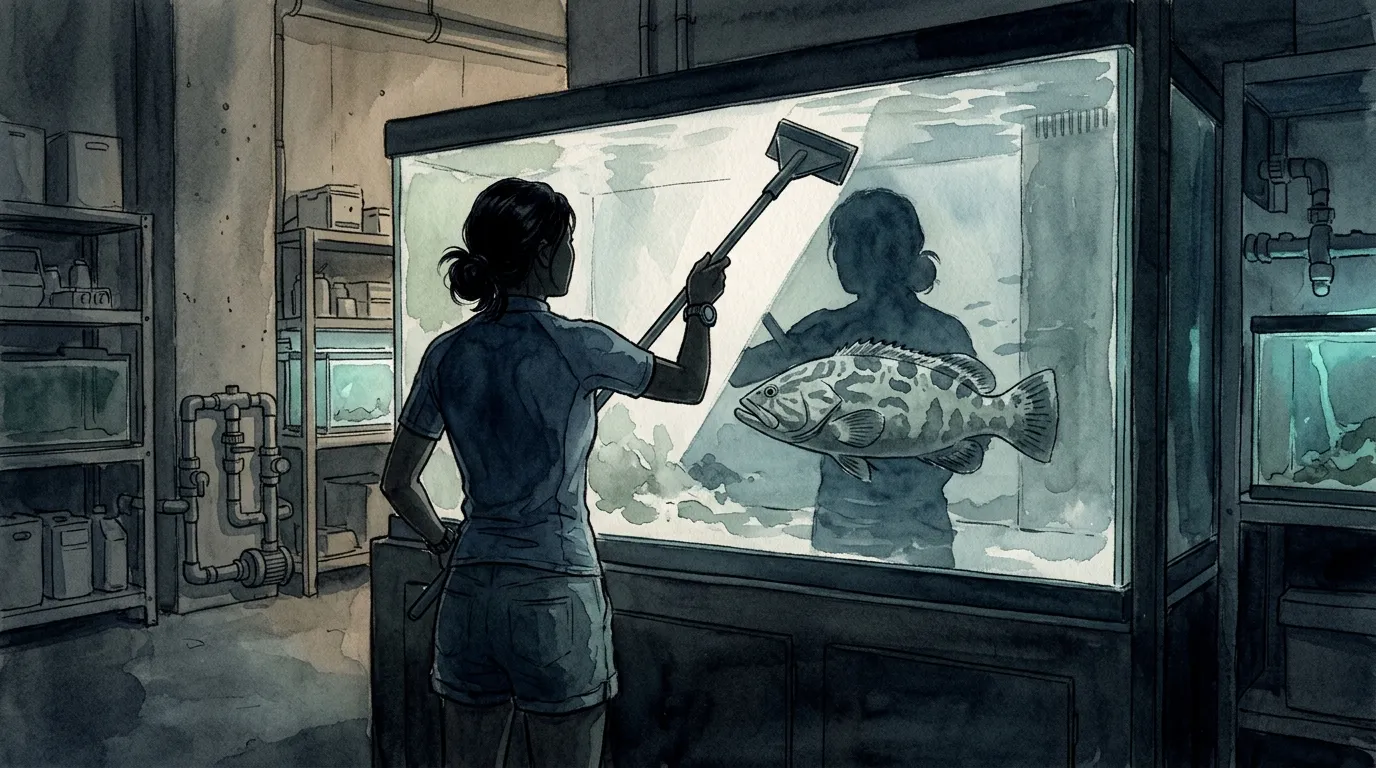
The cleared area on the glass caught the light and the air behind it — the light from the big window on the north wall of the wet lab, mixed with the white of the indoor fluorescents, overlapping at this angle on the glass, turning the glass itself into a mirror.
My outline was there.
Blurred, dark, a silhouette — one hand raised holding the scraper, the shape of a head.
I was looking at that outline. That outline faced this direction too.
Inside the tank: a fish. Outside the glass: me. On the glass: both of us.
Where was I.
I looked, for a long time.
Then I continued scraping.
Seventh stroke. Eighth. Ninth.
The scraper against the glass, back and forth. Resistance gone, transparency appearing. The pump humming. The grouper turned, drifted to the center of the tank, then slowly made its way back to the right. My hand moving, the sound of the rubber blade almost nothing — barely felt as resistance rather than heard as sound.
Something was aligning, very slowly, the way a submerged thing finds the bottom where it was always going to rest.
I continued cleaning. My hand didn’t stop.
My reflection moved with me — rubber blade up and down, the outline growing more complete as more of the glass cleared. I was clearing algal film. My mirror image was clearing algal film. The grouper inside the glass drifted a slow circuit around the center of the tank and swam back to the right.
Three things, at the same time, on both sides of one pane of glass.
I hadn’t thought it through. I didn’t need to.
Four years. I had spent four years at the atoll, cleaned this tank hundreds of times in this lab, stood outside the glass recording the fish — recording water temperature, salinity, the grouper’s behavior, recording my own physiological state as an “error variable,” putting everything that could be recorded into a field, wrapping it in format, wrapping it in analytical layers, wrapping it in pending and requires follow-up.
I was outside the glass. The fish was inside.
That line I had always known. Clear, no need to think about it, just there.
My reflection was on the glass.
I thought of the Day 2 passage that never got sent: “I’m not sure what I’ve been observing all along is actually what I thought it was.”
At the time I couldn’t say what that “thing” was.
Now I know what I was saying. I just wasn’t here yet then.
I thought too of what Takeguchi said: You can’t see the gap while you’re recording. You only see it when you go back and read.
He didn’t say what to do after that. Maybe there’s nothing to do. You just know, and then you continue.
I continued scraping. Resistance gone, transparency appearing. A motion I’d made hundreds of times, still making it today.
The last few strokes, and the glass was almost fully clear — only a faint trace of algal film in the far corner. I cleared that too. The scraper crossed that last position, resistance gone, and that corner went clear as well.
I stepped back and looked at the whole pane.
Clean. Transparent.
The grouper was at the right side of the tank, flank to the current, gill covers moving in their slow rhythm. My reflection filled the whole glass now, more complete than before — a dark outline, the white of the station’s fluorescents wrapping it from behind, the shape distinct.
On both sides of the glass, we were both there.
II. The Last Entry
I put the algae scraper back on the metal rack.
The timed lights cut off while I was walking toward the door — one soft click, the wet lab fluorescents went dark, leaving only the low-frequency hum of the seawater circulation pump and the line of corridor light coming through the gap under the door.
I stood there and let my eyes adjust.
The grouper’s tank still held a faint glow. The tank had a low-wattage maintenance light, separate from the timer system, on all night. Dim — but enough to see there was water, and a fish.
The glass was clean.
I didn’t switch the overhead lights back on. I just stood there for a moment.
The wet lab in the dark had its own sounds: pump humming, the refrigerator compressor cycling on occasionally, the generator’s low frequency coming up through the floor from somewhere farther off. Salt. The smell of metal and rubber. Four years I had worked here in daylight, had come here at night too, hundreds of times. Standing in it now — dark, familiar.
The night outside.
The trade winds were still coming from the northeast — always from there, same next month, same next year. The generator’s low-frequency vibration came up through the floor, somewhere in that steady band between 60 and 80 hertz. Four years I had slept with it and woken with it. Now it was in the soles of my feet, steady as ever.
Voices somewhere on the corridor side, too far to make out. The light from the direction of the dining room filtered through the corridor and fell in a thin strip along the door gap.
I pushed the door open.
The corridor light made me blink.
Priyanka was at the far end of the corridor, carrying something, heading toward her workspace. She didn’t see me, or she saw me and didn’t say anything. I didn’t either. We passed each other like that. This was how it had been lately — everyone in their own work, the station settling back into its rhythm, each person’s rhythm also returning, overlapping but not merging. That was fine.
Walking to the dorm.
A minute and a half — I knew that distance, had walked it hundreds of times. No need to count steps. My feet knew.
Halfway there I stopped.
Nothing particular. I just stopped.
Stars overhead, clear night, dense with them — the nearest human settlement was over a thousand kilometers out, and below that threshold of distance light pollution was nearly nothing, so the stars were the kind that press in. I had been looking at the atoll’s stars for four years. The first month I came out every night, to the reef flat or outside the main building, head tilted back, standing there, sometimes for a long time. Later I came out less. Habituated.
Habituated.
I tilted my head back and looked.
The stars were still those stars.
I was here, feet on the concrete, the generator’s vibration coming up through the ground into the soles of my feet, the trade wind coming in from the northeast carrying the salt of the reef rock, same as before.
Everything the same as before. Everything not quite the same.
Just looking at it.
Then I kept walking.
My working log was on the desk in the dorm — blue cover, thick, half used. The blue ceramic mug sat beside it, empty, chip at the base facing out.
I sat down in the chair and turned to the next blank page.
The blank page was clean — lines printed, fields printed, a Date: box in the upper right corner, a Weather: box beside it, then the main field, then the notes column, then the environmental data column.
I flipped back through the last few pages. Recent days. Daily entries: environmental data, sample processing, observation reports. The handwriting neater than the Day 3 pages, spacing more relaxed than the Day 0 pages. No half-finished sentences. No observation cut off mid-way. Written, closed, opened again the next day on a fresh page.
A few nights ago I’d said I was going to write more. Looking at what I’d written these past few days, there was indeed something in it that hadn’t been there before. The format still there, the fields still there — but what was in the fields had shifted slightly. I hadn’t set out to change it. It just changed on its own.
I picked up the pen.
In the Date: box, I didn’t write a number.
Tonight’s entry was a single line.
No water temperature. No observation results. No error log. No parentheses. No pending.
What I wrote was:
“On both sides of the glass, we are both watching.”
I closed the journal and set the pen back on the desk.
The generator’s low-frequency vibration came up through the floor, steady, same as the first day.
The sea wind was outside.
The grouper was in the wet lab, at the right side of the tank, flank to the current, gill covers moving in their slow rhythm. The glass was clean, transparent — on both sides.
The object was somewhere out on the atoll, consistent, same as it had always been.
I was here. In this chair. In this field. In this station. On this atoll in the middle of the Pacific.
Right here.
That was enough.