Chapter 1
Onboarding
Chapter 1: Onboarding
The Bannan Line in January: cold air on the platform, warm air in the car, and your nervous system catches up every time you step in or out.
I wasn’t playing anything. Earphones in, nothing running. It means I don’t have to respond to the world around me. Some people use earphones to hold a seat. I use them to hold my own perimeter. Not much difference, practically speaking, but it feels different.
I transferred to the Bannan Line at Taipower Building station. Found a spot by the doors, kept my bag in my lap, and ran my thumb across the crack on the side of my phone case. Horizontal, upper right corner. Fell two months ago. Hadn’t gotten around to replacing the case.
Today was my first day.
I’d confirmed that fact three times before leaving the apartment, and each time I confirmed it I just went back to whatever I was doing, as if the confirmation itself accomplished nothing — just some kind of ritual. I packed a metal pen cup with a few pens and put it in my bag. I hesitated for a second, then left it in. Having a few personal things on the desk makes it easier to feel like you’re still somewhere.
Nangang Exhibition Center station. The cold outside had weight to it. I walked close to the building walls — long stretches of gray, one corporate tower after another, each entrance looking more or less the same: glass doors, a small logo, a security desk. I found the right building, went in, took the elevator to the eighth floor.
The elevator opened with a clean chime, a single ding, like an announcement.
To the left of the entrance was the visitor check-in desk — glass surface, an iMac, a woman typing without looking up. To the right, a white wall with a 65-inch landscape display, cycling through a few panels: Employee of the Week (three names, each paired with a quoted Kudos message), OKR Status (three lines, all green), Today’s Mood (85% sunny), and a welcome banner: “Welcome, Ivan Pei — Day One!” with a photo HR had clearly prepared the day before. They’d used my LinkedIn headshot.
I scanned the three names on Employee of the Week, quickly. Mine wasn’t there. Of course it wasn’t.
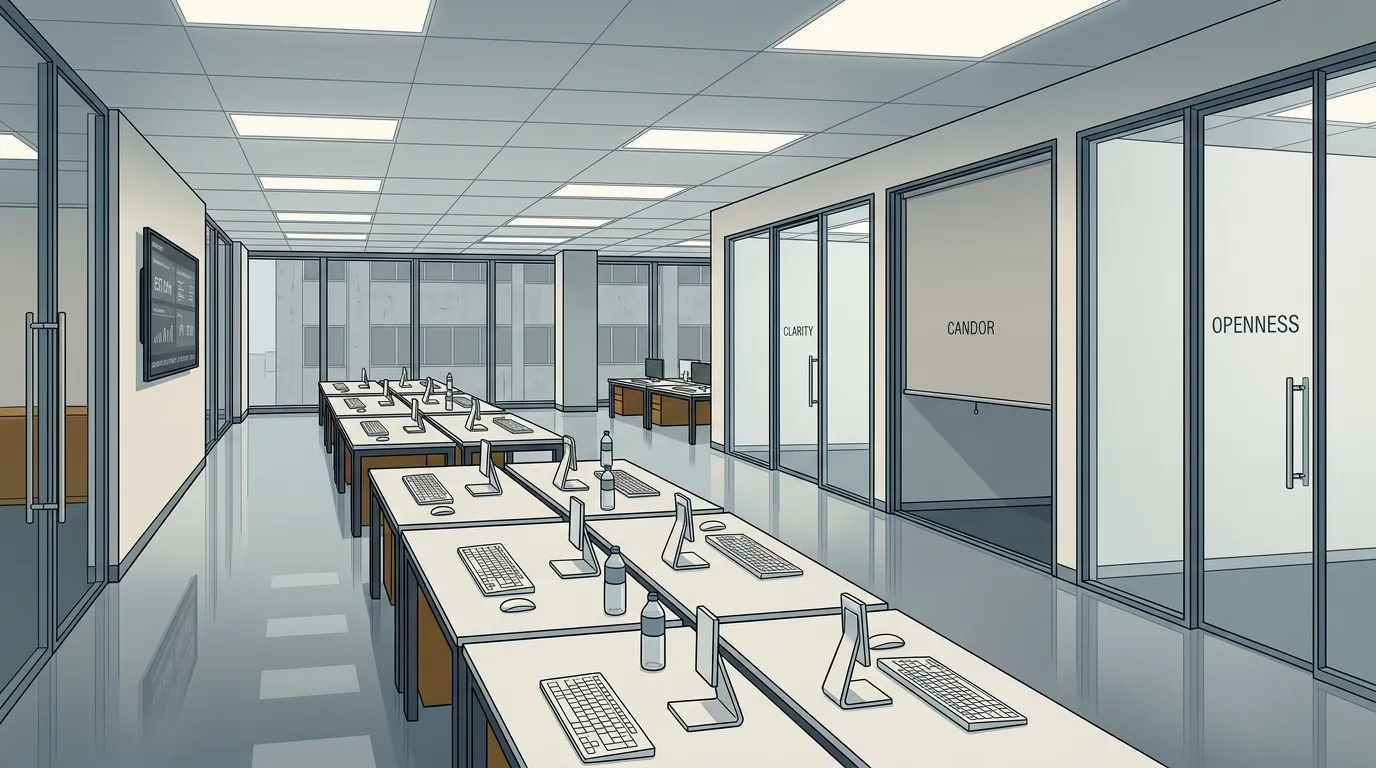
Through the glass revolving door, the open-plan workspace spread out in front of me. I could see the farthest desk from where I stood. This was a deliberate spatial statement: you can see everything, which means everything can see you. Long worktables arranged in clusters of four to six, no partitions. Uniform white keyboards. Uniform monitor arms. Nothing extra on the desks — no photos, no trinkets, a water bottle at most. 4000K white light falling evenly from above, no corners, no shadows.
The pantry was near the elevators, trailing the scent of espresso. It was 8:53 a.m. Nothing had officially started yet.
Yolanda Chen appeared from somewhere to my left, smiling, hand already extended. “Ivan Pei! Welcome, welcome — I’m Yolanda, People Ops.”
Her hair was permed into soft curls, each one identical to the last, as though the same subroutine had run on every strand.
“Hi,” I said, and shook her hand. “Thanks for the welcome email yesterday.”
“Of course! Today is full, but it’s a good kind of full.” The way she said it, she genuinely believed “a good kind of full” was a real and specific thing.
The tour started at the entrance and looped through the workspace. Three glass-walled meeting rooms, each named on the door: Clarity, Candor, Openness. One had its roller blind down, but Yolanda said “people usually leave them up” — phrased as an option, but the kind of option that made clear it was rarely exercised. The pantry: espresso machine and capsule machine, labeled shelves in the fridge. Restrooms at the far end of the workspace, deep gray doors with metal handles, full-height, and Yolanda just said “men’s and women’s, left and right” before moving on. The engineering section ran along the long window-side wall, with a view of the exterior of the adjacent tower. Light, but no view.
“This is your desk,” she said, pointing to a spot roughly in the middle of the engineering section. “The desktop and external monitor are set up. System permissions won’t come through until this afternoon, but go ahead and plug in your laptop.”
I set down my bag and placed the metal pen cup on the corner of the desk.
“Whoa, very vintage.”
I turned. At the next table, a round-faced guy with a slightly heavy build was looking at the cup, expression genuinely delighted.
“Lin Tai-cheng — everyone calls me Theo. Engineering, your team.” He nodded at the cup. “Did you bring that on purpose?”
“Just grabbed it,” I said.
He nodded, as if this were a meaningful answer. I looked at the pen cup for a moment and had a brief impulse to put it back in my bag.
The core values assessment took place in one of the empty meeting rooms — one of the three glass-walled ones, blind not drawn. Yolanda set a tablet in front of me and said there were twenty questions; just let her know when I was done.
I spent about thirty minutes filling it out, and I filled it out carefully.
Likert scale, one to five. Questions like: “When you disagree with a colleague, you tend to…” followed by five options ranging from “address it privately” to “raise it immediately in front of the full team.” Also situational prompts: “Describe the last time you expressed discomfort at work. What was the context?” That one made me pause. I thought about it, wrote “retrospective meeting,” and moved on.
When I was done I went to find Yolanda. She took the tablet, glanced at it, and looked up with a smile. “Your results are in.”
“How’d I do?”
“Everyone’s answers are different,” she said, with complete sincerity, “but the outcome is always the same: everyone’s a good fit.”
I held eye contact for a moment to confirm she was serious. She was.
On the walk back to my desk I spent a few seconds working through the logic: if every set of answers maps to the same result, then the purpose of the assessment is… I got halfway through the thought and let it go. Thirty minutes, done, move on.
The introductions happened in a semi-separated corner of the open workspace, about eight people gathered around a low informal table. Six existing employees, two new hires starting today — me, and a product designer named Dana, who’d been working in Singapore. Yolanda stood at the front and explained that the onboarding group would be with us all day, lunch included, and we could ask them anything until end of day.
“We have a small tradition,” she said. “Everyone shares one true thing about themselves — not something that’s on your résumé. Could be something you like, a habit, anything.”
Before my turn, the others said: likes hiking, hand-sews a garment every month (the product designer said this with a hint of pride), hates being in the sun, has three cats. Then Jasper, a backend engineer, paused, said “I’m learning woodworking,” and seemed to need a beat to make peace with the choice before settling back in his seat.
Then it was my turn.
“I like horror movies,” I said.
“What kind?” someone asked.
“Mostly psychological. Not really into gore.”
A few people nodded with that that tracks expression. Nobody followed up.
Back at my desk, I started setting up the environment, and the question was still running somewhere in the background.
I was replaying why I’d gone with that instead of something else.
I’d almost said I’m studying Japanese — also true — but if I said that, someone would ask how far along I was, and I’d give a level, and then there was a thread someone could pull. “I like horror movies” was true, and it was also a thread that goes nowhere unless the other person is into horror too. You can’t really follow up on it.
I ran through the logic and confirmed: I had chosen something that was both true and conversation-terminal. A precise choice. I just wished I’d said it off the top of my head instead of arriving at it through calculation.
Slack notifications started coming in — one, then another, then another. I was added to seven or eight channels, welcome messages streaming in like water: #general, #engineering, #kudos, #feelings-check-in — with a brief description: “Check in every morning between 9 and 10. Pick a weather emoji for your current state. ☀️🌤⛅🌧⛈”
I looked at the five options. Wide range, I thought. But no option for nothing in particular.
I put my phone face-down on the desk and kept working on the environment setup.
Lunch was the whole onboarding group walking to a nearby Japanese set-meal place. The restaurants in this part of Nangang all look roughly the same: wood-surface tables, white walls, menu boards behind glass. We took a big table, six or seven people, and the conversation started with “where did you live before” and moved naturally from there.
The conversation was friendly. The atmosphere was friendly. I sat inside all that friendliness and ate half my salmon set meal and felt fine.
Then Jasper steered toward previous jobs.
“Where were you before? Good codebase?” He asked it casually, just making conversation.
“Decent,” I said. “Mid-sized company, some debt, nothing unusual.”
“Startup?”
“Yeah.”
“What kind of product?”
“B2B — e-commerce backend.”
All of that was true, no issues. But I could feel where the conversation was headed — the why did you leave question was a few turns away, and I could see it coming.
“That’s not a small operation,” said Fion, a designer sitting nearby. “How long were you there?”
“Almost two years.”
“And then you came here?” Her tone was genuine, curious, no agenda.
“Timing worked out,” I said, and then I redirected. “What about you — how long have you been at Lumen?”
She said four years, and the conversation shifted to her.
The whole move took under two seconds. I kept it natural, like a normal conversational pivot, because from the outside that’s all it was. But something on my end had been pressed down — a habit I have, when I’m deflecting, to add a small extra detail to make the answer feel more solid. I know I do this, so I’d controlled it, said “timing worked out,” kept it short.
I kept eating the salmon. White noise from the restaurant: low murmur from other tables, something frying in the kitchen, the occasional sound of the door.
The afternoon was HR paperwork and system setup, roughly two hours, nothing eventful. Yolanda walked me through every form — emergency contact, direct deposit information, account activations. At four, my manager Deanna stopped by for a brief, warm introduction: she’d find time to talk properly tomorrow, today was just about getting settled. The word that came to mind was calibrated warmth. Genuine, but with a deliberate sense of measure.
At 5:15, most people started packing up.
I shut the laptop, put the pen cup back in my bag, got up to grab my jacket. The keyboard sounds in the workspace had thinned out by this hour — an occasional keystroke standing out clearly in the quiet. As I walked toward the corridor, I noticed something about the atmosphere. Not wrong, exactly, but it took me a moment to identify it.
Quiet. A quiet that had been there from the beginning — never lifted, so there was nothing to settle back down.
At the far end of the corridor, by the window, there was still someone at their desk.
Mid-thirties, maybe close to forty. Short hair, neatly combed, always the same direction. On his desk sat a keyboard that wasn’t company-issued — darker-toned, worn around the edges — but the rest of the desk surface was clean to the point of blankness. He was looking at code. Blue screen light on his profile.
My footsteps must have registered. He looked up from the screen.
The look held a beat too long. Not long enough to be strange. Just one beat slower than normal.
“First day?” he said.
“Yeah.”
He gave a single nod, confirming a data point, and said: “You’ll get used to it soon enough.”
Flat. Not reassurance, not a warning, not commentary. A statement, the way you’d say it’s cold today. On the train home I kept turning the tone over, and I still couldn’t find the right slot for it.
I said “thanks” and kept walking toward the elevator.
When I pressed the button, my finger stayed on it a half-beat longer than necessary. The elevator chimed and came for me.
I got back to Da’an just before seven.
The Shida area is alive at night — people eating outside, people browsing bookstores, people just walking. My studio apartment was down a side alley, third floor, I hung my jacket, went to the kitchen and poured a glass of water.
Through the window, the kitchen light in the apartment across the street was on, and a figure moved inside. Cooking, probably. Couldn’t make out a face.
I drank the water and stood in the kitchen not planning to do anything, and found myself thinking about an inconsequential thing: one of the questions on the assessment had been, “Which types of work information do you think should be accessible to everyone?”
I put down a 5, the most open option.
That was true.
I like knowing everything, because knowing is how I figure out what to do. It’s the things I don’t know that actually unsettle me.
I put the glass away and sat down at my desk.
Let the day’s information settle on its own. That’s how I sort things out — let everything find its place.
By the time it sorted itself through, one thing hadn’t landed anywhere.
I couldn’t say what it was. A faint friction — like a tag on a new shirt, the kind you notice the first time you put it on but not quite enough to make you stop and cut it out.
I picked up my phone, opened the Notes app, started a new entry.
Typed a few words.
Looked at them.
Selected. Deleted.
The note was blank. Just today’s date at the top.
I put the phone face-down on the desk. The kitchen light across the street was still on, and the figure was still moving, slow, like there was no hurry.