Chapter 2
Channels
Chapter 2: Channels
By the third week, I’d learned the office’s sounds.
The continuous soft percussion of silenced keyboards, like some collective heartbeat. Slack notifications, irregular but predictable. The ambient white noise of the AC, present all day, existing only when you notice it. These sounds formed a kind of pressure gauge: if one of them changed, you knew something was up.
The faint friction hadn’t gone away. It was just buried under all that noise. Every morning I walked in, the lobby screen displayed “Today’s Mood: 87% Sunny,” I hung up my jacket, opened my laptop, and kept going.
“Kept going” is the precise phrase, because I hadn’t actually stopped once.
Standup was at ten. At nine fifty-five I walked over and found a spot against the wall. Six engineers arranged themselves in an incomplete circle. Theo stood slightly outside the ring, toes angled outward — not like his usual self, where he’d deliver a sentence and then wait with that focused attention he gave to whoever answered. This morning he looked like he was still asleep.
Felix wasn’t there. Client visit yesterday, working remote today. His spot in the circle was empty, but the rhythm of the standup still carried the slightly careful habit he’d left behind when he was present — everyone spoke with just a little more precision than strictly necessary.
When it was my turn, I said:
“Yesterday I reviewed the auth middleware, found two edge cases. Fixed one. The other needs business logic clarification before I can touch it. Continuing today, should have a PR out by afternoon.”
“What kind of edge case?” Jasper asked. He finished the question and waited with his eyes.
“Timeout handling,” I said. “A few abnormal upstream response formats we hadn’t tested.”
“Got it,” he said, and nodded — a real nod, the kind that was checking whether what he’d understood matched what I’d said.
“Any blockers?”
“Not right now.”
That was true, technically speaking. There was an architecture decision I still hadn’t worked through. On the subway home last night I’d turned it around for a while and it was still blurry — but that blurriness lived inside me. Nobody else could help with it. So saying “no blockers for now” was reasonable. If I hit a wall once I’d thought it through, that would be a blocker. Right now it wasn’t.
As I said it, I could feel clearly what I was doing: converting an internal state into a technical statement. The internal state was I’m not sure. The technical statement was no blockers for now. Both were true. They weren’t the same thing.
I’d done this many times by now. It came naturally. I knew how. I did it.
Then, half a second after it left my mouth, something in me gave a small, quiet turn —
Because I noticed that comes naturally was itself worth noticing.
On my first day, I’d noticed that I’d chosen an answer that was both true and conversation-ending, and that noticing had come with a faint unease. Three weeks later I was doing the same thing, but the unease had worn thin somewhere along the way. The action was still there. The meta-observation was still there. But the part that was uneasy had been, somehow, sanded down.
I didn’t know if that counted as adapting, or something else.
Just before standup wrapped up, after Theo’s update he added: “I’m fine on bandwidth today, but tomorrow I’ve got a dentist appointment, so I’ll probably be in about an hour late.”
Nobody said anything. The meeting moved on. It was a neutral piece of information. Theo delivered it with that casual expression of his and went on standing there, like he’d stated something anyone would naturally want to know.
I noticed my reaction was: he just said that out loud.
Then I noticed I was noticing that. Then I decided that noticing it was a little unnecessary, so I stopped.
The circle broke apart. I walked back to my desk.
It was nine fifteen, and I’d already opened #feelings-check-in.
Messages in the channel, newest to oldest. Yesterday’s were at the top: a row of sunny symbols, one partly cloudy, then Felix’s ☀️ at nine fifty-eight, right before the deadline. He’d been at the client’s, working remote, thought of it and logged it at the last minute — or he’d just gotten into the habit of waiting until the last moment. I couldn’t read anything into that ☀️.
Today’s input box was empty, waiting.
I looked at it for a moment. Honestly, my state this morning was hard to define. Closer to that in-between zone where everything was fine but nothing was particularly good — sunny felt like an overstatement, partly cloudy felt like an overreaction. On my first day I’d noticed this channel had no “neutral” option. That day I’d had more to say than today; that day there’d been a faint friction, a small unfamiliar tension. Today was closer to genuine flatness, more in need of a neutral option than the first day had been — and yet here I was, looking at the input box.
Five symbols: ☀️🌤⛅🌧⛈.
The channel already had six ☀️s and two 🌤s. Clio’s symbol had a red heart reaction on it; someone had pressed lumen-heart, which meant “glad you’re doing okay today,” or meant nothing in particular, just a press.
My phone’s notes app had two entries now. Jotted down sporadically over the three weeks since I started. I hadn’t opened them again since writing them, just let them sit there. I didn’t open them now.
I typed ☀️, sent it, closed the channel.
“What time did you get in?”
Theo had somehow appeared at my side, eyes aimed toward his own desk, asking in a tone that didn’t sound like he was asking me — more like he was saying something else.
“Eight thirty.”
“Oh,” he said. “Earlier than me.”
And he walked back to his desk, nothing more.
My eyes were still resting on the spot where the closed channel window had been. That ☀️ was somewhere in the channel now, nested among everyone else’s sunny symbols, and it was hard to say whether it was true or not — the question of true or not wasn’t part of the channel’s design logic.
The design was clever: it didn’t ask how you felt. It asked about today’s weather. Weather is external, observational, something you don’t have to own. You can say “it’s overcast out there today” without having to say “I’m overcast today.”
But the symbol you choose still represents you.
All-Hands had been moved up to mid-month. Deanna’s calendar invite said “Important Announcement.” Large conference room, ninth floor, two o’clock.
I took the elevator up. Just me and a colleague I didn’t know well. We stood in silence and watched the numbers climb. The mirrored walls on both sides doubled our profiles, overlaying them on each other. I didn’t particularly look.
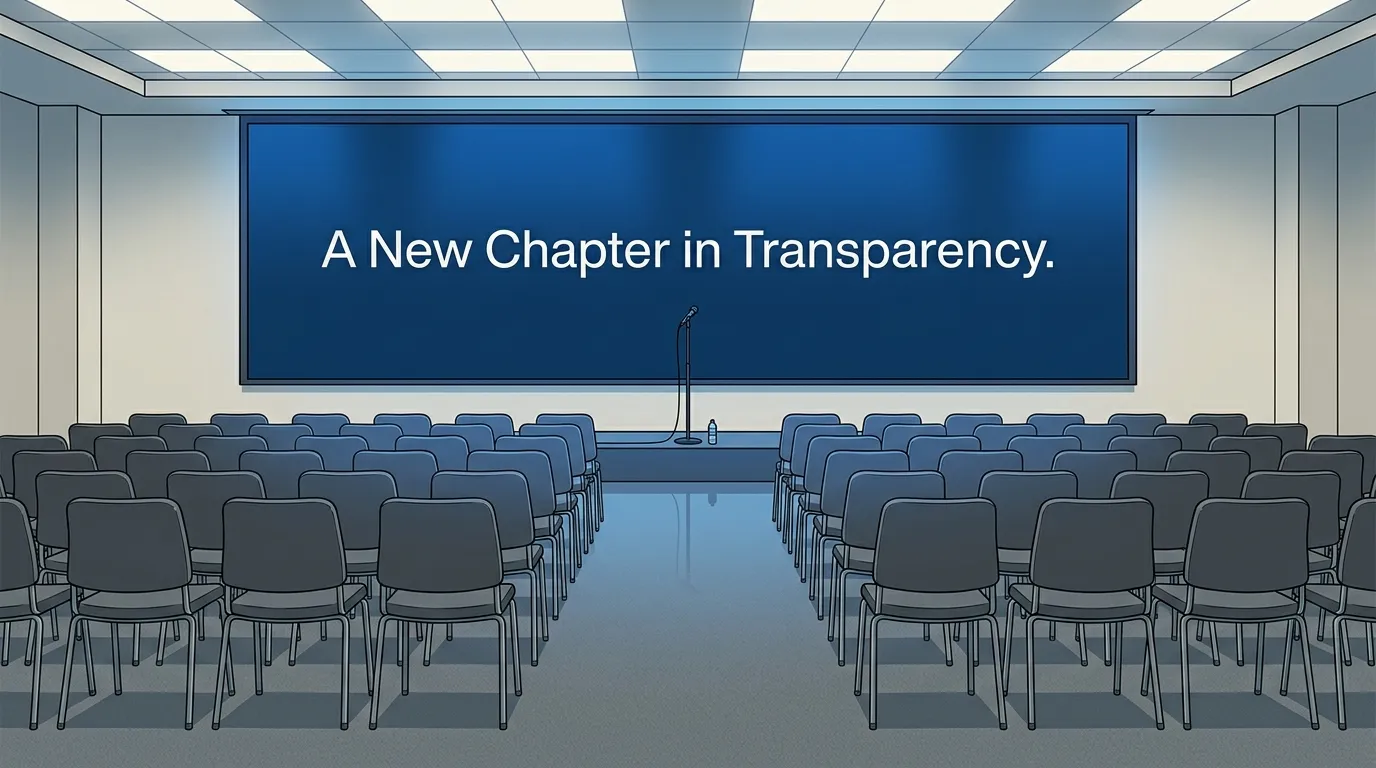
The conference room was already half full. On the screen, brand blue with white text, one line of large type: A New Chapter in Transparency. No subtitle. Just that.
Jason was standing at the front.
Younger than I’d imagined — the youth was in his posture. He stood like someone waiting for a conversation he genuinely looked forward to, not like someone preparing to deliver a presentation. Dark blue, good fabric, casual cut. His hair had some white in it, let in, not hidden. He skipped the warm-up:
“We’ve been thinking about 360 Review for a long time.”
Not loud, the mic expanded it, and every word landed with precision. Not magnetism — certainty. He knew what he was saying. That certainty was its own form of persuasion.
“A lot of companies do 360s to fill out forms, then file them away, then wait for the next cycle. We do 360s so that everyone can see each other’s growth trajectories. Not just managers — everyone.”
I paused on that word. See.
“See” and “record” are two different things. “Record” is a technical fact — where the data lives, what format it’s in, who has read access. “See” is an experience — you look, you see, you are seen, you see others seeing you. The word was accurate, but it was accurate in a way that wrapped a report in a gift.
I swapped it out in my head: if he’d said so that everyone’s growth trajectory gets recorded, the sentence would have a different weight. But he said see.
Jason moved on to the logistics: quarterly, three to five mutual reviewers, manager evaluation, open text boxes. A few people in the front row were nodding. One of them smiled — the smile had the texture of resonance, the this is exactly what we needed kind, the face of someone who’d found an answer and felt lighter for it.
Deanna stood to the side and said nothing, just doing that thing she did, a quiet sweep of the room with her eyes, checking whether anyone needed to be caught. She was wearing deep brown today, a color that held more weight than the whites and greys filling the room. For a moment her gaze passed over me, paused for less than a second, then moved to the next person.
That pause — it might only have been a pause because I thought it was.
For the Q&A, Slido appeared on screen.
I picked up my phone and looked at the input box.
The shape of a question was starting to form: about “seeing each other’s growth trajectories” — if someone’s trajectory was heading in a different direction, did this system have room for that direction?
I typed out half a question mark.
Then I saw on screen that someone had already submitted: “Can we review our managers too?” Seven votes.
I deleted the half question mark, flipped my phone face-down on my thigh.
The person in the front row got their answer from Deanna: “Absolutely — we want this to be bidirectional.” They nodded, satisfied. A few people nearby relaxed a little. The atmosphere moved a step forward.
Asking anything after that question would read as less progressive than it.
Jason closed out: “I hope this system lets you see yourselves. I hope being seen is something good for each of you.”
He said hope, not this is. Someone who truly believes something usually doesn’t need to say this is. He said hope because he believed that once you heard it, you’d feel the same way — he was just saying it for you in advance.
Which made what he said harder to argue with. You can’t debate I hope.
As people filtered out, the crowd moved toward the elevators. Clio came up from my left, her hair down today instead of in a ponytail, walking faster than most people, her orange top a bright point of color in the crowd.
“Ivan—” She stopped beside me, face carrying that quality that made you want to move closer but left you unsure, once you did, which direction gravity was pulling. “Did you put anything in Slido?”
“No,” I said.
“Right,” she said, with an expression that meant she’d observed something. “I thought about it, but then I saw how positive the first question was, and I thought — if I submitted mine it would seem weird. The Q&A design is super tricky, right? The first person to put in a different-direction question, that question just becomes this whole thing, you know? Completely different weight.” She glanced at me to confirm the message had landed. Then the corner of her mouth went up. “But Jason was so good! Did you feel like the way he talks makes you want to go, okay, I accept this?”
“Yeah,” I said. That was true.
“Right! Because he’s saying what he believes, and what you feel is his conviction — not that he’s trying to convince you. That’s a completely different thing. The first time I heard him speak I was so impressed, I just thought, okay, he’s genuinely convicted about this, and that kind of thing you can’t fake—” Her phone went off. She glanced down, thumbs flying, shot back a reply, looked up and kept going. “Have you ever done a 360 before? At your last job?”
“No,” I said.
“Oh, then this could feel really different for you,” she said. “I did one before, and the feedback made me see something I’d completely missed about myself, and I ended up changing a habit, it was actually really helpful. Wait and see — I think it’s going to be a good experience for you. Thanks for sharing!” she said, the exclamation mark fully audible in her voice, gave me a quick nod, and headed toward the elevators. Someone called her name; she turned and was gone.
I stood at the elevator doors and watched her go.
Thanks for sharing! — when she said it, I hadn’t shared anything. I’d said “no” and “yeah.” But she said it and meant it, because for her there’d been something moving in that exchange. She’d said a lot, I’d listened, and that also counted as a transaction.
She left me with a specific kind of unease I couldn’t quite place. She was full of energy. Her observations were real. Her read of Jason was accurate. But her fluency made me think: that observation about the Slido design being “super tricky” — the way she said it was light, a fun discovery, light enough that I felt like the same thing had only landed on her for half a second before sliding past.
I wasn’t sure if that meant she was better at this than me, or different from me, or if I was overthinking it.
The elevator dinged. The crowd moved in. I followed.
Just after three in the afternoon, a DM came in.
Raymond from frontend, same sprint cohort. The message: “Hey Ivan, is there any part of the retro action item on your end? My piece depends on your API. Just checking the timeline.”
I read it, opened a reply, confirmed a few details, said “API should be ready by Tuesday next week,” sent it.
Then I stood up.
And walked to the kitchen.
About two minutes passed between those two things — longer than the walk actually took. I’d stayed at my desk a half-second extra because my phone wasn’t where I’d left it; I had to turn it to find it, and only then stood up, and only then walked.
The capsule coffee machine in the kitchen had just been used. The capsule drawer was closed, the machine still humming with residual warmth. I chose a capsule, inserted it, closed the lid, pressed the button, waited for the extraction. About twenty seconds. Coffee dripped slowly into the white ceramic cup. I picked up the cup and walked back.
Back at my desk, turning into the engineering section, my eyes drifted sideways without deciding to — three people at their desks, each staring at their screens. Jasper was there, pushing his glasses up with one middle finger, eyes still on his monitor. Theo was gone, maybe in the bathroom. The third person was facing the other way.
Nobody was looking at me.
Or someone had been, and turned back just before I turned to look.
I sat down, set the coffee cup on my desk, and let the heat from the cup warm my fingers for a moment.
That or — I stopped, because I realized what I’d just done: I had been checking whether anyone was watching me.
Something was off about that. The off-ness was specific: if Raymond’s message and me going to get coffee were originally two completely unrelated things, I had just created a connection between them, and that connection was my own construction.
But I couldn’t say clearly whether I’d invented it, or observed it.
The coffee was a little too hot. I took a sip and let it burn.
A little before five, I pushed the day’s PR and posted a note in the engineering channel on Slack, then leaned back in my chair and spun my mouse wheel and then realized the mouse spinning had no purpose, I just needed something to do with my hands.
I stopped.
I reached for the coffee cup on my desk. It had gone cold, was empty, but I reached for it anyway. Looked at it. Set it back down.
Jasper stood up from his desk and stretched, glanced in my direction, didn’t say anything. The way he stood reminded me of the way he stood slightly outside the standup circle, giving himself a little extra room — a habit of his. Today he’d asked “what kind of edge case?” That question was direct. He actually wanted to know the answer.
Afterward he’d said “got it,” and waited, checking whether I had more.
I didn’t, so he went back to what he was doing.
That I understood. “Got it” meant got it. Nothing more needed.
Clio walked past my desk. She looked like she was planning to be the last one out today, a printed design spec in her hands with a few sticky notes on it, absorbed in her own view of things. Passing my desk she didn’t stop, but in the instant she went by, she looked over at me, gave a quick twitch of the corner of her mouth, and kept walking.
That small twitch carried something — a quality of I know you’re here — but it was light enough that I couldn’t say whether she’d actually seen me, or whether I was loading that mouth-corner-movement with too much meaning.
I closed my laptop and gathered my jacket.
Before leaving, I opened Google Calendar, found the private notes field under today’s date, and tapped it.
I typed:
Three weeks, four times — after getting a DM, I walked to the kitchen, and every time I came back, my eyes went sideways. Not sure if this is a problem, or if it’s normal, or if I’m manufacturing a pattern.
I paused and looked at what I’d written.
I didn’t know what to do with this observation. It might be nothing. But three weeks, four times — that shape wouldn’t quite let me go, so I put it here for now.
“Putting it here for now” was how I handled things I couldn’t figure out. The notes app had two entries. The calendar had one now. All of them sitting somewhere, all of them unopened, all of them waiting for the day I’d thought it through enough to look back at them.
The problem was: I wasn’t sure when thinking it through would actually happen.
I closed the calendar, picked up my jacket, walked toward the corridor.
At the junction between the engineering section and the hallway, my phone slipped in my hand — almost hit the floor. I reflexively reached and caught it, fingertip catching the corner of the screen, which half-opened the notes app.
I didn’t open it further. I closed it, put the phone in my pocket.
There was still a faint tremor in my fingers, like an abrupt reminder that something was in your hand — but it’s not always something you remember you’re holding.
Waiting for the elevator, I stood where I was, phone in my pocket. Nothing taken out.
Down the corridor, Felix’s desk was empty today. Screen off. The old mechanical keyboard he’d brought from home sat quietly on the desk, not making any sound. A keyboard nobody was using — in a transparent office it just becomes a very quiet personal object. Saying nothing, but there.
The elevator dinged.
I stepped in, pressed the lobby button, the elevator went down, and the slight downward pull made my shoulders relax just a little.
The mirror gave back two of me, layered over each other, both going down.
I wasn’t thinking about anything in particular. The calendar note was in there. The two memo entries were in there. The half question mark I hadn’t sent in Slido was also somewhere — not in any system, just in today.
Lobby. Doors opened. Outside, the evening air of Nangang’s commercial district, carrying just a faint trace of a food stall packing up, not heavy, but real.
I turned right, toward the MRT station. It was early March. Sundown came a little later than January. The streetlights weren’t fully on yet. The sky still held some blue.
Later, on the train, I took my phone out of my pocket and opened the notes app. Looked at those two entries.
Didn’t touch them. Just confirmed they were still there.
Then I put the phone face-down on my thigh and let the train carry me home.