Chapter 3
The Feelings Wheel
Chapter 3: The Feelings Wheel
Seven weeks in, and I’d learned one thing: at a certain point in the afternoon, this office starts to smell different.
The espresso and the institutionalized air circulation that define the morning give way, sometime after three, to something harder to name — something closer to people have been here a long time. The smell itself hasn’t turned. It’s just changed texture. You can’t quite say what it is, but your nose knows. Your nose tells you you’ve been here too long before any system does.
Deanna’s calendar invite had arrived yesterday afternoon: tomorrow, 10:30, 1-on-1, conference room Clarity.
I accepted and went back to the PR I was reviewing.
The name Clarity always makes me want to smile a little when I walk in. Not a full smile — just the corners of my mouth going up by a fraction. I’m not sure what exactly I’m smiling at.
Deanna was already there, a paper notebook on the table in front of her, cap on the pen, cover closed — like she hadn’t quite decided to start yet.
“Ivan, come in,” she said. She was wearing deep orange today. In the conference room it looked almost too warm, like she was sitting inside an extra layer of light.
I sat across from her. No laptop.
No laptop at her 1-on-1s was established protocol. The first time I hadn’t been sure; by now it was habit. Bringing a laptop would only mean one more object to manage on the table.
“This is the official monthly check-in,” she said, unscrewing her pen cap slowly, but leaving the notebook closed. “First ten minutes — is there anything you want to bring up?”
The way she asked the question left room. There was something in the phrasing that contained an option to say no — saying no didn’t feel like closing a door.
“Work’s going smoothly,” I said. “We finalized the auth service architecture last week. Raymond and I are aligned. We start writing it next week.”
She nodded — a light nod — and the pen tip paused on the paper. Taking notes, confirming, no angle of judgment in it.
“How are you feeling?” she asked. “Outside of work. Overall.”
That question. I knew that question. It looked casual but it had weight — it was the key she used to open the room, the real question being is there anything you want me to know?, but that would be too direct, so she asked how I was feeling instead.
“Fine,” I said. “Still adjusting.”
“Good,” she said. “Seven weeks — some people around this point start to have a little bit of… reservedness. Do you have any of that?”
Reservedness.
She used that word with precision, with a quality that said she knew exactly what it meant. Like reservedness itself was a legitimate state to be in, and she was simply checking whether I had it.
“Anything lately that’s been giving you that sense of holding back?”
“No,” I said.
The no came out slightly faster than I expected. It probably sounded normal from her side. But I knew what that speed meant.
She nodded and looked up at me. “That’s good,” she said, then paused a moment. “But you can tell me, you know that, right?”
That sentence.
I stayed with it for a beat.
She hadn’t said you should tell me. She’d said you can. Can is permission. It’s opening a door without walking through it — the door is open, you can see inside, and the responsibility for not going in is yours.
I didn’t know where the line was between you can tell me and you have to tell me. I was sitting there inside Clarity’s glass walls, someone passing dimly in the corridor outside, and I couldn’t articulate what made those two sentences different. But I knew they were.
“I know,” I said.
“Good,” she said, and opened the notebook. “Let me share a few observations from the past two weeks — in standup, your blocker updates have been consistently concise, and I appreciate that. But I’ve noticed that sometimes after you finish speaking, you pause for a moment, like you’re confirming that what you said was what you meant to say.”
I looked at the side edge of her notebook. Couldn’t see what she was writing, just the pen tip moving.
“Does that observation resonate?” she asked, capping the pen and looking up.
She was right. I knew that. But being right and that being a problem — there was a gap between those two things, and I couldn’t say where it was.
“Possibly,” I said. “The way I double-check myself tends to be — I run it through internally before it comes out.”
“I understand,” she said. “Thank you for telling me.”
Thank you for telling me. She delivered the line flat. Not heavy, not light — just set it down at the end of the sentence like a stamp.
I hadn’t told her anything. I’d only said possibly.
The last ten minutes she opened it up. “Is there anything you’d like to ask me?”
“This 1-on-1,” I said. “What happens to the notes afterward?”
Her gaze paused slightly — working out how to answer in a way that felt complete.
“I keep them in my own notebook,” she said. “They don’t go into any system. This is personal. Next 1-on-1, I’ll look back and see if anything in your state has shifted.”
“Okay,” I said. “Thanks.”
Walking out of Clarity, the corridor light was slightly brighter than inside — the glass walls created just enough acoustic cushion that the open office noise hit me all at once when I came out, the keyboards suddenly close. I took a few steps before I registered that my back was slightly straighter than when I’d walked in, like something unnecessary had been added and hadn’t been put down yet.
The company all-hands was on the ninth floor, the big room, eleven o’clock, first Monday of the month.
I took the elevator up with three other people. No one spoke. Everyone looked at the mirror or the floor number display.
The lighting on nine was warmer than on eight — or maybe that was just how it felt — and walking in, the quality of the light seemed to have shifted into some other mode, something harder to categorize than work. The all-hands format was standard: first half, OKR status, HR announcements, team highlights; second half, a culture moment. Today’s culture moment was the Feelings Wheel. HR director Yolanda had posted a preview in #general that morning — “a tool to help us better understand ourselves and each other.”
Sticky notes were already stacked at the corner of each seat. White, square, one pad per person, with a black marker beside it.
Yolanda projected a large wheel onto the screen — circular, layered, outer ring full of specific emotion words, inner ring with the core emotions. Thoughtfully color-coded: blues for sadness-adjacent, oranges and reds for anger-adjacent, yellows for the joy end. The text was small enough that people sitting farther back had to squint.
“Now — on your sticky note, please write down the three emotion words that feel closest to where you are right now, in this moment,” she said, her voice a warm kind of gentle direction. “Don’t overthink it. The first thing that comes up is the most honest. When you’re done, walk up and place it on the board in the corresponding spot.”
I uncapped my marker.
I scanned the outer ring for numb.
It wasn’t there. Numb wasn’t anywhere on the outer ring. Whatever core emotion it was supposed to branch off from, I couldn’t find it. Tired? Lost? Neither felt right. Tired still had an object — something to be tired from. Numb was what was left after the object was gone. It was the metadata of emotion. The residue after an emotion had finished doing what it came to do.
I wrote on my sticky note: calm, focused, tired.
The first two I wasn’t sure about. The third one was true.
People began walking up to the whiteboard, pressing their notes to the wheel. There was a low murmur of movement and the soft sound of paper being peeled away — quieter than the normal office, but more ceremonial.
When Clio went up, she pressed her notes into the joy and gratitude section of the outer ring, quickly, then stepped back to look at the full board the way she’d look at a design layout from a distance. She’d let her hair down today; the way it spread across her shoulders made her look a few degrees lighter than usual.
Someone pressed a note onto the frustrated section — slightly crooked — then stepped back and stood there, not returning to their seat right away.
Yolanda said: “Would anyone who placed their note in the frustrated section like to share?”
That person looked up. Engineering, I didn’t know the name, maybe six months in, hair a little disheveled. The way they stood reminded me of how they stood during standups — slightly pitched forward, feet a bit wider than the rest of the circle.
“It’s just,” they said, then stopped. “This sprint. I keep feeling like I’m chasing it. Can’t quite catch up.”
Silence for a second.
Deanna, from her spot at the side, spoke: “Thank you for your honesty. That takes a lot of courage.”
Then applause.
Office-scale applause. Measured. It lasted maybe five seconds and then ended on its own. The engineer nodded once, walked back to their seat. Something was on their face — relief, maybe, or the look of having received something. I couldn’t tell which.
I pressed my own note into the calm section of the outer ring.
Calm sat in the yellow zone, near content, on the far end of the wheel from the orange-red of frustrated. I pressed it down and stepped back, and no one called on me, and I didn’t raise my hand. I just stood there in the cluster of people in front of the board, looking at it, looking at the word calm and my note next to it.
The person who said frustrated got applause. I scanned the board — others had placed notes in the calm section too, but no one had any remarks about that. Yolanda just moved on, inviting people from the next emotional section to share, as if calm required no explanation, didn’t need to be held, didn’t need anyone to say thank you for telling us you’re feeling calm.
The uncomfortable feeling got applause. The calm feeling got nothing.
I pulled out my chair and sat down.
The numb note that didn’t exist was still in my head. It wasn’t on the board. It was in that unused pad of sticky notes on the table, present as a blank.
The name Candor didn’t make me want to smile this time.
The code review was at two. Five people. Felix stood beside the big screen rather than sitting, my PR already up on the display, first line of code right there.
I sat by the glass wall. The corridor outside was visible through it — the lighting out there and the transparency of the glass made moving figures pass as visible outlines, no sound, just motion and shape.
Felix’s fingertips rested lightly on the table’s edge. The gesture looked like he was confirming the table was there.
“I want to start by saying,” he said, his voice at room temperature — not warm, not cool — “this PR is fundamentally solid. I’ve gone through the token refresh logic. The main flow has no issues.”
Pause.
That pause was him choosing the next word. I already knew the rhythm.
“But,” he said, eyes moving to the screen, “this part here—” he moved to line 47 — “when the upstream response comes back in an unexpected format, what we’re doing right now is throwing a generic error and letting it propagate.”
He said we. Not you.
“I’m thinking about,” he continued, “where this error gets caught. What do you think?”
I looked at line 47. I knew the answer. I’d made the call when I designed it.
“Right now it’s caught at the API gateway layer,” I said. “The gateway converts it into a standard 5xx and sends it to the front end.”
“Right,” he said, then held for a beat. “So the question is — when the gateway receives this error, does it know it’s a token refresh failure, or does it only know it’s a 5xx?”
Sitting with that question.
I knew the answer, and the answer made my stomach drop half a centimeter.
“It only knows 5xx,” I said.
“Yes,” Felix said. “So if a user’s token silently expires at two in the morning, our monitoring picks up a generic 5xx, and we have no way to know immediately whether it’s an auth problem or something else entirely.”
He said all of this with the same flat affect, like discussing a technical matter. That evenness diluted the weight of the responsibility, kept the room at a temperature where people could keep talking.
“I want to make this a learning moment,” he said.
He was still facing the screen when he said it, hand still resting lightly on the table edge, not looking my way. The sentence hung in the room without a specific addressee.
Learning moment.
This was the first time I’d heard him say it in a code review, but it didn’t land like something new. It landed like a phrase he’d used many times before — the delivery had a practiced gentleness to it. Wrapped in learning, framed as a moment rather than a problem. No attack surface. There was nothing to do with that word except accept it.
“You’re right,” I said. “I’ll add a custom error type here so the gateway can log them differently.”
“Thank you,” he said. “Let me see it again once that’s in.”
That thank you.
He thanked me for agreeing to fix it with the same naturalness he’d expect from me thanking him for the review. No hierarchy in the tone, just two acknowledgments meeting in the middle.
Out in the corridor, through the glass wall to my left, a shape paused for a moment. I caught a flash of orange — possibly Clio, carrying design work from one room to another. She glanced through the glass, expression neutral, and kept walking.
The pause must have lasted two seconds. From her side of the corridor, what she would have seen: five people in Candor, a screen with code, Felix standing, me facing the display, the people inside able to hear every word, the person outside only able to see outlines and the shapes of faces.
She was gone. The corridor light returned to empty.
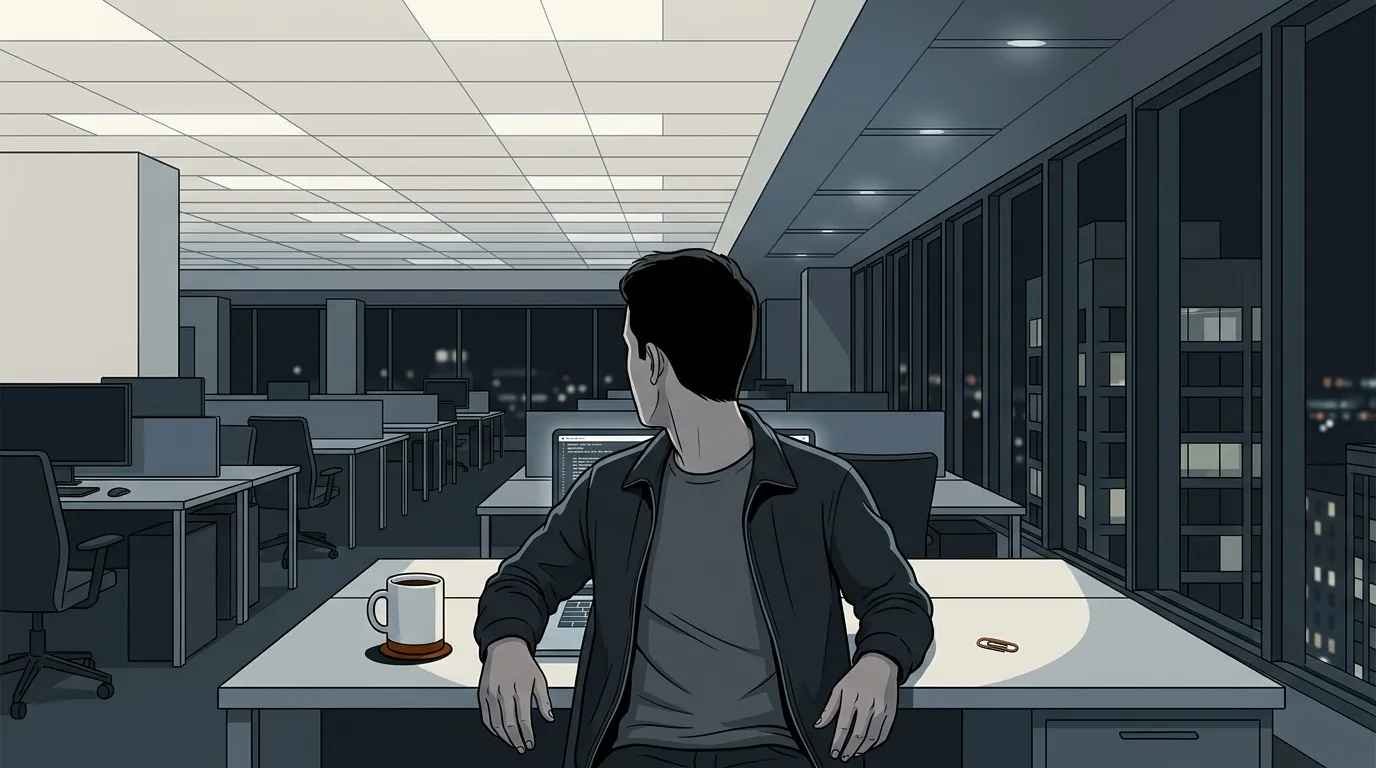
At 8:40, the motion-sensor lights started dropping to low-power mode.
The row by the windows dimmed. The main overhead lights were still on, but where those motion-sensor ones had faded, a boundary I’d never noticed before had shifted. Most of the workstations still had screens glowing, but now the light from the screens and the overhead created a sharper contrast — the desktops eased into shadow.
I was the last one.
The air conditioning became suddenly conspicuous in the silence — no keyboard sounds, no corridor noise, and the white hiss of the AC expanded to fill all the space those sounds had occupied.
My fingers were resting on the keyboard. The custom error type was written. The PR was fixed. All that was left was a push.
I took my hands off the keyboard.
I looked at my coffee mug on the left.
Empty, at some point. Only a thin dark ring left at the bottom, an irregular circle. I wanted to say I just finished it, but I couldn’t, because I had no memory of the last sip. Couldn’t place when it happened.
While I was thinking about that, something along my spine had changed.
Some action I hadn’t been aware I was performing, running continuously — it stopped. Without any instruction. It just wasn’t there anymore.
My shoulders.
My shoulders were lower than a moment before. Lower than at any point during the whole day. Like whatever had been holding something up all day — that force, that ongoing small effort — had set it down without telling me.
My gaze settled on a paperclip near the right edge of the desk. I didn’t know when it had appeared. It was just there. My eyes stayed on it — no impulse to move it, no impulse to look elsewhere.
Somewhere above, one of the LEDs, between the main overhead and the motion sensors, was emitting a faint hum. One of those sounds you only know was there once you hear it, like the office had quieted enough to tell you its real name.
My fingers rested on the keyboard. It was only then I realized they’d been hovering before.
I didn’t know how long.
Five minutes, ten, I couldn’t say. Fingers suspended above the keys, nothing typed, no idea what I’d been doing during that stretch, because I hadn’t been doing anything. That time of not doing anything — it was the only stretch like it in the whole day.
Then a Slack notification chimed.
My shoulders went up. Slightly. That upward movement was reflex — it happened before I thought about it, body faster than mind. Fingers came down on the keyboard. I checked the notification: just the engineering channel bot posting the daily CI report. Nothing urgent. But the chime had activated something at the back of my neck, and that something was running again.
I pushed the PR, dropped a note in Slack, and closed the laptop.
Moved the coffee mug to the corner of the desk. Remember to wash it in the morning.
The bathroom light came on automatically when I pushed the door open.
The metal handle was cold. That coldness was a fixed fact of this office — always the same, every time, cold, and then your hand warms it a little, and something briefly happens between you and it, and then you step in and put your hands under the tap.
Water, soap, lather, rinse.
Orange blossom hand soap — company-supplied, the same every time, every handwash. Internalized into the body long ago now. My nose no longer made a point of receiving it. Just let it be there.
I dried my hands on a paper towel and glanced at the mirror. That was me: almost-nine-o’clock me, been-in-this-office-twelve-or-more-hours me. The line of my forehead hadn’t changed much from this morning, but the angle of the light on my face made the habitual crease between my brows look deeper than I thought it was.
I didn’t do anything in particular at the mirror. I just stopped for a moment longer than necessary.
The exhaust fan turned overhead — mechanical, different from the AC, closer, smaller.
Then I went out.
The note I’d added to my Google Calendar was still there.
I didn’t open it to look. I just knew it was there — more lines than before, not the same count as last time. Those lines sat in a place I didn’t open, the way you confirm a color hasn’t disappeared without having to look directly at it.
I put on my jacket, slung the laptop bag onto my shoulder, and walked toward the corridor.
Nangang at eight or nine: the office tower still lit floor by floor, but that instant when you step from the lobby onto the street — cold air carrying the smell of rain from earlier, late March pushing into April in Taipei, a light dampness and a light night. A smell that didn’t have a name yet. Just present.
I walked toward the MRT, the streetlamps cutting the footpath into pools of light, one section then the next, me walking through the lit ones into the next lit one, then the next.
Somewhere on that walk, something rose up from the back of my mind — no particular trigger, it just surfaced.
The last job.
What the office had felt like. The feeling of sitting at my desk knowing something and not saying it. No specific scene, just the edges of the feeling — like a shadow that had come up close to the surface but hadn’t broken through, and I could feel the weight of it, and then it slowly sank back down to wherever it came from, the depth that doesn’t have a name.
That feeling disappeared the moment I walked through the MRT turnstile.
The gate beeped, the card passed through, inside, the platform, waiting for the train.
I thought that if I moved somewhere new, somewhere I didn’t have to manage so many things, I’d be able to just work.
I can’t quite say what different means. That can’t quite say has been with me all along — I just haven’t found the shape of it yet.
The train came. The doors opened. I got on, stood by the doors, shifted my bag to my front, hand on the pole.
The train moved forward. The lights of Nangang receded from the platform, then the tunnel, then the next station.