Chapter 4
The Calendar
Ch4〈The Calendar〉
Week nine on the job, and the notes app already had thirteen entries.
I didn’t open it. I just launched the app, registered the number, and closed it again. Thirteen. I couldn’t remember what the count was the last time I’d checked — only that this was more than I’d expected.
Two months in, I hadn’t been keeping a deliberate record. But things kept showing up in the notes app anyway. Sometimes on the MRT in the morning, sometimes on the walk back to my desk after the three o’clock coffee run — something I couldn’t quite name would settle, and I’d type it in and keep going. Never revisited, never organized. Just left there. Thirteen entries. I couldn’t say at what number the count had started to mean something to me. Maybe it never had. I’d just happened to see the number when I opened the app.
Monday standup, ten a.m.
Seven engineers in the circle, plus a new face — the one standing a fraction outside the ring, having left himself an extra fist’s worth of space. I glanced over. Glasses slightly too large for his face. Natural curls, unstyled. A loose thread hanging from one sleeve hem, uncut. The way he stood made me think of something quietly waiting.
Theo gave his today/yesterday/blockers — no blockers, “but I think I can work it out” — that closing line he always added, reliable as a refrain. I’d stopped noticing when I’d gotten used to it.
Then it was the new person’s turn.
“Yesterday I was chasing an edge case in the auth token flow,” he said. “The refresh logic downstream fails silently under a specific race condition.” A pause. He stopped there. His eyes moved around the circle, and he pushed his glasses up. The waiting was genuine — he was checking whether anyone had thoughts.
Felix was remote this week. In the small rectangle on the screen, his home study wall was visible behind him, tidy. “Do you have repro steps? We could open a window this afternoon and take a look.”
“Yeah,” the new person said. “I do.”
Then silence. That “yeah” was confirmation — “got it, see you this afternoon” compressed down to its smallest possible form.
I noticed the rhythm for the first time. He said what he had to say and left it there, without adding anything, without checking that everyone had received it. He’d finished; now it just sat there. No “should be fixable haha,” no “hope it won’t take too long,” no softening suffix of any kind.
He was managing something.
I stopped on that thought. No — he wasn’t managing anything. That rhythm was the rhythm of someone who wasn’t managing anything at all.
Theo came over and nudged me with his elbow. “That’s Wen-Kai. Started last week. Did half a year at a senior colleague’s startup. Good with code.” His tone was neutral, reporting, not evaluating.
“Got it,” I said.
After the meeting broke up I walked back to my desk. The paperclip near the right edge of the surface was still where I’d left it.
Ten-thirty, a notification appeared in Slack #general.
From Yolanda: a large blue block with the text ”✨ Lumen Pulse is live ✨”
I opened the announcement and read down.
Lumen Pulse was a real-time feedback platform launching today. Anyone could submit two types of feedback to anyone else: Kudos (appreciation) or Flag (an observation). Kudos appeared publicly in the Pulse main feed, visible to everyone. Flags were not public, but would be raised by managers in the next 1-on-1. Both types could be submitted anonymously or with your name attached — followed by one line at the bottom: “The company encourages named submissions to build trust.”
I read that line twice.
Encourages named submissions to build trust. Encourages.
The gap between that and a requirement — I couldn’t quite articulate it. A rule is a boundary. Cross it and there’s a cost; you know that. Encouragement is something else. It doesn’t have a boundary; it has a direction. It’s a default setting in the air, so that every time you decide whether to include your name, there’s a small voice in the background saying build trust. The company doesn’t require anything. The company just lets you know which choice is better.
I scrolled to the end of the announcement and clicked through to the Pulse explainer page. “Flags are submitted anonymously, but are visible to the recipient” — I read that line an extra second to confirm I’d understood it correctly. A Flag wasn’t public, but you’d know you’d been Flagged. Just not by whom.
The thread in #general was already running — three people saying “so excited!!”, one person saying “love this!”, Clio saying “we’ve been waiting for this forever I’m so pumped 💛”.
I dismissed the notification and went back to work.
Just before eleven, the break room.
The coffee machine was mid-extraction, hissing, and I set my cup under the spout and waited. Clio came in — orange today, hair in a ponytail, walking half a beat faster than most people.
“Ivan!” She spotted me. “Did you see the Pulse announcement?”
“Yeah,” I said.
“Super cool, right?” She put her cup next to the capsule machine. “I’ve been waiting for this for so long — like, the feedback loop can finally close faster, you know? Like those moments when you have a thought but no way to say it —” her hand drew a circle in the air ”— now there’s somewhere to put it.”
She was talking with her face toward the coffee machine, moving quickly, pushing the capsule into the slot while she spoke, the kind of person for whom talking and doing are completely parallel processes with no interference between them. It reminded me of how she’d caught up to me on the first day after orientation — enthusiasm as her baseline setting, already lit before she walked in.
The machine stopped. I picked up my cup.
“Your Deep Work block this afternoon,” she said, picking up the thread naturally, like she was filing two things together. “What are you working on? I saw it on your calendar — two hours back to back.”
I paused. Cup in hand.
After she said it, her eyes settled on my face and waited. That waiting was her usual curiosity — no bad intent, just her direct wanting-to-know that she brought to everything.
“Error handling in the auth service,” I said. “I usually don’t check Slack during that block. Better for focus.”
“Oh!” she said. “Thanks for sharing! So you’re actively protecting that window — super disciplined!”
Completely sincere. Enthusiastic, in the way of someone who’d just been struck by an interesting fact. She said it and turned back to the machine; the capsule unit let out a low warm-up hum.
My fingers tightened slightly on the cup, then loosened.
I’d explained. She’d understood. She’d said thanks for sharing, and the whole thing was a complete exchange for her — done, closed. The blank in the calendar now had content, that content was accurate, she’d received it, she was satisfied, and the thanks for sharing was genuine thanks, her real response to getting new information.
She hadn’t done anything wrong.
I couldn’t say why there was something sitting in my stomach.
I walked out of the break room toward my desk.
Early afternoon, I opened Pulse.
The browser loaded: a clean feed, Kudos entries stacked in a column.
At the top, Clio to Yolanda: “Today’s Pulse announcement was so clear and warm, I loved it! Thank you for the care you put in 💛” Named. The heart count was still going up.
The one below that, Felix to someone whose name I didn’t recognize — I didn’t keep reading.
Then Deanna, a collective Kudos to the engineering team: last week’s sprint delivery had been solid, thank you everyone.
Twenty-one entries in the Kudos feed already, most of them arriving in the window between ten-thirty and now. The office was quietly erupting with a kind of warmth — everyone behind their own screens, typing out appreciation they’d maybe been sitting on for a while, sending it to someone.
I scanned to see if my name appeared anywhere in there.
It didn’t.
I moved my cursor to the Give Kudos button and held it there.
The Pulse feed kept updating. A new entry every few minutes, mostly from design and product, fewer from engineering but some. I looked at the entries and thought about what the Pulse explainer had said: your Kudos record and your Flag record will both come up in the next 1-on-1. There was a strange clarity to that symmetry — what you gave, what you received, all of it in there, all of it entering those thirty minutes.
Then I thought about Deanna.
In our last 1-on-1, she’d said “thank you for telling me” after I’d only said “maybe.” She’d left enough space; she hadn’t pushed; she’d let the thing I couldn’t name just sit there. That was real. The impulse to give her a Kudos had a real foundation.
It was also the safest choice.
I was fully aware that both things were true at the same time. And I was fully aware which one was actually driving the action.
Kudos to your manager — lowest risk of misinterpretation. Giving to a peer, they might not know what it means. Giving to your manager reads as: I’m doing well, I’m engaged. Signal is clean. Felix at this particular moment felt off. The aftertaste of Clio’s “thanks for sharing” was still sitting somewhere in my stomach. Deanna was the cleanest choice. A precise use of institutional language.
I thought about what the message should say. If I wanted it to look natural, it had to be true. If it was false she’d feel it — she has that kind of perception. So the content had to be real. I was just letting that real thing surface now, in this moment, wrapped in the language of the platform.
In the text field, I typed: “Thank you for the space you left in our last 1-on-1 — it let me speak at a pace I didn’t expect to be comfortable with.” Named. Submit.
The system displayed: Sent ✓
I sat in my chair and felt the lightness of having finished something. Exactly that feeling. Very clear, very specific — the release was institutional. The feeling of having taken a reasonable action within the bounds of the system.
I’d used it in exactly the way I least wanted to. I knew that. I knew it quickly.
Mid-afternoon, a figure in the break room. I went to get hot water.
Wen-Kai was there, leaning against the counter, looking at his phone. His mug sat beside him. He saw me come in and pushed his glasses up.
“Getting hot water?” he said.
“Yeah,” I said, and placed my cup under the dispenser.
He picked up his mug, took a sip, and made no move to leave, no move to keep talking. Just stood there. The silence, he let it exist. He didn’t fill it with words.
“That race condition,” I said. “Felix help you look at it?”
“Yeah,” he said. “At two. The lock timeout was set too short — downstream hadn’t responded yet when it released.” A pause. “Simpler than I thought.”
“It usually is,” I said.
He gave a small nod and didn’t continue. That silence again, the kind he just left alone.
Then: “Did you see that Pulse thing?”
“Yeah,” I said. “Just launched.”
“Seems fine to me,” he said, pushing his glasses up. “I don’t really have anything to hide anyway.”
He said it lightly. The way you’d say I’m not allergic to it. A statement of fact. He put his mug back on the counter and headed back toward his desk.
I stood there, the hot water still running.
“Yeah, fair enough,” I said.
He might have heard it, might not have — he’d already turned out of the kitchen.
I shut off the dispenser, picked up my cup, and walked back to my desk.
Nothing to hide.
I turned that phrase over for maybe three steps, then stopped.
Friday afternoon, four o’clock. Openness.
Of the three glass meeting rooms, this was the one I’d used least. Clarity was for 1-on-1s. Candor was for code review. Openness — I was in it for the first time today. Engineering sprint retrospective, seven people plus Deanna.
Openness was slightly larger than the other two: a long table, two glass walls, one white wall with a whiteboard, one glass wall facing the office corridor. Deanna sat off to the side of the table, a paper notebook open in front of her, pen cap on. She was in deep orange again, the same as our last 1-on-1 — the kind of person who seems like a light source wherever she sits.
The retro format was What Went Well / What Could Be Better / Action Items. The first half was routine. CI pipeline stable, cross-team API coordination faster than last time. Theo said “my PR merge time is down from the last two sprints, don’t know why, but it’s good.” Nods around the table. Nobody asked why. Good is good; the direction is right.
Then someone I didn’t have a name for spoke up. Frontend engineer, early thirties, a slightly squared face, not someone who talked much in standups — when he did talk, there was a deliberateness to it, a need to say things correctly.
“I want to raise something under What Could Be Better,” he said. “It’s about compensation.”
He paused, letting that land.
“We build HR tech. Our product includes a salary transparency module,” he said. “But our own company isn’t transparent. Salary transparency can clear up a lot of feelings of unfairness. I think it’s a direction worth discussing.”
He looked around at everyone when he finished, then leaned back into his chair. Something in that leaning back — he’d said what he came to say, he’d released the weight of it into the room. Now it was everyone else’s turn.
No one spoke.
The silence had more weight than the statement that caused it. No one disagreed, but no one said yes, exactly, let’s start on this next week. It held the proposal’s weight in the room, let it neither drop nor rise, kept it suspended there.
Through the glass wall facing the corridor, a figure walked by, head down, carrying something.
I didn’t speak either.
Deanna’s pen stopped on her notebook. That stop made me notice that her pen had been moving the whole time — she’d been writing, recording everything anyone said, and now she’d stopped, and the stop was her thinking about how to respond.
“This is a big topic,” she said. “I want to bring it up at the next All-Hands with Jason, so this conversation can have a fuller framework around it.” She looked toward him and gave a small nod. “Thank you for raising it.”
He nodded and said “sure,” and the retro moved on to Action Items.
Walking out of Openness, I stopped in the corridor for a moment before I realized — my breathing was shallower than it had been before, had gone shallow somewhere in there, and was only now coming back. I took a breath. The corridor air was slightly cooler than the glass room. I walked back to my desk.
Friday, eight-thirty p.m.
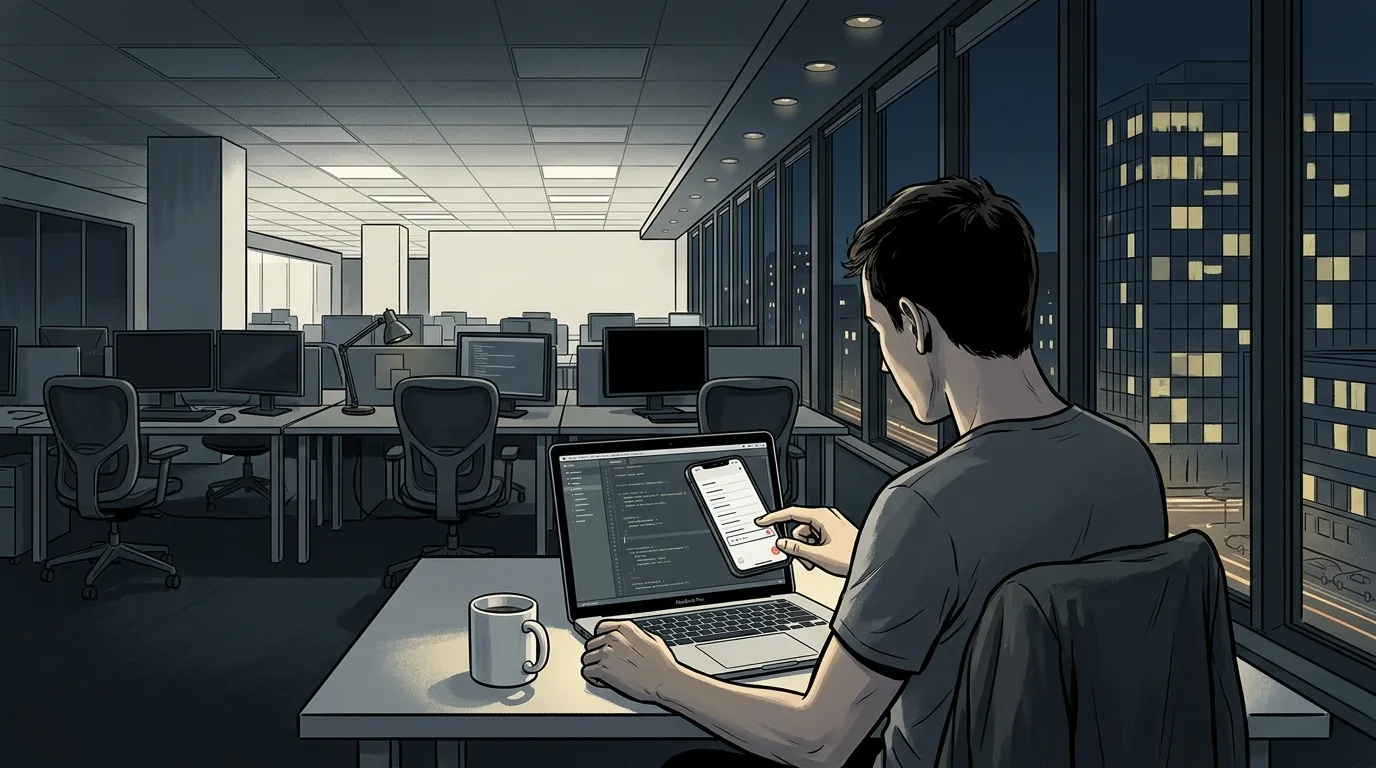
Most people had cleared out. The motion sensors had shifted to low-power mode; the lights along the window row had dimmed. I turned my laptop screen brightness up one notch and gave the room to it.
Maybe twenty minutes of cleanup work left, but I hadn’t started.
I opened the notes app on my phone.
Thirteen entries.
The interface was clean — entries in a column, each with the date it was written beside it. This was the first time I’d actually opened it all the way, scrolled back to the beginning, read what was there.
The first twelve, I scrolled through without reading closely. Just let my eyes move across the surface — certain words surfaced, then disappeared as I kept scrolling. One entry from a specific moment in standup. One that had to do with what Deanna had said — that “okay.” One from an afternoon, after a Slack DM, going to the kitchen and coming back. One about Clio’s “thanks for sharing.” One that said “not sure what Felix meant by that.” Every entry the same kind of thing: something I couldn’t quite name, something I couldn’t say was or wasn’t a problem, kept because I hadn’t decided yet.
Two months, twelve observations. The density — I couldn’t say whether it was high or low.
Then entry thirteen.
The date was earlier than I’d expected. Week three, a little after — right around when I’d started getting used to the sounds of this office. The date made me stop. Earlier than I’d thought. Earlier than any other entry, closer to day one.
What that entry was about was the previous job.
I didn’t read it a second time. Just let my eyes rest on it for a second. The text was fragmented, phrases and half-phrases, as if typed in stages, stopped and started again: “the quarterly version → he said it was a data issue → but I saw the original → didn’t say → I didn’t say.”
This was a complete event. Between each arrow was memory I had — but on the page they were just symbols and gaps, like a cipher, like shorthand only I could parse, like I’d written the thing in just enough blur to make it look like one more observation I couldn’t name.
But it wasn’t.
I held my finger on the entry and pressed. Select.
Delete.
A confirmation dialog appeared. I tapped confirm.
The notes app returned to twelve entries.
I set the phone on the desk, screen still lit. Twelve entries, sitting there, quiet.
I was keeping the first twelve. They were observations — uncertain ones, possibly invented, possibly real. I was keeping them because I hadn’t finished deciding.
Entry thirteen I’d deleted.
That wasn’t an observation. That was something I was clear on — something I knew had happened, something I knew my role in. I’d written it like something I couldn’t name because I was afraid of someone seeing it. Afraid that if I read it word for word I’d have to acknowledge again what that role was.
I was protecting one specific thing.
Just this one.
I sat there in the low-power office light, the motion-sensor yellow-white making the whole space feel a little narrower than it had that afternoon. And I thought of something I’d said in the kitchen that day — I like knowing everything. Because knowing is what lets you decide what to do. The things you don’t know — those are the ones that actually make you uneasy.
When I said that, I already knew what I was leaving out.
From somewhere across the floor came the sound of a keyboard, steady, rhythmic, like rain. The cursor on my screen hadn’t moved.
I turned the phone face-down and pushed it to the corner of the desk.
Next Monday was the quarterly offsite. The calendar invite from Deanna was still in my inbox — subject line “Q2 Season Kickoff — Outdoor,” all day. I hadn’t responded.
I opened the inbox, looked at the invitation, and hit Accept.
Phone face-down again.
Outside the window: Nangang at eight-thirty p.m. The office tower across the way, floor after floor of lights — some windows still on, some already dark, the pattern of it irregular, each one running on its own schedule.