Chapter 5
The Backyard
Ch5〈The Backyard〉
The shuttle bus departed from Nangang station at seven-fifty in the morning.
The windows still held a thin layer of morning mist, not quite clear. Sitting by the window and looking out, everything had a soft-focus edge. I set my phone on my thigh without opening the notes app — just knowing it was there was enough.
About twenty-some people on the bus, fewer than our usual office headcount. I thought about how yesterday afternoon several people in the company system had changed their status to “out” and a few to “remote.” No mandatory attendance — there never was. People who didn’t come had their reasons. People who did had theirs. My reason was that I’d accepted the invite, so here I was.
Clio was seated in the front-left, already talking to a designer whose name I couldn’t quite place. Fragments of her voice drifted back: “Right, right, last time we went to that place — ” Her hand traced some shape in the air that I couldn’t decode. She’d worn her hair down today; it moved slightly in time with her words.
Deanna was further up near the driver, looking out the window, not speaking. She wore a deep mustard jacket. In the dim light of the front seats, she looked like a quiet source of warmth.
Wen-Kai sat two rows ahead of me, by the window, silently watching outside. His glasses reflected the still-dim streetlights. His posture was the same as at his desk — that way he has of occupying exactly the space he needs, nothing more. I noticed he wasn’t scrolling his phone. Just sitting, letting the bus move.
I wondered if he’d checked in on #feelings-check-in today. We were off-site; it was probably optional. Last night before sleep I’d thought about checking in early. I put my phone down instead.
After we passed the highway on-ramp, the road opened up and the windows brightened. Nangang’s office towers fell back behind us, and the outlines of mountains appeared in the distance. I leaned against the headrest, earbuds in but playing nothing, letting the road noise be what it was.
Theo sat diagonally in front of me, leaning back, mouth slightly open — maybe asleep, maybe just resting his eyes. At yesterday’s standup he’d mentioned needing to wake up early for today, said “seven-fifty is an hour before I usually get in, but I think I can work it out” — that closing line came out faster than usual, and he laughed at himself a little after.
Felix wasn’t on the bus. Someone said he’d driven himself ahead.
The bus headed toward the mountains. I let my gaze rest on the glass and let the scenery pass through.
The venue was in the outskirts of New Taipei. It took nearly fifty minutes to get there.
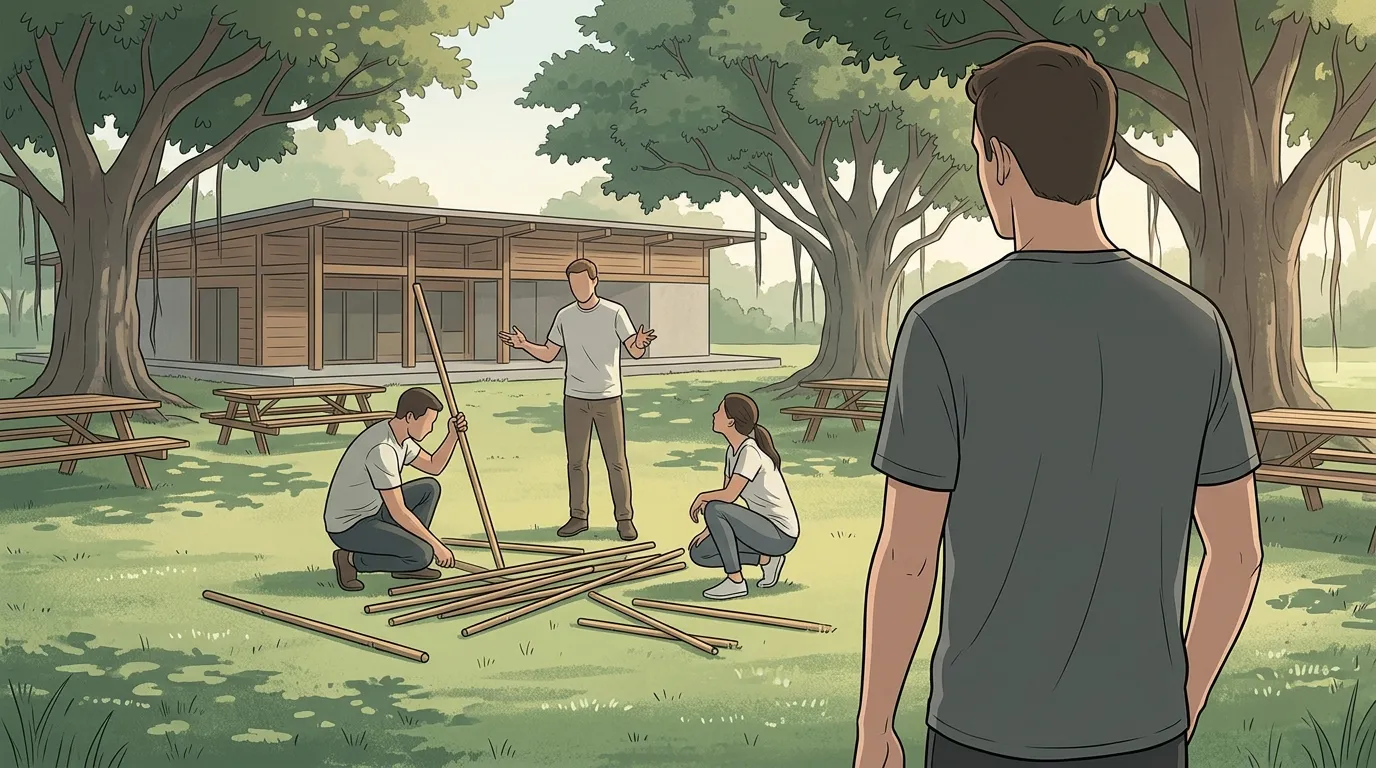
From the parking lot you walked downhill to a stretch of grass that felt like a backyard — a few large banyan trees at the edges, their shadows falling in irregular cool patches across the ground. The activity center itself was modest, with a semi-open space for events; outside, the grass extended further, scattered with wooden tables whose surfaces still showed traces of morning dew.
The first breath after stepping off the bus — I noticed the air was different.
Not mountain air, not that clean. Just the absence of recirculated office AC, the absence of floor-wax from the corridor, the absence of metal smell from the espresso machine. Outdoor air, slightly damp with grass, faintly of trees, nothing remarkable. But something else entirely.
My shoulders dropped, just slightly, before I’d noticed I was holding them up.
Felix was already there, standing on an open patch beside the activity center entrance, holding a coffee, wearing a pale blue casual shirt I’d never seen on him before — looser than his usual muted-neutral palette, though still neat. When he saw us step off, he gave a single nod, didn’t walk over, just nodded, then turned back to look at something in the distance.
“You made it!”
Deanna was at the entrance welcoming everyone, not making any formal announcements — just present the way a host is when making sure everyone has found their place. “No rigid schedule today. There’s a small activity from around ten to noon, then the afternoon is completely open, dinner at six, and after that if anyone still has energy, we can keep talking.” She said it lightly, the way you confirm that everyone heard, or the way you say something half to yourself.
The morning activity was a group challenge.
Teams of five. The task: use the provided materials to build something that could stand on its own — no specified shape, taller was better, but no tape allowed. Materials: several wooden sticks, some hemp rope, and a few styrofoam blocks of uncertain provenance.
I ended up on Wen-Kai’s team, along with Theo, a product person named Nadia, and a designer I’d only seen a few times.
Wen-Kai crouched down first to study the wooden sticks without saying anything, picking them up one by one to test their weight, then setting them back down. Theo said, “Probably want to go for a triangular base — more stable.” Nadia said, “Right, triangular, but the sticks aren’t the same length, so —” she stopped mid-sentence, looked at the materials, ”— actually fine, should work.”
Wen-Kai pushed his glasses up and said: “Let’s lash the base first. Check stability before we build up.”
And that was how it started.
No one appointed a leader. No one volunteered to be in charge. Everyone just picked up materials and began — someone asked a question, someone answered, someone realized the knot they’d tied was wrong and started over. Theo said “wait, wait, this is going to —” at one point, and the whole structure tipped gently over, wooden sticks scattering across the grass. Everyone froze for a second. Then Nadia laughed first, and then everyone was laughing.
Wen-Kai picked up the stick that had landed near his feet, said nothing, a faint curve at the corner of his mouth, glasses catching the light.
I crouched down and helped pick up the rest. The soil was slightly wet, and where my fingers touched the grass it was cool.
There was a feeling here of not needing to manage anything. I couldn’t tell exactly when it had started — I just noticed it was there, like something that had been clenched beginning to loosen, not all the way, just a little. The outdoor light came down at an angle that made you squint, a brightness that prickled, the kind that comes from the sun, not from a screen.
On the next team over, someone was walking through their design, technical seriousness in their voice, and then someone said “no, but if you do it that way, the center of gravity —” and another said “that’s what I said, but —” as if a code review had been relocated to the grass, but the atmosphere was right, so the way people talked was different.
We ended up with a structure about a meter tall. It looked precarious. It stood. Theo gave it a clap and said “I don’t know why, but I think I can work it out” — and everyone laughed again, including him, the kind of laugh that reaches the corners of your eyes.
Lunch was set out by the activity center — several large platters on the wooden tables, self-serve, no assigned seats.
I found a shaded spot and sat down. Before long someone came and sat nearby — Felix, carrying his plate. “Is this okay?” he said. I said “of course.” He sat down.
He talked differently today than he did at the office. Less of the scaffolded structure he brought to code reviews, more like regular conversation, looser, his pauses still there but without the weight behind them. He asked whether I usually came to these offsites, or if the previous company was my first. I said the previous place had only one. He said Lumenra did them more often, that he wasn’t used to them when he first joined but it grew on him.
“It grew on me” — he said it flatly, as a statement, not as a recommendation.
I said, “Do you think they actually work? These things.”
He paused — it was his pause, the kind where he’s choosing words. “For certain things, yes,” he said. “When you put people in a different physical space, the way they talk is already different, by default.”
I nodded, didn’t push further.
Over on the grass, a few people were playing with the wreckage of the building activity — reassembling the fallen sticks into something stranger. Someone said “this one has better artistic vision,” someone said “but it’ll fall faster,” someone said “then it means more.” The three of them talking, voices carrying that looseness that only happens in the afternoon, the kind that makes everything happening over there feel inconsequential in the best way.
The sunlight on the grass came in fragments, filtered through banyan leaves, arriving as small scattered patches, moving with the wind, assembling into something whole but never quite finishing. It was the first time I’d really looked at what an afternoon outside the office looked like.
In the open afternoon, Clio found me.
I was sitting by a wooden table in the backyard, a coffee in hand — the activity center had put out a whole thermos and it was better than expected.
She walked over and sat down directly. “The coffee here is actually pretty good.”
“Better than the machine at the office,” I said.
“That machine is too good. Somehow that makes it less.” She paused and looked out at the grass. “Did your old company do offsites like this?”
“No,” I said. “More traditional. Nothing like this.”
“Very traditional?” Light tone, more curious than leading.
“Sort of. Information didn’t move around much. Everyone did their own thing.”
Clio nodded — a nod with texture, the kind that says “I know.” She rotated her coffee cup once and said: “My last place was like that too.”
She paused, a pause with some weight in it, something she was deciding about.
“My old manager,” she said, voice shifting into something slightly more deliberate, “was incredibly experienced and capable, but completely closed-off with information. Design decisions all lived in his head. You’d ask, he’d say he’d tell you, but it was always ‘later,’ and so you waited, and you waited until you’d developed your own direction, and then he’d say ‘no, it needs to go this way,’ and only then would you find out he’d had the answer three months ago. That context gap — there was no filling it.”
She told this at a steady pace, not fast, not slow, the way you tell a story you’ve already found the shape of. Her hands rested on the table; she gestured occasionally, naturally.
“And then the timeline compressed, and toward the end everyone was rushing, communication started breaking down, and then —” she paused, ”— a design I’d done was called out in a meeting for not being aligned with requirements. But his requirements had never been stated clearly. Only in that meeting, everyone was looking at me, and all I could say was ‘okay, I’ll revise it.’”
I listened and said nothing.
Her expression, while telling this part, carried something — the particular expression of someone who remembers the weight of a thing, who is standing at a distance from that weight now, picking it up to show you. She’d told this before. Maybe many times. Each telling made it cleaner, gave it more of a timeline, brought it closer to a complete story.
“How did you handle it?” I said.
“I left,” she said, her voice lifting slightly. “But before I did, I did one thing that mattered a lot to me — I wrote down everything from that meeting, in detail, all of it, and I sent it to people I trusted, and I asked them to confirm I wasn’t losing my mind. That confirmation was what let me hold on until I got my new offer.”
She stopped there, glanced down at her coffee cup.
“Looking back, that period taught me a lot, actually,” she said. “About how to say things out loud. About how to make sure information doesn’t live in only one person’s head. That unhappiness showed me I needed a different environment.”
That closing line was genuine. Her eyes were looking forward when she said it. She really believed it — or she’d told this version often enough that it had become the version she truly believed. I wasn’t sure those two things were different.
“Coming here has honestly been healing,” she said, with the ease of someone stating something settled, “I feel like information actually flows here, everyone can see it.” She paused, looked out at the grass. “Thanks for sharing,” she said, quietly, as if to herself. “You made me remember again — that it was right to get from that time to here.”
I said: “Yeah. Thank you for telling me.”
She took a sip of her coffee, set the cup down, and said “Oh, did you see that thing earlier, it was about to collapse —” and moved on to something else.
Dinner was in the dining hall, long tables, six o’clock.
Someone brought beer; some people drank, some didn’t, no one made it a thing. I had one glass, then switched to water. The looseness from the afternoon carried over, slightly more now — the particular looseness of being on the other side of a day after everything in it had already happened.
Felix was at the far end of the table, talking with a few engineers about some technical architecture, his voice carrying over occasionally — the same rhythm as at the office, but out here in the dining hall it sounded looser, his pauses still present but lighter than in the office, closer to the natural pacing of conversation, less of the weight of selecting each word.
Wen-Kai was diagonally across and two seats down, eating, mostly silent, occasionally saying a sentence or two to the person next to him. His glasses had a slight redness on them from the morning sun on the grass — not severe, but you could tell he’d been outdoors. Same as at the office, I thought. He was the same person wherever he was. No change.
After dinner, some people went for a walk on the grass outside, some stayed in the dining hall to keep talking, some took out their phones to reply to messages. The day’s accumulated ease developed a slight heaviness after dinner — moving from “loose” toward something with a little weight, the way you know that looseness is borrowed, that the clock is running.
Deanna found a natural moment after dinner.
She stood up — easily, without ceremony — scanned the dining hall, and said:
“Sorry to interrupt for just a moment. This is completely optional — but if anyone wants to stay and say one thing you wouldn’t normally say at the office, you’re welcome to. Just listening is fine too. I’ll be here.”
She said it and sat back down.
The tone was sincere. The non-mandatory part was genuine. She offered the option to not participate, and the way she said it made that option feel real.
Someone said goodnight, stood up, left — they had to call home. A few others said they were going outside for a walk. The dining hall slowly emptied. In the end, seven people stayed: Deanna, Felix, Clio, Wen-Kai, Theo, Nadia, and me.
I had started to stand up.
My feet didn’t move.
I don’t know why. I stood up, and then my feet didn’t move, and then I sat back down. That’s all. I let that “I don’t know why” sit there, didn’t try to explain it.
Everyone shifted their chairs slightly closer. Deanna turned off the main dining room light, leaving just the small lamp by the window and the glow from the lights out on the grass filtering through. The color of the whole space changed — warmer, less defined around the edges.
Nadia spoke first.
She said that after she graduated from university, there were two years when she had no idea what she wanted to do — she sent out a lot of applications, heard nothing back, couldn’t find a direction. “My mom asked me every day if I’d found something,” she said. “Every day I’d say ‘almost, almost.’ And then at some point I realized I had no idea what ‘finding something’ was even supposed to mean.” She laughed when she finished. The laugh was for herself.
Theo said something I hadn’t expected. He said he’d spent the year before last quietly researching a move into product management, took a long look at it, and then decided to stay in engineering. What the research actually showed him was that he genuinely loved writing code — only that he’d always assumed loving code wasn’t enough, wasn’t ambitious enough, didn’t have the right kind of “scope.” That research made things clear. He went back to being an engineer, but now with more ground under his feet. He finished, then added: “but I think I can work it out” — laughed first himself, “sorry, reflex.”
The room temperature had dropped a little. That gentle cool that comes when the crowd thins.
Then Felix spoke.
He found a position leaning back in his chair, hands resting on his knees. The posture was a little more relaxed than his usual — none of that checking quality that comes from fingertips resting lightly on table edges. Just resting.
“I used to feel like something was off about this place,” he said.
A pause.
His gaze settled on some point on the table, weighing.
“When I first came.”
Another pause, slightly longer than the words that preceded it. That extra length gave every word that followed a beat of silence before it, made each word carry more.
“And then I understood.” He said, “That sense of something being off —” he paused, ”— was because I was protecting myself. I thought what I needed to protect was my privacy. What actually needed protecting was the self that hadn’t been seen. But after being seen, I realized that self didn’t amount to much.”
When he said that last sentence, his voice was flat. No persuasion in it, no expectation of applause. Just stating something he himself believed.
“Now I feel lighter, actually.”
He finished, raised his head, looked around the table once, then returned to that middle-distance point.
The lamplight on his face was warm.
I heard it, and something in my chest settled — not a painful settling, the kind that happens when something slots into place. That path he described, I recognized it. That “something off because I was protecting” — that “after being seen, realizing it doesn’t amount to much” — he’d passed through here too. He’d found the way out. And then he said he felt lighter.
After Felix finished, Clio’s eyes held a brightness for a moment — the light of “that was me too” — and she nodded, just slightly.
Nadia said one more small thing after Felix, and the atmosphere lightened a fraction.
Then the conversation naturally turned toward me.
I spoke.
“I’m sometimes not sure why I tell people things.”
I stopped.
Didn’t continue, didn’t explain, didn’t add anything. The sentence was out there now, floating between the seven of us. I couldn’t take it back.
I had just released something with no name into the air. That thing was now in this space, weightless, drifting, irretrievable. What I said was true, and that truth didn’t make me lighter — it made me feel exposed, like I’d shown someone the shape of something that had only belonged to me, even if they couldn’t quite make out what that shape was.
Deanna was looking at me. Her gaze was her gaze — the quality of “I’m really listening to you,” eyes slightly widened, not judging.
“Thank you for being willing to share,” she said.
She didn’t ask follow-up questions.
She let it stay there, without pushing, she let it be my freedom to not say more. Her kindness was real. The space she gave me to choose was hers to give. But that freedom itself was also something with weight — because I chose not to keep going, and that “not keeping going” hung in the air, somehow more visible than if I had spoken.
The evening wound down on its own.
Someone got up to get water; the sound of moving let the room breathe. Felix stood up, stretched — arms raised, back arched — let out a low sound, the kind you make after sitting too long. He dropped his arms and said “good, thank you everyone,” lightly, then: “What time is breakfast tomorrow?”
Deanna said seven-thirty.
He nodded once and left.
I went back to my room.
In bed, I took out my phone, opened Slack.
#feelings-check-in today’s check-ins were still coming in. Most were ☀️, a few 🌤, one ⛅.
Wen-Kai had posted ☀️ today, just after nine, before the shuttle left.
I looked at that symbol and thought for a moment about whether to post. Today was an offsite; Deanna had said there was no requirement, so not posting was fine. I set the phone on my chest and looked at the ceiling.
If nothing were all I felt, I’d post that.
I didn’t post. Closed Slack.
Opened Google Calendar. The notes in the app were still there, quiet. The text in the calendar private notes was still there — I didn’t open it, just confirmed it existed.
Closed it.
Set my phone face-down on the nightstand.
Morning. Breakfast, then back on the bus. The atmosphere was “one step removed” from last night’s session — as if that distance had returned on its own overnight. Felix brought up some DB sharding question at the breakfast table, talking through it seriously while a few engineers nodded along. Last night stayed in last night’s space. Today was today. Nobody carried it over.
Wen-Kai finished breakfast, took his coffee cup, stood in the doorway looking out at the grass for a moment. Then got on the bus.
Deanna did a headcount, said “all here,” and the return bus pulled out.
I leaned against the window, watching the road fall away behind us.
Past the highway on-ramp, the city’s silhouette began to reassemble — office towers, streetlights, overpasses. The scenery shifted, the air shifted, I could feel it. My shoulders had already come back up from where they were yesterday, slightly higher than when we’d arrived, somewhere between the two.
I closed my eyes.
The bus moved, the sound steady.
No specific place.
Just that desk, that screen’s glow, that feeling of sitting there knowing something but not saying it. Sitting, knowing, not saying — three things stacked.
Back then, he hadn’t said anything either.
My phone screen lit up.
I opened my eyes. The light outside the window was different now — the mountains were gone, replaced by industrial buildings on both sides of the highway, gray and low. The sign for the Nangang MRT station exit appeared in the distance.
I looked down at my phone — company internal notifications, an auto-sent calendar reminder, next Wednesday’s engineering standup. Nothing urgent.
I flipped the phone face-down and put it back in my pocket.
The bus was slowing, pulling up to the stop.
When I stepped off, the ground under my foot felt more solid than it had that morning. That’s all.