Chapter 7
Wall
Ch7 〈Wall〉
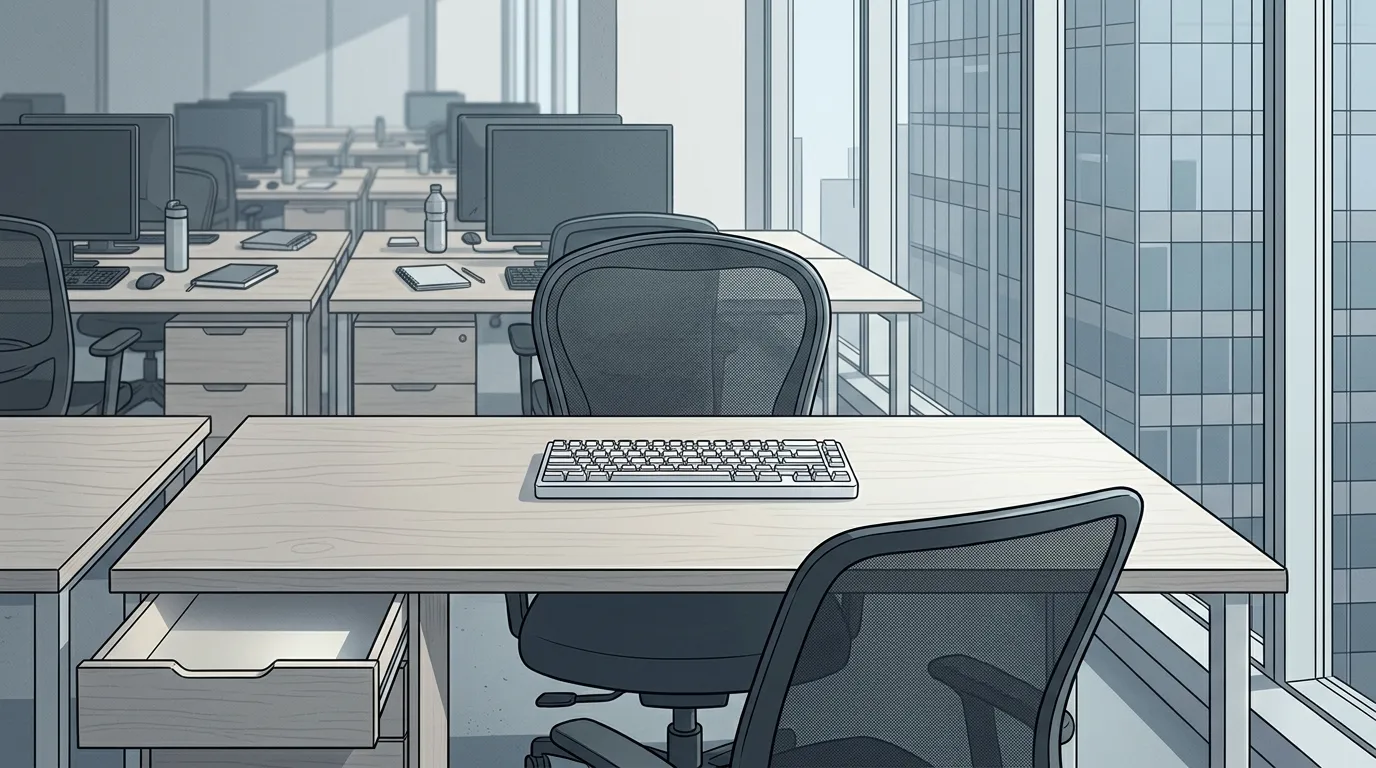
The chair at that desk had been pushed all the way in.
I walked into the engineering area, slung my backpack over my chair back, swept a glance around the room out of habit — and stopped. Wen-Kai’s desk, diagonally ahead of mine — the chair had been pushed in, all the way under the table. The desktop was clear. The drawer was half open, nothing inside. The glasses that had always been a little too big for his face weren’t there anymore. The white keyboard sat alone, but the person wasn’t there.
I stood and looked for one second. Not more than a second.
Then I walked to my own workstation, sat down, opened my laptop, and waited for it to wake up.
Standup went as normal. Theo, Jasper, Felix in his small remote window, and me — four of us in the circle. Wen-Kai’s spot was empty. That empty was physical: the circle didn’t reform around it, it was just a place where one person used to stand, and now it stood empty. Theo reported what he’d finished yesterday, what he was working on today, his blocker was a CI pipeline running slower than expected. Jasper said he was reviewing an external API’s documentation, needed to confirm a few edge cases today. Felix in his remote window said three things, technical, confirmatory, ending with “I’ll send you an issue link in a bit.” I said mine.
No one mentioned Wen-Kai.
Something in my throat tightened for half a second, then dispersed. I kept working.
“Thank you all” appeared in #general just after ten-thirty, less than an hour after standup ended.
The notification bar flashed. I clicked in. It was posted from Wen-Kai’s account. The format was standard, paragraphs aligned, reading like HR had provided a template:
“I’ve learned so much during my time at Lumenra. Thank you to every colleague for your help and generosity. Thank you all as well for the support you’ve shown me — I’ve felt so much warmth here. Wishing everyone the best going forward!”
Reactions appeared in quick succession below. Clio was first: “All the best to you! 🌱”. Deanna, a 💛. Felix, remote, a ✅. Theo, nothing. Jasper, a 👋.
I finished reading and stayed there.
This wasn’t his writing. Or he’d written part of it and it had been changed. “I’ve felt so much warmth here” — was that the warmth he wanted to say? “Thank you to every colleague for your help and generosity” — the last time he’d talked to me in the break room, asked whether that Flag was from me, he didn’t sound like this. He spoke short, direct, without padding. This version’s sentences were sentences written for everyone to read. That wasn’t how he talked.
My cursor sat on that message window for a few seconds. The emoji panel floated at the edge, ☀️ at the front, then 💛, then ✅, then a whole row of symbols I rarely used. I moved toward it, then stopped, then moved the cursor back to the editor.
I didn’t react.
If it were me — if I were the one leaving — I could only write something like this too. This template is the path with the fewest choices. I’d take it as well.
I kept working.
The next morning I opened #feelings-check-in as usual.
This action was reflex. Every morning, first thing after the laptop woke up — open Slack, go to #feelings-check-in, find today’s date, type a symbol, send. I can’t remember anymore how long I thought about it the first time I typed a sunny day. Now it’s a frictionless motion.
I scrolled down, looking for Wen-Kai’s row.
He usually posted ☀️, somewhere between nine and ten every morning. That ☀️ had been there for a lot of days, showing up every day, stacking dense going upward, and then on one day it stopped. The timestamp on his last ☀️ was yesterday’s — the day before he left the company, nine forty-five, and at that time point he had typed that symbol, sent it. And then nothing more.
His account avatar had a small gray dot beside it now. Deactivated.
I scrolled up further. A few more days back — that row of ☀️s stacked dense, almost the same time every day, like some fixed rhythm. Then one day it suddenly skipped, nothing in Wen-Kai’s row that day, and then the next day it resumed, continued. That one missed day — who knows what happened. Maybe he was rushing to do something else, maybe he forgot, maybe that day he simply never opened the channel at all. Now I’m looking at that missed empty slot and it stands beside the stopped ☀️, but those two gaps don’t weigh the same. One is coincidence. One is the end.
Today that slot has been covered over by someone else’s reaction, the timeline continuing to grow downward, Wen-Kai’s ☀️ stopped where it is, no next one, no option for indifference either — he doesn’t need to pick any symbol anymore.
I still hadn’t posted today. I looked at the empty slot for a few seconds, typed ☀️, sent it, closed the window.
A week later, one morning, a notification from Yolanda appeared in #general — familiar format, blue background white text, with a Confluence link attached. Page title: “Talent Update — Q2 2025 Exit Interview Summary.”
I clicked in.
The page was bullet points, anonymized, four items:
“Gave positive feedback on team cadence.” “Design feedback on Lumen Pulse: recommended clearer anonymity boundaries.” “Raised concerns about certain workflows.” “Extended well wishes for the company’s future direction.”
I finished reading and stayed on the line: “recommended clearer anonymity boundaries.”
The anonymization was clean. No name, no timestamp, no department. Anyone reading it would see only “a generic employee’s generic opinion and feedback.” But I could tell it was Wen-Kai, because the shape of “recommended clearer anonymity boundaries” is the shape of how he talks — direct, technical, pointing at a specific problem, no circling around. He was still filing product feedback in his exit interview. Even after leaving, still trying to make this system a little better.
I paused on that sentence for a moment, had a faint urge to laugh. The laugh was bitter.
My gaze moved down to the third item: “Raised concerns about certain workflows.”
This one was much cleaner than the second. “Certain workflows” — which? The summary didn’t say. “Concerns” — what kind? The summary didn’t say either. It had taken something that should have been specific and processed it into background noise, letting it exist while making no sound. I paused on that sentence and thought: this one was probably cut. Whatever the original said probably had more in it, but what came out was this: “Raised concerns about certain workflows.” Very tidy. Very harmless. Completely incapable of producing any reaction in anyone.
My first week here I’d read an earlier version of this format on Confluence — back then this “Talent Update” page was evidence to me that “the company is very transparent.” I’d thought: a company willing to compile exit interview results and make them visible to all employees — that says something in itself. Then I kept scrolling through the tool documentation and let that thought go.
Reading it now, the meaning of that format is different. Its reason for existing is to give this thing a shape — to make it possible for “feedback was received” to hold true — and then that feedback can be filed, summarized, anonymized, posted for everyone to glance at, and everyone keeps working. The transparency was real. No one lied. No one pretended. This summary was genuine. It just took something that had edges and sanded them round, round enough that anyone could pick it up and set it back down.
I could tell it was Wen-Kai also because of what he’d asked me in the break room — about that Flag. He asked that question because he wanted to know where the line was on “anonymous.” The shape of that question, and the “recommended clearer anonymity boundaries” in this summary — the same person saying the same thing. Just that this time, no one knows it was him who said it.
I scrolled through the rest of the page, then closed it.
The Kudos interface in Lumen Pulse was off-white, with a ”+ Give Kudos” button in the top left corner. I stared at that button for a few seconds, then clicked in.
The form opened. First field: recipient name. Second field: named or anonymous. Third field: content.
I typed Felix’s name in the first field, selected named, and started typing in the third.
What I wrote was this: “Thanks for your breakdown of the token refresh boundary handling in that Code Review — that learning moment made me rethink the layering of error propagation. That discussion is still part of how I approach similar problems now.”
I paused on the send button.
This Kudos was real. Felix’s Code Review had genuinely helped me — that learning moment section, about how to handle the layers in token refresh, I’d applied that way of thinking in another module later. The gratitude was genuine.
But I had calculated the timing of sending this. After Wen-Kai disappeared, I needed Felix to see me. To see that I was “fine,” that I was working seriously, that I remembered what he’d said, that I affirmed his language. This Kudos was for him to see, and also for everyone who could see this Kudos to see — this person is good, he gives positive feedback, he’s safe in this system.
The gratitude was real. It was just the timing that had been calculated.
I clicked send. Pulse displayed “Kudos sent ✨”.
About ten minutes later, Felix’s reply appeared in #kudos. A 💚, then one sentence: “No problem — that boundary discussion actually taught me something too. When we handle these layering problems, we often don’t stop to look at what the underlying assumptions are. Thanks for giving me the chance to work through that thinking again.”
He didn’t say “I see you.” But he believed I’d sent it sincerely.
He was also right. The gratitude was real. It was just the timing that wasn’t. Both things were true at the same time, and I was fully aware of this. It made me temporarily safe.
That afternoon while working through issues, I idly scrolled up through the #kudos channel, looking at a few others people had sent.
Theo had sent one to a cross-department PM, thanking her “for clearly defining the requirement boundaries at the last cross-team coordination meeting.” Two days ago. I was at that coordination meeting, and Theo had been a bit hard in it — his tone caught a few times. Two days later he sent this: let that PM know he’d seen what she’d done, let everyone in the channel see that he and that PM were still good.
One more up — Jasper to Clio, thanking her “for proactively flagging a documentation update that was missing during code review.” Timing: three days before Clio’s transparency share. The advance-deployment kind.
I kept scrolling up. A few more. Every single one was real. Every single one’s timing had also been calculated.
I stopped scrolling. Closed the channel, went back to the issue.
All-Hands was held in the large meeting room on the ninth floor, two in the afternoon. Yolanda stood at the front, said there was a “culture spotlight moment” to kick things off today, then turned: “Please welcome Clio to share her transparency journey.”
Clio walked up, smiling, nothing in her hands. Her pace was measured, slightly slower than her usual — as if she’d deliberately slowed a little.
“Hi everyone. I’ll just take five minutes. I want to share a moment that was pivotal for me.”
She said, two-some months ago on a certain evening, she’d realized something. She’d always thought of herself as transparent, but she discovered she had a habit of “tidying first before speaking” — needing to fully process something, think it through, before she was willing to say it. That habit had made her miss a lot of real-time connection, and had kept her sharing stuck at the “finished and polished” level. What she wanted was “the truth of things still in progress.”
“After that evening, I started letting myself speak up even when I hadn’t tidied things yet. What comes out might not be fully formed, might contradict what I said yesterday, but that state of ‘in the middle of saying it’ has made my relationship with myself and with all of you more genuine. Transparency has made me a more complete person.”
Applause.
I applauded too, the same force as usual.
“Two-some months ago on a certain evening” — I paused internally, my gaze drifting toward the window at that angle, somewhere west of Taipei, the sky white, afternoon light falling on the glass. I pressed down that feeling of having stopped, kept going with the applause.
When All-Hands wrapped up, I saw Nadia say a few words beside Clio, nodding. Clio smiled and said something back. The two of them walked off in another direction.
A few days after All-Hands, one afternoon, Deanna passed by my workstation and stopped: “Next Monday at noon — are you free for lunch? Not a 1-on-1.”
I said I was free.
The noodle place was seven minutes on foot from the office, Taiwanese-style, noisier at lunch, but with a few small tables along the wall that were quieter. We placed our orders and sat waiting; the first few exchanges were work — a sprint thing, a cross-team communication issue — natural, the kind of easy talk you’d have in a corridor.
Then the food came and we started eating. Deanna’s eyes rested on my face for a moment.
“You’ve seemed a little different lately.”
She didn’t explain what “different” meant. That absence of explanation was itself a method — leaving the subject suspended, letting me fill in the blank.
I lifted some noodles with my chopsticks, said nothing.
“I’ve noticed you’ve been quieter in PR reviews lately,” she said. “Fewer comments.”
When those words landed I had a brief reaction — she’s been watching PRs. What she’d observed had a concrete shape, had a basis, landed somewhere I knew about myself but hadn’t planned to say out loud. It made it impossible to brush aside with a “just.” My mouthful of noodles wasn’t fully chewed yet, my chopsticks paused at the table’s edge, eyes on another tangle of noodles in the bowl that I hadn’t lifted yet, then back to the table surface.
Then I swallowed.
My hand stopped at the edge of the bowl, gaze landing somewhere on the table — a very brief pause, like breathing had shifted rhythm.
“Just not sleeping well.”
As it came out I knew clearly what I’d said and what I hadn’t said. Not sleeping well was true — I really had been sleeping badly lately, irregular, sometimes waking at three and lying there staring at the ceiling. But “just” had locked away all the reasons for not sleeping well. It said: this is the whole thing, there’s nothing else. And that wasn’t the whole thing.
Deanna nodded, didn’t ask what was causing the poor sleep.
“I want you to know — this is a safe space.”
She said it in the same tone she might use to talk about the weather. Flat. Certain. Not expecting any particular response.
I believed she meant it. I genuinely felt there was no other calculation behind her words. She’d seen something, she wanted me to know there was somewhere to put it, and she was sincere.
This was the part that made it most impossible for me to go on, because her sincerity had no gaps in it. She genuinely thought this, genuinely felt this, and then she placed that sincerity on the table and waited for me.
My chopsticks rested on the bowl. My gaze had nowhere to settle — looking directly at her was too direct, looking at the table was too deliberate — and I finally let it fall somewhere past her shoulder toward the window, where there was nothing, just light.
“Thank you.”
I heard myself say those words, my voice a little quieter than usual, but steady.
Then she started asking about next week’s sprint plan, and the conversation moved on naturally.
The words “just not sleeping well” stayed somewhere on the table. Deanna let them stay there, didn’t touch them. We finished the rest of the noodles, the sounds of it perfectly normal, and then lunch was over, we paid, walked out of the restaurant.
The sun outside was strong — past one in the afternoon, the kind of Taipei midday that makes the pavement glare.
I walked in the direction of the office.
And then, on that walkway, something loosened a little.
Some place that had been holding on — it relaxed, just slightly. So small it was almost imperceptible, like a muscle finally being permitted to stop working so hard. She’d accepted it. She hadn’t pressed further. That path — the “just not sleeping well” path — she’d stepped in and looked around, hadn’t gone deeper, and then she’d stepped back out, kept eating, kept talking about work. That path had closed for now.
I kept walking. A dozen seconds or so.
Then I realized I’d just felt relief.
That realization made me feel sick.
A low, slow feeling — the kind of too-full heaviness after eating too much oil, like swallowing something that hadn’t been chewed properly, lodged somewhere between down and not-down, sitting there quietly, not going away soon.
I stopped at an intersection, took out my phone, lit the screen, wasn’t going to tap anything — just letting that feeling move through. Eyes resting on the screen, not reading any message, just letting it move through.
Red light turned green.
I put my phone back in my pocket and kept walking.
That night I sat at the desk in my studio, opened my laptop, opened an incognito tab.
I typed the name of that company into the search bar. Got halfway, deleted a character, retyped it, pressed Enter.
The first few pages were the company website, the careers page, the product page, a few press releases, and one interview with the founder. I scrolled down into the interview.
The headline was: “We Believe Transparency Is the Foundation of Next-Generation Business Competitiveness.” The headline was in quotes, indicating the founder’s own words. I read a few lines — he said the original impulse behind founding the company was “to let every person be their genuine self at work,” that he believed when people can speak the truth, companies can make truly good decisions. The interview photo showed him sitting somewhere bright inside the company, smiling, city outside the window.
I reached the “transparency as foundation” line and paused.
Then kept scrolling.
The name of that thing didn’t appear in this interview. That afternoon didn’t appear. The two versions of the quarterly report, the number, the distance between them — none of it appeared. This interview was a different version of the story, clean and shaped, the founder smiling in his photo, city outside the window.
I kept scrolling. Page two of search results, page three.
No trace of that thing anywhere.
That thing had never been written down by anyone. Not once. The two versions of the quarterly report, that afternoon, that distance — nothing. I’d checked. Every time the same result; every time I’d scroll down a few pages and close the tab. That thing doesn’t exist in the outside world. It only exists in my notes app, in the four sentences I’d written for myself.
I moved the cursor to the upper right and closed the tab.
Then I thought about how those four sentences were still there. I hadn’t deleted them.
Those four sentences were in the notes app, in the thirteenth entry — four clean declarative sentences: I knew who altered the quarterly report at my previous company. I saw the original version. I didn’t speak up. I chose to leave. Their being there was enough for me. They were there, they were true, and whether or not anyone had seen them, they were equally true.
That night I didn’t open the notes app to look at those four sentences. Knowing they were there was enough. They were in the thirteenth entry, and that slot in the app list was a yellow square, the yellow square somewhere on the home screen — my thumb knew the path, had pressed it too many times, it had become muscle memory. I didn’t need to open it to confirm. They were there, I knew they were there, and that was enough.
I closed my laptop.
The room’s light was white, slightly cold. This studio was in Da’an, the window facing east, and the light that came in at night was white light reflected off the glass of the building across the street, carrying a little blue, not the warm kind. The AC vent was above my head and to the right — it wasn’t running now, but I could still feel a kind of stillness-cold in the room.
I lay down on the bed without pulling the covers over myself. Just lay there.
My laptop sat closed on the desk, screen dark. Beside it an eco bag I’d brought home from the office, still holding an apple I hadn’t eaten today, had forgotten. It had probably been sweating in the bag, might be a little soft by tomorrow. The metal edge of the window frame reflected that blue-white light, thin and quiet, like someone had taken a very fine brush and drawn one line there.
Outside, occasional cars passing, tires on asphalt, then going still. Then another one.
I didn’t pick up my phone. Didn’t check the time.
Today Deanna had said “this is a safe space.” Those words were still there, and I couldn’t make them not be there. They sat there like that Confluence summary, taking something that used to have weight and giving it a clean shape, placing it there to wait for me. I thanked her, then kept eating my noodles. That passed for completing something.
Tomorrow was Tuesday. I still had three issues to work through.