Chapter 8
Interview
Ch8 〈Interview〉
I didn’t close the incognito tab right away.
That night I used it to look up the company’s name, read through the “Transparency as Foundation” interview, found no trace of that thing anywhere, and then closed the tab. But the hollow motion of it — open, search, scroll, close — that stayed. Like running a test without knowing what I was testing for. The result was no result, and yet I felt like I’d gotten some kind of answer.
Two or three weeks later, I started using incognito tabs to look for jobs in earnest.
It wasn’t really in earnest. Or rather, not entirely.
If I were genuinely job hunting, I knew the process — update the resume, reach out to a few friends, upload to a couple of engineering-focused platforms, then wait. I’d done that before. It wasn’t complicated, but it required one precondition: you had to have already decided to leave.
I hadn’t decided to leave.
What I was doing was smaller than that, and harder to explain. I just wanted to know — was there somewhere out there without all this. Was there a company where the interviewer wouldn’t say “we believe in authentic connection at work,” where there’d be no Lumen Pulse, where you wouldn’t have to post a sunshine emoji every day in some channel to let everyone know how you were feeling. This was an information problem, not a decision problem.
I searched with a few different terms, filtered through the results. Some companies I’d heard of, some completely unfamiliar, some with backend engineering openings. I clicked through and read JDs — read a lot of JDs. Whenever I hit “we foster a culture of open communication” or “every voice is valued,” I’d scroll on, looking for whether they’d written anything like “our feedback process is…” or “we use…tools.” Most JDs don’t put that kind of thing in. But occasionally one did, and I’d stop, read the page to the bottom, and think: could I live with this?
Two of them I ended up applying to. Their JDs didn’t have any sentences that made me stop.
The first interview was remote — Thursday at three in the afternoon. I booked the Phone Booth for three hours. Not a lie — I did have a vendor call around that time, so I’d padded the booking, and I took the interview in the gap between. Entirely within the rules. I sat in the Phone Booth with the video on, background blurred, my voice contained in the soundproofed space where only I could hear it. Through the window people outside could see my silhouette and the movement of my mouth, but couldn’t hear anything. That design worked in my favor this time.
The interviewer’s last name was Hsieh, mid-thirties, spoke slowly, asked fairly specific questions. Standard engineering interview material — walk me through the most complex system design you’ve built, what was your role, what challenges did you run into. I answered at normal pace, gave concrete examples, didn’t lie, didn’t over-polish.
Then in the second half, Hsieh leaned back a little, his tone lightening: “Last few questions about your professional motivations. How long were you at your previous company?”
“A little over three years.”
“Why did you leave?”
I let a pause form in my head — about three-tenths of a second, which looks like a normal thinking beat on video.
“Looking for a better environment to grow.”
The moment that answer came out I knew it was the kind of answer that passes. The interviewer would nod, move on, not push further. But I also knew it had wrapped that whole thing up — the two versions of the quarterly report, that afternoon, the distance between those numbers — wrapped it clean, the way a Confluence summary wraps something, turning it into an object with shape but no weight.
Hsieh did nod, continued: “And why are you looking to leave your current role?”
That question was harder than the first.
I talked for about two minutes. Everything I said was true — I wanted to move in a slightly different technical direction, the systems I’d been working on at my current company had reached a natural stage, the timing felt right. Every sentence was grounded. Every sentence was true.
But when I finished there was a strange feeling — like I had just used language to draw a circle around something, tighten the opening, give it a shape that someone else could look at and think: oh, that makes sense — but what was inside the circle wasn’t the complete thing. I knew what was inside. I knew I’d drawn the circle myself.
Hsieh said “Okay, one last question,” and it was technical. I moved back into more familiar ground.
When the interview ended I stayed in the Phone Booth an extra minute, letting myself return to baseline, then walked out, grabbed some water, and continued with the afternoon.
The second interview was in person — near Songjiang Nanjing, in an office building with actual glass doors, not a tech park, more like an older commercial block. The company was on the fourth floor. The elevator opened to a circular reception desk, the company logo on the wall behind it, warm lighting. I waited maybe three minutes before someone came out to get me, led me into a meeting room with a solid wooden door, and pulled it shut behind them.
The sound it made closing was blunt. Thick.
I paused on that sound.
Just the fact that it existed. I used to think meeting room doors were like that — but I’d realized somewhere along the way that I hadn’t heard that sound in a while. Clarity, Candor, Openness: all three glass meeting rooms had sliding glass doors, and when they closed they made almost no sound.
Two interviewers, a product lead and a tech lead, sitting at the far end of the table. The questions were similar to the first interview, and when we got to “why are you looking to leave your current role” I said more or less what I’d said before, slightly more fluent this time because I’d practiced once already. Afterward I had the same feeling — something had been neatly enclosed in the shape of language, set out there for the other person to read, but the shape wasn’t the thing’s real shape.
Near the end, the tech lead said something, curious rather than confrontational: “Is there anything about why you want to leave your current company that you haven’t fully worked out yet?”
I said: “Probably.”
He nodded, said “honest answer, thank you,” and the interview was over.
The HR from the first company called back one Wednesday morning.
The phone rang and I looked at it out of habit — unknown number, something in me quickly calculated: HR said they might reach out around this time — and I took a step toward the Phone Booth. Both Phone Booths had people in them.
The phone rang again, about to cut out.
I answered at my desk.
The call was short — five minutes, a second-round invitation, confirming a few times, saying thank you, hanging up. My voice was level, not loud, short sentences, a few pauses while I ran through my calendar in my head, not from nerves. I sat there, head slightly lowered, phone against my ear, eyes resting on an empty spot on the desk surface.
After hanging up I left the phone face-down on the desk for a moment, didn’t put it away right away.
My right index finger gave a small scrape along the edge of the phone case — a quick motion — and then I pulled my finger back.
I looked up. Everyone in the workspace was doing their own thing, every person facing their own screen. No one was looking at me.
Then I noticed the Candor meeting room’s glass wall at an angle. On the corridor side of that glass, there was a figure walking away — Felix’s back, heading in the other direction, not turning around, disappearing into the kitchen. I wasn’t sure how long that silhouette had been there.
Wasn’t sure whether he’d seen me with my head down, talking.
That uncertainty sat there, impossible to confirm, impossible to clear. I let it sit there. Pocketed my phone, picked up my water glass, and walked to the break room to refill it.
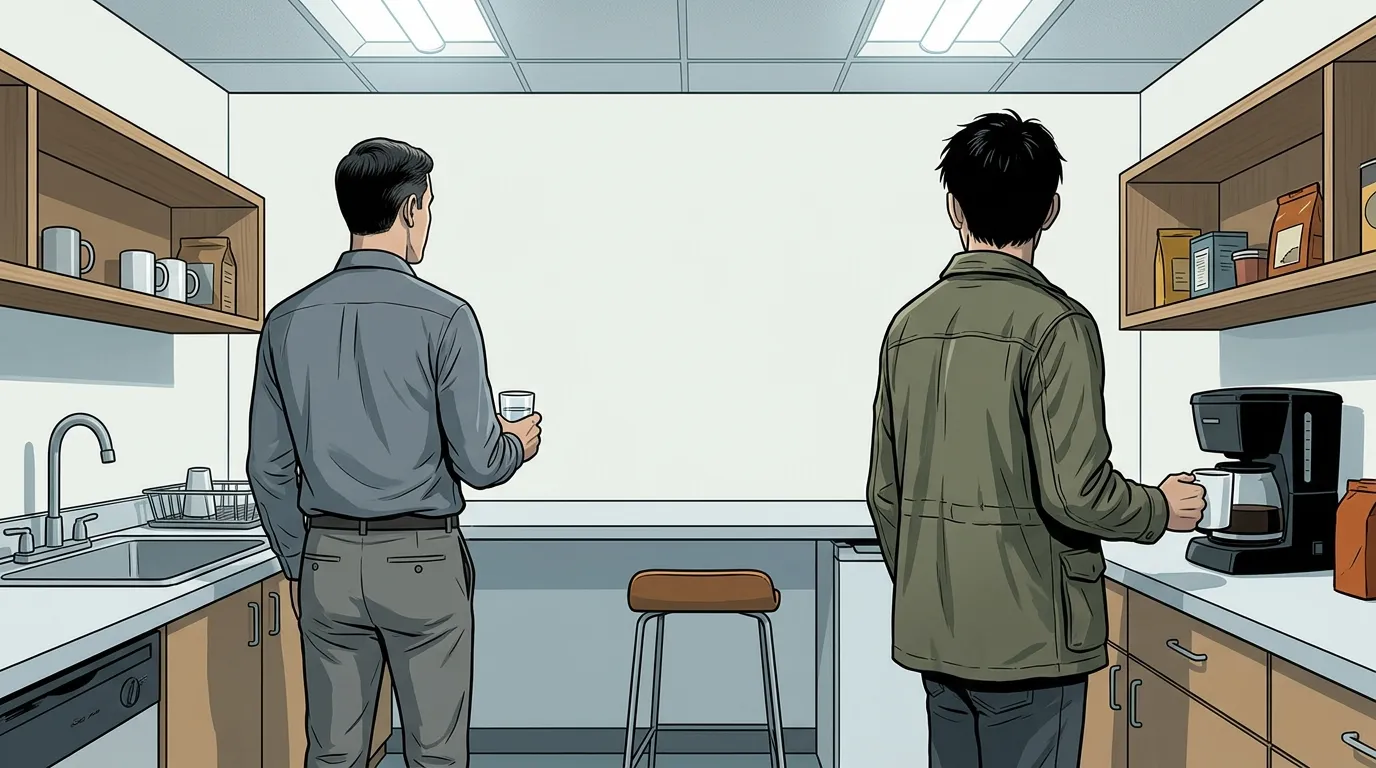
Felix was in the break room.
He was standing by the coffee machine, waiting for it to finish, his back to me. He must have heard me come in — he turned, gave a small nod, said: “Ivan.”
“Felix.”
I walked to the sink side and ran the tap. His machine finished; he picked up the cup, took a sip, set it on the counter.
“Are you looking around at all lately?”
He asked it lightly, the same weight he’d give “how’s your issue count this sprint,” not turning to face me directly but angling his gaze my way without pressing. He left space after saying it. The stool beside the counter was empty, the lights were 4000K white, and right then it was just the two of us.
“You can talk to me. We could work through it together.”
I let the water run for two seconds.
Two paths appeared in those two seconds at the same time.
Say yes: admit I’m looking, admit some degree of dissatisfaction, let that thing surface, let him see it. I didn’t know what would happen after he saw it. Didn’t know what “work through it together” actually meant. Didn’t know whether “you can talk to me” was an offer of help or an offer of another place things would get recorded.
Say no: lie, cleanly, make it sound real, and let things continue. But if he’d seen me with my head down on that call, “no” would put me in a position where he’d know I was lying — and that position was harder to stand in than “yes.”
I moved the glass away from the tap, turned it off.
“Just a call from a friend.”
The moment that sentence came out I caught it — the “just,” and then “a friend,” two unnecessary details I’d added without needing to. I knew I’d put them in as I was saying it, and I knew this was a habit I had when lying — adding one extra detail you didn’t need, as if density could make it more convincing. I pressed down on that habit once the sentence was already out. But the sentence was already out.
Felix said: “Okay.”
Just that.
One word, a period, he picked up his coffee, didn’t continue. I couldn’t tell whether that “okay” meant I believe you or I’ll let it go or I’ll file that away for now. It was a signal that something was ending, but I couldn’t read which kind of ending from his voice.
He said “alright then” and walked out of the break room.
I stood by the sink, glass in hand.
That “okay” just sat there — one word, and it gave me nowhere to land.
I drank some water and went back to my desk.
That afternoon I couldn’t focus. The background process was running, just kept running, running so that when I was writing code my mind would slip between two functions into that break room, replay the conversation once, then get pulled back.
Felix wasn’t surveilling me. I was certain of that.
It wasn’t surveillance — he didn’t have a list with names he was crossing off one by one, the way he’d asked wasn’t that kind of asking. I knew what surveillance looked like: the design of Lumen Pulse, the framework of the Feelings Wheel, the format of that Confluence summary — those things spoke the language of systems, the language for moving information into storage. Felix’s question wasn’t that.
He was offering to help. That I was also certain of. That “you can talk to me, we can work through it together” — he genuinely believed it was something that could be worked through, believed he had the ability to help find a solution, believed that kind of conversation was a good conversation. His goodwill was real.
But his goodwill sitting next to that “okay” left me nowhere to stand.
He’d asked. He knew I’d been on a call. Even if he believed my “call from a friend,” he still knew that at some point this afternoon, from somewhere in the workspace, he’d seen me with my head down talking — and that image now existed in his memory. It wasn’t a digital record. But it was there. He was offering to help, and the act of offering had given that thing a location.
I thought about the offsite, Felix standing in the half-circle when everyone gathered around and saying “I get it now” — at the time I felt like it was a sentence he was saying to himself, because he’d already crossed to the other side, already reached a place called “I get it,” and was now standing there saying it to the rest of us.
Now I was thinking about what “I get it now” meant.
He wasn’t being false. That was real understanding — a real “I’ve been where you are, I know what it feels like, I chose to stay.” His belief was genuine, his goodwill was genuine. That whole system had worked for him, and he genuinely believed transparency made things better.
That made him harder to deal with than someone who was fake. A fake person has cracks — has motives, has a place where you can say he’s not worth trusting. Felix had no cracks. He was a mirror with no one standing behind it: you lean in close and what you see is yourself, and you don’t know whether to be angry at the mirror or at yourself.
That night I saved the HR contacts from the two interview companies onto an old phone.
The phone was on the top shelf of my studio closet, inside a cardboard box, buried with charging cables, old earphones, packaging that had sealed itself shut. I wasn’t sure how old it was — maybe three years, maybe four — an older model, with slight scuffs on the edges.
Finding it took longer than I expected. I had to dig through the box, untangle two cables that had knotted together, before I found one USB-A that still worked. I plugged it in, waited a few minutes, and the screen came on.
The boot time was long — long enough that I thought it might be broken, but it wasn’t, just slow. When it finally reached the home screen a notification popped up saying “Connected to Wi-Fi,” and then it began trying to sync some things I’d left behind three-plus years ago.
I typed in the two HRs’ phone numbers and emails, saved them in contacts with initials only — no company name. This phone had iCloud backup off; I’d checked the settings. These two contact entries wouldn’t appear anywhere synced. They’d just be on this phone, and this phone would just be in that box.
After saving them I set the phone on the desk and left it charging.
Then a string of notifications ran through the notification bar — old messages, photo sync reminders, push alerts from an app I’d disabled long ago. I was swiping past them, not really looking, when the screen stuck on a message thread and my thumb stopped.
An ex-girlfriend.
The last timestamp in that thread was over three years ago. The conversation was long, took several scrolls to get through, the last message at the bottom was mine — short, just a sentence — and then she hadn’t replied, and below that was the blank where conversation ends. I scrolled up and read a few stretches.
Halfway through I realized something: I felt nothing.
Nothing at all. Genuinely nothing. The message history was detailed — contentious, with a few late-night stretches where a lot had been typed, questions that had felt important at the time. Reading it now felt like reading someone else’s messages. The person who had typed all that was a version of me from three-plus years ago, and the relationship between that version and the one running now was the relationship between an old commit and the current branch — it was in the git log, I knew the commit was there, I could check it out and look at it, but the distance between that version and the branch I was running now had grown too far for me to feel anything reading it.
I scrolled up further and found one particularly long message from her. She’d written that she thought I was honest in a lot of ways, but not honest with her. That “I knew many things, but the line I drew between what I chose to say and what I chose not to say was impossible for her to read.” That she wasn’t sure whether the transparency between us was real transparency or just the absence of secrets.
I finished reading that passage, set down the phone, and let it keep charging.
She had described something accurately. The logic of that line was the distinction between “things I had chosen to face” and “things I hadn’t chosen to face yet” — she couldn’t read that line because I’d never explained it clearly, had never even thought it through clearly.
No one had asked me to keep a record of that relationship. But I had.
At Lumenra I couldn’t avoid being required to document everything. And I was less transparent there than I’d been in that relationship.
That observation came with a strange, light feeling — the calm recognition of identifying a logical mismatch. Oh. So that’s how it is.
And then there was that thing.
I wasn’t sure at what point it had started taking a different shape. Maybe when the interviewer asked “why did you leave your previous company” and I said “looking for a better environment to grow” and felt the language circle close around something. Maybe after reading her messages that night — that “the line you draw between what you choose to say and what you choose not to say” pulling something from the periphery straight to the center of my field of vision.
I lay on the bed and let that thing be there. I didn’t try to push it away.
Previous company. That afternoon. The two versions of the quarterly report.
I knew who had changed those numbers. Confirmed. That afternoon I’d gone into the shared folder looking for a contract, opened the wrong level, and found two versions of the Q3 report — the original and the updated. In one cost category in the original there was a figure that had disappeared in the updated version: a significant difference, an entire expense category that had simply ceased to exist. The person was my direct manager, who had edit permissions. The folder’s access log was right there. No guessing required.
I closed the folder. Went to the break room. Stood there for a moment. Then went back and continued working.
I didn’t say anything.
Didn’t call finance, didn’t email legal, didn’t find someone above him, didn’t post anonymously. Nothing.
After that I spent a long stretch of time being “the person who knew.” I sat through many standing meetings, said “understood” under his project updates, sat next to him at all-hands, let the knowing run inside me for about half a year. Then I decided to resign, handed in my notice with “looking for personal growth opportunities,” and let him say in my exit interview: “Thank you for your contributions over these years. You’ve been a very reliable engineer.”
That wasn’t courage. It wasn’t cowardice either. It was choosing myself.
I knew what would happen if I said something — an investigation, being named, possible legal exposure, confirmation that this would make my position in this industry complicated. I’d considered all of that. I’d decided not to take it on. I kept myself away from that thing, chose not to make myself part of it. That was a clear-eyed choice.
And what I was doing now at Lumenra — timing my Kudos strategically, telling Deanna “just not sleeping well,” telling Felix in the break room “just a call from a friend,” not saying anything when Wen-Kai was barely holding on — those were also choosing myself. Every time I drew the line between what I chose to say and what I chose not to say, it was operating on the same logic.
I knew the name of that logic now.
The four sentences in the notes app had always been there — “I knew who altered the quarterly report at my previous company. I saw the original version. I didn’t speak up. I chose to leave.” Those four sentences were no longer just evidence of something existing. They were a coordinate, telling me where I’d always been standing.
This clarity didn’t make me feel better.
It just let me know, with greater precision, what kind of person I was. That knowing was clean, stable — it left no space for me to find an excuse to say “I didn’t know I was like this.” I knew. I’d always known. Now I knew it more clearly.
Then I let these things stay where they were, and didn’t continue.
The old phone was still charging.
On the desk, screen dark, battery probably full by now. That phone held two contact entries, no cloud backup, just sitting on that phone. What was the point of it — preparation for escape? Or just a physical form of confirming that there was a door out there somewhere? I hadn’t thought it through, and hadn’t decided to think it through.
The metal edge of the window frame let in that thin stripe of blue-white light — faint, the same as last time, the same as every time. The AC vent was above my head and to the right; it wasn’t running now, but I could still feel exactly where it was.
Outside, the sound of cars. Tires on asphalt. Then quiet. Then another one.
I let all of it — the choice at the previous company, the four sentences in the notes app, today’s “okay” in the break room, that relationship whose lines I’d never been able to explain, the HR contact info for two companies out there — I let it all sit, in the same space, without trying to arrange any of it into a shape.
Tomorrow was Friday.
Next week’s all-hands had a new item on the agenda — the notification came out this afternoon, Yolanda saying there’d be a “special announcement.”
I didn’t know what that was.