Chapter 9
Stay
Ch9 〈Stay〉
The all-hands was next Wednesday.
Friday to Wednesday. Five days. Weekend plus three workdays. Long enough for something to go from “I don’t know what that is” to “I think I know what that is, but not what kind of that.”
Yolanda’s announcement was white text on a blue background, brief: “All-Hands — Next Wednesday, 2PM — 9th Floor Large Conference Room. This session includes a special announcement. Please attend on time.”
I read it twice. Not much to go on. “Special announcement” was the broadest category it could hold — bad, neutral, something Yolanda considered important but that might not touch me at all. I flipped my phone over and kept running the last test.
Test passed.
I typed a functional one-liner into the commit message, pushed, then sat without moving. Outside was the sound of a normal Friday afternoon — voices, people talking, content I wasn’t receiving, just the frequency of the sound being there, like the office’s background temperature.
Five days.
Over the weekend I stopped myself from thinking about work the way an engineer would: whenever a work-related word floated up, I tagged it // TODO: later in my head and let that loop pause. This worked to about seventy percent. The other thirty was the kind of low-frequency process that seeps into the background — I couldn’t shut it off, just let it run behind everything else without letting it onto the main thread.
By Monday I confirmed one thing: the old phone was still on my desk. I put it in my bag.
Not a decision to use it. I just didn’t want it to keep sitting there on charge, like a device asking me so what are you going to do. Once it was in the bag it became a weight, nothing more — unnecessary, not urgent, just present. I zipped the bag shut.
Monday and Tuesday at the office, those two days, my progress was normal, meetings normal, standups normal. I posted a symbol in #feelings-check-in, sent it, closed the window, kept working. Nothing in particular happened. Nothing in particular happening is also, sometimes, a kind of drain.
Clio came by Tuesday afternoon: “Hey, what do you think Wednesday’s all-hands is about?” Her tone was casual but expectant.
“Not sure,” I said. True.
“I have a feeling it’s good news,” she said. “The company’s been in a good place lately, don’t you think?” Then she named two things she took as signs of that. I nodded. She smiled and walked off. I wasn’t sure whether she genuinely had that feeling or whether she habitually set a positive frame first — but maybe for her those two things were equally real.
Wednesday, 2PM.
I got to the ninth-floor conference room a few minutes early and took my usual spot — back row against the wall, clear view of the screen in front, solid wall behind me, not glass. That choice was instinct.
The room filled slowly. I opened Slido and saw a few questions already submitted, all technical — they disappeared quickly, covered by new ones. Someone was troubleshooting their equipment; “No HDMI Signal” appeared in the top-right corner of the projection screen, then vanished. Nobody said anything.
Jason stepped up at exactly two, dark navy blazer, delivery unchanged — not loud, but the kind of certainty that made you feel this person knew what he was talking about. Yolanda stood to the side, head down, checking something on her phone, probably confirming the flow.
“I’m glad everyone’s here,” Jason said, then paused — that was just his rhythm. “Today I want to share a new initiative. It’s something I developed together with Deanna and the whole people ops team over the past few months. I think it aligns with what we’ve always been building toward.”
The way he said “hope” was the same way he said every other word — no extra weight — but the word always landed in exactly the right position in the sentence.
Then he introduced the annual transparency report.
Personal dashboards. Numbers.
KF count and positive-to-negative ratio, #feelings-check-in response rate, public channel activity, average 360 Review scores across categories, percentile rankings across culture metrics — you can see where you stand, but not where anyone else stands.
Jason made it sound natural: “We’ve always believed transparency is a form of respect toward each other. This report is a tool that lets every person see where they are in the culture we’ve built together, where they’re headed — and how we get better, together.”
The aggregate numbers were anonymized. The individual view was private, not shared.
He said “so everyone knows where they are and where they’re headed” in the tone of someone presenting something he considered good.
I looked at the dashboard mockup on the projection screen. The design was clean — light grey background, numbers shown as proportional bars, percentile ranking on the right as a small dot on a curve. Your dot lit up. Everyone else’s dots were grey shapes you couldn’t identify.
The most unsettling thing about a system is usually not what it says, but the way it speaks that leaves no room to ask wait, is this actually reasonable? Percentile rankings make transparency one-directional — you’ve been quantified, and the result tells you where you sit on the curve, not who the curve is made of, not how the shape of the curve was decided. But the curve already exists. Your dot is already there. It’s lit up. It’s yours.
I put my fingers over the Slido input field and typed half a question.
“This percentile ranking —”
Then I glanced sideways. No one else was typing.
I selected the half-sentence and deleted it.
The Q&A ran about ten minutes. Someone asked when the dashboard would be accessible — Yolanda said end of quarter. Someone asked how 360 Review scores were calculated — she said people ops would publish detailed methodology later. Someone asked whether this affected performance reviews — Jason smiled and said “this is a tool for understanding yourself, not an evaluation tool.”
I didn’t type anything else.
When the session broke up, the crowd moved toward the door, the noise level rose slightly, people exchanging impressions — the sound of a meeting ending, normal. Felix passed me on his way out. He slowed — just slightly slowed — and said one thing:
“Good share.”
Tone flat, no upward inflection, no downward weight. He kept walking, didn’t wait for a response. I stood there and watched his back, not sure what he’d meant by it — he might have genuinely thought it was a good share, he might have been watching, he might have been both, he might have been neither. That uncertainty was the hardest part of his voice to decode.
Then Clio came over, stride much faster than Felix’s, the energy she carries when she’s happy moving visibly through her:
“What did you think of today?”
“Good,” I said.
True in every sense. Clio gave that smile she makes when she receives positive feedback, said “super!” and then someone across the room called her name and she turned and went.
I walked out of the conference room toward the corridor, maybe three steps, then I ducked into the bathroom.
Not escaping.
Just the bathroom.
Behind the door was that low-frequency exhaust fan, orange-scented hand soap, white LED light — same as every time. I stood at the sink, turned the tap, washed my hands, not slow, not fast.
The face in the mirror was the one I knew.
I knew who had altered the quarterly report at my previous company — those four sentences were in the notes app, I hadn’t opened it, but I knew they were there, like knowing exactly which shelf something is on without having to look. That knowing was stable. Not comfortable, but stable.
2:18PM.
I turned off the tap, took a paper towel, pushed the door open, and walked out.
Deanna came by my desk at 3:30.
She walked past and said “Do you have a moment? Clarity’s free, let’s chat.” The tone was the same one I’d heard for three-plus months — the form of an invitation, but the kind where turning it down would cost something.
“Sure,” I said.
The blinds in Clarity were halfway down. Through the glass I could see shapes moving in the corridor, but couldn’t make out who. When Deanna sat down she set her notebook on the table, pen in hand, but the pen didn’t move right away — that posture read more as I’m here than I’m about to write.
Her top was deep orange, the color standing out clearly in the glass-room light.
“I want to show you something,” she said, and turned her laptop toward me.
On the screen was the Lumen Pulse admin view. My name.
The numbers weren’t bad.
#feelings-check-in response rate in the upper-middle range, public channel activity on the lower side but not the lowest, technical scores on 360 high, collaboration scores in the middle. Three Kudos: two from others to me, one from me to Felix. And the Flag — anonymous, still don’t know who wrote it — sitting in a field on the page in its read state.
She let me read through the whole page without rushing me, without explaining anything, just let me read.
“Your numbers,” she said, “aren’t bad. The feedback you’ve received has been positive. Your technical contributions are recognized.” She paused — a deliberate pause, part of her rhythm. “But I don’t think you’re fully here yet.”
She said it evenly, the way you’d confirm an observation rather than make a criticism.
Not a criticism. But the way it landed left no room to step back behind anything.
Fully here.
I turned the phrase over in my head. It didn’t refer to any field on that page. It referred to that part — the part I’d consciously, systematically kept from getting too close, the part that in the bathroom was stable, in the notes app was four sentences, the part that told me who I was.
You’re not fully here yet.
She was right.
Three-plus months, I had been here. I came every day, I did what I was supposed to do, I spoke up, I responded, I posted weather symbols, I liked things in public channels, I left comments in code reviews, I said something in the honesty circle that hung in the air, I let this place’s language run through me, let its shape pass through me. I was here.
But I wasn’t fully here.
Deanna was watching my face with that quality of I’m actually listening to you — real, not performed, three months of consistency had made that clear to me — she was real, her goodwill toward me was real, she said “you’re not fully here yet” because she saw it, not because she wanted something.
Which made it impossible to deflect with you’re not being genuine.
She waited.
I looked at the table. Smooth, white, with a faint sense of temperature.
“I know,” I said.
A few seconds passed. Deanna said, “You can tell me, you know. This notebook is personal — it doesn’t go into the system.” She moved the notebook slightly toward herself. The gesture meant: I’m here.
I knew what she meant. She’d said it more than once, and every time she’d been sincere. This time too.
From the first week to now, from “you can tell me” to “this is a safe space” to today’s “not fully here yet,” she’d been saying the same thing each time, just moving one step closer with each pass. Today was the closest step.
I could say it now. After saying it maybe things would feel lighter — or maybe just shift the weight from one place to another, maybe nothing would change at all, maybe Deanna would say “thank you for telling me” and write something in her notebook, and it wouldn’t go into any system, but it would be in that notebook — which was also a place, a place with edges I didn’t fully know.
Or I could not say it. Keep staying. Learn the kind of quiet Felix had settled into after his I get it now.
On my first day, in the kitchen, I’d said: “I like knowing everything, because knowing lets me decide what to do.” I now knew everything. I knew that afternoon at my previous company, the two versions of the quarterly report, the distance. I knew I was someone who chose himself, knew that logic kept operating through every line I’d drawn at Lumenra, knew Wen-Kai had disappeared and I’d let it happen, knew Felix was a mirror with no one standing behind it, knew Deanna’s good faith was complete.
I knew everything. And then I chose to say half.
“I left my previous job because of something,” I said.
My voice was calm. I’d verified the sentence before speaking, confirmed it was inside the range of what I intended to say. The calm came from that.
“That thing made me feel like knowing too much isn’t necessarily safer.”
Deanna didn’t respond right away. She listened, the quality of I’m actually listening holding steady.
I stopped.
The half covered the core of it — something had happened, and knowing turned into a weight, and finding a way to set that weight down meant leaving, and it changed the way I felt about knowing. Every word of that was true. But the four sentences in the notes app, the specific afternoon, the person, the two versions of the numbers, the distance — those were unspoken, still there, in the part of me that doesn’t face outward.
Deanna waited, no pressure, her way of waiting, letting the silence stay, giving room to fill or not fill.
“That’s all,” I said.
She said, “Thank you for telling me.”
The way she said it was the same as every time before — sincere, grounded, as if she had genuinely received something.
She let the silence sit for a few more seconds, then: “I want you to know that this takes time to say, and I understand that. I’m here.” A pause. “When you feel ready to say more, you can. Not today.”
“Okay,” I said.
“Mm.” She leaned back slightly, picked up her pen, wrote something in the notebook — I couldn’t see what, and didn’t try to — then closed it. “I think just coming here today was something. This conversation is already a step.”
She stood up. The meeting was over.
I stood up too.
Walking out of Clarity, the light in the corridor was late-afternoon light, angled, coming through the west-facing windows, shadows stretched a little longer. I started back toward my desk, made it halfway, and stopped.
The feeling of halfway was there. Not victory. Not defeat.
The four sentences in the notes app. Sentences one and two: “I knew who altered the quarterly report at my previous company. I saw the original version.” — I had said them, in another language, wrapped around the specifics, but the skeleton was there. Sentences three and four: “I didn’t speak up. I chose to leave.” — those I hadn’t said. Those two carried the most weight. Saying those two would mean handing over the complete shape of the whole thing — including the logic that told me what kind of person I was, including the part I couldn’t pretend was just an “information-processing problem.”
Said halfway. The gap that size: too small for the system to take, large enough that I knew it was still there.
I kept walking to my desk.
The paper clip on the right side of my desk was where it had always been.
I sat down, opened Slack, scrolled to today in #feelings-check-in. The afternoon slot was still empty.
I thought about Wen-Kai.
His ☀️ stopped at 9:45AM the day before his last day, a small grey dot beside his profile picture. Scroll up and you could see the rhythm of his ☀️s — dense, occasionally one day missing, then continuing — until the final blank. Two blanks, one a coincidence, one an endpoint. The weight was different. But if you scroll up now, you can’t tell them apart at a glance.
Wen-Kai hadn’t said enough and then left. Or he had said everything he had, and that’s why he left. I had no way to confirm which was true.
I moved my cursor to the input field, typed a symbol, sent it, closed the window.
A little after four, I cleared my desk and picked up my bag. The weight inside it included that old phone. The numbers and email addresses were still there, no cloud backup, just on that phone. I didn’t throw it away, didn’t take it back out — just zipped the bag, shouldered it, and walked toward the elevators.
At the lobby, there was a transition point between the building’s air-conditioning and the outside air — the gap of the revolving door. I pushed through the revolving door and walked out.
May in Taipei, evening not yet arrived, a layer of heaviness in the air — the kind of wet heat that rises from asphalt, constant, soaking into everything around you.
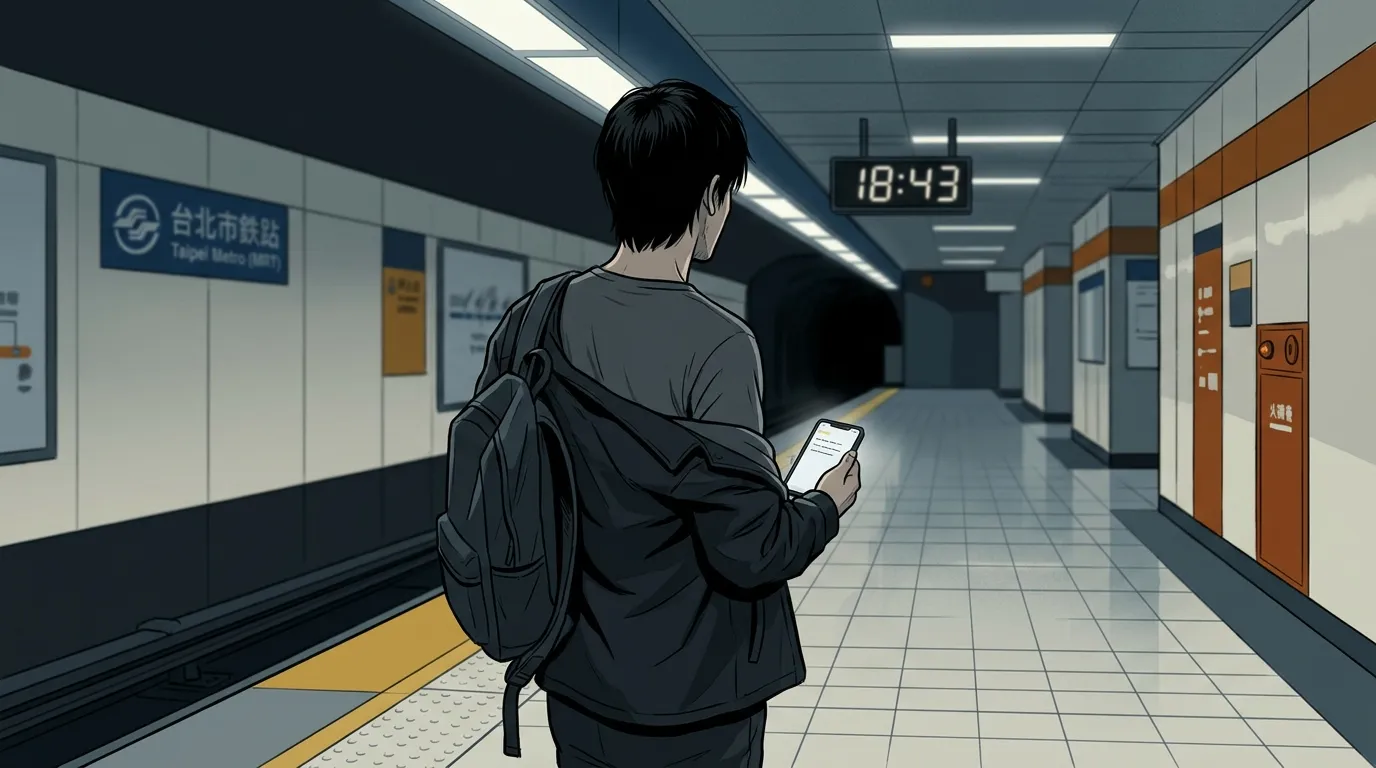
I didn’t stop. Walked along the sidewalk toward the MRT at my normal pace.
He hadn’t left. He hadn’t really stayed either.
A secret told halfway is more durable than a whole secret, because its edge is like a water surface — you know what’s underneath, but the surface is still there, flat, no ripple, unless you decide to make one.
I knew the shape of the gap now.
I opened the notes app, and under the four sentences, I added a new line:
I told half of it.
Then I closed the notes app, walked toward the MRT entrance, the cool air from the air-conditioning seeping through the gates. I tapped my card, went through, stood on the platform on the side I always stand.
The sound of the train came from far away, then grew closer, then arrived, stopped, and the doors opened.
I walked in.
The doors closed.