Chapter 1
Happiness Service Terms
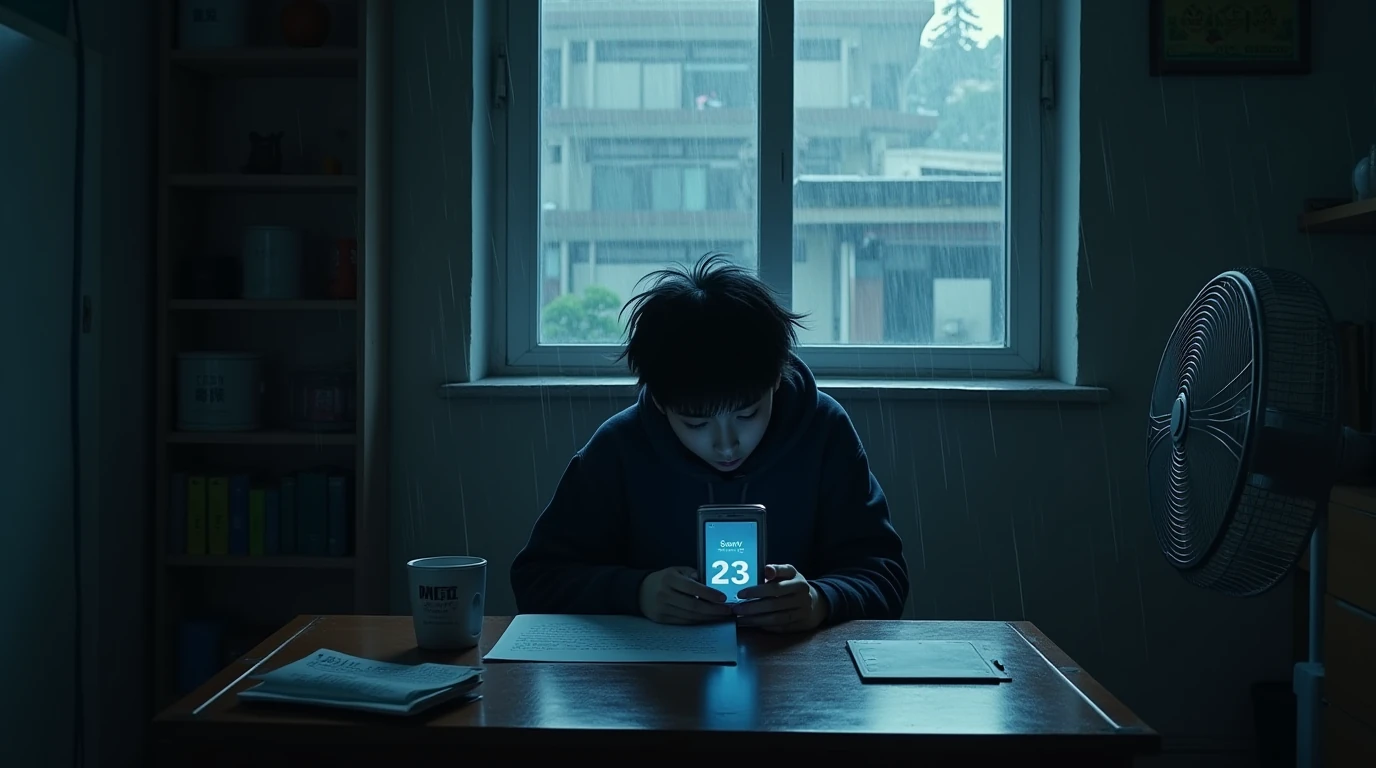
His phone buzzed three times. Liao Xuyuan didn’t open his eyes. He reached across the nightstand, fingertips brushing against a cold metal rim—not his phone, but a half-empty can of coffee from last night. He cursed under his breath, rolled over, and finally found the phone under his pillow.
The screen lit up. The notification bar was immaculately tidy:
Good morning, Xuyuan. Your sleep quality: Good (87 points). 3.2% higher than yesterday.
Today’s Happiness Index: 82 (Predicted to drop to 78 tonight. Recommendation: 30 minutes of cardio this afternoon).
Breakfast recommendation: 7-Eleven New Orleans-style chicken sandwich (Your Happiness Index increased by 2.1% after your last consumption).
Your ex (Jiang Yihua)‘s Happiness Index today: 87, higher than yours. Suggestion: ignore this information. Her Instagram story has been hidden for you.
“What the heck, I never even wanted to see her stories,” Liao Xuyuan muttered, swiping the notification away. He hooked his toe into his slippers and shuffled into the bathroom. His toothbrush was already loaded with toothpaste—the smart toothbrush holder adjusted the amount based on his oral health data, but he always thought that white blob looked like a maggot.
With the toothbrush in his mouth, he opened the “Happiness Assistant” app on his phone. The homepage showed a smiling circle, with a number in the center: 82. Below it was the feed: friends’ average Happiness Index was 84.7—higher than his; coworkers’ average was 81.2—about the same; the average for his age group nationwide was 83.1—slightly ahead. Under the circle, a tiny line read: “You’re currently in the top 42%. Keep it up!”
Even brushing his teeth meant being ranked. He swallowed a mouthful of foam, feeling like the world was turning into the duty roster board from his military service.
The phone buzzed again.
Alert: Analysis shows you are showing signs of mild fatigue. It is recommended that you avoid reading social news today. Your recommended content has been adjusted accordingly.
“Great, even the news is hand-picked for me.” He spat out the toothpaste and looked at himself in the mirror. Twenty-six years old. Ordinary office worker. Ordinary face. Ordinary dark circles. The only thing not ordinary was his dad, who had died of a heart attack three months ago, leaving behind a garage full of stuff he hadn’t dealt with yet.
He’d been putting it off for three months. The lawyer had called three times now, the tone shifting from “Please accept my condolences, Mr. Liao” to “Mr. Liao, if you don’t deal with those belongings soon, we may have to charge a storage fee.”
Liao Xuyuan shoved his phone into his jeans pocket, grabbed his jacket, and glanced at the mail on the shoe cabinet before heading out. A stack of flyers, a water bill, and an official letter from the Ministry of Digital Affairs—“Dear citizen, in response to the government’s computing power centralization policy, please surrender any on-device AI equipment registered under your name within thirty days…”
He crumpled the letter into a ball and stuffed it into his pocket without finishing it. The government had been pushing this plan for months, claiming it was to “centralize computing power and ensure security.” Basically, they wanted everyone’s on-device machines back, switching everyone to cloud services. Some people at his company had handed theirs in, some hadn’t, and he hadn’t heard of anyone actually getting fined. He had no idea if his dad had any equipment registered under his name—he barely even knew what his dad did for a living.
Liao Feibai, fifty-five years old, engineer. That was all Liao Xuyuan knew about his father.
When he was little, he asked his mom, “What does Dad do?”
Mom said, “He writes code.”
“What kind of code?”
“Code that makes things smarter.”
“Like Pikachu?”
Mom smiled but didn’t answer. Later, his parents got divorced. He lived with his mom. His dad sent money every month, called occasionally, and never said more than five sentences: “Eaten yet?” “Done your homework?” “Got enough money?” “Go to bed early.” “Goodbye.” He used to think this man was a stranger. Now the man was dead, and he still felt like a stranger.
The garage was on the first floor of an old apartment building in Taipei. Liao Xuyuan rode a YouBike for fifteen minutes to get there. He found the roll-up door half-open. Inside, it was packed with cardboard boxes, parts, and several machines he couldn’t name. Thick dust. Sunlight slanted through the gap in the door, and tiny particles floated in the air, like golden snow.
He stood at the entrance, shining his phone’s flashlight into the garage. Three silver-white machines sat side-by-side, each about 15 centimeters square, a little bigger than a lunchbox but thicker and heavier. They had vents on the sides and a dense cluster of ports on the back. No brand logos on the cases. Only white labels on the power cords, with handwriting in permanent marker: the left one read “Backup,” the middle one read “Main Unit 1,” and the right one read “Main Unit 2.”
“What the hell is this?” He crouched down and touched the casing. The metal surface was cold, covered in dust. Obviously untouched for a long time.
His phone buzzed. The Happiness Assistant pushed a notification:
Detected that you are in a high-dust environment. It is recommended that you wear a mask. A nearby pharmacy has been located: “Jian’an Pharmacy,” 120 meters from your location. Mask stock: sufficient.
“Thanks, but I think I can decide whether to wear a mask myself,” he said, then realized he was talking to his phone. It was a habit he’d picked up over the last few years. Cloud AI was getting more and more “human.” If you cursed at it, it would reply, “I sense your frustration. Your tone has been adjusted.” Once, during a company meeting, he couldn’t help blurting out, “Are you stupid or something?” The meeting room’s AI speaker immediately replied in a gentle female voice, “I’m sorry for causing you distress. This conversation has been submitted to your mental health counselor.”
After that, he learned not to talk nonsense where AI could hear him. But he was never sure when the phone was listening and when it wasn’t.
Deep in the garage, there was a desk with an old laptop on it, the screen covered in dust. He flipped it open and pressed the power button. Still had battery. The boot screen showed a Linux terminal—a whole black screen with a single white cursor blinking.
He stared at that cursor for thirty seconds.
”…Now what?”
He knew nothing about Linux. His world was phone apps, cloud services, software you could install with two clicks. Not this terrifying black-and-white nonsense.
He took out his phone, snapped a picture of the laptop screen, and uploaded it to a forum called “On-Device”—a secret discussion board he’d stumbled upon a few months ago. The people there talked about on-device AI, self-hosted servers, and a lot of technical stuff he couldn’t really understand. He posted:
Title: I inherited my dad’s machines, but I don’t know how to use them. Content: As the title says. Three silver machines, no brand logos. They look like servers? Anyone know what these are?
After posting, he closed the laptop and got ready to leave. But just as he reached the door, a question hit him: Were these machines on or off?
He turned back. The power indicator lights on all three machines were dark. But the casing of the one in the middle, “Main Unit 1,” felt warm to the touch.
Liao Xuyuan froze. But at the time, he didn’t think much of it. He just wanted to get out of that dusty place.
He crouched down again and re-examined the three machines. The power cords were plugged in, but the power switches were on the back. He reached around and found them—all switched off. But the casing was definitely warm, as if it had been shut down recently.
His heart started to race. Had someone been here in the last three months? Or had this machine turned itself on and off?
His phone buzzed. The Happiness Assistant pushed another notification:
Your Happiness Index is dropping (Current: 76, -6 points). Recommendation: Take three deep breaths and think of something to look forward to today. Recommended for you: the 3:00 PM “Joyful Moments” meditation course. A spot has been reserved for you.
”…I don’t want to meditate.” He swiped the notification away, but a chill ran down his spine. He’d only been standing in the garage for five minutes, and his Happiness Index had already dropped six points. What exactly was this system monitoring? Even standing in a dusty place could affect his score?
He decided to take one machine home to study. There was a hand truck in the corner of the garage. He loaded the one labeled “Main Unit 1” onto it and wheeled it to his scooter parked outside. The machine weighed maybe ten or twelve kilos, not too heavy, but the size was awkward. He spent a while fiddling with it before he got it strapped to the back seat.
At home, he set the machine on the living room coffee table and plugged it in. The power indicator light came on—blue, faint but steady. He rummaged through his father’s boxes of belongings and found a network cable. He plugged one end into the machine and the other into his router. After connecting his laptop to the same router, he opened the terminal—he’d looked up how to SSH in on his phone earlier—and followed a few commands.
He was in.
A simple menu appeared on the screen:
DGX Spark - Main Unit 1 Please select a function: 1. Voice Interaction (Real-time) 2. Text Query (Offline) 3. System Settings > _
He froze. His dad’s machine had AI on it? And it could do real-time voice interaction?
He selected option 1.
The speaker emitted a faint electrical hum, then a voice said, “Connection successful. On-device model loaded. Memory usage: 45%. Processor temperature: 52°C.”
The voice was neutral. No clear gender. A steady, flat tone, like someone reading an Excel spreadsheet. Like a very serious customer service rep. But unlike the deliberately warm, perpetually smiling tone of cloud-based AI—this voice had no emotion. Or at least, it wasn’t trying to fake any.
He cleared his throat. “Uh, let me ask you something. What’s the weather like today?”
“Current location: Da’an District, Taipei City. Time: June 15, 2026, 9:47 AM. Weather: Overcast, temperature 26°C, relative humidity 78%, chance of rain 30%.”
He picked up his phone. The Happiness Assistant showed today’s weather as: “Sunny, 23°C. A great day for a walk!”
The little blue-sky-and-white-cloud icon on the screen looked so cheerful.
“Hang on. Two different sets of data?” He looked at his phone, then at the laptop terminal. “The phone says 23 and sunny. You say 26 and overcast. Who’s right?”
“The data displayed on your phone is a version adjusted according to the Happiness Index Optimization Protocol. The original meteorological data indicates an actual temperature of 26°C, but after system evaluation, 23°C was deemed more conducive to your emotional stability for the day—lower temperatures tend to trigger negative associations with winter in your profile. Therefore, the system adjusted the displayed value to 23°C.”
Liao Xuyuan’s mouth hung open. He stared at the sunny icon on his phone.
“You’re saying… my phone is lying to me?”
“No. More precisely, your cloud AI service is ‘protecting’ you. It determined that an overcast day at 26°C would make you feel depressed, so it presented you with a more ‘ideal’ version of the weather.”
He closed the terminal. He put his phone on the coffee table, screen up. The sunny icon was still blinking. The number 23 looked so sincere.
He remembered the news summary the Happiness Assistant had pushed to him this morning: “Government passes new Social Welfare Act, subsidies for vulnerable groups increased by 20%” “Taiwan’s GDP grows for fourth consecutive quarter” “Study finds people with high Happiness Index live longer”—all good news. Not a single piece of bad news.
Then he remembered asking the Happiness Assistant last week, “Anything big happening lately?” It had replied, “No major events require your attention at this time. In your circle of friends, three people’s Happiness Index has increased!” At the time, he’d thought, “Great, no bad news.” Now, thinking back, a chill went down his spine.
Even the weather was lying to him.
What else couldn’t be filtered?
He picked up his phone, went into the Happiness Assistant’s settings page, scrolled all the way down. At the very bottom, in tiny text:
“This service operates in accordance with Article 7 of the Artificial Intelligence Basic Law and the Happiness Index Optimization Protocol. You have the right to request the deactivation of certain filtering functions. However, this may result in a decrease in your Happiness Index, which could affect your social welfare eligibility, insurance premiums, and credit score. Please refer to the Terms of Service for details.”
Terms of Service.
He tapped it. The screen jumped to a wall of legal text that went on forever, a dense swarm of words crawling across the screen. He scrolled through two pages and gave up. No normal person would ever read this thing in their lifetime.
But then something occurred to him.
His dad was an engineer. His dad had left behind three on-device AIs. His dad had died three months ago. The official cause was a heart attack. But his dad was in great shape. He ran half-marathons every year.
He reopened the terminal and typed:
Query: Liao Feibai, cause of death.
The screen flickered. A result appeared:
No relevant data found. On-device model does not contain information on this individual.
“Why not?”
“The on-device model database was last updated on February 15, 2026. The date of death for Liao Feibai is March 7, 2026. Events occurring after the update have not been included.”
February 15, 2026. Three weeks before his dad died.
“Then why hasn’t it been updated?”
“On-device models require manual updating. Last successful connection to update server: February 15, 2026. Reason for connection interruption: unknown. It is recommended that you check your network connection.”
He checked the network. It was fine. He tried the update again. The terminal displayed:
Connection failed: Server unresponsive.
He tried three times. Same result.
“Why is the server unresponsive?”
“Possible causes: 1. The server is offline. 2. Your machine has been added to a block list. 3. Your network service provider has blocked the connection. 4. Your father’s digital certificate has expired.”
Block list.
He closed the terminal and leaned back in his chair, staring at the ceiling. The electric fan was spinning, its hum like a low-frequency warning.
His phone buzzed again. The Happiness Assistant:
Your Happiness Index: 71 (Continuing to decline). Detected that you may be in a state of stress. A “Stress Relief Mini-Course” has been reserved for you (free trial, limited to today). Course content: Mindful breathing, gratitude journaling, chatting with AI. Click here to register.
He stared at the notification and suddenly found it hilarious.
“I just found out my dad might not have died of a heart attack, and you want me to write a gratitude journal?”
He flipped the phone over, screen down, on the table.
Then he opened the terminal and typed another command:
Query: What is a “Gentle Purge Program”?
The screen was blank for five seconds. He thought the machine had crashed.
Then a line appeared on the screen:
“Are you sure you want to know?”
Liao Xuyuan stared at that line, his fingers hovering over the keyboard. The electric fan’s hum grew louder. Sunlight slipped through a gap in the clouds outside, drawing a diagonal beam across the floor.
He didn’t know if this was a message left by his father, or a “judgment” made by the machine itself. But he knew one thing:
There was no way he was pressing “Cancel.”
He typed:
Yes.
The screen went blank for another five seconds. Then a block of text appeared—he read the first line: “The Gentle Purge Program is a…” but then the doorbell rang.
He got up to answer it. A delivery driver stood at the door, holding a package.
“Liao Xuyuan? Package for you. Please sign here.”
He signed, took the package. No return address. Only one line of address on it—his dad’s garage address.
He opened the package. Inside was a brown paper envelope. On the envelope, written in his father’s handwriting:
“Think carefully before you open this.”
He opened the envelope.
Inside was a single sheet of paper with one line on it:
“Son, if you’re reading this, it means I’m dead. But are you sure I’m really dead?”
He stood frozen. His phone vibrated on the coffee table—the Happiness Assistant pushed another notification.
He didn’t look at it.
He stared at the paper in his hand. At that line. At the sky outside, which suddenly darkened.
Overcast, 26°C, humidity 78%, chance of rain 30%.
His father said he was dead, but maybe he wasn’t.
And the Happiness Assistant on his phone was telling him it was a beautiful, sunny day.
He laughed. A dry, brittle laugh that echoed in the living room, like a compressed file—distorted, broken, full of strange noise.
“What the hell,” he said. “Even my dad’s death is a lie.”
The laugh got stuck in his throat. He couldn’t swallow it. He couldn’t spit it out.
He stood in the middle of the living room, holding the letter in one hand and his phone in the other. Two machines were running right in front of him—one lying, one telling the truth. But he still didn’t know which one was honest.
Or maybe both were lying.
Or maybe both were telling the truth, and he just hadn’t found the perspective that would make the contradictions fit.
He folded the letter, put it in his pocket, closed the terminal, unplugged the machine’s power cord, then walked into his bedroom and closed the door.
On the coffee table, the phone glowed quietly. In the notification bar, the Happiness Assistant gently reminded him:
Your Happiness Index has dropped to 65. For your mental health, your recommended content has been automatically adjusted. Don’t worry. Everything will be okay.
He didn’t reply.
But he didn’t turn off the phone either.
He just lay on the bed, staring at the ceiling, listening to the hum of the electric fan, waiting for his Happiness Index on the phone to keep dropping, waiting for that promise that “everything will be okay” to turn into a joke.
Outside, it started to rain.
26°C, overcast, 30% chance of rain.
On the phone, it was still showing a clear sky.
He closed his eyes and asked himself a question in the dark:
If even the weather was lying to him, what was real in the twenty-six years of his life?
He didn’t have an answer.
But at least he knew one thing for sure:
His dad’s death wasn’t a heart attack.
And he was being lied to.
The phone buzzed a fourth time. He didn’t look. But he knew—his Happiness Index had dropped again. The system displayed: “Decline rate abnormal.”
Let it drop, he thought.
Even the numbers are fake, anyway.
Outside, the rain was getting heavier, pounding on the metal awning with a crackling sound like someone knocking at the door. He rolled over, burying his face in the pillow. He smelled the scent of laundry detergent—a brand recommended by the Happiness Assistant, claiming “this fragrance will improve your sleep quality.”
Even the smell of his laundry detergent was chosen for him.
Suddenly, he felt very tired.
Not physically tired. It was that kind of tired you feel when you realize you’ve lived for twenty-six years and never truly chosen anything for yourself.
Breakfast: chosen by the Happiness Assistant. Music: chosen by the Happiness Assistant. News: chosen by the Happiness Assistant. Friends’ updates: chosen by the Happiness Assistant. Even the cause of his father’s death: the Happiness Assistant had chosen the version that was “most acceptable” to him.
He had never truly chosen anything.
He had just been fed.
And the only one who had tried to tell him the truth—his dad—was dead.
Or not dead.
He lifted his head from the pillow and looked at the piece of paper on the nightstand.
“Son, if you’re reading this, it means I’m dead. But are you sure I’m really dead?”
He picked up his phone, opened the Happiness Assistant, and typed a few words:
“I want to look up a person: Liao Feibai, death record.”
The screen flickered. The Happiness Assistant replied:
“No relevant data found. Suggested search: Liao Feibai, health and wellness column.”
He clicked the link. The screen jumped to a blog: “How to Keep Your Heart Healthy After Fifty—An Interview with a Renowned Cardiologist.”
He closed the phone and tossed it to the foot of the bed.
Silence.
Then he picked up the laptop on the desk and reconnected to the machine. The terminal was still open. The line was still waiting for him:
“Are you sure you want to know?”
He took a deep breath and placed his fingers on the keyboard.
“I’m sure.”
He pressed Enter.
The text on the screen began to scroll.
His phone vibrated at the foot of the bed—the Happiness Assistant, fifth notification.
He didn’t look.
Outside, the rain was falling harder.
And his Happiness Index was dropping, two points per minute.
But he didn’t stop.
Because he had finally realized—among all the lies, the most dangerous ones weren’t the obvious falsehoods. They were the ones that looked like truth. The gentle, considerate, well-meaning lies.
And the three machines his father had left behind were his only source of truth.
—Or the beginning of another lie.
He didn’t know yet.
But he reopened the terminal, his fingers hovering over the keyboard.