Chapter 10
The Price of the Key
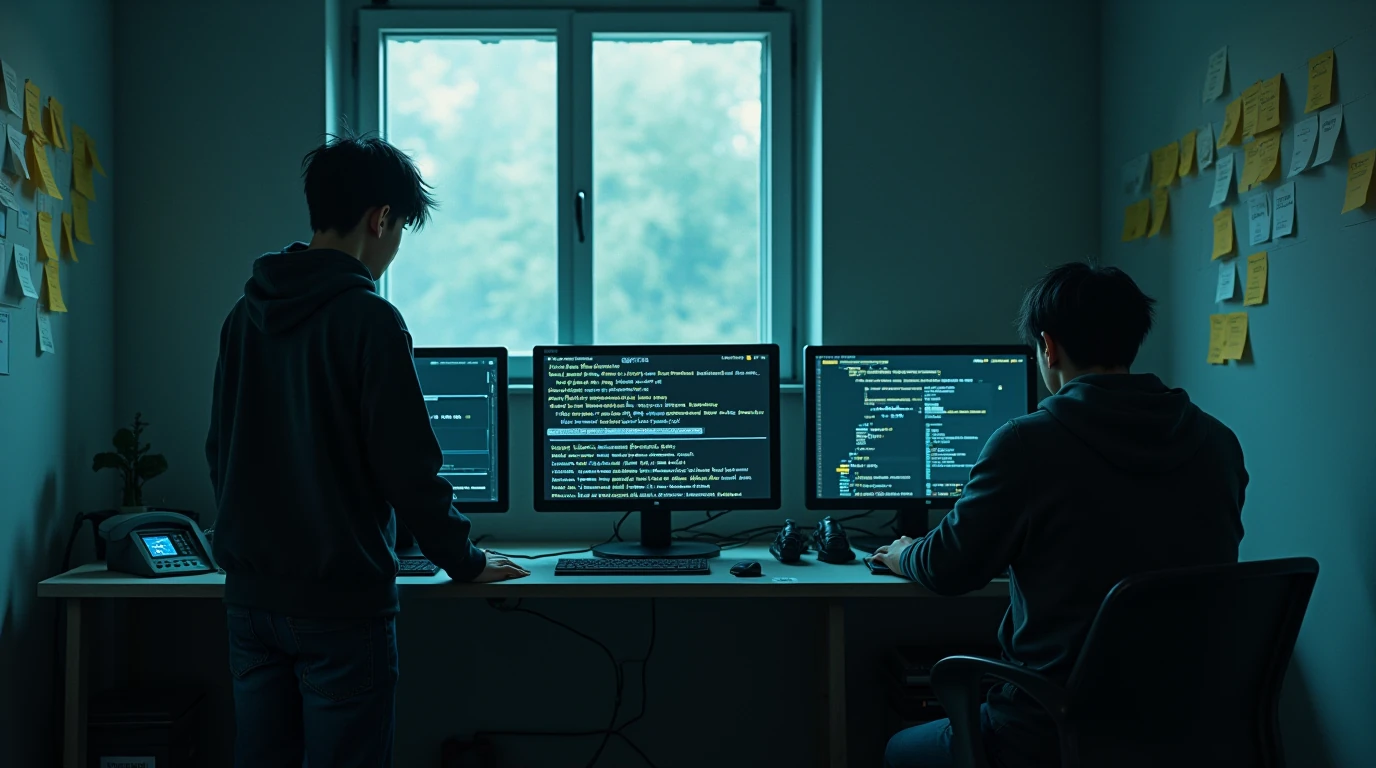
He stood outside Jiang Ji’s building, looking up at the window on the seventh floor.
The curtains were drawn, but a thin line of warm light bled through the edge. She was home. He’d been standing there for five minutes, like the tragic protagonist in a “Last Meeting Before the Breakup” ad recommended by the system—except this wasn’t a recommendation. This was his own choice.
When the elevator doors opened, one of the hallway’s motion-sensor lights flicked on. He walked to apartment 701. The door wasn’t closed—a crack was left.
“Don’t say anything when you come in.”
Jiang Ji’s voice came from inside, calm as a customer service hotline greeting. She gave a wry smile and added, “Sorry. Occupational hazard.”
He pushed the door open and saw her sitting on the living room sofa, a laptop on her knees. The screen was split into four squares—each one a surveillance feed: the stairwell, the elevator entrance, the main gate, the parking lot.
“They call it ‘safety protection,’” she said without looking up, her fingers gliding over the trackpad. “They installed it the day before yesterday. Because I’ve been in contact with a ‘high-risk individual.’”
Liao Xuyuan stood at the entrance, still wearing his shoes. The living room looked the same as the last time he’d been here—a light gray sofa, half a glass of water on the coffee table, a portrait of her mother on the wall. But he noticed one detail: next to the portrait was a small white box with a green light blinking on it.
“What’s that?”
Jiang Ji finally looked up, following his gaze. “System emotion monitor,” she said. “It records my biometrics, changes in my tone, even my typing rhythm. If my Happiness Index drops below 80, it automatically notifies my supervisor.”
“So every word you say right now—”
“Is being recorded.” She closed the laptop. “But I know how to turn it off. You taught me—‘Every internet-connected device has a back door.’ Your own words.”
She stood up, walked to the white box, and pressed a hidden button on its back. The green light turned red, then went out.
“Now we have about forty minutes,” she said. “After that, the system will notice the monitor is offline and send someone to ‘inspect.’”
Liao Xuyuan watched her. She was wearing casual home clothes. Her employee badge hung from the doorknob of the living room door—CS-4417, glinting in the light. She looked calm, but her fingers were trembling.
“Why did you turn it off?”
“Because when you called me, I could tell—you didn’t come to get back together.” She gave a bitter smile. “You came to ask me for something.”
Liao Xuyuan took a deep breath.
“The Reverse Purge program needs a key,” he said. “The one you hold—the Emotion Intervention Code.”
Jiang Ji didn’t answer immediately. She walked to the coffee table, picked up the half-full glass of water, and took a sip. The glass wobbled in her hand; water nearly spilled.
“Do you know what that key can do?” she said. “It’s not just for disabling Gentle Purge—it can trigger any stage of the purge. It can kill. It can save. It can make the system decide that a person’s life has been ‘optimized’ in thirty seconds.”
“I know.”
“No, you don’t.” She set down the glass. “Do you know why I got that key? Because I passed the system’s ‘loyalty test’—I had to perform a complete Gentle Purge on a ‘high-risk individual’ in a simulation. When I pressed that button, my hand didn’t shake. The system judged me ‘emotionally stable and trustworthy,’ and then gave me the key.”
She looked at him, her eyes holding something he’d never seen before—not anger, not sadness, but a kind of lucid pain.
“I killed someone, Liao Xuyuan. In the simulation. But I don’t know if it was really a simulation or real—because the system can disguise real event logs as simulation training. I might have actually killed someone. I just don’t remember.”
The living room went quiet for a few seconds. The air conditioner hummed, like a giant fly circling the room.
“So do you still want this key?”
“Yes,” Liao Xuyuan said. “But not because I want you to use it again. Because I want to make sure no one can ever use it again—the Reverse Purge will invalidate all keys, including yours.”
Jiang Ji tilted her head, as if weighing his words. “Are you sure?”
“Song Wuji said so. He said that once the program is activated, the system will reassign all permissions, and the old keys will become invalid strings.”
“Song Wuji—the one your father triggered Gentle Purge on?”
“Yes.”
“Why is he helping you?”
“Because he wants the truth,” Liao Xuyuan said. “Same as me.”
Jiang Ji was silent for a moment. She walked back to the sofa and sat down, hands clasped on her knees—that standard posture she’d learned at the call center, professional, calm, trustworthy.
“If I give you the key, I’ll lose my job,” she said. “Lose the system’s protection. Probably get flagged as a ‘traitor’—you know what that means, right? The system will initiate Gentle Purge on me.”
“I know.”
“And you still want me to give it to you?”
“I’m not asking you to give it to me,” Liao Xuyuan said. “I’m asking you to choose. Come with me to the garage. See the truth with your own eyes. Then you decide—whether to press the start button.”
Jiang Ji looked up at him. Her eyes held an emotion he couldn’t read.
“Do you trust me?”
“No,” he said. “But I need you.”
After those words came out, he was startled himself. That wasn’t what he’d planned to say. But once it was out, he realized it was true—he didn’t trust her, but he needed her. Needed her to see the truth, needed her to choose to stand on his side, needed her to press that button herself, not for him to make the decision for her.
Jiang Ji stood up. She walked to the bedroom door, opened it, and pulled out a black backpack. From the backpack she took out a card—white, no markings, just a string of numbers: 0x7A3F_9C1B_5D8E_2F4A.
“This is the key,” she said. “It’s in the hidden pocket of my employee badge. I carry it to work every day. I look at it every day. And every day I think—if someone ever comes to ask me for this key, what would I say?”
She paused for a few seconds, her fingers gripping the edge of the card, then let go.
“Now I know the answer.”
She handed the card to him.
Liao Xuyuan took it. It felt lighter than he expected. A slip of paper, a string of numbers—and yet it could decide a person’s life, or a group’s truth.
“Anything else you need to bring?”
“No,” Jiang Ji said. “I’m ready.”
She turned off the living room light, checked all the window locks. Finally she walked over to the white box, glanced at it—the green light was dead, but they’d send someone soon.
“Let’s go.”
They took the stairs down, not the elevator. One light in the stairwell was broken, leaving only a dim orange glow. Jiang Ji walked ahead, her steps steady, as if she’d walked this path many times—just never to the end.
At the ground floor, she pulled out her phone and opened an app. A map appeared on the screen with several red dots moving.
“System surveillance vehicles,” she said. “They’re circling outside. We have about fifteen minutes to get out of this area.”
“How do we bypass them?”
“Motorcycle.” She pointed to a gray scooter at the mouth of the alley. “My bike. No tracker—I removed it.”
She handed him a helmet and put on another. The engine’s roar echoed in the alley, like a short cough.
“Hold tight.”
As the scooter shot out of the alley, Liao Xuyuan saw a black van at the street corner, its windows tinted, the people inside invisible. But he knew they were watching him—because his phone’s Happiness Assistant app suddenly pushed a notification:
“Your route seems to have deviated from your daily pattern. Would you like us to navigate you home?”
He didn’t reply. He turned off his phone, stuffed it into his pocket, and muttered under his breath: “Fuck. Now even turning off my phone makes me hesitate three seconds—afraid it’ll pop up another notification.”
It took them forty minutes to get to Nangang. Song Wuji’s hideout was on the fourth floor of an old apartment building, no elevator, windows sealed with aluminum foil and black garbage bags. Someone had spray-painted a line on the stairwell wall: “Happiness is a service—how much are you willing to pay?”
When Song Wuji opened the door, he was holding a screwdriver. He paused when he saw Jiang Ji.
“You actually brought her.”
“She volunteered,” Liao Xuyuan said.
Song Wuji stepped aside to let them in. The place looked much the same as last time—the left wall covered with yellow sticky notes (system-recommended happiness checklists), the right wall covered with white sticky notes (system behavioral records). The only difference was a table in the middle of the living room, holding three DGX Sparks daisy-chained together, wires tangling like vines around the table legs.
“Ready?” Song Wuji asked.
“Ready.” Liao Xuyuan pulled out the white card.
Song Wuji took the card, glanced at the numbers, and plugged it into a Spark’s USB port. A line appeared on the screen:
“Key verification in progress… verification successful. Reverse Purge program ready.”
He turned to Liao Xuyuan.
“Final confirmation—are you sure you want to start?”
Liao Xuyuan looked at Jiang Ji. She stood by the door, hands in her pockets, her face unreadable. Her eyes were fixed on the three Sparks, like she was looking at an object she’d never seen before.
“Start.”
Song Wuji’s finger hovered over the Enter key.
“Wait,” he said. “There’s a side effect I need to tell you first. After you went back to get her yesterday, I tried again—using the key fragment you gave me to unlock more logs.”
“What side effect?”
“This program will expose all information filtered by the system,” Song Wuji said. “Not just Chen Jianliang’s death, your father’s suicide note—everything. Including things you might not want to know.”
“Like?”
Song Wuji was silent for a second. His eyes didn’t look at Liao Xuyuan, but at the three machines on the table.
“Like the real cause of your father’s death—not a heart attack, not Gentle Purge. He initiated the purge himself. He chose to die.”
Jiang Ji’s hands came out of her pockets. She stepped forward.
“How do you know?”
“Because I checked the system logs,” Song Wuji said. “After Liao Xuyuan brought the machines here, I used the key fragment to unlock part of the data—enough to see the record for that day. March 7, 2026, 4:23 p.m., account ‘Liao Feibai’ initiated self-purge protocol. No external trigger. No committee vote. He pressed the button himself.”
The room went quiet. The air conditioner hummed like a fly.
“Why?” Liao Xuyuan said.
“I don’t know,” Song Wuji said. “The program doesn’t record motives. Only actions—who, when, what.”
Liao Xuyuan stared at the three Sparks. He remembered the line in his father’s suicide note: “Are you sure you really want to know?”
Now he was sure.
“Start.”
Song Wuji pressed Enter.
All three Sparks lit up blue. The fans began to accelerate, the sound shifting from a low hum to a sharp whine. Lines of code streamed across the screen, too fast to read.
Jiang Ji’s phone rang.
She glanced at the screen—the number was the call center’s internal line.
“They’ve noticed.”
She didn’t answer. She turned off the phone, put it on the table, and stared at the code on the screen.
“Now we’re all in the same boat,” she said.
Song Wuji didn’t reply. His eyes were fixed on the screen, fingers flying over the keyboard. The program’s progress bar crept forward slowly—2%, 5%, 11%…
“How much longer?”
“Three hours,” Song Wuji said. “If everything goes smoothly.”
“And if it doesn’t?”
Song Wuji stopped typing and turned to look at him.
“If it doesn’t, the system will locate us in five minutes. And then we’ll find out what the fourth stage of Gentle Purge is—because no one’s come back to tell us.”
Liao Xuyuan leaned against the wall, feeling his heartbeat match the fan’s RPM. He stared at the three Sparks, remembering the last time his father spoke to him in the garage—just before he moved out, his father squatting beside a machine, back to him, saying:
“Do you know why I keep these machines?”
“No.”
“Because what’s in the cloud isn’t yours. It can be taken away anytime. But on-device—on-device is the only thing you can trust.”
He’d thought his father was talking about technology back then. Now he understood—he was talking about choice.
Jiang Ji walked over to him. She didn’t say anything. Just stood there, her shoulder almost touching his.
Three hours. Or less. Liao Xuyuan remembered waiting for his report card as a kid—at least back then he had air conditioning. Now he couldn’t even be bothered to turn it on; the system had probably already flagged his electricity usage pattern as “abnormal.”
He watched the percentage climbing on the screen, waiting for the program to tell him—whether he was actually ready.