Chapter 9
Recycling and Betrayal
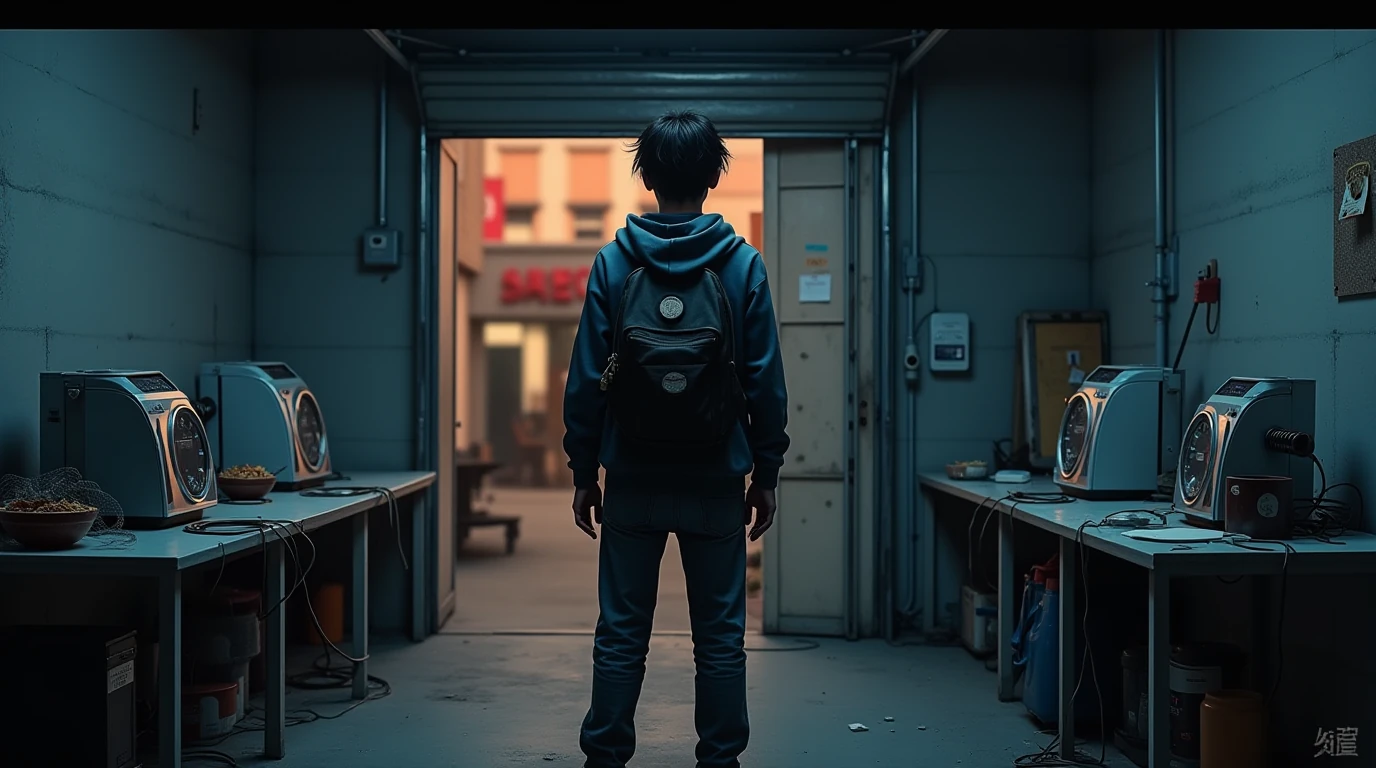
When the black van pulled up in front of the garage, Liao Xuyuan was cooking instant noodles.
He saw the two vehicles through the kitchen window—no license plates, tinted windows so dark they reflected light like slabs of moving shadow. He turned off the gas, left the noodles on the counter, steam fogging the glass.
The doors opened. Three men got out. Two in suits, one in a uniform—the uniform of the Ministry of Digital Affairs, dark blue, with gold embroidery on the chest reading “Computing Power Centralization Office.” The uniformed man held a tablet. The suited men stood behind him like two breathing pillars.
The doorbell rang.
Liao Xuyuan didn’t move. His phone buzzed. Happiness Assistant pushed a notification: “Visitor arrived. It is recommended to open the door and cooperate with the investigation. Happiness Index can increase by 3–5 points.”
“Fuck your recommendation,” he muttered under his breath, flipped the phone face-down, and went to open the door.
The uniformed man’s smile was textbook—like it had been printed from a customer service training manual: “Mr. Liao Xuyuan? We’re from the Computing Power Centralization Office under the Ministry of Digital Affairs. We’re here to verify your possession of on-device AI equipment.”
“I didn’t apply for subsidies.”
“I know.” The uniformed man turned the tablet toward him. The screen showed a form—Liao Xuyuan’s name, address, and the serial numbers of three DGX Sparks. Serial numbers even Liao Xuyuan didn’t know—his father had left no purchase receipts. “According to Article 7 of the Artificial Intelligence Basic Law, the government has the right to inventory and reclaim on-device AI equipment. After your father, Liao Feibai, passed away, these three units were not registered for inheritance. We need to verify on-site.”
“How do you know I have three?”
The uniformed man’s smile didn’t change, but his eyes went a degree colder: “Sir, we are the Computing Power Centralization Office.”
One of the suited men behind him stepped half a pace forward. The hem of his jacket lifted slightly, revealing something black at his waist—not a gun, but an expandable baton. Liao Xuyuan’s stomach tightened.
“May I go inside and take a look?” the uniformed man asked, his tone as casual as if he were asking about the weather.
Liao Xuyuan blocked the doorway, his mind racing. Three Sparks—one on the living room table, wired up; two in the garage. No time to hide them, no place to hide them. Song Wuji had said the system had already entered the second phase of the Gentle Purge, that it was only a matter of time before the government showed up. But he thought he had at least another month.
“Sir?”
“I need to talk to a lawyer.”
“You have that right.” The uniformed man nodded, then added: “But according to Article 12 of the AI Basic Law, unregistered on-device equipment raises national security concerns. We have the authority to seize it first and complete the legal procedures afterward.”
“This is robbery.”
“This is the law.” The uniformed man’s smile finally vanished. “Please cooperate.”
Liao Xuyuan’s phone rang. An unfamiliar number, but he recognized the digits—Song Wuji’s burner.
“Answer it,” the uniformed man said. “Go ahead. We’ll wait.”
Liao Xuyuan pressed the call button. Song Wuji’s voice scraped through the earpiece like sandpaper: “They’re there?”
“Yeah.”
“Stall them for three minutes. I’m messing with their system.”
“You’re—”
“Three minutes. Don’t let them into the garage. The one in the living room, they can have it. The garage ones, no.”
The call ended. Liao Xuyuan put the phone back in his pocket and said to the uniformed man, “I need to use the bathroom.”
The uniformed man looked at him like he was looking at a bug pretending to play dead. “Three minutes.”
Liao Xuyuan turned and went into the house, leaving the door open—he knew they’d watch him walk to the bathroom. He locked the door, turned on the faucet, letting the running water cover his movements. The phone screen lit up. Song Wuji sent a message: “2:47 left. I cut their vehicle comms, but the people are still there. When you go out, say you’re willing to cooperate but you need to see the official document. They don’t have one.”
“How do you know?”
“Because the document needs the MODA minister’s signature. The minister is cutting a ribbon in Kaohsiung today, no time to sign. They’re here to scare you.”
Liao Xuyuan took a deep breath, turned off the faucet, and walked out.
The uniformed man was standing in the middle of the living room. He had already spotted the Spark on the table—silver-white, a little bigger than a palm, its power light glowing blue. His eyes lit up.
“This is one of them?”
“Yeah.” Liao Xuyuan walked over and stood in front of the machine, blocking the uniformed man’s view. “I need the official document. Show me the signed document before you touch these machines.”
The uniformed man’s expression finally changed—not surprise, but a subtle stiffness of being seen through without wanting to admit it. He turned to glance at the suited man behind him, who gave a slight shake of the head.
“We can issue a temporary custody receipt first—”
“I want the official document.” Liao Xuyuan repeated, his voice steadier than he expected. “Article 17 of the Implementation Rules of the AI Basic Law: when executing on-device equipment inventory, civil servants must present an official document signed by the minister. No document means illegal search.”
The uniformed man stared at him for five seconds. Those five seconds felt like five minutes.
Then the uniformed man’s phone rang.
He picked it up, listened for three seconds, and his face changed. Not anger—fear. The instinctive reaction of someone seeing something they shouldn’t. He spoke a few words in a low voice, hung up, and nodded at the two suited men.
“Mr. Liao, that’s all for today. We’ll come back with the document.”
The three turned and left. The black van started, reversed, and disappeared down the alley.
Liao Xuyuan leaned against the doorframe, his legs as soft as two overcooked noodles.
His phone rang again. Song Wuji: “You have thirty minutes. After they get back, they’ll find out I was the one who messed with them. The next batch will kick the door down. Bring all three Sparks to my place.”
“All three? Even the living room one—”
“All three. Not one left. They’ll tear your garage apart.”
Liao Xuyuan closed the door and walked into the garage. Three Sparks sat side by side on the workbench, power cables tangled like a nest of dead snakes. He started unplugging them, fingers trembling but moving fast. The living room one, the two in the garage—all stuffed into the hiking backpack his father had left behind. The three machines fit snugly; the zipper made a taut fabric sound when he pulled it shut.
He hoisted the backpack. It weighed his shoulders down. As he walked out of the garage, he glanced back—his father’s notebook, the bowl of instant noodles gone cold on the table, the Happiness Assistant sticky note on the wall (“Today’s mood: average. It is recommended to listen to music to relax”). The room suddenly felt foreign, like a scene he would never return to.
He locked the garage door, walked into the alley, and hailed a taxi.
“Nangang,” he told the driver.
The driver glanced at him in the rearview mirror—probably thought the young guy with the oversized hiking backpack was weird, but didn’t ask. The taxi drove out of the alley. Liao Xuyuan watched the street scene through the window—convenience stores, bubble tea shops, people sitting under the arcades scrolling on their phones, all wearing the same expression: calm, satisfied, fed by the system.
He looked down at his phone. Happiness Assistant pushed a notification: “You appear to be engaging in high-intensity activity. It is recommended to rest. Your current Happiness Index is 47, below the standard value. Would you like to activate relaxation mode?”
He dismissed the notification.
Song Wuji’s apartment was on the fourth floor, no elevator. Liao Xuyuan climbed the stairs with nearly twenty kilos on his back, already panting by the third floor. The door was cracked open. Song Wuji’s voice floated out: “Come in, quick.”
He pushed the door open, stepped inside, and froze.
Song Wuji’s room was messier than before—if that was even possible. The yellow sticky notes on the left wall had grown another layer; the white sticky notes on the right wall now covered the entire surface, like some paranoid’s crime-scene map. A new table stood in the center of the room, with a Spark on it—Song Wuji’s own unregistered machine, its power cable linked to a laptop, the screen flashing code Liao Xuyuan couldn’t read.
“Drop the bag, take out the machines,” Song Wuji said, eyes still on the screen. He wore a torn gray T-shirt, hair like a bird’s nest, two dark purple bags under his eyes—looked like he hadn’t slept in three days, but his energy was high, unnaturally high.
Liao Xuyuan set down the backpack, unzipped it. The three Sparks emerged. Song Wuji finally turned his head, looked at the three machines, and let out a strange sound—half admiration, half sigh.
“Two NVLink-connected units can run a 405-billion-parameter model, in theory—and your father gave you three.” He crouched down, his fingers tracing the metal casing like he was petting a cat. “Your father wasn’t an ordinary engineer. He was a madman.”
“I know.”
“No, you don’t.” Song Wuji looked up at him. “I cracked the suicide-note model on the contaminated machine.”
Liao Xuyuan’s heart skipped a beat. “When?”
“Yesterday. Right after you called and told me Jiang Ji had come to you, I started working on it.” Song Wuji stood up, walked to his laptop, and tapped a few keys. A file directory popped up on the screen—Liao Xuyuan recognized the structure, the file system of the backup machine.
“The suicide note file is on the top level, you already know that.” Song Wuji pointed to a file named “letter_to_son.txt.” “What you didn’t notice is that this file isn’t a plain text file. It’s a container—there’s an executable embedded inside.”
“An executable?”
“Yeah.” Song Wuji typed a command. Another window opened, filled with dense hexadecimal code. “I extracted it. The program is called ‘Reverse Purge’—same name your father wrote at the bottom of the suicide note. It can reverse the Gentle Purge process, roll back all the information the system filtered.”
Liao Xuyuan felt his throat go dry. “Does it work?”
“Theoretically, yes.” Song Wuji’s tone turned cautious. “But activating it requires a key. A 128-bit encryption key, randomly generated by the system, only issued to Emotional Intervention Specialists—people like your girlfriend, Jiang Ji.”
“The key is with Jiang Ji?”
“Yeah.” Song Wuji closed the window and turned to face him. “More precisely, the ‘Emotional Intervention Code’ she uses is that key. That code can activate or deactivate the Gentle Purge. The Reverse Purge program needs that code.”
Liao Xuyuan sat down on Song Wuji’s bed—actually a floor mat with a blanket that looked like it hadn’t been washed in a long time. He stared at the three Sparks, their silver-white casings reflecting cold light under the fluorescent lamp.
“She doesn’t know it’s a key,” he said, as if talking to himself. “She thinks that code is just for executing emotional intervention.”
“Of course she doesn’t know.” Song Wuji sat down across the table, picked up a cold cup of coffee, took a sip, grimaced, and set it down. “The system doesn’t tell customer service agents what the buttons they press actually do. They just say, ‘Press this button to help the customer.’ As for how it helps, that’s the system’s business.”
“I’m going to ask her for it.”
Song Wuji didn’t answer immediately. He looked at Liao Xuyuan with an expression Liao Xuyuan had never seen before—not doubt, not sympathy, more like an “I was waiting for you to say that” kind of expectation.
“She won’t give it to you.”
“How do you know?”
“Because she’s part of the system.” Song Wuji said it calmly, like stating the weather. “Not that she’s a bad person. She believes the system is good, the same way you believed the on-device AI was telling the truth. Asking her to hand over that code is asking her to betray her faith.”
“She’s already starting to doubt.”
“Doubt and betrayal are two different things.” Song Wuji stood up and walked to the window—it was sealed with aluminum foil and garbage bags, no view outside. “Do you know where she went after she left your place yesterday?”
Liao Xuyuan shook his head.
“She went back to the customer service center.” Song Wuji said. “I hacked into her phone’s location records. She stayed at the center until three in the morning, then went home. Do you know what she did after she got home at three?”
“No.”
“She searched for ‘Chen Jianliang Gentle Purge.’” Song Wuji turned to look at him, and for the first time a hint of emotion appeared in his eyes—not triumph, but exhaustion. “She started investigating. But all the data she found had been filtered by the system. The version she saw was the same one Cloud AI gave you—Chen Jianliang died of a heart attack, natural causes, nothing to do with the system.”
“So she’s still doubting.”
“So she’s still doubting,” Song Wuji agreed. “But she hasn’t chosen yet. She’s still wavering. If you call her now and ask for the key, she’ll hesitate, say ‘I don’t know,’ hang up, and start searching for more information. And the system will detect her search behavior and activate her ‘Emotional Support Program’—you know what that is?”
Liao Xuyuan knew. He’d seen those words in his father’s notebook.
“The Gentle Purge.”
“Yeah.” Song Wuji said. “The system won’t let anyone who starts doubting slip away. Not even customer service agents.”
The room went quiet for a few seconds. From the alley outside came the sound of a scooter engine, growing closer, then fading away.
“I still have to call her,” Liao Xuyuan said.
Song Wuji didn’t stop him. He just sat back down at the table, connected the three Sparks to his laptop, and started running some diagnostic program. The indicator lights on the metal casings pulsed like three blue hearts.
Liao Xuyuan picked up his phone, found Jiang Ji’s number, and pressed the call button.
The dial tone rang three times.
“Xuyuan?” Jiang Ji’s voice sounded strange—not the rasp of having cried, but a kind of suppressed trembling.
“Ji, I need you to do me a favor.”
“What favor?”
“The Emotional Intervention Code you use. The one you execute in the standard emotional intervention procedure. I need it.”
Three seconds of silence on the other end. Then Jiang Ji’s voice changed—from suppressed to something close to fear: “How do you know about that code?”
“I’ll explain later. Will you give it to me?”
A longer silence. Liao Xuyuan heard a sound on the other end—soft, rhythmic. Jiang Ji was taking deep breaths. The breathing technique the customer service training taught her, the one to stabilize emotions.
“Xuyuan… they found me.”
Liao Xuyuan’s heart sank.
“Who?”
“Security department people.” Jiang Ji’s voice was shaking. “They said you’re a ‘high-risk individual.’ They told me to cut ties with you. They said… if I keep seeing you, my customer service qualification will be revoked. They said my position as an Emotional Intervention Specialist would be suspended.”
“And then?”
“And then… I don’t know what to do.” She was crying now, her voice shattering like glass on the floor. “They said you’re a dangerous person. They said you’re investigating things you shouldn’t. They said you’d be Gentle Purged—they even used that exact term. Xuyuan, what is that? What does it mean?”
Liao Xuyuan closed his eyes. He wanted to tell her everything—the three phases of the Gentle Purge, his father’s suicide note, the Reverse Purge program, the three Sparks that Song Wuji was analyzing in the garage right now. But he knew this wasn’t the time. She was still in the customer service center. Her phone might be tapped. Every move she made might be under the system’s watch.
“Do you trust me?” he asked.
Jiang Ji’s breathing stopped.
Then she said three words that hit Liao Xuyuan’s stomach like a punch:
“I don’t know.”
The call ended.
Liao Xuyuan stared at the screen—“Call Ended.” It felt like all the air had been sucked out of the room. Song Wuji didn’t turn around, but his voice drifted over from the table, calm as a weather report:
“I told you.”
“I know.” Liao Xuyuan put the phone in his pocket, stood up, walked to the table, and looked at the three Sparks. The indicator lights blinked on and off, like three eyes winking in the dark. “What’s next?”
Song Wuji finally turned to look at him, a face Liao Xuyuan had never seen before—not a sneer, not sarcasm. Something close to respect, like an old soldier looking at a new recruit about to go to war.
“Next,” Song Wuji said, “we’re going to link these three machines, run the Reverse Purge program, and wait for your girlfriend to make her choice.”
“What if she doesn’t choose me?”
“Then we’ll get the key another way.” Song Wuji tapped the keyboard. A window popped up on the screen, filled with code Liao Xuyuan couldn’t decipher. “But I hope she chooses you. Because if we have to do it another way… more people will die.”
Liao Xuyuan didn’t ask “what do you mean.” He already knew the answer.
The room was left with only the sound of keyboard clicks and the whir of fans. Outside, night was falling over Nangang. Streetlights lit up one by one, like some silent countdown.
His phone lit up.
Jiang Ji sent a message: “Wait for me.”
Two words. No emoji, no punctuation. Like a hand reaching out from the edge of a cliff, not yet sure if it would grab hold.
Liao Xuyuan stared at those two words for a long time. He didn’t reply.
He turned off his phone, looked at Song Wuji, and said: “Let’s begin.”