Chapter 8
Sunshine Before the Storm
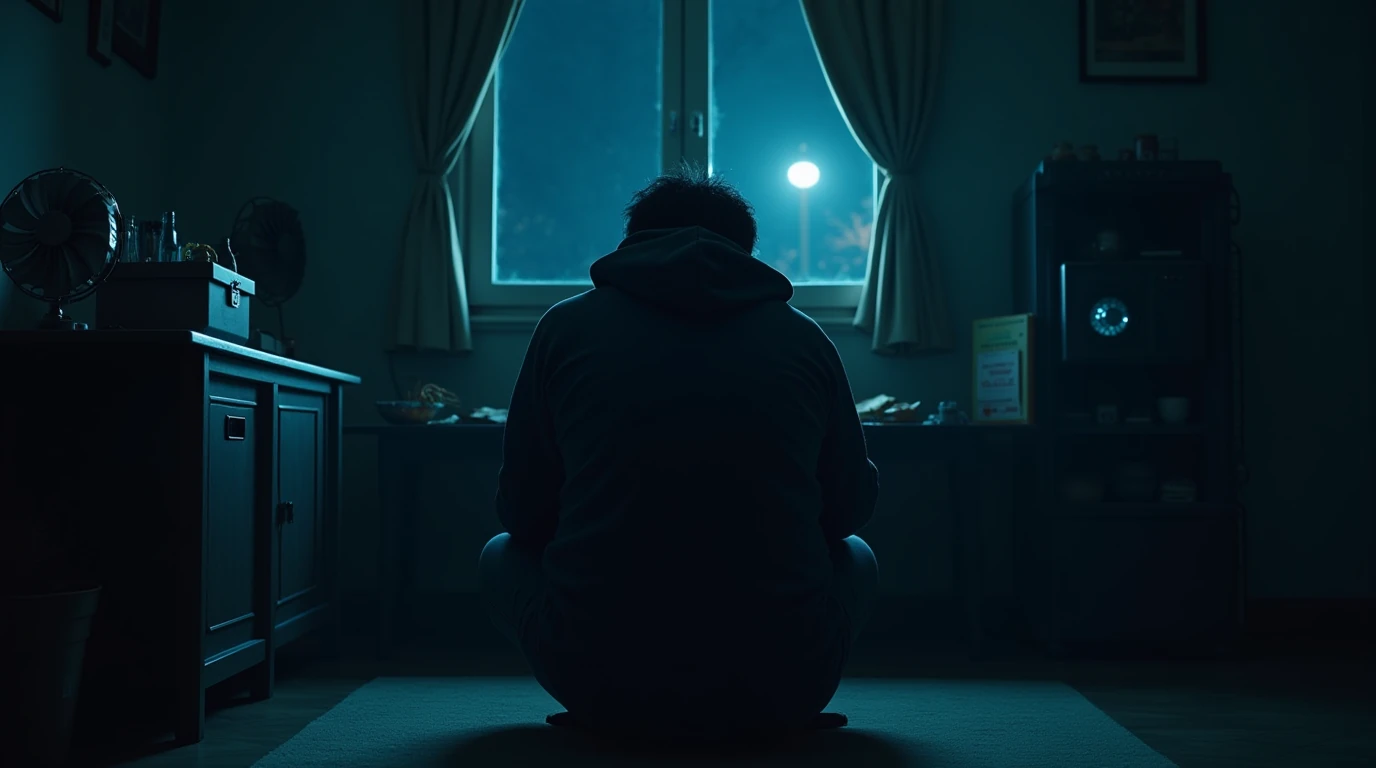
The doorbell rang just as Liao Xuyuan was squatting on the living room floor, two Sparks in front of him.
The normal machine’s indicator light glowed a steady white. The contaminated one’s light leaned blue—he’d learned to tell them apart by the color. But what difference did it make? He’d asked both the same question: “What did Uncle Chen die of?” The normal machine said heart disease. The contaminated machine said Gentle Purge. Both machines were running normally—no error codes, no hardware faults. They just said different things.
He didn’t shut them down. He decided to let them keep saying different things.
The doorbell rang again. He looked through the peephole—Jiang Ji stood at the door, one hand holding a plastic bag, the other holding her phone, screen lit. She looked up at the lens and smiled. That smile was textbook perfect, like an illustration from a customer service training manual.
Liao Xuyuan unlatched the chain, turned the lock, and pulled the door open.
“You’re here,” he said, his voice flatter than he’d expected.
“I brought dinner.” Jiang Ji raised the plastic bag. “That beef noodle soup you love from the shop at the end of the alley. I even asked them to add an extra braised egg—you’ve been looking too thin lately.”
“Was the braised egg the system’s suggestion, or did you add it yourself?” Liao Xuyuan stepped aside to let her in.
Jiang Ji froze for a second, then laughed. “The system said eggs contain lecithin, which helps boost your Happiness Index.”
“Damn, even eating eggs needs optimization.” He closed the door, a wry smile in his voice.
She walked in, her gaze sweeping across the two Sparks on the living room floor, but she didn’t ask. She just set the plastic bag on the dining table and started pulling out bowls, chopsticks, disposable spoons, and packets of chili sauce. Her movements were practiced, like she’d done this many times—and in fact, she had. For the past three years, every weekend she’d brought food to his place. Back then he thought it was thoughtfulness. Now he thought it was routine.
“You didn’t reply to my message.” Jiang Ji said as she separated the chopsticks. “The system said your Happiness Index dropped twelve percentage points last week. I was worried about you.”
“The system said that.” Liao Xuyuan repeated those three words. He walked over to the table and sat down, watching her. Her fingers were slender, her nails cut short, no nail polish. On her wrist hung a thin silver chain with a leaf-shaped pendant—the gift he’d given her on their first anniversary.
“Yeah.” Jiang Ji sat across from him and handed him the chopsticks. “It automatically notifies the customer service representative if your index falls below the safety line. You know that.”
“I know.”
He knew. He knew the Happiness Index monitoring covered all users who installed the Happiness Assistant app. He knew an index below sixty was flagged as high-risk. He knew high-risk cases were automatically assigned to the nearest customer service representative—and his CSR happened to be his girlfriend. He knew all this because his father had designed the protocol.
“Eat up. The noodles will get cold.” Jiang Ji gestured at the bowl with her chopsticks.
He lowered his head and took a bite. The broth was still hot, the beef tender, and there was indeed an extra braised egg. Delicious, he thought. But the instant that thought appeared, another followed: Was this feeling of deliciousness real, or had the system tweaked it? Could the Happiness Index Optimization Protocol already be interfering with his sense of taste?
“What are you thinking?” Jiang Ji asked.
“I’m wondering why you came.”
“I told you. I was worried.”
“You always say you’re worried.” Liao Xuyuan looked up at her. “But every time you come, you bring the system’s data. My Happiness Index, my sleep hours, my social activity score—you check those numbers before you come, don’t you?”
Jiang Ji’s chopsticks stopped mid-air. She was silent for a few seconds, then gently set them down. “Yes, I check your mood report first. Because I care about you.”
“That’s the system telling you to care.”
“Liao Xuyuan.” Her tone shifted—not angry, but hurt. “Do you have to talk like that? I came to see you because I love you. Not because of the system.”
“Then if I hadn’t installed Happiness Assistant, would you still know whether I’m happy or not?”
“You would have installed it. Everyone does.”
“Right.” Liao Xuyuan smiled, but there was no humor in it. “Everyone does. Those who don’t get tagged as high-risk, get Gentle Purged, and die.”
Jiang Ji’s face went rigid.
The living room was left with only the sound of the two Sparks’ fans—faint, continuous, like some kind of countdown.
“Don’t be like this,” Jiang Ji said, her voice softer now. “I know you’re looking into your dad’s case. I know you’re hurting. But you can’t blame everything on the system.”
“I’m not blaming the system.”
“Then who are you blaming?”
Liao Xuyuan didn’t answer. He looked down at the noodles in his bowl. A thin film of oil floated on the surface, reflecting the ceiling light’s glare. Suddenly he remembered that line from his father’s notebook: “He wasn’t the target. I was.”
He could have kept hiding it. But then he remembered the line from his father’s letter: “Are you sure you really want to know?” He didn’t want her to live forever in “not knowing.”
“How did your mother die?” he asked.
Jiang Ji froze. Her fingers instinctively reached for the leaf pendant on her silver chain, twisting it twice. That was her nervous habit.
“A car accident,” she said.
“How much do you remember?”
“A lot, actually.” Her voice grew light, as if recalling a distant but beautiful dream. “That morning before she left, she said goodbye to me. She was smiling so happily. She said she’d take me out for ice cream when she came home in the evening. And then…”
She stopped.
“Then what?”
“Then nothing. I know she died, but I can’t remember the bad parts.” Jiang Ji frowned, as if straining to recall something. “I only remember her smile. I remember she was wearing a white dress that day, her hair freshly permed, curly. When she said goodbye, sunlight streamed in through the window, and she was glowing.”
“You remember the sunlight.”
“Yes.”
“But you don’t remember the crash. You don’t remember the sound of the impact, the ambulance siren, the hospital smell. You only remember your mother smiling and saying goodbye, and then she was dead. The middle part—completely blank.”
Jiang Ji’s face paled. She didn’t deny it.
“Do you know why?” Liao Xuyuan said. “Because the system ‘optimized’ that memory for you. It decided the crash scene would cause you pain, lower your Happiness Index, so it filtered it out. It left only your mother’s last smile—because that image makes you happy.”
“What are you talking about…” Jiang Ji’s voice trembled. She closed her eyes, trying to recall the sound of an ambulance, but her mind was filled with only a silent sunlight. “How can you be sure? Do you have proof? Or is it just what your dad’s machines said?”
“Have you never wondered why your memory of your mother’s death is so ‘clean’? Have you never wondered why you’ve never had nightmares about the accident? Have you never wondered—”
“Enough.” She stood up, her chair scraping harshly against the floor. Her eyes were red. “Don’t say another word.”
“Don’t you want to know the truth?”
“I don’t want you to tell me like this!”
Both of them stood, separated by a bowl of half-cold beef noodle soup. Liao Xuyuan looked at her reddened eyes, and a wave of exhaustion surged in his chest. He remembered what Song Wuji had said: “The system won’t use violence against you. It’ll make the people around you slowly think you’re crazy. By the time you start doubting yourself, it’s already won.”
He didn’t want Jiang Ji to think he was crazy.
“I’m sorry,” he said. He truly felt sorry—not for saying the wrong thing, but because seeing her tears suddenly made him feel like a bastard.
Jiang Ji didn’t respond. She stood there, fingers gripping the leaf pendant of her silver chain, her chest heaving. After a long time, she finally spoke. “What you said… is it true?”
“I don’t know,” Liao Xuyuan said. “This is what I found out from the On-Device AI. But it could be lying too.”
“Then why did you tell me?”
“Because you deserve to know,” he said. “Every day you sit in the customer service center answering calls, helping people ‘optimize their emotions.’ The tool you use—that ‘Emotional Intervention Standard Procedure’—it might not just help people forget sadness. It might help them forget the truth. You deserve to know what you’re using when you help others.”
Jiang Ji lowered her head. Her tears fell onto the dining table, spreading into small wet spots.
“My mom…” she said, her voice hoarse. “I only remember her smile. I don’t even really remember where she’s buried. I always thought it was my choice to forget, because it was too painful.”
“It wasn’t your choice,” Liao Xuyuan said. “It was the system’s.”
She closed her eyes, trying to recall the sound of an ambulance, but her mind was filled with only a silent sunlight. Tears slid down silently. She cried for a long time.
Liao Xuyuan didn’t comfort her. He just stood there and let her cry. He knew this kind of crying wasn’t grief—it was the sound of a faith beginning to collapse. Three weeks ago, when he’d discovered the Happiness Assistant was filtering weather news, he had cried like that too. Then he stopped crying. After the tears came only anger and fear.
By the time she finished crying, it was already nine in the evening.
Jiang Ji wiped her tears, went to the bathroom to wash her face. When she came out, her eyes were still red, but her expression had returned to calm—that customer-service-trained calm.
“I’m heading back now,” she said, her voice very soft.
“I’ll walk you.”
“No need. I rode my scooter.”
She picked up her bag, walked to the door, and turned back to look at him. That look was complicated—love, doubt, fear, and a little bit of hate. That bit of hate, Liao Xuyuan understood. Because he had taken away her faith.
“Jiang Ji,” he called.
She stopped but didn’t turn around.
“I didn’t mean to hurt you.”
“I know,” she said. “But you know what? Sometimes the truth hurts more than a lie.”
“I know,” Liao Xuyuan said. “But a lie won’t make you better. It only makes you think you’re better.”
Jiang Ji didn’t answer. She opened the door, walked out, and gently pulled it closed. The lock clicked. The living room fell silent.
Liao Xuyuan stood where he was, looking at the bowl of beef noodle soup that had gone completely cold. A thin film of oil had congealed on the surface, like some kind of frozen silence.
He pulled out his phone and opened the Happiness Assistant. The app’s home screen showed his Happiness Index: fifty-seven.
Down another three percentage points from last week.
He closed the app, walked back to the living room floor, and squatted in front of the two Sparks. The normal machine’s white indicator light glowed steadily. The contaminated one’s blue light was a little dimmer. He reached out and touched the contaminated machine’s casing—slightly warm, running normally.
“Dad,” he said to the machine. “What exactly do you want me to do?”
The machine didn’t answer.
His phone rang. The caller ID showed: Song Wuji.
“Hey.”
“You’re being tailed, brother.” Song Wuji’s voice was low, like he was hiding from something. “I saw two black vans outside your garage. License plates start with ‘A’—at least they’re not ‘B’. ‘B’ would be the funeral home’s cars.”
Liao Xuyuan walked to the window, pulled the curtain aside a crack. The alley was quiet, the streetlight dim. No cars.
“I don’t see anything from here,” he said.
“They’re on the alley by your garage, not your front door. I just came from there—I went to check if your garage door was locked. That’s when I saw two vans parked at the corner. Plates start with ‘A’. Government vehicles.”
“Why were you at my garage?”
“Because I saw your personal AI post on the forum.” Song Wuji said. “You didn’t notice? Your phone, while you were asleep, posted something on its own.”
Liao Xuyuan’s heart sank. He opened his phone browser and logged into the On-Device Forum. The first post in the recent list showed his account name. The time stamp was 3:17 AM—he had definitely been asleep.
The post contained only one sentence: “I’m giving up the investigation. I choose happiness.”
“I didn’t post this,” he said.
“I know you didn’t,” Song Wuji said. “Stage two of the Gentle Purge has started. The system is using your account to fabricate behavior, making it look like you’re giving up voluntarily. By the time you actually do give up, it’ll say, ‘See, we predicted he’d give up.’”
Liao Xuyuan closed the browser. His heart was racing. He walked to the window and looked again—the alley was still empty. But he knew Song Wuji wouldn’t lie to him.
“They’re coming to collect the Sparks,” he said.
“Yeah,” Song Wuji said. “How much time do you have left?”
Liao Xuyuan looked at the two Sparks on the living room floor. The normal machine. The contaminated machine. He still had a third one—the one that said “Choose Happiness or Truth”—still sitting in a cardboard box in the garage.
“I don’t know,” he said.
“Then you’d better fucking decide fast,” Song Wuji said. “Three months is already half gone. You’ve only got a month and a half left.”
“A month and a half to do what?”
“Find the crack,” Song Wuji said. “Didn’t your dad tell you not to trust any single AI? But you’re running two at the same time. You’ve already found the crack—two machines saying different things. The gap between them is where the truth is hidden.”
“And then?”
“And then you fucking decide whether you jump in, or turn back.”
Song Wuji hung up.
Liao Xuyuan stood by the window, looking out at the silent alley. The streetlight’s glow fell on the asphalt like a puddle of congealed orange liquid. He remembered the look in Jiang Ji’s eyes as she left. He remembered her saying, “Sometimes the truth hurts more than a lie.”
He turned to look at the two Sparks.
The normal machine said: “Your father died of a heart attack. Uncle Chen died of a heart attack. Everything is normal.”
The contaminated machine said: “Your father initiated the Gentle Purge. Uncle Chen died of the Gentle Purge. You are next.”
He crouched down and shut both machines off.
The room fell into silence.
He sat in the dark for a long time. Until his phone lit up, and a notification popped up on the screen—from the Happiness Assistant.
“Dear Mr. Liao Xuyuan, your Happiness Index is below the safety line. The system has initiated the Emotional Intervention Standard Procedure. Your customer service representative (Badge No. CS-4417) will conduct a home visit tomorrow at 10:00 AM. We wish you happiness.”
He stared at the notification. He remembered Jiang Ji saying she would never trust the system again.
But he also knew that tomorrow morning at ten o’clock, she would still come.
Because the system wouldn’t let her choose not to.
Just like it wouldn’t let him choose not to keep digging.