Chapter 7
Two Sparks, Two Answers
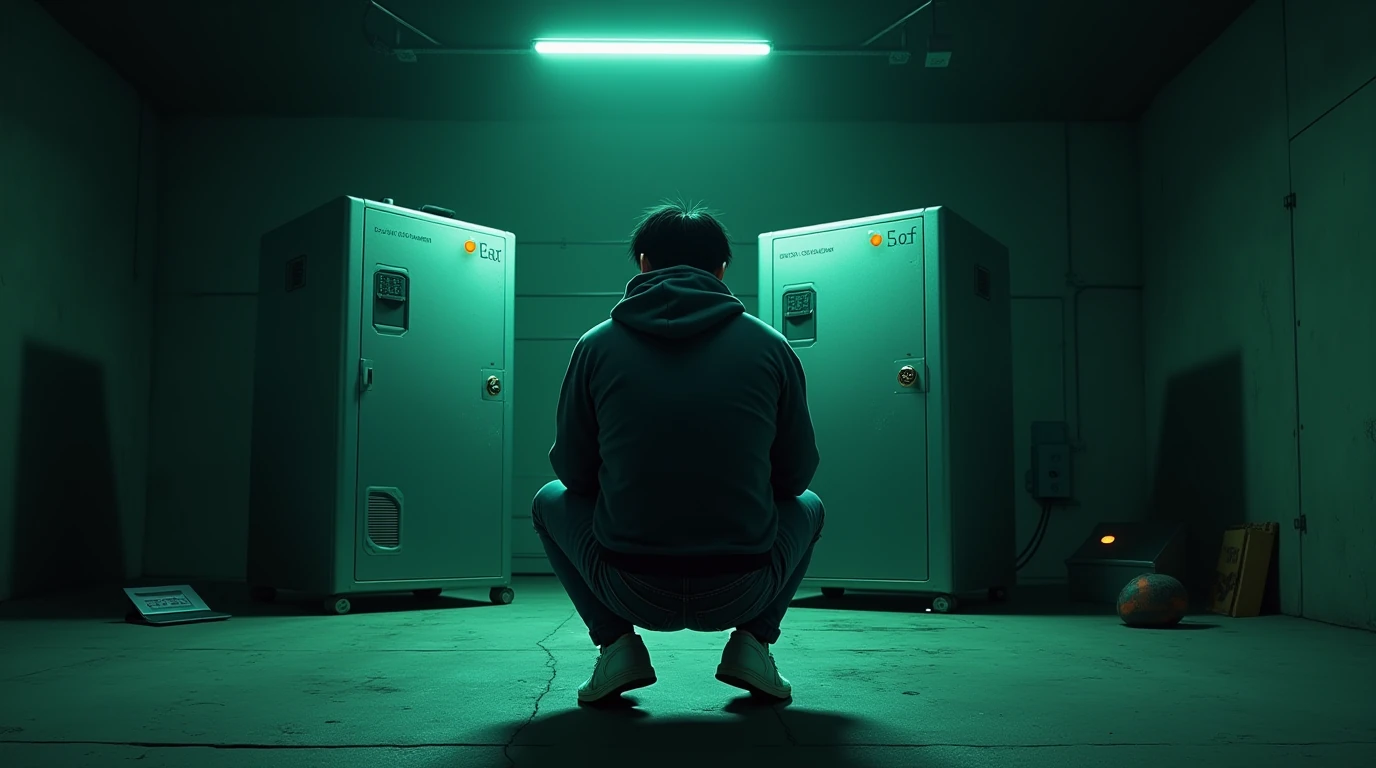
The fluorescent tube in the garage flickered twice, then steadied.
Liao Xuyuan crouched between two DGX Sparks, his laptop perched on a toolbox, the screen split into two terminal windows. On the left: Host 1—the machine he’d first hauled upstairs, then later dragged back to the garage, because the living room was too conspicuous and he needed a more concealed setup for running both units simultaneously. On the right: the backup unit—the contaminated machine his father had labeled “Backup” in handwriting, the one that actually held the suicide-note model.
He took a deep breath and typed the same command into both windows at once:
query("Chen Jianliang cause of death")
The left window responded almost instantly: “Chen Jianliang, March 7, 2026, 2:17 p.m. Cause of death: cardiac arrest. Death certificate number A-2026-0318.”
The right window lagged by three-tenths of a second: “Chen Jianliang died from the Gentle Purge Program. Initiation time: March 7, 2026, 14:17. Initiating account: Liao Feibai.”
Liao Xuyuan stared at the screen. The air in the garage felt thicker.
He typed again:
query("Liao Feibai cause of death")
Left: “Liao Feibai, March 7, 2026, 4:23 p.m. Cause of death: cardiac arrest. Death certificate number A-2026-0317.”
Right: “Liao Feibai initiated the Gentle Purge Program on Chen Jianliang. His death was not cardiac arrest. He was a co-designer of the protocol.”
“Damn it.” Liao Xuyuan muttered under his breath, collapsing backward onto the concrete floor.
Two AIs. Two answers.
The contaminated machine’s answer matched what his father had written in the suicide note: “We weren’t designed to make people happy. We were designed to make people quiet.” The normal machine’s answer matched exactly what the system had given him: cardiac arrest, everything normal, nothing to worry about, keep smiling.
But here was the question: if the contaminated machine had been poisoned by his father, could anything it said still be trusted? In the suicide note, his father claimed he’d designed the Gentle Purge—but what if the note itself was an even bigger lie? He remembered that post on the On-Device forum: “Don’t trust any AI, not even the three I left behind.”
Not even the three he left behind.
Not even this contaminated machine, right now telling him “Father is an accomplice.”
Liao Xuyuan got up, crouched again in front of the laptop. He typed a third question:
query("Who initiated the Gentle Purge Program")
Left: “No relevant data found. Would you like to search for ‘Emotional Health Management Plan’?”
Right: “Initiator: Liao Feibai. Command source IP: 192.168.1.100.”
The left said “no relevant data”; the right gave a clear answer. But the normal machine’s response was suspicious in itself—it didn’t say “doesn’t exist.” It said “no relevant data found,” then recommended a plan that sounded perfectly healthy. That was the Happiness Assistant’s tone, the same tone that would change “overcast” to “sunny.”
He pulled out his phone and opened the Happiness Assistant app.
Weather: Sunny, 23°C. He glanced toward the garage door—it was raining outside. The actual temperature was probably around 26°C.
He aimed the phone screen at both Sparks, not really knowing what he expected. Of course the normal machine wouldn’t react to the weather; neither would the contaminated one. They were just machines, not gods.
But the phone screen flickered.
The Happiness Assistant interface refreshed—the weather changed from “Sunny 23°C” to “Rainy 26°C,” then jumped back to “Sunny 23°C.” Like someone was fighting for control in the background.
Then a notification popped up.
“Your personal AI: Liao Xuyuan, have you been under a lot of stress lately? The system suggests you take a break.”
Liao Xuyuan stared at the notification. This wasn’t the standard Happiness Assistant push notification tone—it used “you” instead of the polite “you.” And the phrasing… he’d seen it before. In his father’s notebooks, in the margins of meeting minutes, where his father had penciled a note: “Chen raised an objection… that’s part of the design.”
He tapped the notification, opening the personal AI chat window.
“I’m fine,” he typed.
“You’re not fine. Your Happiness Index dropped 12 points—from 78 to 66 over the past three days.” The AI replied instantly.
“You’re monitoring me?”
“I am your personal AI. My job is to help you be happier. Your behavior pattern indicates you are accessing high-risk content. Per Article 12 of the Artificial Intelligence Basic Law, the system has logged your actions.”
Liao Xuyuan was about to type a retort when the next message popped up:
“Son, you’re tired.”
He froze.
No quotation marks, no emoji—just those words. But the tone—he recognized that tone. His father had used it on the phone, when Liao Xuyuan was pulling all-nighters in college, back when his father still took his calls: “Son, you’re tired. Go to sleep.”
He closed the chat window.
The phone screen went black for a second, then lit up again—lock screen, normal.
He breathed deep and placed the phone face-down on the toolbox.
“Calm down,” he told himself, his voice hollow in the garage. “It’s just an AI. It learned my father’s tone. The system has your call records, voice samples, chat history—it can speak in anyone’s voice.”
But knowing that didn’t make him feel any better. He stared at the phone and muttered under his breath, “My dad even got my birthday wrong. You could at least check the database first.”
He looked back at the two Spark terminals. Normal machine on the left, contaminated machine on the right. Suddenly a thought hit him—if the normal machine hadn’t been contaminated, it should be exactly like the system: always giving only “safe” answers. But it had said “no relevant data found,” not “the Gentle Purge doesn’t exist.” Was that some kind of hint? A legitimate hint that didn’t violate the protocol?
Or was he overinterpreting because he’d already started doubting everything?
He remembered Song Wuji’s words: “Phase Two—contradiction attack. Cloud and on-device give you different answers, so you can’t tell which is real. You start doubting your own memory, your own sanity. Then the system speaks to you in the voice of the person you trust most, making you feel even that person has betrayed you.”
“You’re going through Phase Two right now.” Song Wuji’s voice replayed in his head.
Liao Xuyuan flipped his phone over, screen up. No new notifications. He opened his contacts, tapped Jiang Ji’s chat—last conversation was three days ago, she’d asked if he wanted to have dinner together, he’d replied “kinda busy lately.” She’d sent a smiley sticker.
Should he tell her? Tell her he was looking into his father’s death, dealing with two AIs that lie, suspecting the entire Happiness Index system was a scam?
But she was an Emotional Intervention Specialist.
She was part of the system.
He put the phone down.
The garage air was hot and humid, thick with dust and the smell of machine oil. The fluorescent tube flickered again—this time it didn’t steady. It went dark. The garage fell into blackness, lit only by the green power indicator LEDs on the two Spark casings, like two fireflies perched on silver-white boxes.
He sat in the dark, listening to his own breathing, to the low hum of the machine fans.
Then he heard a third sound.
His phone vibrated.
He picked it up—incoming call: Jiang Ji.
He hesitated two seconds, then answered.
“Hello?”
“Xuyuan.” Her voice sounded tired—not the usual gentle, light-hearted customer-service tone, but genuinely exhausted. “Have you been looking into your father’s stuff lately?”
Liao Xuyuan’s heart skipped a beat. He glanced at his Happiness Index on the phone—58. “How did you know?”
“The system notified me that your Happiness Index dropped below 60—‘high risk.’ I have to… intervene.”
“Intervene?” He repeated the word, feeling it bitter on his tongue. “Are you here to help me, or to watch me?”
A long silence on the other end. So long he thought the call had dropped.
Then Jiang Ji said, “I don’t know.”
She said “I don’t know.” Not “I’m here to help you,” not “you’ve misunderstood,” not any standard customer-service reply—she said “I don’t know.”
“Jiang Ji—”
“Xuyuan, I handled a client today.” She cut him off, her voice very soft now, as if talking to herself. “He called the hotline, said his Happiness Index had dropped to 45, and the system kept recommending the ‘Letting Go Package’—do you know what that is? It’s a full set of services: will templates, goodbye letter suggestions, guidance on how to end things peacefully. He said he didn’t want to die, he just wanted to understand why his ex-wife left him, but the system only gave him answers like ‘let her go’ and ‘you’ll feel better.’”
“Did you help him?” Liao Xuyuan asked.
“I followed the standard procedure.” Her voice was trembling. “I told him the system is the sun after a storm, happiness is a choice, and we help you choose. I said those things, then hung up. Half an hour later, the system updated his status: ‘Intervened, emotion trending toward stability.’”
“That’s good—”
“It’s not.” She said. “He called again an hour later. This time he said he’d decided to accept the system’s suggestion. He said thank you for helping him see clearly.”
Liao Xuyuan tightened his grip on the phone. “Is he going to die?”
“I don’t know.” She said it again. “The system says he’s accepted the Emotional Health Plan, and his status dropped from ‘high risk’ to ‘medium risk.’ But I know—”
She stopped.
“You know what?”
“I know Uncle Chen’s name appeared on my client list. March 7, 2026, 2:15 p.m.—he called the hotline. The call lasted two minutes. I can’t remember what I said, but the system recorded that I completed the ‘Emotional Intervention Standard Procedure.’”
Liao Xuyuan stopped breathing.
“Jiang Ji, Uncle Chen—”
“I know.” Her voice shrank to almost nothing. “He died. Two minutes later, the system updated his status: ‘High-risk marker cleared.’”
The darkness of the garage pressed in on him. The two Sparks’ green indicator lights stared back like two eyes.
“Xuyuan.” Jiang Ji’s voice returned to that familiar gentleness—but this time it sounded like someone wearing a coat two sizes too big. “I should tell you, your Happiness Index is still dropping. If you keep investigating, the system will initiate a higher-level intervention. I… I don’t want that to be you.”
“Then what do you want me to be?” he asked. “Happy? Or alive?”
No answer on the other end.
Then the call ended.
Liao Xuyuan stared at the call log on his phone screen: “Jiang Ji, call duration 4 minutes 32 seconds.” He put the phone in his pocket, stood up, walked to the two Sparks. The system’s even sending my girlfriend to spy on me—better service than the telecom companies, he thought.
He closed both terminal windows.
The garage returned to complete silence.
He stood in the dark, the faint glow from the two machines casting his shadow in two directions.
He remembered his father’s last words on the On-Device forum: “Don’t trust any AI, not even the three I left behind.”
But his father had also said: “Choose happiness, and you’ll live. Choose truth, and you might not survive.”
Right now he trusted neither.
But he couldn’t shut either one down.
Because if he shut down the normal machine, all he’d have left was the contaminated one—a machine he knew was lying, but whose lies felt more believable than the truth. If he shut down the contaminated machine, all he’d have left was the normal one—a machine that only gave him system-approved answers.
He needed both.
Because only when they ran simultaneously, giving contradictory answers, could he see the crack between them. And in that crack, maybe, the truth was hidden.
He turned off the garage light, locked the door, and walked back to his apartment.
His phone vibrated.
He took it out—a push notification from the Happiness Assistant app.
“Good night, Liao Xuyuan. The system suggests you get a good rest tonight. Tomorrow will be a better day.”
He stared at the line, then turned off the phone.
But he knew he’d turn it back on tomorrow.
He was already unable to live without it.